

 One app for all your study abroad needs













We know that psychologists study behaviours, mental processes, and experiences in different contexts, but have you ever given thought to what methods psychologists use to understand these phenomena? Psychologists use a variety of research methods such as experiments, observation, interviews, case studies, surveys, etc. It is the methodology used that makes psychology a scientific endeavour. Let’s further understand and explore these interesting and illuminating methods that make psychology a scientific endeavour. In this blog, you will find some of the most crucial notes on Methods of Enquiry in Psychology- Class 11 Psychology.
This Blog Includes:
Download the Full NCERT Chapter on Methods of Enquiry in Psychology Here.
Methods of Enquiry in Psychology: Goals
The Enquiry in Psychology is done for various goals and follows different methodologies. Each goal varies as per the context of psychology. Here, we have mentioned the methods of enquiry in Psychology depending on the goals.
- Description: The description requires recording a particular behaviour and describing it accurately so as to attain a comprehensive understanding of the same. For example, morning habits may have a diverse range of behaviours like reading positive literature, meditation, exercise, journaling, etc.
- Prediction: It is the second goal of psychological enquiry. Here, we attempt to understand the relationship between the behaviour we are describing and the other types of behaviour.
- Explanation: It is the third goal of psychological enquiry. It attempts to explain the causal factors of behaviour and attain an understanding of the conditions in which the behaviour occurs or does not.
- Control: It is the fourth goal of psychological inquiry. It focuses on three things: Making a particular behaviour happen, reducing it and enhancing it.
- Application: It is the fifth goal of psychological enquiry. It focuses on bringing out a positive change in people’s lives
Steps in Conducting Scientific Research
There are certain steps followed while conducting scientific research. These steps need to be followed in a systematic manner as they have a scientific reason behind them. The steps along with illustration below will help you understand the steps in conducting scientific research.
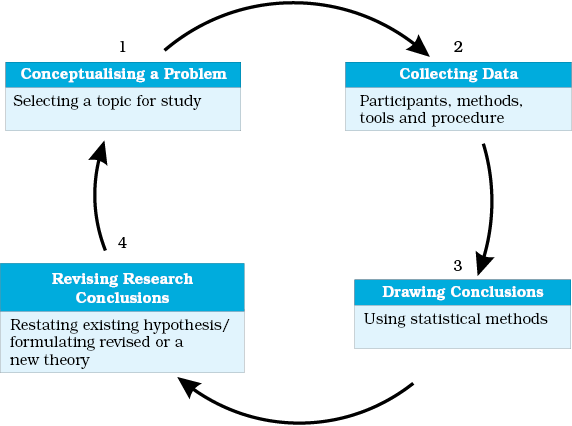
- Conceptualising a problem: It is the first step of conducting scientific research. The researcher selects a topic for study, which is done on the basis of either a review of past research, observations, or personal experience
- Identification of the problem: It is the second step of scientific research. Development of a tentative statement about the topic takes place, which is termed a hypothesis. For example, “the greater the amount of time spent by children in playing violent video games, the greater the degree of impatience and anger developed by them”
- Collection of data: This step focuses on developing a research design or blueprint of the entire study.
- Decisions are taken about the following:
- Participants in the study
- Methods of study
- Tools to be used in research
- Procedure for data collection
- Drawing conclusions: The next step of scientific research is to analyse data through statistical procedures. It can be achieved through measures of central tendency like mean, median, mode and graphical presentations like pie charts, bar diagrams.
- Revising research conclusions: The researcher revises the whole study, and the hypothesis being tested is analysed thoroughly to see whether it stands true or not
Also Read: Everything about Applied Psychology
Nature of Psychological Data
Psychological data has been used in scientific research due to its nature and method of research, which vary from the rest of the data. Below, we have mentioned the nature of psychological data for your understanding:
- Demographic information: It includes personal information like name, age, gender, education, occupation, etc.
- Physical information: It includes information about ecological conditions, housing conditions, size of rooms, facilities available at home, in the neighbourhood, in the school, etc.
- Psychological information: The information focuses on areas like intelligence, personality, interests, etc.
Different Methods of Enquiry in Psychology
There are many methodologies used in the study of psychology. Some of these methods are listed below:
Observation
It is a very powerful method of psychological enquiry. It involves the selection of a particular behaviour, recording the selected behaviour using symbols, photographs and analysis of the recorded behaviour
Merits
- enables the researcher to study people and their behaviour.
- Can provide in-depth information about behaviour to be observed
Demerits
- It is time-consuming
- It can be labour-intensive at times
- Poor method for establishing a cause-and-effect relationship.
Experimental method
Experiments are generally conducted to establish cause-and-effect relationships between two or more variables in a controlled setting. Independent variables are manipulated, and their effects are measured on the dependent variable.
Merits
- The optimal method for establishing a cause-and-effect relationship between two or more variables
- The extraneous variables can be controlled; thus, no scope for an alternative explanation
Demerits
- The experimenter’s bias may affect the
- The authenticity of the experiment
Correlational research
A number represents the strength and direction of the relationship between two variables, termed the correlation coefficient. Its value may range from +1.0 through 0.0 to -1.0
Merits
- Correlation helps in the prediction between the given variables
- Can examine issues that cannot be studied ethically or practically in experiments
Demerits
- Fails to establish a cause-and-effect relationship between variables
Survey research
It came into existence to study opinions, attitudes, and social facts by use of techniques such as questionnaires, interviews, etc.
Merits
- A properly selected representative sample may yield an accurate result
- It is flexible and adaptable to individual situations
- Information can be gathered quickly and efficiently
Demerits
- Unrepresentative samples may yield misleading results
- Interviewer bias and social desirability bias may distort the findings
- Inaccurate information may be obtained at times
Case study
It is an in-depth study of a particular case. It employs multiple methods for collecting information, such as interviews, observations and psychological tests, from a variety of respondents who in some way or another might be associated with the case and can provide useful information.
Merits
- Provides rich descriptive information
- Helps in an in-depth study of a rare phenomenon.
Demerits
- Fails to establish a cause-and-effect relationship
- It may be subject to the biases of the researcher.
Psychological Testing
A psychological test is a standardised and objective instrument that is used to assess an individual’s standing in relation to others on some mental or behavioural characteristics
The construction of a test is a systematic process and involves certain steps. It involves a detailed analysis of items and an estimation of their reliability, validity, and norms.
- Reliability refers to the consistency of scores obtained by an individual on the same test on two different occasions
- Validity refers to the question, “Does the test measure what it claims to measure?”
- Norms help in making a test standardised. Norm is referred to as the average performance of the group.
Analysis of Data
Data in Psychology is analysed in various ways. Look at the methods of analysing data in the field of psychology.
- Quantitative Method: Psychological tests, interviews, and questionnaires contain a series of closed-ended questions and the probable responses to these questions are given in a scaled manner, which clearly illustrates the strength and magnitude of the response.
- Qualitative Method: Human experiences are very complex. This complexity is lost when one elicits information from a respondent based on a question.
Also Read: What are the Different Types of Psychologists?
Limitations in Methods of Enquiry in Psychology
Apart from the benefits that it offers, there are many limitations as well in the methods of enquiry in Psychology. Look at them to understand in a detailed manner.
- Lack of a true zero-point: Psychological measurements lack an absolute zero point. For example, even after scoring zero on a vocabulary test, it can’t be said that the respondent has zero knowledge of vocabulary.
- Relative nature of psychological tools: The nature of psychological tools is relative, not absolute, and they are developed keeping in view the important features of a particular context.
- Subjective interpretation of qualitative data: The interpretation of the qualitative data used in the research is characterised by subjective interpretation, which means that it varies from individual to individual.
Ethical Issues with Methods of Enquiry in Psychology
Some of the methods of enquiry in Psychology have their own ethical concerns that need to be considered while using them. Some of these ethical issues are mentioned below:
- Informed consent: The principle of informed consent states that potential participants must understand what will happen in the experiment and to them during the study so that they can make an informed decision about their participation in the study.
- Confidentiality of the data source: Participants of the study have the right to privacy, and the researcher must safeguard the privacy of the participants by keeping the information provided by them confidential.
- Voluntary participation: As per this principle, the participants must have the freedom to decide whether to participate in the study or not.
- Debriefing: Once the study is over, the participants are provided with the necessary information to complete their understanding of the research. The researcher should make efforts to remove any sort of anxiety which may have taken place as a result of the experiment
FAQs
The relationship between the client and the therapist requires a lot of trust, empathy, and non-judgmental behaviour, and keeping that in mind, the ethical guidelines to be kept in consideration are informed consent, the confidentiality of data source, voluntary participation, and debriefing.
The method used by Dr Ram is the observation method. In this method, the to be observed is selected, recorded, and then analysed properly to draw relevant conclusions. The advantage of this method is that phenomena can be observed in real-time, but the disadvantage is that it can be time-consuming at times.
The psychological data basically comprises demographic information, psychological and physical information.
The goals of psychological enquiry are description, prediction, explanation, control and application.
Scientific inquiry is a lengthy and detailed process that involves conceptualising a problem, identifying the problem, collecting data, drawing conclusions, and revising research conclusions.
Related Reads:
Hence, we hope that this blog summarising Methods of Enquiry in Psychology notes helped you cover the key topics and concepts in this chapter of the Class 11 Syllabus. For more information on such informative topics for your school, visit our school education page and follow Leverage Edu.


 60,000+ students trusted us with their dreams. Take the first step today!
2 comments
PPT format
Dear Nameera,
Thanks for your comment. We do not have a PPT available for Methods of Enquiry in Psychology. I was able to find some sources that might be helpful to you.
https://www. slideshare.net/slideshow/methods-of-psychology-class-xi-psychology/269273936
https://www. gcg42.ac.in/medias/media/other/456/methods-of-psychology-final-bajaj.ppt
(Paste in browser and remove space.)
Hope this helps! Looking forward to hearing from you again.