

 One app for all your study abroad needs

















Forming a considerable portion of life science courses, zoology is the extensive study of animal sciences and when seen alongside botany, it acts as a foundation for biological research as well. Furthermore, with the inclusion of digital technologies and parallel advancements in advanced research techniques, the scope of biology, in general and as a whole, has risen manifold.
As a zoologist, one can expect to study the behaviour and life cycles of animals, their evolution and physiology, current demographic changes, and assist in conservation efforts, amongst others. This article focuses on the major branches of zoology and what they entail as career fields.
This Blog Includes:
- Why Study Zoology as an International Student?
- Major Branches of Zoology
- Sub-Branches of Zoology
- Understanding the Origins of Zoology
- Major Universities for Branches of Zoology
- Top 10 Colleges in India for Zoology
- Offered Courses in Zoology
- Branches of Zoology for MSc
- Branches of Zoology Syllabus
- Career and Scope After Zoology
- FAQs
Why Study Zoology as an International Student?
Before we explore the branches, consider the unique advantages for international students:
- Studying zoology allows you to understand biodiversity across different continents and cultures.
- Many countries are at the forefront of zoological research, offering cutting-edge facilities and projects in various sub-disciplines.
- You’ll connect with fellow students and leading researchers from around the globe, fostering a valuable international network.
- From climate change to habitat loss, zoological knowledge is crucial for addressing pressing environmental issues worldwide.
Also Read: BSc Zoology
Major Branches of Zoology
Here are the main branches of Zoology:
- Biogeography
- Classification
- Developmental Biology
- Ethology
- Evolutionary Biology
- Molecular Biology
- Physiology
- Structural Zoology
- Vertebrate and Invertebrate Zoology
Sub-Branches of Zoology
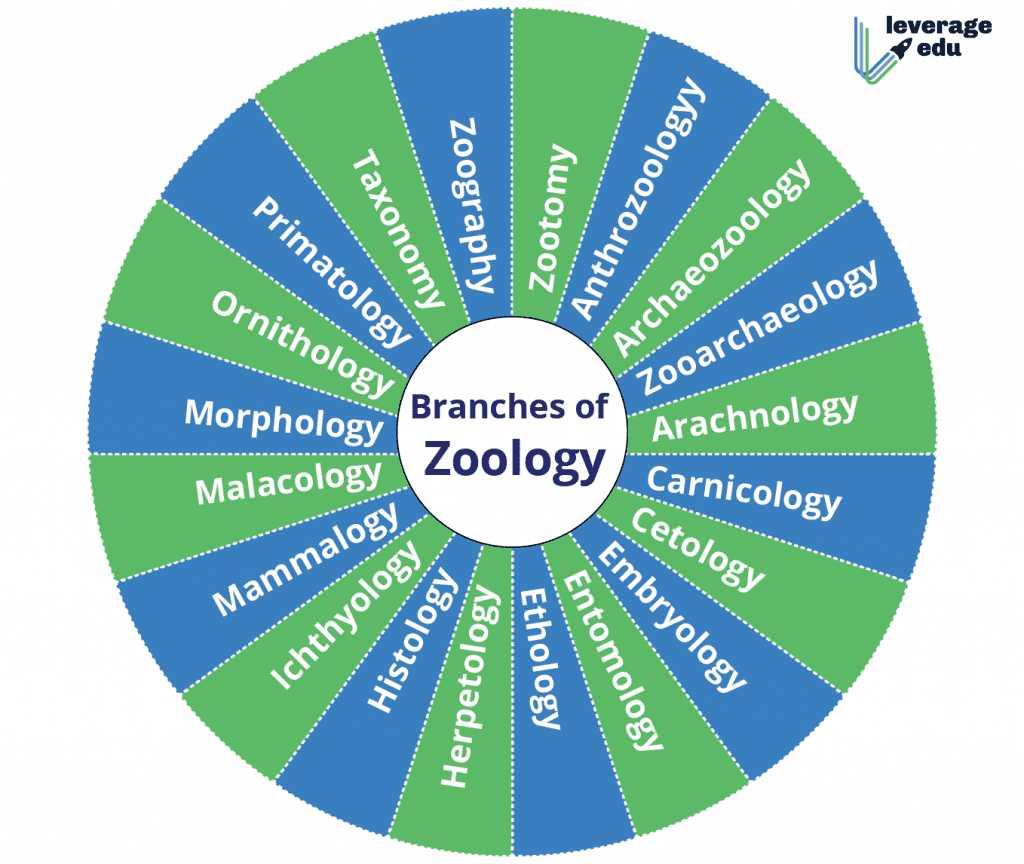
The world of animals is incredibly complex, and to truly understand it, zoologists often specialize further within their chosen fields. These sub-branches represent highly focused areas of study, often combining knowledge from different disciplines and utilizing advanced techniques.
Let’s explore some significant sub-branches of zoology:
| Branches of Zoology | Definition |
| Anatomy | Study of internal structure of animals |
| Anthrozoology | Study of past, present and future interactions between animals and human beings |
| Archaeozoology or Zooarchaeology | Study of dead animals |
| Arachnology | Branch of biology that deals with the study of spiders, scorpionsor other arachnids |
| Bionics | Study of mechanical systems like living organisms and parts of living organisms |
| Carnicology | Study of Crustaceans |
| Cetology | Study of marine mammals [Dolphins, Whales, Porpoises, etc] |
| Cytology | Study of cell structure and its functions |
| Ecology | Relationship between the organisms and their surrounding environments |
| Embryology | Study of egg fertilisation, embryos and fetuses |
| Entomology | Study of insects |
| Ethology | Study of the behaviour of animals to interpret their effects on evolution |
| Evolution Environments | Study of origin of animals and their adaptation |
| Genetics | Study of heredity and variations |
| Geology | Study of earth and life as shown by fossils in rocks |
| Herpetology | Study of reptiles and amphibians |
| Histology | Study of anatomy of cells and tissues of animals |
| Ichthyology | Study of Fishes |
| Mammalogy [Also called Mastology] | Study of Mammals |
| Malacology | Study of animal forms with shells [Snails, Octopus, Slugs, etc] |
| Morphology | Study of form and specific structures of animal organisms |
| Nematology | Division of zoology that studies roundworms |
| Neonatology | Study of newborn animals till the age of two months |
| Ornithology | This branch of zoology concerns the study of birds. |
| Paleontology | Study of fossils and extinct animals |
| Pathology | Study of bodily fluids in laboratory like blood, urine, tissues, etc to diagnose diseases |
| Primatology | Study of primates [apes, gorillas, monkeys, prosimians, etc] |
| Protozoology | Study of protozoa or the unicellular organisms |
| Taxonomy | This field studies, groups and formulates nomenclaturerules of animals on the basis of common characteristics. |
| Zoography (Descriptive Zoology) | Study of animals and their respective habitats |
| Zoogeography | Study of geographical distribution of animal species |
| Zoometry | Study of measurement including size and length of animal parts |
| Zootomy | Study of animal anatomy |
Understanding the Origins of Zoology
Concerned with the study of the animal kingdom, Zoology focuses on the interaction of animal kingdom with their ecosystems as well as animal biology. It encompasses a detailed study of different species coming under the animal kingdom. The early origins of Zoology trace back to the ancient Greek Philosopher Aristotle who actually classified the living things broadly in the 4th century BC. He is often considered as the father of Zoology as he classified the living things into animals and plants and it was only later that words like zoology, botany, etc. originated. Further, Charles Darwin brought forward his theory of evolution by natural selection.
The branches of zoology are spread across the comparative anatomy of animals, plants, and other living things. Though the study of animal sciences is quite ancient, the actual areas of zoology investigations were developed from the comparative anatomical study on morphographs which was carried out by Hunter and Cuvier.
Major Universities for Branches of Zoology
While it is no surprise that Ivy League Colleges and royal UK universities feature amongst the highly revered institutions offering degree programs across the different branches of zoology and life sciences in general, there are scores of emerging universities worldwide which are consistently being recognised for their academically as well as professionally oriented courses. Glance over the following table to have a view of the Zoology courses you can consider.
| Name of University | Location | Courses Offered in Branches of Zoology |
| University of Edinburgh | UK | 1. Bachelor of Science Hons Agricultural Science [Animal Science] 2. MSc Animal Biosciences 3. BSc Hons Biological Sciences [Biology] |
| The University of Melbourne | Australia | 1. BSc [Major in Animal Science & Management] 2. BSc Major in Zoology 3. Graduate Diploma in Science [Advanced] – Zoology |
| The University British of Columbia | Canada | BSc in Zoology MSc in Zoology PhD in Applied Animal Biology PhD in Zoology |
| McGill University | Canada | PhD in Animal Science: Bioinformatics PhD in Animal Science |
| University of Illinois at Urbana Champaign | USA | BSc in Animal Science MSc in Animal Science PhD in Animal Sciences |
Top 10 Colleges in India for Zoology
There are plenty of colleges and universities in India offering Zoology at undergraduate, postgraduate, and doctoral levels. Here are the top colleges in India for Zoology:
| College/University Name | Location | Key Highlights & Programs Offered |
| University of Delhi (Multiple Colleges) | Delhi | Home to several top-tier colleges (e.g., Hindu College, Miranda House, Hansraj College, Kirori Mal College) offering excellent BSc (Hons) Zoology and MSc Zoology programs. Known for strong faculty and research. |
| Banaras Hindu University (BHU) | Varanasi, Uttar Pradesh | A prestigious Central University with a well-established Department of Zoology. Offers comprehensive undergraduate and postgraduate programs with a focus on research. |
| Aligarh Muslim University (AMU) | Aligarh, Uttar Pradesh | Another prominent Central University with a strong and research-active Department of Zoology, offering BSc and MSc courses. |
| Loyola College | Chennai, Tamil Nadu | An autonomous college affiliated with the University of Madras, highly reputed for its science programs, including a robust Zoology department. |
| Madras Christian College (MCC) | Chennai, Tamil Nadu | Affiliated with the University of Madras, MCC has a long-standing reputation for academic excellence in Zoology and other sciences. |
| University of Calcutta | Kolkata, West Bengal | One of India’s oldest universities, known for its rich academic heritage and a comprehensive Zoology department offering extensive research opportunities. |
| Panjab University | Chandigarh | A well-regarded university with a dedicated Department of Zoology, known for its strong academic curriculum and research output. |
| Christ University | Bengaluru, Karnataka | A deemed-to-be university recognized for its modern infrastructure, dynamic curriculum, and interdisciplinary approach in its science programs, including Zoology. |
| Savitribai Phule Pune University | Pune, Maharashtra | A leading university for science and research in Western India. Its Department of Zoology offers strong postgraduate and doctoral programs with diverse research areas. |
| Indian Institute of Science (IISc) | Bengaluru, Karnataka | While primarily a research institution, IISc offers world-class postgraduate and doctoral programs in biological sciences that encompass various aspects of zoology, ecology, and evolutionary biology. Ideal for research-oriented students. |
Offered Courses in Zoology
The zoological or animal kingdom is further classified into taxonomic classes, namely, birds, reptiles, amphibians, fishes, invertebrates and mammals. Though exceptions exist, this is more of a large overview. Moreover, it also includes the study of extinct animals and skeletal studies and many zoological experts work with archaeologists and geologists and even anthropologists. If you are in search of the course offerings pertaining to the variegated branches of Zoology, take a look at the following list.
- BSc Biology
- BSc Animal Sciences
- BSc Bioinformatics
- BSc Biotechnology
- BSc Zoology
- BSc Botany
- BSc Genetics
Branches of Zoology for MSc
- MSc Zoology
- MSc Microbiology
- MSc Bioinformatics
- MSc Botany
- MSc Biotechnology
- MSc Biochemistry
- PhD Animal Sciences
Branches of Zoology Syllabus
Wondering what are the subject you will study in Zoology? Zoology is a study of earth, animals, their origin and behavior, and even about life underwater such as fishes, dolphins, etc. Here are the core types of Zoology:
- Morphology
- Genomics
- Ecology
- Biology of Parasitism
- Animal Behaviour
- Genetics and Evolution
- Chronobiology
- Structure and Function of Genes
- Cell and Molecular Biology
- Animal Physiology and Ethology
- Biosystematics, Structure, and Functions of Invertebrates
- Biochemistry
- Biotechnology
Also Read: Courses After BSc Zoology
Career and Scope After Zoology
A career in zoology is not just an episode of Man vs. Wild. There are plenty of other options to explore. Students can work in the public or private sector in India and abroad as well. Top recruiters in India are the Ministry of Environment and Forests, Forest Department of State. Here are the top job profiles and salary structure:
| Job Profiles | Salary in INR per annum |
| Conservationist | ₹468715 |
| Wildlife Rehabilitator | ₹657937 |
| Veterinarian | ₹571965 |
| Zoology faculty | ₹1248849 |
| Marine Biologist | ₹900000 |
FAQs
The main branches of zoology include Entomology (study of insects), Ichthyology (study of fishes), Ornithology (study of birds), Herpetology (study of reptiles and amphibians), Mammalogy (study of mammals), Parasitology (study of parasites), Embryology (study of animal development), and Ecology (study of animals in their environment). Each branch focuses on a specific group or aspect of animal life.
Zoology is a branch of biological science that focuses on the study of animals. It deals with their structure, classification, evolution, habitats, behavior, and life processes. As a major part of biology, zoology helps us understand animal life and its role in the natural world.
In zoology, you study animals and their biological processes. This includes their structure, classification, evolution, behavior, reproduction, habitats, and how they interact with their environment. Zoology also covers topics like genetics, physiology, ecology, and conservation of wildlife.
Aristotle is the father of Zoology because of his research and discoveries in this field.
Zoology offers various job opportunities in both government and private sectors. Zoologists can work as wildlife biologists, conservationists, zoo curators, animal behaviorists, marine biologists, environmental consultants, or researchers in laboratories and universities. They can also find roles in national parks, wildlife sanctuaries, NGOs, and pharmaceutical companies. With further qualifications, they can become professors or join civil services related to environment and forestry.
Yes, mathematics is used in various branches of zoology to analyze data, model biological processes, and understand patterns in animal behavior and populations. Fields like ecology, genetics, and evolutionary biology often use statistics, probability, and mathematical models to study species distribution, population growth, and genetic variation.
Relatable Reads
We hope this blog gives you a complete overview of the Branches of Zoology. Stay tuned to Leverage Edu for more such content on student life abroad. Thank you for reading!


 2,00,000+ students realized their study abroad dream with us. Take the first step today.