

 One app for all your study abroad needs

















Preparing for the IELTS exam demands focus and strategy, especially when time feels limited. If you wonder how to crack IELTS in 3 months, this guide outlines a proven path forward. Many test-takers achieve their target band scores, often 7.0 or higher, through consistent practice and targeted efforts. The IELTS assesses listening, reading, writing, and speaking skills on a 9-band scale, where an average of these scores determines your overall result. With the right plan, you transform challenges into strengths and build the confidence needed for test day. This blog brings a detailed study plan on how to clear IELTS in 3 months with a higher band score. Let’s get started!
This Blog Includes:
IELTS Exam Pattern Highlights
Grasping the IELTS structure sets a strong foundation for your preparation. The test lasts about 2 hours and 45 minutes, split into four sections: Listening (30 minutes), Reading (60 minutes), Writing (60 minutes), and Speaking (11-14 minutes). Each section is scored on a scale of 0 to 9, and the average of all sections determines the overall band score.
Before imparting to you a comprehensive guide on how to crack IELTS in 3 months, let’s first take a look at its paper pattern, which is as follows:
| Name of the Section | Duration | Number of Questions |
| Reading | 60 minutes | 3 sections, 40 questions |
| Writing | 60 minutes | 2 questions |
| Speaking | 11-14 minutes | Face-to-face Discussion |
| Listening | 30 minutes | 4 sections, 40 questions |
The Best 3-Month Study Plan for IELTS
A structured schedule turns ambition into results when you aim to crack IELTS in 3 months. Divide your time into phases: foundation-building in month one, skill sharpening in month two, and full simulation in month three. Dedicate 2-3 hours daily, balancing all sections while tracking progress weekly. Adjust based on initial diagnostics—many improve by 2 bands in this period with focused effort.
Key principles guide this plan:
- Assess your baseline: Start with a full practice test to identify strengths and gaps.
- Set realistic goals: Aim for incremental gains, like 0.5 bands per section monthly.
- Incorporate variety: Mix drills, reviews, and rest to prevent burnout.
- Track and tweak: Use a journal to log scores and refine strategies.
Sample weekly breakdown for Month 1 (focus on basics):
- Days 1-2: 1 hour grammar/vocabulary; 1 hour Listening practice.
- Days 3-4: 1 hour Reading strategies; 1 hour Writing outlines.
- Days 5-6: 1 hour Speaking recordings; 1 hour review/mistakes.
- Day 7: Full section test + analysis.
This phased approach builds momentum. Transition now to resources that fuel your progress.
Section-Wise Study Plan to Crack IELTS in 3 Months
Now that you are aware of the pattern as well as the bifurcation of marks and the number of questions, we have designed a section-wise analysis on how to crack IELTS in 3 months.
Strategies to Master IELTS Reading Section
As the name suggests, this section is aims to assess your reading skills by providing you with reading comprehension questions. It encompasses different type of questions for IELTS Academic and General Training. For all those wondering about how to crack IELTS in 3 months, it is important to know that the reading section contains a mixed bunch of questions like MCQs, gap fillings, short answers, inference from pictures etc. hence, you must focus on practising various kinds of comprehension passages to effectively prepare for this section.
- To ace your reading abilities, you must inculcate the habit of reading a newspaper daily through the 3-month preparation period.
- Starting from the first month, put an essential focus on the sentence structure as well as learn at least five new words every day as well as try to adopt a formal tone for your answers.
- Spend at least a week going through numerous comprehension passages in mock tests and analyse their structure thoroughly.
- Practice one set of sample test every day to understand the structure as well as gearing yourself up to efficiently answer different questions.
- In the second month of preparation, train yourself to create an efficient outline of different passages as well as learn to highlight the important keywords that might assist you in writing a high-scoring answer.
- Towards the end, when only 1-2 weeks are left, spend at least an hour every day reading online blogs and articles on contemporary topics which might occur in the exam.
Must Read: How To Crack IELTS
Plan to Ace the IELTS Speaking Section
The speaking section is considered the trickiest one of all. Unlike the other language proficiency exams, the speaking test of IELTS is conducted as a face-to-face session. Thus, it is important to confidently answer all the questions. Generally, the duration of this test is 10-15 minutes, wherein you have to answer every question asked by the examiner. To thoroughly prepare this section, you must go through some IELTS Speaking Questions. Take a look at the study plan you can follow in order to learn how to crack IELTS in 3 months.
- From day 1, spend 20 minutes daily to read aloud a passage from any newspaper, book, or magazine, etc, with an imperative focus on your enunciation and pronunciation.
- As you will begin to notice the strong and weak points in your speaking ability, take out an hour every day to jot down the key aspects where you need improvement.
- Coming closer to the 4th or 5th week, start watching debates and bulletins conducted on English news channels to familiarize yourself with the contemporary IELTS Speaking Topics as well as to grasp their tone, style, and enunciation in terms of speaking.
- From the ninth week onwards, practice speaking on different questions from mock tests while standing in front of a mirror. Continue this on a daily basis and ensure that you make notes of your improvement.
- Throughout the 3-month period, carry out your daily conversations in English and seek feedback from others on your speaking abilities.
- On the exam day, make sure that you use a formal tone to answer questions and include relevant examples while speaking on different topics.
Quick Read: Describe a Shop/Store You Often Visit: IELTS Speaking Topic
Strategies to Master IELTS Writing Section
The IELTS writing section comprises an essay question that requires a lengthy answer. Apart from this, there is another question based on a diagram, picture or chart on which you must pen down your answers. While understanding the process of how to crack IELTS in 3 months, the key to acing the writing section is to stay updated with the latest happenings, work consistently on your grammar and vocabulary as well as practising mock tests regularly.
- Spend the first two weeks improving your grammar by going through its basic rules and grasping the intricacies of sentence structure.
- By the 3rd week, go through a few IELTS tests and practice beginner-level questions.
- With the start of the 2nd month, you must switch to advanced IELTS Essay Topics for the remaining 4-8 weeks of preparation.
- Spend the last month by practising 1 essay and 1 description answer daily setting a timer and then evaluate your essays.
- Stay conscious of the use of a conversational tone in your essays and train yourself to adhere to a formal tone.
Plan to Crack the IELTS Listening Section
This section aims to assess your listening abilities and how attentively you can focus on an audio recording. Candidates are provided with questions in an audio format and then they are required answers to the questions. It constitutes of different questions like fill in the blanks, short answers, one-line answers etc.
- Daily practice one set of the sample from IELTS practice tests or you can also look for listening samples online.
- For the first two weeks, learn to adapt the pace and formal language of the recordings by playing them twice for a sample.
- By the end of the first month, start practising with two audio recordings every day.
- For the 5th to 8th week, it is important to train yourself with playing an audio recording only once.
- In Week 9, practice with two audio recordings without any pause and carry out proper self-evaluation.
- Focus on how the narration has begun.
- Jot down important pointers while listening.
- Craft a precise and concise answer. Concentrate on the introduction of situations and characters.
- Revise your answers thoroughly to locate any grammatical or spelling marks which might make you lose marks.
Also Read: 200+ IELTS Writing Task 2 Topics and Questions
What is a good IELTS Score?
The IELTS Score is decided as per the result you receive under each section of the exam. However, a combined grade of 7 is considered as one of the good IELTS grades out of 9. However, your target should depend on the university and country you wish to study in.
IELTS Preparation Books
While you gear up for IELTS, you ought to have the perfect notes and study materials in order to ace the exam. There are numerous high-quality books with all the relevant content and audio files to accelerate your preparation for IELTS. Here are some of the popular books for IELTS preparation that you must have in your collection:
| Books |
| IELTS Preparation and Practice: Reading and Writing Academic Student Book |
| IELTS General Training & Academic Study Guide |
| Cambridge Grammar for IELTS |
| Listening and Speaking Skills by Barry Cusack and Sam McCarter |
| Check Your English Vocabulary for IELTS by Rawdon Wyatt |
| IELTS Reading Tests by Sam McCarter |
| Ace the IELTS: IELTS General Module – How to Maximize Your Score |
| Improve Your IELTS Writing by Norman Whitby and Sam McCarter |
| Success to IELTS: Tips and Techniques |
Leverage Edu Rockstars
Here are some of our students who scored their dream IELTS score with expert guidance at Leverage Live, have a look at their journey:
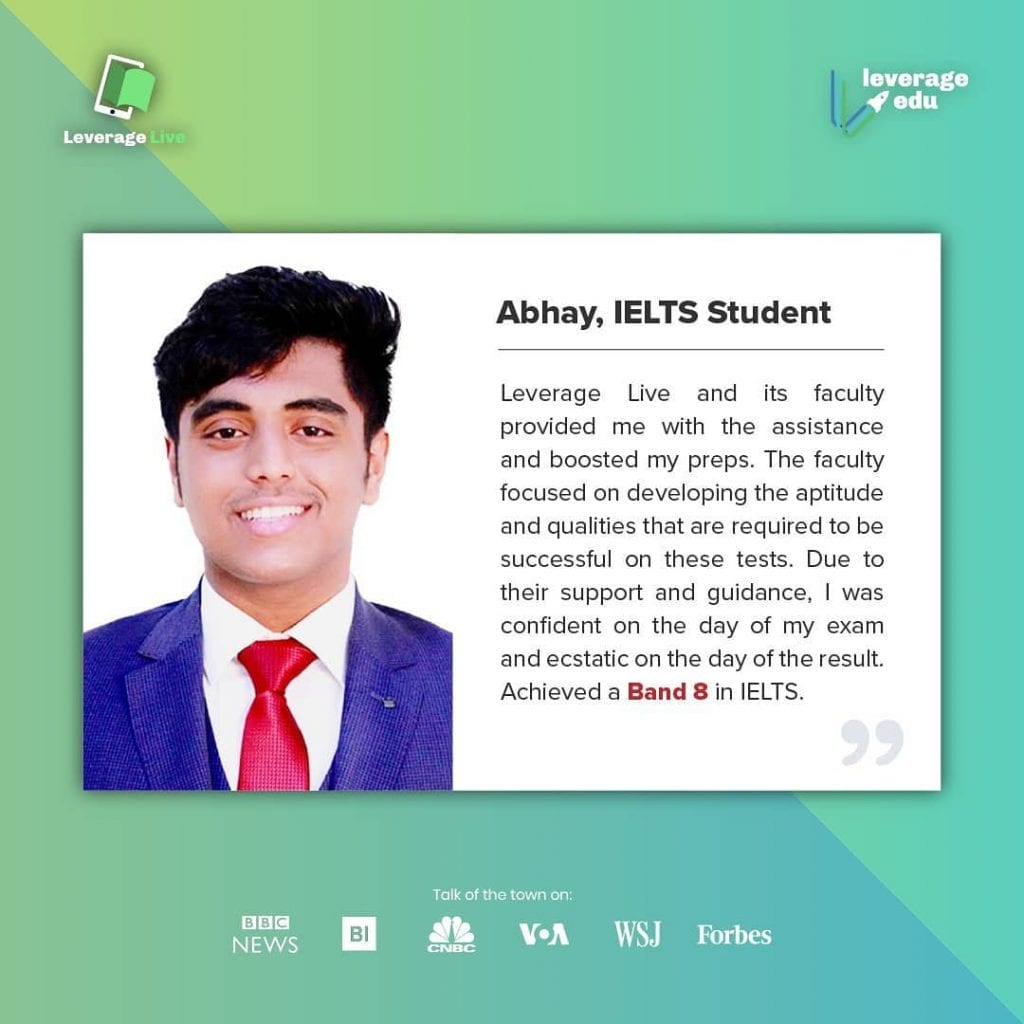
Our Student, Abhay Achieved a Whopping Band 8 in IELTS
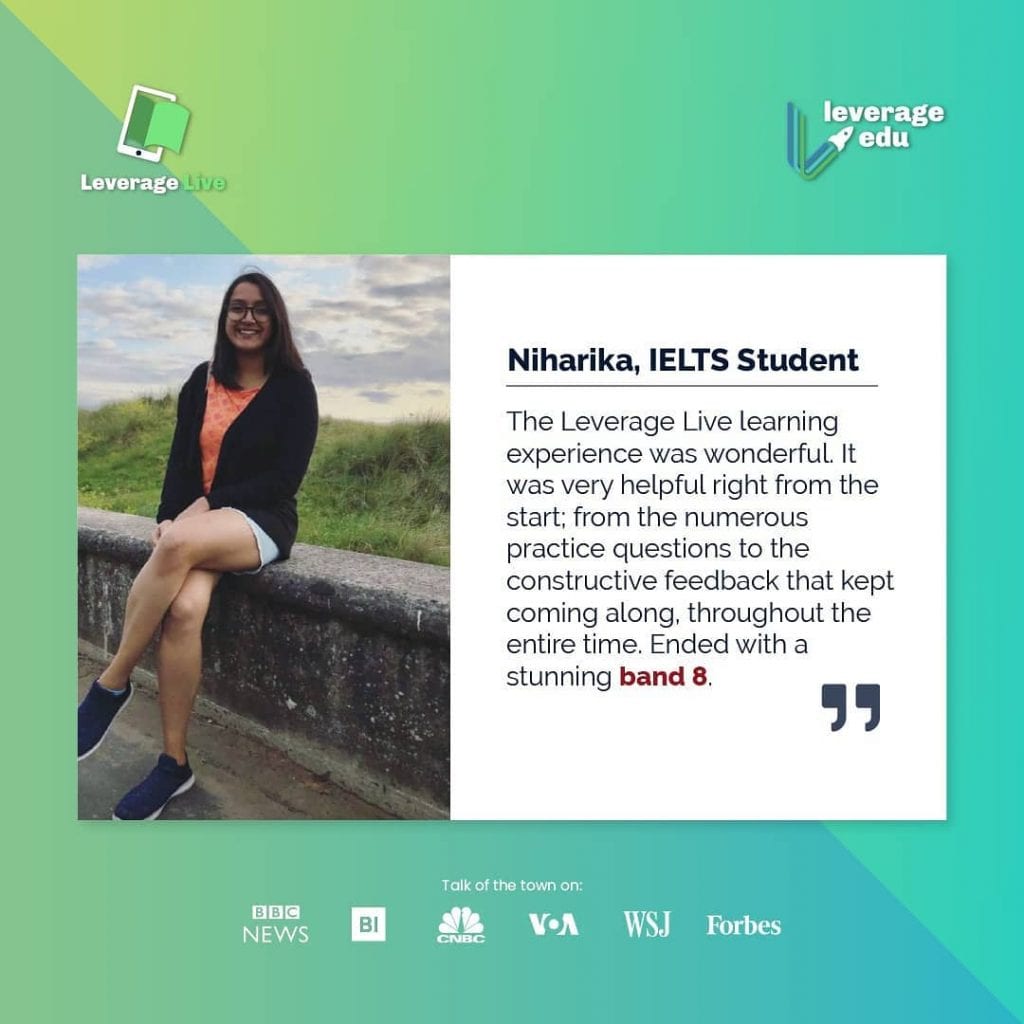
Another Amazing Achiever at Leverage Live, Niharika Scored a Striking Band 8!
Discover more stories here – Success Stories
FAQs
Yes, you can absolutely prepare for and crack IELTS in 3 months. Thousands achieve 7.0+ bands by following a structured daily plan, using official resources, practicing full tests, and fixing weak areas consistently. With 2–3 focused hours daily, significant improvement is realistic and proven.
An overall grade of 7 is considered as one of the good IELTS grades out of 9. However, your target should depend on the university and country you wish to study in.
No, 6.5 is not easy—it requires solid intermediate English skills. Many test-takers need 2–3 months of focused preparation to reach 6.5 overall, especially in Writing and Speaking, where scoring consistently above 6.0 demands clear structure and accurate grammar.
Absolutely not—7.5 is an excellent score! It places you in the “good user” category, meets requirements for top universities worldwide (including Oxford, Harvard, and most Australian/Canadian programs), and proves a strong command of complex English.
Aim for 8.5 by scoring 8.0–9.0 in at least two sections and never below 8.0. You need near-native vocabulary, flawless grammar range, perfect task achievement in Writing, and natural, idiomatic fluency in Speaking. Only 3–5% of test-takers achieve 8.5+; it usually requires 6–12 months of advanced practice plus immersion.
The reading section in IELTS is 60 minutes.
We hope this blog on the topic ‘How to Prepare IELTS Online?’ helped you learn something new. If you are planning to study abroad, preparing for the IELTS exam is a key step in your journey. For expert guidance, call us at 1800 572 000.


 60,000+ students trusted us with their dreams. Take the first step today!
1 comment
All these tips and tricks find me very useful 👍