

 One app for all your study abroad needs
















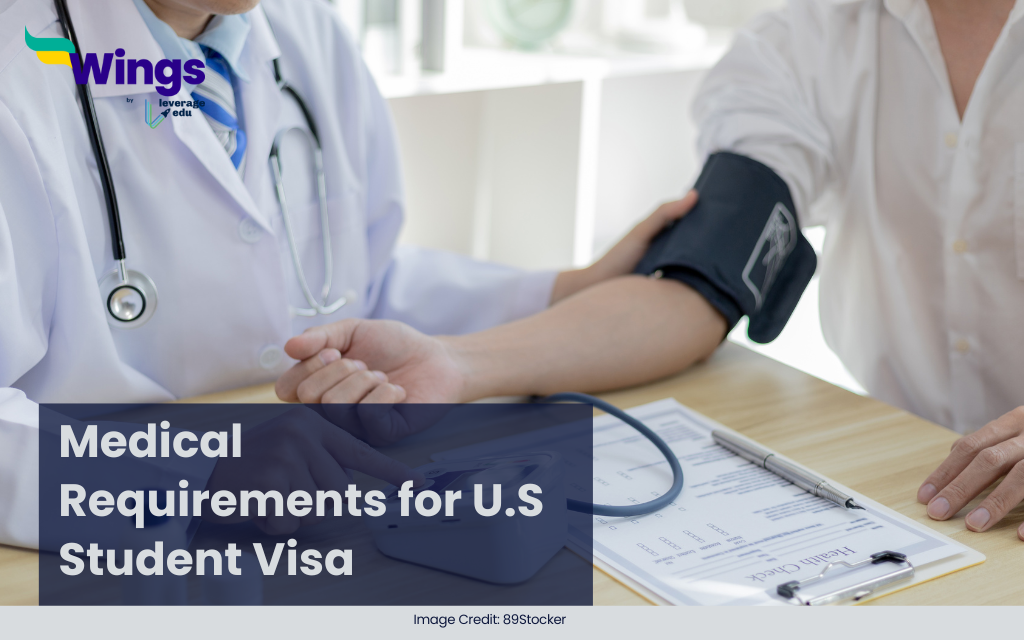
Medical requirements are one of the main requirements for a U.S visa application. To apply for any US visa, you must be medically fit. You must also not have any communicable illness that can be a threat to the life or way of life of a U.S. citizen. Those with chronic conditions are also not issued a visa, as they can become a burden on the state. Therefore, a medical test is conducted to ensure that you meet the medical requirements for a US visa as a student.
In this guide, you’ll learn everything about the medical requirements for US student visa: required exams and vaccinations, disqualifying health conditions, approved panel physicians, necessary documents, and how medical results impact your F-1 visa approval. Understanding these medical requirements early can help you avoid delays or refusals under Section 212(a)(1) of the Immigration and Nationality Act. Read on to ensure you’re fully prepared!
This Blog Includes:
- What are the Medical Requirements for U.S. Student Visa?
- Age-Specific Medical Tests for U.S. Student Visa
- What are the Disqualifying Medical Conditions for a U.S. visa?
- How to Prepare for the Medical Exam for a US Student Visa?
- Medical Documentation Requirements for a US Visa
- About Medical Requirements for U.S. Student Visa: Key Details
- Medical Examination Fees
- U.S. Student Visa Application Process
- FAQs
What are the Medical Requirements for U.S. Student Visa?
As an international student, you must meet the medical requirements for a visa application. Only after you clear the medical test will you be called for a visa interview. The following are the tests you need to clear as a student.
- Physical examination: A review of your medical history and general medical examination. This includes checking ears, eyes, throat, extremities, heart, lungs, abdomen, lymph nodes, and skin for any illness.
- Vaccinations: The panel physician would check if you have had the necessary vaccinations. For example, Polio, DT/DTP/DTaP, Measles (or MR or MMR), Hepatitis A & B and more.
- Age-Specific Tests. The age-specific tests are conducted for those who qualify in terms of their age for a specific medical examination.
Age-Specific Medical Tests for U.S. Student Visa
As per the medical requirements for a US student visa, there are certain tests that you only have to take if you are of a certain age. The age-specific medical tests for a US visa application are as follows:
|
S/N |
Test |
Age Group |
Requirement Summary |
|
1 |
Interferon Gamma Release Assay (IGRA) |
2 years and above |
Blood test for TB; X-ray needed if the result is positive. |
|
2 |
Chest X-ray (CXR) |
15 years and above |
Required for adults; also for children with TB exposure or positive IGRA. |
|
3 |
Syphilis Test (Blood) |
18–44 years |
Blood test; treatment needed if positive. |
|
4 |
Gonorrhea Test (Urine) |
18–24 years |
Urine test required for this age group. |
Also Read: Learn about the H1B USA Visa in a simplified way
What are the Disqualifying Medical Conditions for a U.S. visa?
A US visa can be rejected if you are suffering from any kind of medical condition that is considered unacceptable for visa applications. The following are the conditions that will automatically qualify you for a visa application. Even if you clear the interview, you will not receive a student visa if you have any of the following conditions;
- Communicable diseases (as they are a threat to public health)
- Physical or mental disorder with associated harmful behaviour
- Durg addiction
- Drug abuse
Your application can also be rejected if you do not show proof of the required vaccinations.
Communicable Diseases That Can Prevent You From Getting a U.S. Student Visa
The U.S. Centres for Disease Control (CDC) has a list of communicable diseases. Therefore, if you have any of the communicable diseases in the list, you will not be given a visa. Some of the communicable diseases under the list are as follows:
- Lymphogranuloma Venereum
- Hansen’s Disease (Leprosy, infectious)
- Gonorrhea
- Granuloma Inguinale
- Tuberculosis (active)
- Chancroid
- Syphilis (infectious stage)
Note: People with HIV AIDS are not denied a visa.
How to Prepare for the Medical Exam for a US Student Visa?
A US government-authorised doctor can only conduct your medical examination. This is part of the medical requirements for a U.S. student visa. The medical examination for a visa will include the following:
- A review of your medical history
- A review of your vaccination details
- Test for various diseases and illnesses
- Drug and alcohol screening
To prepare for the medical examination, ensure that you have all your documents ready.
Medical Documentation Requirements for a US Visa
The following are the medical documentation requirements for a U.S. Student Visa. The documents you need to present are as follows. The medical examiner will go through these documents before conducting your medical tests:
- A copy of the medical history
- Vaccination records
- Copies of any previous chest X-rays (if applicable)
- A letter from your regular doctor stating the current treatment plan for any health problem you might have
- Your passport, or any other valid government-issued ID card, or a diver’s license
- Payment receipt of medical examination fee (consult the doctor’s offers before appointment to know the payment options)
- Health insurance card (contact the doctor’s office before the appointment to check if they accept your insurance card).
- Spectacles (if you use them)
- Details of your intended address in the US.
About Medical Requirements for U.S. Student Visa: Key Details
Here is some additional information that you should know when applying for a student visa in the USA. The details regarding the TB test (applicable in India), vaccines that are mandatory, and the age group for blood tests are explained in detail.
Tuberculosis Testing
The medical examiner might do a tuberculosis test depending on the age of the candidate:
- 2-14 years: The candidates under this age category are required to undergo a PPD Test (Tuberculosis Skin Test). If the test is positive, the doctor might recommend a chest X-ray test of the candidate.
- 15 Years & Older: All the candidates of this age group are required to undergo a chest X-Ray test.
Depending upon the results of the test, the doctor might prescribe and suggest the kind of treatment the patient requires to undergo.
Blood Tests
All the candidates above 15 Years of age have to undergo a Blood test and have to submit the result at the time of the Visa interview, which will be provided by the authorised medical examiner. This is one of the mandatory Medical Requirements for a U.S. Student Visa.
Vaccines
The candidate must obtain all the mandatory vaccines listed below. The age group for the same is also provided below for your reference:
|
SN |
Vaccine / Screening |
Recommended Age Group |
|
1 |
Hepatitis B |
All ages; starts at birth |
|
2 |
Pneumococcal |
All ages; infants, older adults (65+), and high-risk groups |
|
3 |
Mumps (or MMR) |
All ages; given in early childhood or later if no immunity |
|
4 |
Varicella (Chickenpox) |
All ages; for those without prior infection or vaccination |
|
5 |
Hib (Haemophilus Influenzae B) |
Mainly under age 5 |
|
6 |
Td (Tetanus, Diphtheria) |
All ages; booster every 10 years for adults |
|
7 |
COVID-19 Screening & Vaccination |
All ages; recommended from 6 months and up |
|
8 |
Measles (or MR or MMR) |
All ages; usually given in childhood or if no proof of immunity |
|
9 |
Influenza |
All ages; yearly from 6 months onward |
|
10 |
Hepatitis A |
All ages; typically starts at 12 months |
|
11 |
DT/DTP/DTaP |
Mainly under age 7; schedule varies by age and vaccination history |
|
12 |
Polio (OPV/IPV) |
All ages; standard doses in infancy and early childhood |
|
13 |
Meningococcal |
Mainly ages 11–16; also for certain risk groups |
|
14 |
Rubella (or MR or MMR) |
All ages; given in childhood or if not immune |
|
15 |
Rotavirus |
Infants; first dose usually at 2 months/ |
Medical Examination Fees
The general medical examination fees are provided below;. The fees are subject to change. Moreover, the fees can vary depending on the kind of medical examination you take. Tge
|
Age Category (Approximate) |
Typical Fee Range (INR) |
Approx. Fee Range (USD) |
|
Children Below 2 Years |
4,000 – 13,000 |
48 – 156 |
|
Children 2 – 14 Years |
8,000 – 24,500 |
96 – 294 |
|
Adults 15 – 17 Years |
6,400 – 25,000 |
77 – 300 |
|
Adults 18 – 24 Years |
14,800 – 39,000 |
178 – 468 |
|
Adults 25 – 44 Years |
6,400 – 25,500 |
77 – 306 |
|
Adults 45 Years & Above |
6,400 – 28,500 |
77 – 342 |
U.S. Student Visa Application Process
Medical examination is a part of the U.S student visa application process. After the documents are submitted, a medical test is conducted. The overall application process is provided below for your general understanding of the student visa process:
Step 1: Apply to an SEVP-approved Institution
Some universities in the US are accredited by SEVP, and the candidate applying for the US Visa should make sure that his/her university falls under the list of universities accredited by SEVP. Only SEVP-approved universities can enrol international students and provide them with the documents necessary to obtain the student visa i.e., you will receive a SEVIS-generated document by email.
Step 2: Amount Payment (SEVIS Fee)
The candidate is required to submit the SEVIS fee at least three days before applying to the US Website portal and print the fee receipt, as it has to be submitted at the time of the interview with all the other documents. The fee payment is available through various modes such as debit cards, credit cards, online banking, etc. A sponsor can also pay the fees.
Step 3: Application Form
After obtaining the SEVP form and paying the SEVIS visa fees, you can successfully proceed with your application. You can apply online or schedule an appointment with the US Embassy to fill out the DS-160 application form. Your visa can be issued up to 120 days prior to your entering the US.
You will need some basic information handy while filling up the application like name & DOB, Permanent Address, Phone Number, Passport Details, Travel Plans & Companions information, Contact information in US, Family background, Education Details, security background, criminal background, medical examination test and medical history, SEVIS Id and name of the university you intend to attend and its acceptance letter, recent passport photograph etc.
Step 4: Pay the Visa Fee
Pay the required Visa Fee and make sure to print the fee receipt as you will be required to submit it at the time of the interview.
Step 5: Medical Examination
A medical test is conducted at this stage. You will have to meet the medical requirements for a US student visa. Generally, the physicians require 4-7 business days (sometimes more) to decide after the medical tests are conducted. You need to schedule your medical appointment 7 days before your visa interview. The results are sent to the interviewer in a sealed envelope before the interview directly by the hospital.
Step 6: Scheduling & Attending Interview
The final step is to schedule an interview with the US Embassy to obtain your visa. You need to carry various documents with you at the time of the interview, like a valid passport, SEVIS Fee receipt, SEVIS Form, application form, visa fee receipt, copy of interview letter, passport-size photographs, education transcripts, required test scores like GMAT, IELTS, etc. & financial evidence and is the final step of Medical Requirements for U.S. Student Visa.
Reasons for US Student Visa Rejection
FAQs
You must have a medical checkup by a physician approved by our Embassy before your visa interview. The medical examination should be finished at least three weeks before the interview.
A review of the patient’s medical history, a physical examination, a chest X-ray, and syphilis blood tests are all included in the medical examination. The physical examination will at the very least involve checking the skin, lymph nodes, skin, extremities, ears, nose, and throat.
Prior to the issuance of a visa, all immigrant visa applicants, regardless of age, must undergo a medical examination. This checkup can only be carried out by a doctor who has received U.S. Consulate accreditation.
Related Reads:
| 8 Documentation Requirements for an F1 Visa | What is US Work Visa? |
| US Visa Application Process | What is US Visitor Visa? |
| A Comprehensive Guide to Types of US Visas | US B1/B2 Visa Renewal Process |
Are you planning to study in USA but not sure where to start? Call our Leverage Edu experts at 1800 572 000 for end-to-end guidance from application to Visa process.


 60,000+ students trusted us with their dreams. Take the first step today!