

 One app for all your study abroad needs













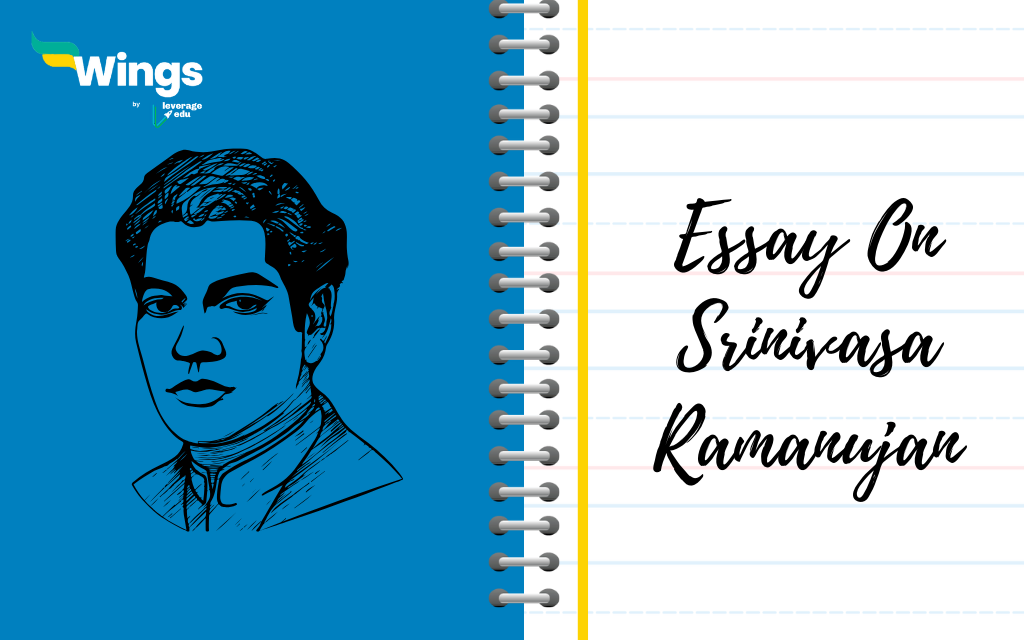
Srinivasa Ramanujan, one of India’s most brilliant mathematical minds, is admired for his extraordinary ability to discover advanced formulas despite having very limited formal training. Born on 22 December 1887 in Erode, he produced nearly 3,900 mathematical results, many of which continue to guide modern mathematical research. His partnership with G.H. Hardy at Cambridge University led to remarkable breakthroughs in number theory, infinite series, and partitions. Although he lived only 32 years, his legacy remains unmatched in the world of mathematics. Acknowledging his dedication to the field, in 2012, Dr. Manmohan Singh declared 22 December as “National Mathematics Day”. Studying Ramanujan’s life inspires students to value curiosity, perseverance, and passion for learning.
In this blog, we provide sample essays to help students write effectively about the life and contributions of Srinivasa Ramanujan.
Contents
Essay on Srinivasa Ramanujan in 100 Words
Srinivasa Ramanujan was one of India’s greatest mathematicians, born on 22 December 1887 in Erode, Tamil Nadu. From a young age, he loved numbers and spent hours solving mathematical problems on his own. Even without formal higher education, he discovered many new formulas that surprised trained scholars.
In 1913, Ramanujan wrote to the famous mathematician G. H. Hardy in Cambridge. Hardy immediately recognized his genius and invited him to England. Together, they worked on number theory, infinite series, and special mathematical functions.
Although Ramanujan faced health problems in England due to the climate and food, he continued to produce exceptional work. He returned to India in 1919 but passed away the next year at only 32.
Today, Ramanujan’s notebooks, filled with nearly 3,900 mathematical results, are still studied. His birthday, 22 December, is celebrated as National Mathematics Day to honour his remarkable contributions.
Also Read: 10 Steps on How to Write an Essay in English
Essay on Srinivasa Ramanujan in 200 Words
Srinivasa Ramanujan, born on 22 December 1887 in Erode, was a self-taught mathematical genius whose ideas changed the world of mathematics. Growing up in Kumbakonam, he showed extraordinary talent and spent most of his time exploring formulas, patterns, and equations. His early work was recorded in notebooks that later became famous among mathematicians.
In 1913, Ramanujan sent a letter containing several unusual theorems to the British mathematician G. H. Hardy. Recognizing his brilliant mind, Hardy arranged for Ramanujan to travel to Cambridge University in 1914. Their partnership became one of the most important collaborations in mathematics. Together, they worked on partitions, modular forms, and infinite series.
Life in England during World War I was difficult. Ramanujan struggled with health issues due to the cold climate and lack of proper vegetarian food. Even during illness, he produced groundbreaking results, including formulas that helped in the fast calculation of π and discoveries that were decades ahead of his time.
Ramanujan returned to India in 1919 and died the following year at just 32. Despite his short life, he left behind nearly 3,900 results, many of which were later proved correct. His story inspires students to believe in dedication and curiosity.
To honour him, the Government of India declared 22 December as National Mathematics Day in 2012. Today, Ramanujan’s works are used in modern fields like computer science, physics, and cryptography.
Also Read: 200+ Essay Topics for School Students in English
Essay on Srinivasa Ramanujan in 300 Words
Srinivasa Ramanujan was born on 22 December 1887 in Erode, Tamil Nadu, and grew up in Kumbakonam. From early childhood, he showed a powerful interest in numbers. While other children played, Ramanujan spent hours solving equations and exploring patterns in mathematics. At age 16, he studied a book called A Synopsis of Elementary Results in Pure and Applied Mathematics, which introduced him to thousands of theorems. This book influenced him deeply and helped shape his mathematical journey.
Although he had great talent, Ramanujan struggled in school because he focused only on mathematics and ignored other subjects. As a result, he could not complete college. However, he continued to write formulas and theorems in his notebooks, many of which were completely new to mathematics.
In 1913, Ramanujan wrote a letter to G. H. Hardy at Cambridge University. Hardy was amazed at his discoveries and invited him to England. Ramanujan joined Cambridge in 1914, where he collaborated with Hardy and J. E. Littlewood. Together, they worked on number theory, partitions, and special mathematical functions. One of Ramanujan’s most famous findings was the taxicab number 1729, the smallest number expressible as the sum of two cubes in two different ways.
Life in England was challenging, especially during World War I. Ramanujan suffered from poor health, and the cold climate did not suit him. Despite this, he continued to produce extraordinary work. In 1919, he returned to India, but his health declined further, and he died in 1920 at the age of 32.
Ramanujan left behind nearly 3,900 mathematical results. His “lost notebook,” found in 1976, contained new formulas such as mock theta functions, which later became important in physics and modern research. His birthday, 22 December, is celebrated as National Mathematics Day, honouring his dedication to the world of mathematics.
Essay on Srinivasa Ramanujan in 500 words
Srinivasa Ramanujan is widely regarded as one of the greatest mathematical minds in history. Born on 22 December 1887 in Erode, Tamil Nadu, he grew up in Kumbakonam, where his love for numbers began at an early age. While his classmates focused on textbooks, Ramanujan spent hours exploring mathematical patterns and solving complex problems. His talent was so exceptional that by the age of 13 he had mastered advanced trigonometry and created his own theorems.
A life-changing moment came when he discovered the book A Synopsis of Elementary Results in Pure and Applied Mathematics. This book contained thousands of formulas, and Ramanujan studied it deeply, often extending the results with his own ideas. Although he earned scholarships, he lost them because he ignored all subjects except mathematics. Without formal training, he continued working independently and filled his notebooks with new theorems.
In 1913, Ramanujan wrote to the British mathematician G. H. Hardy, sending several pages of unfamiliar formulas. Hardy was stunned by the originality in Ramanujan’s work. He described him as a “mathematical genius of the highest order.” With Hardy’s help, Ramanujan traveled to Cambridge University in 1914. Their partnership combined Ramanujan’s intuition with Hardy’s logical approach, leading to important discoveries in partitions, prime numbers, infinite series, and modular equations.
During his time in England, Ramanujan published several papers that influenced modern mathematics. One famous example is his rapidly converging series for calculating 1/π, which helped researchers compute digits of π faster than before. He also introduced ideas such as the tau function, Ramanujan primes, and mock theta functions, the last of which became important in modern physics and string theory.
However, Ramanujan’s health suffered in England due to the cold weather, food shortages during World War I, and difficulty finding suitable vegetarian meals. Despite being seriously ill, he continued producing results that were far ahead of his time. In 1919, he returned to India, where he passed away in 1920 at just 32 years old.
Even though his life was short, Ramanujan left behind nearly 3,900 mathematical results, many discovered in his notebooks. In 1976, his “lost notebook” was rediscovered, revealing formulas that researchers are still studying today.
To honour his contributions, the Government of India declared 22 December as National Mathematics Day in 2012. Ramanujan’s life story teaches us that passion, curiosity, and dedication can overcome even the greatest challenges. His work continues to guide researchers, inspire students, and shape modern mathematics.
Also Read: Essay on Myself: Samples of 100, 200, 300 and 500 Words
10 Important Lines on Srinivasa Ramanujan
Here are 10 important lines on Srinivasa Ramanujam:
- Srinivasa Ramanujan was born on 22 December 1887 in Erode, Tamil Nadu, and is remembered as one of the greatest mathematical geniuses in the world.
- He had very little formal education in advanced mathematics, yet he discovered thousands of formulas and identities on his own through deep interest and constant practice.
- Ramanujan filled several notebooks with nearly 3,900 results, including new theorems, number patterns, and formulas that mathematicians still study today.
- A turning point in his life came in 1913 when he wrote a letter full of mathematical ideas to G. H. Hardy at Cambridge University.
- Hardy immediately recognized his extraordinary talent and invited him to England in 1914, where they worked together on number theory, partitions, and infinite series.
- During his time in Cambridge, Ramanujan made important discoveries such as the tau function, partition formulas, and rapid methods for calculating π.
- He is also known for the famous “taxicab number” 1729, which reflects his quick ability to recognize deep mathematical properties in simple numbers.
- Life in England during World War I was difficult, and Ramanujan suffered from health issues due to the cold climate and lack of proper vegetarian food.
- He returned to India in 1919 but passed away the next year at just 32 years old, leaving behind a legacy of extraordinary mathematical brilliance.
- To honour his contributions, the Government of India declared 22 December as National Mathematics Day in 2012, inspiring students to explore and love mathematics.
FAQs
To write an essay on Srinivasa Ramanujan, begin by introducing him as one of India’s greatest mathematicians and briefly mention his birth, early life, and natural talent for numbers. Describe his major achievements, such as his self-taught discoveries, his partnership with G. H. Hardy at Cambridge, and the nearly 3,900 results found in his notebooks. Include important facts like the “taxicab number” 1729 and the declaration of National Mathematics Day on 22 December. Explain his challenges, his return to India, and his lasting impact on modern mathematics. Conclude by highlighting why his life inspires students to value curiosity, hard work, and passion for learning.
We can learn many valuable lessons from Ramanujan’s life, especially the power of passion, dedication, and self-belief. His journey shows that true talent can shine even without formal training if we stay curious and committed to learning. Ramanujan teaches us to work hard, think differently, and never give up despite challenges like illness, poverty, or limited resources. His humility, discipline, and deep love for mathematics remind us that great achievements come from determination and continuous practice. Above all, his life inspires us to believe in our abilities and to follow our interests with confidence and courage.
Srinivasa Ramanujan’s greatest achievement was his groundbreaking contributions to number theory, particularly his discovery of nearly 3,900 original mathematical results, including the famous partition formula, Ramanujan’s tau function, and mock theta functions. These ideas were far ahead of his time and later became important in modern mathematics and even physics. His collaboration with G. H. Hardy at Cambridge produced results that changed the direction of number theory. Among all his work, the discovery of mock theta functions is often considered his most remarkable achievement because they opened new research areas and are still actively studied today.
Related Reads:
| Essay on Life for Students in English | My Future Plans Essay |
| Essay on Education Should Be Free | Essay on My Favourite Subject |
| My Perfect Day Essay | Essay on Who Am I |
For more information on such interesting topics, visit our essay writing page and follow Leverage Edu.

 60,000+ students trusted us with their dreams. Take the first step today!