

 One app for all your study abroad needs


















Article Summary
- List of courses after 10th in 2026 includes three main paths—11th–12th streams, polytechnic diplomas, and ITI/vocational training—ranging from 6 months to 3 years, with fees from INR 500 to INR 2.5 lakh/year and starting salaries up to INR 5 LPA.
- List of courses after 10th offers stream-wise career options such as Science (engineering, medical), Commerce (CA, banking, management), and Arts (law, UPSC, design), with salaries ranging from INR 3–25 LPA depending on course, skills, and experience.
- List of courses after 10th also includes skill-based diplomas, ITI, paramedical, and short-term certifications (3–12 months), enabling early job entry (INR 1.2–5 LPA) and pathways to higher studies like lateral entry into B.Tech or specialised careers.
Completing Class 10 is the first big turning point in your life. After this, you will need to choose from the full list of courses after 10th, and that choice can shape your career. Most people usually go with one of these paths, which are 11th and 12th streams, diploma or polytechnic courses, or ITI and vocational training.
But this is also where many students get confused, because it can be hard to know which option is best. You may want a high-paying career in the long term, or you may want to start earning early. That is why making the right choice matters so much. In this blog, you will understand the full list of courses after 10th, along with fees, salary, future scope, and government job options. So if you are unsure about what to do next, this blog will help you understand every option and pick the one that feels right for you.
Complete List of Courses After 10th
The list of courses after 10th includes three main paths. You can continue with 11th and 12th, go for a polytechnic diploma, or pick an ITI course for skill-based training. Each option is made for different career goals. So, understanding the full list of courses after 10th can help you choose the path that fits you best. Here is the list of three main paths.
| Factor | 11th-12th (Academic) | Polytechnic Diploma | ITI (Vocational) |
| Duration | 2 Years | 3 Years | 6 Months to 2 Years |
| Primary Focus | Theoretical learning in Science, Commerce, or Arts | Technical and engineering practical learning | Hands-on trade and workshop training |
| Governing Body | CBSE / ICSE / State Boards | State Board of Technical Education (BTE) and AICTE | NCVT / SCVT under DGT |
| Job Readiness | Low, most careers need further study | Good, can get junior technical roles | Very High, direct job-ready training |
| Higher Studies | BA, BSc, BCom, BTech, MBBS, Law, etc. | BTech/B.E. Lateral Entry into 2nd Year | Diploma Lateral Entry or CITS |
| Avg. Fees, Govt. | INR 500 to INR 5,000 per year | INR 3,000 to INR 38,000 per year | INR 1,000 to INR 10,000 per year |
| Avg. Fees, Private | INR 50K to 2.5 Lakhs per year | INR 30K to 2.5 Lakhs per year | INR 15K to INR 50K per year |
| Starting Salary | Not Applicable | INR 1.4 to 5 Lakhs per year | INR 1.2 to 2.1 Lakhs per year |
Which Path Is Best for You After 10th?
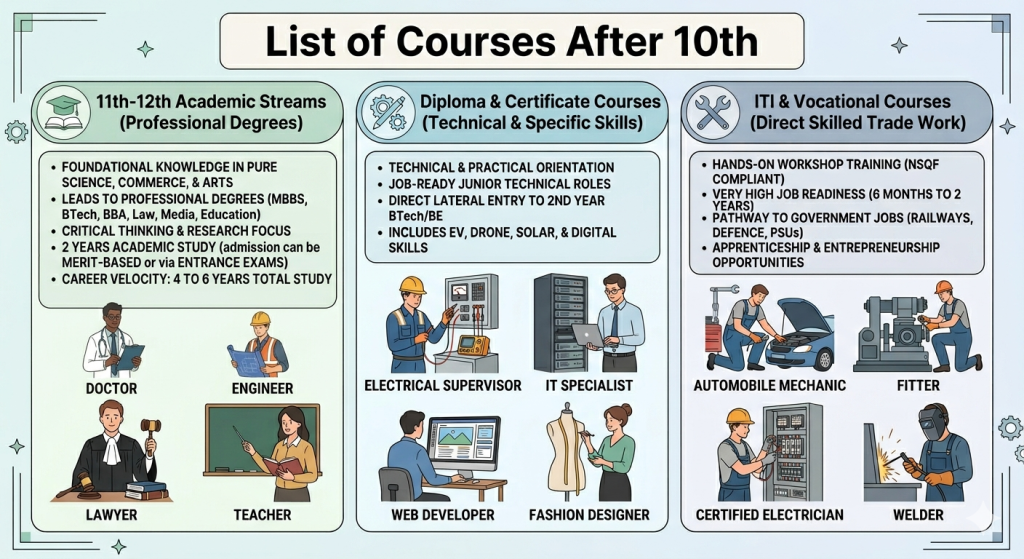
The best path after 10th will depend on your career goals and the way you like to learn. If you want careers like a doctor, an engineer, a lawyer, or a civil servant, then 11th and 12th will suit you best.
If you like technical work and want to join engineering jobs faster, then a polytechnic diploma can be a great option. And, if you want practical training and wish to start earning quickly, then ITI can help you get job-ready in less time.
Stream Wise List of Courses After 10th for Higher Studies
Most students continue with their 11th and 12th, and this is the most popular option in the list of courses after 10th. If you want to study for a professional career, then this is the route you will need to take. After Class 10, you can pick Science, Commerce, or Arts in Class 11.
Science Stream Courses After 10th
The science stream is a really good option for students who enjoy Maths, Biology, problem-solving, and technical subjects. You can choose it if you want careers in engineering, medicine, research, defence, or technology. In most schools, Science is divided into PCM, PCB, and PCMB combinations, so you can pick based on your career goals. Let us break down each for you.
PCM Subjects and Career Options
PCM stands for Physics, Chemistry, and Mathematics. This combination is best if you enjoy numbers, logic, machines, and technical problem-solving. It is good for careers in engineering, defence, design, and modern tech fields.
| Career Path | Course Duration | Average Fees Total | Starting Salary Annual | Main Qualification Needed |
| Engineering | 4 Years | INR 5 to 12 Lakhs | INR 5 to 25 Lakhs+ | B.Tech / B.E. |
| NDA Officer | 3 Years | Government Funded | INR 6.7 to 10 Lakhs | NDA Training + Degree |
| Merchant Navy | 3 to 4 Years | INR 6 to 15 Lakhs | INR 6 to 12 Lakhs | Nautical Science / Marine Engineering |
| Architecture | 5 Years | INR 4 to 15 Lakhs | INR 3.5 to 7 Lakhs | B.Arch |
| Data Science | 3 to 4 Years | INR 3 to 8 Lakhs | INR 6 to 18 Lakhs | B.Tech / BSc Data Science |
PCB Subjects and Career Options
PCB stands for Physics, Chemistry, and Biology. This option is for students who want to work in healthcare, medicine, life sciences, or research fields. If your dream is to become a doctor or work in the medical industry, then PCB is the main route.
| Career Path | Course Duration | Average Fees Total | Starting Salary Annual | Main Qualification Needed |
| MBBS / BDS | 5.5 Years | INR 5 to 50 Lakhs+ | INR 8 to 16 Lakhs | MBBS / BDS |
| Nursing | 4 Years | INR 3 to 8 Lakhs | INR 3.5 to 6 Lakhs | BSc Nursing |
| Pharmacy | 4 Years | INR 4 to 10 Lakhs | INR 4 to 7.5 Lakhs | B.Pharm |
| Biotechnology | 4 Years | INR 6 to 14 Lakhs | INR 6 to 12 Lakhs | B.Tech / BSc Biotechnology |
| Allied Healthcare | 3 to 4 Years | INR 2 to 6 Lakhs | INR 3.5 to 6.5 Lakhs | BPT / BSc Allied Health |
PCMB Combination Benefits
PCMB includes Physics, Chemistry, Mathematics, and Biology together. It is the most flexible Science combination because it keeps both engineering and medical options open. If you are unsure between JEE and NEET, then you can choose this, but it can be more demanding because you will study all major Science subjects together.
Entrance Exams After Science Stream
After choosing Science, you can prepare for these entrance exams in Class 11 and 12 based on the career you want. These exams can help you get admission into top colleges and government institutes across India.
| Entrance Exam | Level | Conducting Body | Main Purpose |
| JEE Main / Advanced | National | NTA / IITs | Engineering admissions in IITs, NITs, IIITs |
| NEET UG | National | NTA | Medical and dental admissions |
| NDA | National | UPSC | Entry into the Army, Navy, or Air Force officer training |
Commerce Stream Courses After 10th
Commerce is a great option if you enjoy business, money management, numbers, and economics. It can lead to careers in finance, law, banking, management, and entrepreneurship. It is good for both professional courses and corporate career options later.
Commerce With Maths vs Without Maths
If you are wondering if you should take Maths with Commerce. Then the answer depends on your plans. Maths is helpful for some advanced finance and economics careers, but many Commerce careers do not require it.
| Feature | Commerce With Maths | Commerce Without Maths |
| Main Benefit | Gives more college and career options | Makes studies slightly easier for many students |
| Best For | Economics, Finance, Data, & Actuarial careers | Law, Management, General Commerce careers |
| Common Extra Subject | Applied/Core Mathematics | IP, PE, Psychology, Marketing |
| Career Impact | Helpful for technical finance roles | Enough for CA, BBA, Law, Banking |
Career Paths in Commerce
Commerce can lead you to many solid and well-paying careers in business, finance, and management. You can go for professional courses, business degrees, or banking exams after graduation.
| Career Path | Course Duration | Average Fees Total | Starting Salary Annual | Main Qualification Needed |
| CA | Around 5 Years | INR 2 to 4 Lakhs | INR 8 to 22 Lakhs | ICAI Qualification |
| CS | Around 3 to 4 Years | INR 1 to 2 Lakhs | INR 5 to 12 Lakhs | ICSI Qualification |
| CMA | Around 3 to 4 Years | INR 1 to 2.5 Lakhs | INR 6 to 14 Lakhs | CMA Qualification |
| BBA | 3 Years | INR 3 to 12 Lakhs | INR 4 to 10 Lakhs | BBA Degree |
| Banking | 3 Years + Exam | INR 1 to 3 Lakhs | INR 5 to 9 Lakhs | Graduation + Bank Exam |
| Economics | 3 Years | INR 50K to 4 Lakhs | INR 6 to 18 Lakhs | Economics Degree |
Entrance Exams and Certifications for Commerce Students
After Class 12, you can take different entrance exams based on the career you want in Commerce. Some exams can help you get into finance and business jobs, while others can help you enter law or management colleges. Here is the list of exams.
| Exam Name | Conducting Body | Main Purpose | Frequency |
| CA Foundation | ICAI | Entry into Chartered Accountancy | Twice a Year |
| CS Executive Entrance Test | ICSI | Entry into the Company Secretary Course | 4 Times a Year |
| IPMAT | IIM Indore / Rohtak | Admission to Integrated MBA Programmes | Once a Year |
| CLAT | Consortium of NLUs | Admission to Law Colleges | Once a Year |
Arts/Humanities Stream Courses After 10th
Arts or Humanities is a great option if you enjoy creativity, writing, social topics, history, politics, or understanding how people think. You can choose Arts if you want to go into law, civil services, media, psychology, or design later. It is also a very strong stream for students planning for government exams later.
Career Opportunities in the Arts Stream
Arts can give you a lot of flexibility after graduation, so you can explore many paths later. This stream is a strong choice if you want a career where you work closely with people, ideas, or communication. Here are the common paths.
| Career Path | Course Duration | Average Fees Total | Starting Salary Annual | Main Qualification Needed |
| UPSC / Civil Services | Degree + Prep | INR 50K to 3 Lakhs | INR 7 to 12 Lakhs | Graduation + UPSC Exam |
| Law | 5 Years | INR 5 to 15 Lakhs | INR 6 to 18 Lakhs | BA LLB / LLB |
| Journalism | 3 Years | INR 2 to 7 Lakhs | INR 3.5 to 8 Lakhs | Journalism Degree |
| Psychology | 3 to 5 Years | INR 1.5 to 6 Lakhs | INR 4 to 9 Lakhs | BA / MA Psychology |
| Teaching | 3 to 5 Years | INR 1 to 4 Lakhs | INR 4.5 to 8 Lakhs | BA + B.Ed |
| Design | 4 Years | INR 8 to 20 Lakhs | INR 5 to 15 Lakhs | B.Des / Design Degree |
Also Read: Top Careers After Arts Stream: Courses, Jobs & Salaries
Diploma Courses After 10th
Diploma courses are one of the most practical options in the list of courses after 10th. Most diploma courses take 3 years to complete and can help you enter technical fields faster. Also, if you want to study further later, you can do a B.Tech. through lateral entry and join directly in the second year.
Engineering Diploma Courses After 10th
Engineering diploma courses are a good choice if you enjoy technical work and want job-ready skills early. These courses can help you learn practical engineering skills from the start. They are a smart option if you want to move into engineering later.
| Diploma Course | Duration | Annual Average Fees | Starting Salary Annual | Job Roles |
| Mechanical Engineering | 3 Years | INR 10,000 to 80,000 | INR 2.4 to 4.2 Lakhs | Manufacturing, machine design, production. |
| Computer Science Eng. | 3 Years | INR 15,000 to 1.2 Lakhs | INR 2.8 to 5 Lakhs | IT support, coding, & software testing. |
| Electrical Engineering | 3 Years | INR 10,000 to 85,000 | INR 2.2 to 4 Lakhs | Power plants, wiring, & renewable energy. |
| Civil Engineering | 3 Years | INR 8,000 to 75,000 | INR 2 to 4.5 Lakhs | Construction, site supervision, infrastructure. |
| Electronics & Comm. | 3 Years | INR 12,000 to 90,000 | INR 2.5 to 4.8 Lakhs | Telecom, hardware systems, networking. |
| Automobile Engineering | 3 Years | INR 15,000 to 95,000 | INR 2.2 to 3.8 Lakhs | Car manufacturing, servicing, EV tech. |
| Mechatronics | 3 Years | INR 25,000 to 1.5 Lakhs | INR 3 to 5.5 Lakhs | Robotics, automation, smart machinery. |
Non-Engineering Diploma Courses After 10th
You can choose non-engineering diploma courses if you want to work in creative, business, hospitality, or management fields. These courses also focus on skills and training. They can help you where talent and hands-on experience matter more.
| Diploma Course | Duration | Annual Average Fees | Starting Salary Annual | Job Roles |
| Hotel Management | 3 Years | INR 50,000 to 1.5 Lakhs | INR 3.0 to 6 Lakhs | Front Office, F&B Manager, Cruise Lines. |
| Fashion Design | 3 Years | INR 60,000 to 2 Lakhs | INR 2.5 to 7 Lakhs | Merchandising, Assistant Designer, Styling. |
| Interior Design | 2 Years | INR 50,000 to 1.8 Lakhs | INR 3 to 8 Lakhs | Residential/Commercial Design, CAD Expert. |
| Animation & VFX | 2 Years | INR 80,000 to 2.5 Lakhs | INR 3.5 to 10 Lakhs | Game Design, Film VFX, Digital Marketing. |
| Culinary Arts | 1 Year | INR 1.0 Lakh to 3 Lakhs | INR 2.5 to 5.5 Lakhs | Specialised Chef, Bakery Owner, Food Stylist. |
| Business Admin | 3 Years | INR 30,000 to 1.2 Lakhs | INR 2.2 to 4 Lakhs | Office Operations, Junior HR, Sales Executive. |
Polytechnic Entrance Exams in India
Many government polytechnic colleges will ask you to clear an entrance exam after Class 10. These exams usually test the Maths, Science, and reasoning that you already studied in school. If you score well, you can get into a good government college and pay much lower fees. Here is a list of polytechnic entrance exams.
| Entrance Exam | State | Conducting Body |
| JEECUP | Uttar Pradesh | Joint Entrance Examination Council |
| Delhi CET | Delhi | DSEU |
| AP POLYCET | Andhra Pradesh | SBTET AP |
| TS POLYCET | Telangana | SBTET TS |
| Bihar DCECE | Bihar | BCECE Board |
Can You Do B.Tech. After a Diploma?
Yes, you can do B.Tech. after a diploma. You can get admission through lateral entry, which means you will join directly in the 2nd year of BTech. This will save you one full year and still give you the same engineering degree. Many colleges also keep special seats for diploma holders, so this route can be a smart choice.
ITI Courses After 10th
ITI is one of the fastest options in the list of courses after 10th. These courses are all about hands-on training, and most ITI courses take just 1 to 2 years, which makes them shorter than diploma or degree courses. Here is a list of the best ITI courses after 10th.
| ITI Trade | Duration | Annual Average Fees | Starting Salary Annual | Job Roles |
| Electrician | 2 Years | INR 1,500 to 35,000 | INR 1.8 to 3 Lakhs | Electrical maintenance, railways, power sector |
| Fitter | 2 Years | INR 1,500 to 30,000 | INR 1.5 to 2.8 Lakhs | Machine assembly, factories, heavy engineering |
| Mechanic Motor Vehicle | 2 Years | INR 2,000 to 40,000 | INR 1.6 to 3.2 Lakhs | Automobile repair, servicing, EV workshops |
| Draughtsman (Civil) | 2 Years | INR 2,000 to 35,000 | INR 2 to 4 Lakhs | Design, construction planning, surveying |
| COPA | 1 Year | INR 3,000 to 25,000 | INR 1.2 to 2.4 Lakhs | Data entry, office support, computer operations |
| Welder | 1 Year | INR 1,500 to 25,000 | INR 1.5 to 3 Lakhs | Fabrication, pipelines, industrial welding |
| Mechanic Diesel | 1 Year | INR 2,000 to 30,000 | INR 1.4 to 2.6 Lakhs | Diesel engine repair, machinery maintenance |
| IoT Technician | 1 Year | INR 5,000 to 45,000 | INR 2.2 to 3.5 Lakhs | Smart devices, automation, tech systems |
Difference Between NCVT vs SCVT in ITI
When you choose an ITI course, you will often hear about NCVT and SCVT. These are the two main types of ITI certificates in India. The type of certificate matters because it can affect where you can apply for jobs later. Most people prefer NCVT because it is accepted in more places across India.
| Feature | NCVT | SCVT |
| Full Form | National Council for Vocational Training | State Council for Vocational Training |
| Recognition | Accepted across India | Mostly accepted within one state |
| Curriculum | Set by central authorities | Set by state authorities |
| Job Scope | Useful for national-level jobs | Better for local or state-level jobs |
| Mobility | Easier if moving to another state | Can be limited outside the state |
Apprenticeship Opportunities After ITI
After ITI, you can do an apprenticeship before taking a full-time job to build experience. Also, many companies hire apprentices permanently if they perform well. NAPS is a government scheme that supports apprenticeship training after ITI, and under this program, you can usually earn a stipend of around INR 7,000 to 12,000 per month while training.
Can You Do Polytechnic After ITI?
Yes, you can do Polytechnic after ITI to move ahead in technical education. If you finish ITI in a related trade, some colleges let you join directly in the 2nd year of the diploma through lateral entry. It is a smart option if you want better technical roles and a higher salary later.
Vocational & Paramedical Courses After 10th
Vocational and paramedical courses are a smart pick because these courses teach you skills that companies and hospitals need. Many jobs today need trained support staff, and that is why many people choose these from the list of courses after 10th.
Paramedical Diploma Courses After 10th
Paramedical diploma courses are a great option if you want to work in healthcare without spending many years becoming a doctor. These courses train you for important support roles in hospitals, labs, clinics, and diagnostic centres. Here is a list of paramedical diploma courses.
| Course | Duration | Annual Average Fees | Starting Salary Annual | Job Roles |
| DMLT (Lab Tech) | 2 Years | INR 15,000 to 70,000 | INR 2.4 to 4 Lakhs | Medical lab work, pathology, & blood banks |
| Radiology / X-Ray Tech | 2 Years | INR 20,000 to 80,000 | INR 2.5 to 4.5 Lakhs | X-Ray, CT Scan, and MRI assistance |
| OT Technician | 2 Years | INR 20,000 to 75,000 | INR 2.2 to 4.2 Lakhs | Assisting in surgeries and sterile setups |
| ANM Nursing | 2 Years | INR 10,000 to 60,000 | INR 2 to 3.5 Lakhs | Maternal care, rural health, and clinics |
| Dialysis Technician | 2 Years | INR 30,000 to 90,000 | INR 2.5 to 4.8 Lakhs | Operating dialysis machines for kidney patients |
| Ophthalmic Assistant | 2 Years | INR 20,000 to 65,000 | INR 2 to 3.8 Lakhs | Vision testing and eye clinic support |
Also Read: Paramedical Courses List: Best Diploma, BSc & Masters Paramedical Programs
Vocational Courses Offered in Schools
Many schools let you learn job skills along with normal Class 11 and 12 subjects. So while you study for board exams, you can also build skills side by side. These subjects come under the NSQF and are made to help you learn useful work early. Here is the list of vocational courses offered in schools.
| NSQF Skill Area | Skill-Based Electives |
| NSQF IT Skills | Information Technology, Coding Basics, Data Entry |
| NSQF Retail Skills | Retail Management, Sales, Customer Service |
| NSQF Healthcare | Basic Healthcare, Nursing Assistant Training |
| NSQF Tourism | Travel and Tourism, Hospitality Basics |
| NSQF Beauty & Wellness | Makeup, Hair, Skin Care |
| NSQF Agriculture | Farming Basics, Food Production |
Also Read: Vocational Courses After 12th: A Guide
Short-Term Certificate Courses After 10th
Short-term certificate courses are perfect if you want to learn a skill quickly. Most of these courses finish in just a few months, so you can start working, freelancing, or doing internships pretty quickly. They also cost much less than full degree or diploma programs.
| Course | Duration | Total Cost (INR) | Income Potential (Annual) | Job Roles |
| Digital Marketing | 3 to 6 Months | INR 5K to 30K | INR 1.8 to 4 Lakhs | SEO Executive, Social Media Manager |
| Graphic Design | 6 to 12 Months | INR 10K to 50K | INR 1.8 to 3.5 Lakhs | Logo Designer, UI Layout Artist |
| Tally with GST | 2 to 4 Months | INR 3K to 15K | INR 1.8 to 3 Lakhs | Accountant, GST Assistant |
| Web Development | 6 to 12 Months | INR 15K to 60K | INR 2.5 to 5 Lakhs | Front-end Developer, Web Designer |
| Cyber Security | 3 to 6 Months | INR 10K to 40K | INR 3 to 6 Lakhs | Network Security, Data Protection |
| Hardware & Networking | 6 to 12 Months | INR 15K to 50K | INR 1.8 to 3.5 Lakhs | IT Support, System Technician |
| Mobile Repairing | 3 to 6 Months | INR 5K to 20K | INR 1.5 to 3 Lakhs | Service Tech, Mobile Shop Owner |
| Data Analytics | 6 Months | INR 10K to 40K | INR 3 to 5.5 Lakhs | Junior Data Analyst, Excel Expert |
Trendy Futuristic Courses After 10th
If you want to learn something modern and stay ahead of the crowd, then these trendy courses in the list of courses after 10th can give you that early edge. A lot of people are choosing them because these fields are growing fast and have less competition than the usual career paths.
| Course | Duration | Total Cost | Annual Income Potential | Job Roles |
| EV Technician | 6 to 12 Months | INR 5K to 50K | INR 2.5 to 4.5 Lakhs | EV Battery Repair, Charging Station Tech. |
| Drone Pilot & Tech | 3 to 6 Months | INR 20K to 80K | INR 3 to 6 Lakhs | Drone Operator, Aerial Surveyor. |
| Solar Panel Tech | 6 to 12 Months | INR 10K to 40K | INR 2 to 4 Lakhs | Solar Installer, Grid Maintenance. |
| AI & Digital Skills | 3 to 12 Months | INR 5K to 60K | INR 3 to 7 Lakhs | AI Prompt Engineer, Data Labeller. |
| Cybersecurity | 3 to 6 Months | INR 10K to 50K | INR 3 to 6 Lakhs | Security Support, Cyber Guard. |
Government Job Options After 10th
Government jobs are famous for job security and a steady income. A lot of people like them because, along with a salary, you may also get benefits like allowances, promotions, and a pension in many roles. Some government jobs need only a 10th pass qualification, while others may ask for ITI, entrance exams, or physical tests. Here is a list of some popular options.
| Government Job Option | Eligibility / Role | Average Annual Salary | Selection Process |
| Railway Jobs | Group D, Track Maintainer, Helper | INR 3 to 5.5 Lakhs | CBT Exam + Physical Test |
| Defence Jobs | Army Tradesman, Agniveer, Navy MR | INR 3.6 to 4.8 Lakhs | Exam + Physical + Medical |
| Post Office GDS | Branch Postmaster, Dak Sevak | INR 1.5 to 3.2 Lakhs | Merit-Based (10th Marks) |
| Police & Constable | State Constable, Home Guard | INR 3 to 5 Lakhs | Written Exam + Physical Test |
| SSC MTS | Office Staff, Havaldar, Clerk Support | INR 3.2 to 4.5 Lakhs | Computer-Based Exam |
Also Read: Government Exams after 12th Science
How to Choose the Right Course After 10th?
Before choosing from the list of courses after 10th, you need to understand that one wrong decision can waste years if you choose a path with no real demand or growth. Today, many old career paths are getting replaced by automation. Here are some realistic tips to stay valuable for years.
- Pick careers that solve real-world problems because those jobs survive the longest. Tech, healthcare, energy, repair, and infrastructure will always need people.
- Learn one main skill and one extra modern skill together. For example, if you study engineering, also learn coding or AI tools on the side.
- Focus on jobs that need human work and practical thinking because many basic desk jobs may be reduced in the future.
- Think long-term before choosing. Ask yourself if this course will still have demand 10 years from now, not just today.
Common Mistakes to Avoid While Choosing Courses After 10th
Some students make mistakes while choosing the best course from the list of courses after 10th grade. And because we should learn from people’s mistakes, here is a list of some common mistakes that you need to avoid in 2026.
- Do not pick a course just because your friends are picking it. Half of the people end up regretting their stream because they copied others without thinking.
- Do not chase fancy degrees with no real skill. A degree alone means very little now if you cannot actually do useful work.
- Avoid crowded safe options if you are not serious about being the best in them. Average people in oversaturated fields struggle the most.
- Do not delay earning. Try to start earning early if possible. Real work experience at 18 can beat theory-only knowledge at 23 in many cases.
FAQs
The top 3 choices after 10th are the Science stream, the Commerce stream, and Polytechnic Diploma. Science is best for medical and engineering careers. Commerce is good for finance, banking, and business roles. Polytechnic is great for students who want technical jobs faster.
Yes, a 10th pass student can start earning money after learning practical skills. Many students do ITI, certificate courses, or part-time jobs after 10th. Skills like computer basics, graphic design, and digital marketing can help you earn online, too. Your income can grow more as your skills improve.
To become a CEO, you need to keep studying and build leadership skills step by step. Most CEOs complete school, graduation, and often an MBA or business degree. Then they gain years of work experience and move into management roles. Strong communication and business skills are very important in this journey.
The 3 hardest exams in India are usually UPSC, JEE Advanced, and NEET. These exams are highly competitive, and lakhs of students apply every year. Students need deep preparation and regular practice to crack them. Strong focus and discipline are very important for success.
Some of the shortest courses after 10th are certificate programs that last 3 to 6 months. These include Tally, digital marketing, computer basics, and graphic design. They help students learn one skill quickly. They are useful if you want fast training in less time.
Girls can choose Science, Commerce, Arts, diploma, ITI, or certificate courses after 10th based on their goals. There is no separate rule for girls because every option is open to everyone. The best choice depends on career interest and future plans. Girls today are succeeding in every field, from defence to tech.
Choosing from the list of courses after 10th can feel confusing at first, but once you know what you want, it will be easier to decide. There is no pressure to be perfect because no one has it figured out. Your first choice after 10th does matter, but it does not lock your whole life forever. Because today, you can switch fields later, upgrade your qualifications, and even change careers if needed. So for now, you should choose what actually matches your strengths, your money situation, and how fast you want results.
One additional piece of advice would be to add one extra skill besides their main path. For example, if you choose Science, you can learn coding too. If you choose Commerce, you can learn digital marketing or Excel. If you choose ITI or Diploma, you can add communication and computer skills. This will give you an edge over others because in real life, candidates with extra skills often get picked first.
Relatable Reads
Keep learning and stay connected with the Career Counselling page on Leverage Edu for more helpful and student-friendly blogs. And if this helped you, don’t forget to share, rate, and drop a comment. Your support helps more students find the good stuff.

 2,00,000+ students realized their study abroad dream with us. Take the first step today.