

 One app for all your study abroad needs

















The advancement of human civilisation is significantly influenced by education. Since the beginning of time, the way people learn has undergone significant changes and continues to evolve due to advancements in technology. However, thanks to the internet and other digital technologies, online learning environments are becoming more popular than traditional classrooms. The spatial restriction of a physical classroom has been entirely eliminated by the current educational system, benefiting a wide variety of pupils simultaneously throughout the world. In this blog, we shall shed some light and talk about Modern Education and its way of moving development forward.
This Blog Includes:
- What is Modern Education?
- Traditional Education vs. Modern Education
- Which One Is Better?
- Need For Modern Education
- What is the Purpose of Modern Education?
- Benefits of Modern Education
- Disadvantages of the Modern Education System
- Challenges Faced By the Modern Education System
- Modern Education in India
- Notes on Modern Education
- Smart Education: The Advent of Online Learning
- Grading & Assessment in Modern Education
- FAQs
What is Modern Education?
Modern Education is the latest and contemporary version of education that is taught in schools and learning institutions in the 21st century. It doesn’t only focus on prominent academic disciplines of Commerce, Science and Arts but also aims to foster critical thinking, life skills, value education, analytical skills and decision-making skills in students. Modern Education also makes use of the latest technology, such as mobile applications, audio and video platforms like YouTube, Podcasts, E-books, Movies, etc., to educate learners and make the learning process more engaging and interesting.
We have all been educated in a teacher-centric classroom, a system where the teacher is in front and the students are seated in nice, neat rows, listening to the lecture and taking notes. This system has been, and to some extent, still forms the core of our education system. Schools have relied on it for decades and have only recently undergone major changes. Living in the 21st century, technology has become an integral part of our everyday lives. None of us can deny that it has brought about nothing short of an overhaul of our world, and more importantly, of our educational system. From chalkboards to whiteboards and now to smart boards, technology has become our main source of research, knowledge, and teaching.
Traditional Education vs. Modern Education
A traditional education looks like it does in a classroom, chalkboard and face-to-face lectures. It focuses on in-person teaching, fixed schedules, and textbooks as the main sources of learning.
On the other hand, modern education is flexible and technology-driven. It uses online platforms, digital resources, interactive tools, and self-paced learning to make education more engaging and accessible. Below, we have mentioned the difference between the two.
| Aspect | Traditional Education | Modern Education |
| Learning Style | Teacher-centered | Student-centered |
| Mode | In-person, classroom | Online & hybrid |
| Resources | Books, notes | Digital tools, e-books, videos |
| Flexibility | Fixed schedule | Learn anytime, anywhere |
| Interaction | Limited to class | Global, virtual collaborations |
Also Read: Impact of Digital Tools & Technolgy in Modern Education
Which One Is Better?
Both types of education have their own place and importance in society. We cannot categorise education as good or bad. Traditional education was good in its time, and modern education is good in its time. Actually, it depends on the individual. It all depends on what the individual wishes to learn.
Traditional education is unquestionably better for learning about one’s customs and religion. Modern education, on the other hand, is beneficial to those who wish to learn about science or mathematics. Both types of education are equally important. Our culture is frequently associated with traditional education. Similarly, it is critical to keep up with the world in terms of modern developments that are taking place today. This expresses the significance of modern education.
Need For Modern Education
The academic curriculum needs to be modernised, not simply to keep up with the times, but also to better educate students about the rapid breakthroughs in technology. Becoming flexible to changing times helps students become skilled at employing both conventional abilities and technical competence with equal ease.
The existing educational system does ordinary people an injustice by limiting their potential, making it impossible for them to handle the intricacies of both private and public life. Since there are many different issues facing mankind in today’s competitive world, the educational system must be made adaptable enough to educate pupils for this dynamic environment.
What is the Purpose of Modern Education?
Modern education is important for this generation as it helps to adapt to the latest developments and happenings in the education field. Here are the key purposes of this education:
- To foster essential life skills, critical thinking, decision-making skills and analytical competencies in its learners.
- To facilitate a positive approach towards diversity, inclusion, compassion and a sense of responsibility in students.
- To create a fun and engaging learning process.
- To incorporate educational technology to make the learning environment more experiential, with a key focus on real-world applications of concepts.
- To ensure that learning and education reach every corner of the world, whether through physical classrooms or online learning.
- To build an equal relationship between the teacher and learner, foster the curiosity of students and teach them to inquire and ask questions rather than the passive traditional approach.
Benefits of Modern Education
In particular, the advantages of modern education can be summarised as follows, and we have listed its most prominent benefits for all:
- Modern education is a dynamic way of learning, enabling students to learn a lot faster. The interaction between students and teachers helps students understand better.
- Enabling students to participate in physical activities to improve their efficiency is another advantage. It allows students to do a lot more than just learn and helps them become more social and interactive.
- Co-curricular activities, recreational activities, drama and art in education help students to become creative, industrious, and patient. This is one of the factors that makes students look forward to schooling.
- Modern education comprises screening classes and lectures, which are scheduled at specific timings; this helps to make students punctual and consistent.
Disadvantages of the Modern Education System
Apart from the benefits that it offers, there are certain cons of modern education as well. Below, we have mentioned some of its disadvantages.
- Lack of interpersonal interaction: Courses taken online are self-paced. It is challenging for the students to build relationships with their peers. little to no face-to-face interaction and little social engagement.
- The likelihood of becoming distracted: The likelihood of becoming distracted is quite high for students who are less focused and lack motivation. The students wander off course and end up doing something different.
- Learners get isolated: since they don’t engage with the outside world, which increases the likelihood that they may feel lonely and alone.
Challenges Faced By the Modern Education System
While we are all moving forward with education, it is important to understand its limits and the challenges that can come in the way. Look at the most common challenges faced by the modern education system:
1. Conformity: Employees are required to abide by a set of rules to accomplish corporate goals or targets, which may limit their freedom and creativity.
2. Loss of Responsibility: The people feel less accountable for the general expansion of the business as a result of the development in the specialisation. Even though their employees are not receiving the required training and development, it has been observed that firms frequently blame “globalisation” for all of their problems.
3. Lack of Proper Communication: There is frequently poor communication between various sectors and teams as a result of overcomplication and shortened deadlines, which has a detrimental effect on the company’s overall performance.
Also Read: Discover Your Path to Academic Excellence
Modern Education in India
The Indian education system has its deep roots in ancient oral learning as well as the Gurukul education system, which was later transformed into formal education by the British. Here are the salient features of modern education in India:
- Modern education in India was brought by the British colonisers in the 1830s, along with the English language, which is credited to have been introduced in India by Lord Thomas Babington Macaulay.
- While metaphysics and philosophy were earlier studied at Nalanda University, the new modern education system brought by the British focused on academic disciplines like Science and Mathematics.
- As India became free from the British, basic education was made compulsory, especially for children aged 6-14 years, with schools constructed all across the country.
- The modern-age education system of India in the 21st century is constituted of a new approach to learning from online education to skill-development courses, digital learning platforms, a grading system, as well as the use of educational technology in the classrooms and a newly introduced New Education Policy!
Notes on Modern Education
Want to study the importance of modern education and how it is different from traditional education? Here are some important study notes for better understanding:
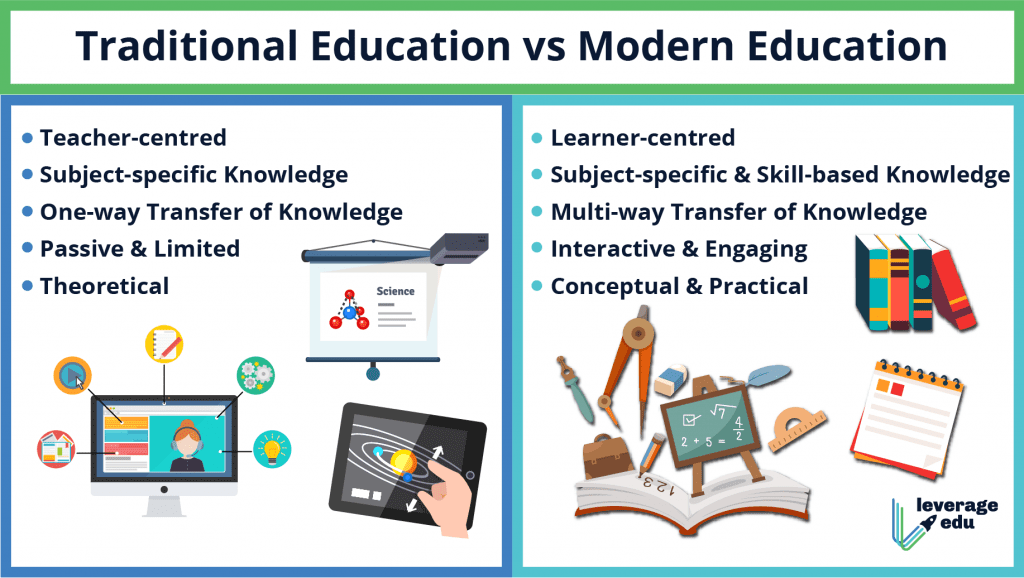
Teaching styles have changed significantly over the years. The traditional way of imparting education primarily employs recitation and memorisation techniques, whereas modern education involves interactive methods for effective learning. The following paragraphs elaborate more on both approaches.
Traditional Education: Tried and Tested
The conventional education method focuses more on teaching and passing on information and knowledge to learners. It focuses more on recitation than on anything else. For example, students are made to sit in silence while one student after another takes turns reciting a lesson until each one has been called upon. The teacher will listen to each student’s recitation, who is expected to learn and memorise the assignments to the word.
Traditional education methods rely heavily on replication-based assessment in practical and written exams as well. However, how traditional teaching methods were utilised ensured that students were rewarded for their efforts, used class periods efficiently and exercised clear rules to manage student behaviour. Traditional methods are based on established customs that have been used successfully in schools for many years.
Modern Education: A Welcome Change
Modern education significantly differs from the traditional methods of teaching and is widely practised in schools today, emphasising science and technology. Progressive modern education focuses more on the students’ needs rather than assuming that all students are at the same level of understanding. It is activity-based, comprising questioning, explaining, demonstration and collaboration techniques. Embodied in the BEd Syllabus, this form of education teaches imaginative, creative thinking and visualisation.
Smart Education: The Advent of Online Learning
Amongst the core features of Modern Education, Online Education has become a quintessential part of the learning process and pedagogy in the contemporary age. The Internet has become a vast pool of knowledge, welcoming people of all ages to enhance their skills and expand their expertise in different fields of study. Further, online learning is just a constituent of Smart Education, which utilises technology to facilitate an interactive process of teaching and learning. The importance of technology in education is imperative today, and you can learn anything and anywhere just with the help of a functioning network connection and a smartphone, tablet or computer, utilising tools like MDM for education.
Grading & Assessment in Modern Education
Apart from the approach to teaching and learning, another unique aspect of modern education is the introduction of a grading system that focuses on providing students with certain grades rather than marks to eliminate the quantification of a student’s knowledge about a subject.
While marks were the major element of assessment in traditional education, modern education has brought forward a grading system, which is a better way to provide students with an overview of their knowledge and understanding of different subjects. With this advanced marking pattern, students are relieved from the scoring pressure, and teachers are also able to highlight the areas where a student needs to work more on and where they can focus on helping the student perform better.
FAQs
Modern education is a student-focused learning system using technology, practical skills, and updated methods. It prepares you for real-world challenges through digital learning, critical thinking, and interactive teaching.
Modern education in India was introduced by the British. Lord Thomas Babington Macaulay played a key role in 1835 by promoting English-based education to replace traditional systems.
Examples include online learning, smart classrooms, digital libraries, skill-based courses, and blended learning. These methods combine theory with practical application, helping students gain knowledge in innovative and flexible ways.
In India, Thomas Babington Macaulay is called the father of modern education. Globally, John Amos Comninius is often considered the father of modern education for his progressive teaching ideas.
The main aim of modern education is to develop knowledge, creativity, and life skills in students. It helps you adapt to changing career needs and become future-ready.
Related Reads:
Thus, we hope that this blog on modern education helped you gain some modern perspectives on new methods of learning and teaching. We at Leverage Edu, believe in pushing your potential and bringing out the best in you. If you’re planning to pursue higher education and need assistance, get in touch with our experts and start your career today!


 60,000+ students trusted us with their dreams. Take the first step today!
9 comments
Thank you for sharing the great informatic article. It will definitely many people.
Hey Prami!
Thank you for taking out the time and writing the comment! Do explore similar blogs and sign up for our newsletter.
Very well explained the modern education system how it will change and how it will work in a positive manner. You can also go for interactive training rooms. If you want your employees to enjoy the initial on-borading days, then head on to automation services provided by lightomated to build interactive training rooms. They use best quality and standardized products like hi tech audio sytems, speakers, remote controlling, etc
Thank you for your comment!
Thanks for sharing. I will try to implement these methods on my blog. Thanks for sharing. Keep updating us.
Thanks for reading.
Wow! Thank you so much sharing this information, I was researching for information on modern education and this has helped me a lot..
Thank for the comment!
Please sign up for our newsletter to get all the information you need on studying abroad!
This blog worths reading! Loved the way it has been represented. Thank you for such helpful sentences and ideas that I have been adding to my project.
Good day~