

 One app for all your study abroad needs














One of the most important questions Indian Students ask is, ‘How long does the Canadian study visa process take?’ Understanding the Canada study visa processing time helps you plan your application, book flights confidently, and avoid last-minute stress before your intake.
In this detailed blog post, we explain the latest Canadian study permit processing time in 2026, based on an update from immigration, Refugees and Citizenship Canada (IRCC). We also cover the SDS vs Non-SDS timeline, step-by-step process, intake-based planning strategy, and comparisons with the UK and Australia.
This Blog Includes:
- Canada Study Visa Processing Time: Quick Overview
- Canada Study Visa Processing Time from India
- Non-SDA Processing Time
- SDS vs Non-SDS Comparison Table
- Which Strength is Faster SDS vs Non-SDS in 2026
- Average Processing Timelines By Stream
- Step-by-Step Timeline After Applying
- Factors That Affect the Canada Study Visa Process Time
- When Should You Apply? (Intake-Based Strategy)
- How to Speed Up Your Canada Study Permit
- Canada Study Visa Processing Time vs UK vs Australia
- Common Reasons for Delays or Rejection
- FAQs
Canada Study Visa Processing Time: Quick Overview
Here is a snapshot of the current 2026 processing timeline. As per the IRCC’s official processing time tool:
| Average Processing Time (Outside Canada) | 7-10 weeks |
| India-Specific Estimate | 6-9 weeks (varies by intake season) |
| SDS Average Time | 4-6 weeks |
| Non-SDS Average Time | 8-12 weeks |
Important: Processing times are dynamic and updated regularly by Immigration, Refugees, and Citizenship Canada (IRCC). Processing time starts after biometric submission, not from the day you submit your online application.
Canada Study Visa Processing Time from India
Indian students are one of the largest international student groups in Canada. Processing times may vary during peak seasons.
SDS Processing Time SDS Processing Time
The Students Direct Stream (SD) is designed for faster processing for eligible countries, including India.
| Average Time | 4-6 weeks |
Requirements
Here are the SDS requirements:
- IELTS Academic scores of 6.0 overall (no bands less than 6.0)
- GIC of CAD 20,235 (as per updated cost of living requirements)
- Fully first-year tuition payment
- Upfront medical examinations
- Complete documentation
SDS applications are usually processed faster due to standardised financial proof.
Also Read: Canada Visa for Indians: Types, Eligibility, Documents
Non-SDA Processing Time
Non-SDS is for students who do not meet SDS eligibility or choose the regular stream.
| Average Time | 8-12 weeks |
Processing is generally slower because:
- Financial documents are reviewed in detail
- More scrutiny on proof of funds
- SOP evaluation is stricter
SDS vs Non-SDS Comparison Table
Understanding the difference between SDS and Non-SDS is crucial before applying for a Canadian study permit. The comparison table below highlights key differences in processing time with approval trends to help you choose the right category based on your eligibility and profile.
| Category | SDS | Non-SDS |
| Average Time | 4-6 weeks | 8-12 weeks |
| Key Requirements | IELTS 6.0, GIC, full tuition | Flexible financial proof |
| Success Rate Trend | Higher (if documents are strong) | Moderate |
| Financial Review | Standardise | Detailed Scrutiny |
| Best For | Students with strong academic and clear funds | Students with flexible financial sources |
Which Strength is Faster SDS vs Non-SDS in 2026
The SDS remains the gold standard for students in 14 particular nations, including China, India, and the Philippines. IRCC confirmed its pledge to process SDS files within 20 calendar days for 2026. But the requirements for eligibility have become more stringent. You must meet stronger language proficiency requirements and have a large GIC amount to be eligible for this fast-track study in Canada.
The wait is much longer for people in the Non-SDS stream, which is now frequently referred to as the Regular Study Permit stream. Since these files do not have a guaranteed status or SDS-compliant language scores, they go through a more strict financial verification process. Depending on the complexity of their financial documentation, non-SDS applicants may have to wait eight to twelve weeks in the 2026 cycle.
Average Processing Timelines By Stream
The typical timelines currently observed for Canadian students’ visas across major student pathways are shown in the following table. Keep in mind that these are averages and may change depending on the complexity of each file.
| Stream | Priority Level | Average Processing Time in 2026 |
| Inside Canada (Renewals) | High | 4–6 Weeks |
| Postgraduate Work Permit | Low | 3-5 Months |
| SDS (Indian/Philippines) | High | 15–20 Days |
| Non-SDS (Global) | Medium | 8–11 Weeks |
Step-by-Step Timeline After Applying
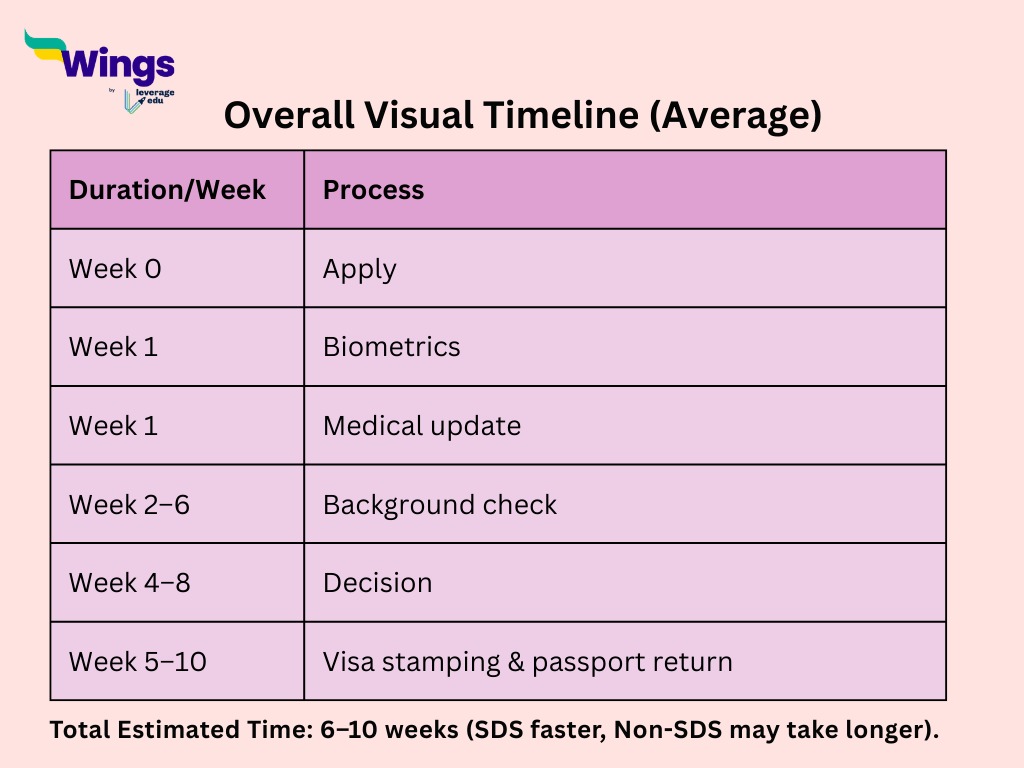
The Canada study visa process follows a structured system under Immigration, Refugees and Citizenship Canada (IRCC). While exact timelines vary depending on intake seasons and individual profiles, most applications move through the following stages:
- Document Review (1-3 weeks): After you submit your application and complete biometrics, IRCC begins reviewing your documents. During this stage, the visa officer assesses:
- Letter of Acceptance (LOA) from a DLI
- Academic transcripts and IELTS/PTE scores
- Financial documents (GIC, tuition payment, bank statement)
- Passport and identity details
If documents are incomplete or unclear, IRCC may request additional information, which can extend the timeline.
- Biometrics (Within 1 week of BIL): Once you receive the Biometric Instruction Letter (BIL), you must book an appointment at a Visa Application Centre (VAC).
- Biometrics usually get updated in your profile within a few days after submission.
- Processing officially progresses after biometrics are enrolled.
Delays mostly happen if appointment slots are unavailable during peak intake months.
- Medical Examination (1-2 Weeks): If you complete an upfront medical, results are typically uploaded within 5-10 days by the panel physician. If medical is requested later:
- You must book an appointment quickly
- Additional tests (if required) can increase processing time.
Your account status will update to Medical Passed once cleared.
- Background and Security Check (2-6 Weeks): This is often the longest stage. IRCC conducts background checks:
- Travel history verification
- Previous visa refusal checks
- Criminality and security screening
- Financial background validation
The duration depends on your travel history and personal profile. Applicants with complex travel records may experience longer reviews.
- Final Decision & Passport Request (4-8 weeks total): Once eligibility and background checks are complete, IRCC makes a final decision. If approved:
- You receive a Passport Request (PPR)
- Submit a passport for visa stamping
- A passport is typically returned within 1-3 weeks.
If reused, a refusal letter is issued explaining the reason.
- Visa Stamping (5-10 weeks): Your visa is requested to be stamped
- Submit your passport to VAC after PPR
- The visa counterfoil (TRV) is stamped in the passport
- Passport returned via courier within 1-2 weeks
You will also receive a Port of Entry (POE) Letter of Introduction, which must be shown to the immigration officer when you arrive in Canada.
Visual Style Breakdown in Weeks
Also Read: Canadian Student Visa: Eligibility Criteria, Documents.
Factors That Affect the Canada Study Visa Process Time
The Canada study visa processing time in 2026 is not fixed. Even though Immigration, Refugees and Citizenship Canada (IRCC) provides estimated timelines through its official processing tool, your individual application profile plays an important role in how quickly a decision is made. Below are the key factors that can significantly impact your study permit processing speed:
- Country of Residence: The processing time for a student visa to Canada may also be impacted by your nation of residence. While some countries might have more efficient processes, others might have more applications, which could result in longer processing times.
- Program Type: The processing time is also influenced by the academic program’s nature. Additional documentation may be needed for some programs, which might extend the time it takes to process a visa application.
- Biometrics and Medical Examinations: A seamless application procedure depends on the timely completion of biometric and medical examinations. The total processing time for a Canadian student visa may increase if these procedures are delayed.
- Incomplete or Incorrect Documentation: One of the most common reasons for delays is submitting an incomplete application. If any of the following are missing or unclear, IRRC may request additional documents (which adds 2-4 weeks), put your file under extended review, and refuse the application outright.
- Quality of Statement of Purpose: Your SOP plays a critical role in eligibility assessment. If your SOP does not clearly justify course selection, shows a program mismatch, fails to explain study gaps, lacks clarity about a career plan, or appears copied or generic. The officer may conduct a deeper eligibility review, increasing processing time.
- Application Category (SDS vs Non-SDS): The category you apply under also directly affects processing speed. SDS applications are usually processed faster because they follow standardised documentation requirements. Non-SDS applications require a more detailed financial assessment and may take longer.
- Background and Security Verification: Every Canadian study permit application goes through background checks. This includes travel history review, previous visa refusals, criminal background screening, security verification, and information cross-checking with other countries.
When Should You Apply? (Intake-Based Strategy)
Choosing the right time to apply for your Canadian study visa is crucial to avoid delays and last-minute stress. Your application timeline should align with your intake (Fall, Winter, or Spring) to ensure smooth processing and timely arrival in Canada:
| Strategy | Sep 2026 fall intake | Jan 2026 Winter Intake |
| Apply to colleges/universities | Nov 2025-Feb 2026 | June-Aug 2025 |
| Receive offer & PAL | Jan-March 2026 | Aug-Sep 2025 |
| Apply for a visa | March-May 2026 | Sep-Oct 2025 |
| Ideal submission deadline | Before June 2026 | Before Nov 2025 |
How to Speed Up Your Canada Study Permit
While you cannot directly control the internal processing timelines of Immigration, Refugees and Citizenship Canada (IRCC), you can significantly improve your application speed by submitting a complete, well-prepared, and low-risk profile. A properly structured file reduces additional verification and prevents unnecessary delays.
Apply Under SDS (If eligible): If you meet the eligibility criteria, applying through the Students Direct Stream (SDS) can help streamline your application. SDS requires standardised financial documents such as full-year tuition payment and a valid GIC, which reduces financial scrutiny and often results in faster processing.
Submit Upfront Medical: Completing your medical examination before submitting your application helps avoid delays at the stages. If you wait for IRCC to request medical, it can add 2-3 extra weeks to your overall timelines.
Complete Biometric Early: After receiving your Biometric Instructions Letter (BIL), book your biometrics appointment within 3-5 days. Processing moves forward only after biometrics are enrolled, so delaying this step can slow your entire application.
Prepare a Strong SOP: Your statement of purpose should clearly explain:
- Any study gap
- Your academic and career progression
- Why the chosen course is relevant
- Your long-term career goals and return intent
A clear and logical SOP reduces the chances of additional eligibility review.
Maintain Clear Financial Documentation: Even under SDS, ensure that:
- Your tuition fee receipt is official and verifiable
- Your GIC confirmation letter is final and accurate
- All names and passport details match exactly
Well-organised financial proof minimises the risk of secondary review
Avoid Last Minute Filling: Submitting your application 4-5 months before your intake gives you buffer time in case of delays, additional document requests, or peak season backlog. Early filling is one of the most effective ways to avoid stress and last-minute complications.
Canada Study Visa Processing Time vs UK vs Australia
Before finalising your study destination, it is important to compare the students’ visa processing time across Canada, the UK, and Australia. This section highlights the average timelines in 2026 to help you understand which country typically offers faster visa decisions.
| Country | Average Student Visa Processing Time |
| Canada | 6-10 weeks |
| United Kingdom | 3 weeks |
| Australia | 4-8 weeks |
In the UK, student visa processing is handled by UK Visas and Immigration (UKVI). Australia’s student visa is processed by the Department of Home Affairs.
While the UK is generally faster, Canada offers stronger post-study work opportunities under PGWP, which makes slightly longer processing acceptable for many students.
Common Reasons for Delays or Rejection
The common refusal reason can help you strengthen your application and avoid unnecessary delay. Visa officers at Immigration, Refugees and Citizenship Canada (IRCC) carefully review financial proof, academic intent, and overall credibility before approving a study permit.
- Insufficient Funds: Failing to meet Canada’s updated cost of living and tuition requirements is a major reason for refusal. If your financial documents do not clearly show tuition payment, the required GIC amount, or a legitimate source of funds, your application may be delayed or rejected under financial insufficiency.
- Weak SOP: A generic, copied, or poorly structured Statement of Purpose raises doubts about your genuine study intent. If your career goals are unclear or your course choice is not properly justified, IRCC may refuse the application under the purpose of visit concerns.
- Travel History Concerns: Previous visa refusals, overstays, or unexplained international travel can trigger deeper background checks. If you fail to disclose or properly explain past immigration issues, it may lead to process delays or negative decisions.
- GIC Mismatch: For SDS applicants, submitting incorrect or incomplete GIC certificates can cause delays. Any mismatch in name, passport number, or bank details may require verification, slowing down the processing timeline.
- Program Mismatch: Choosing a course that does not align with your academic background or work experience can raise credibility concerns. If the program does not show logical academic progression or career relevance, the visa officer may question your study intent.
Also Read: Canada Visa Requirements for Indian Students
Canada remains one of the top study destinations for Indian students in 2026. While processing time may range between 6 and 10 weeks, proper planning makes the process smooth and predictable.
To avoid delays, apply 4-5 months before intake, choose SDS if eligible, submit complete documentation on time and complete biometrics and medical early. Always rely on official updates from Immigration, Refugees and Citizenship Canada (IRCC) for the most part and medical early.
FAQs
On average, 6-10 weeks; SDS applications may be processed within 4-6 weeks, while non-SDS applications can take 8-12 weeks, depending on the intake season.
Yes. SDS is usually faster because it includes standardised financial documentation and upfront requirements, reducing IRCC review time.
Yes. You can track your application status through your IRCC online account. Updates include:
Biometric received
Medical passed
Background in progress
Final decision
Processing officially starts after biometrics are submitted. Delays occur only if you book biometric appointments late.
After PPR, submit your passport to VAC, get a visa stamped within 1-3 weeks, and have your passport returned via courier. You will also receive a Port of Entry (POE) Letter of Introduction, which you show at the Canadian airport.
This was on the Canada Study Visa Processing Time 2026 intake plans. Get expert guidance on SDS eligibility, SOP drafting, financial documentation, and complete visa filing support with Leverage Edu.
Connect with Leveredu Edu’s study abroad experts today and make your Canada study visa process smooth, accurate, and stress-free.
Related Reads

 60,000+ students trusted us with their dreams. Take the first step today!