

 One app for all your study abroad needs


















A consolidated mark sheet is a mark sheet given to a candidate by a university upon completion of a certain course. The aggregated mark sheet serves as verification of course completion. It is determined by the subject grade, which is determined by the candidate’s semester and CGPA rate. Consolidated mark sheets are one of the crucial documents supplied by the institution following the completion of your study, and they are also necessary when applying for higher education anywhere in the world. Read this blog to know more about the consolidated mark sheet in this blog.
This Blog Includes:
- What is a Consolidated Marksheet?
- Purpose of a Consolidated Marksheet
- Consolidated Marksheet Format
- Consolidated Marksheet of Different Universities
- Application for Consolidated Marksheet
- Types of Consolidated Marksheet
- Is Consolidated Marksheet the Same as a Consolidated Certificate?
- Consolidated Marksheet vs Transcript: Key Differences
- How to Calculate CGPA and Percentage from Consolidated Marksheet?
- Consolidated Marksheet Processing Timeline: How Long Does It Take?
- Where and When to Use Consolidated Marksheet?
- FAQs
What is a Consolidated Marksheet?
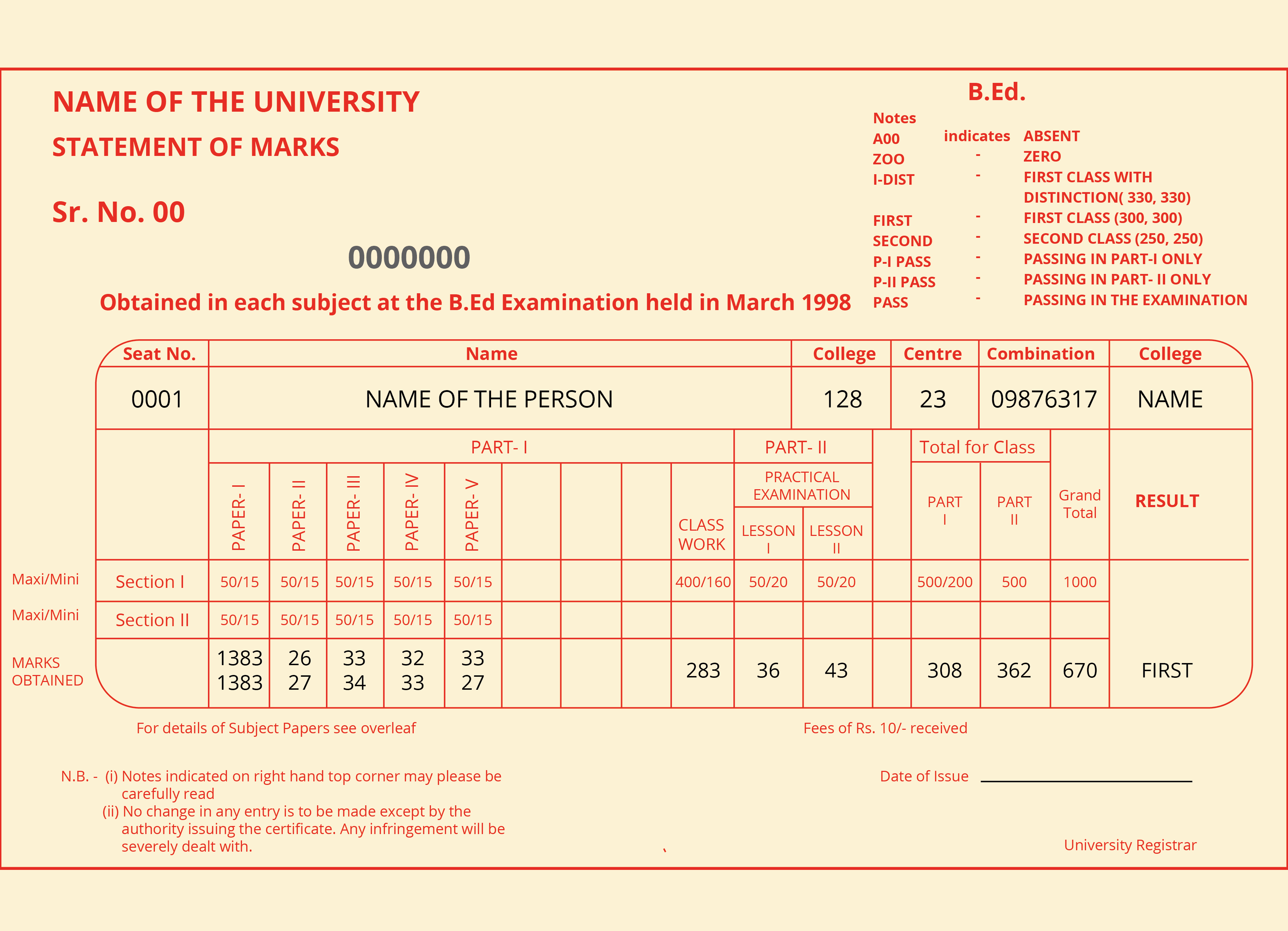
Consolidated Marksheet is a type of academic transcript that compiles all the marks obtained by a student throughout all the semesters. The word ‘consolidated‘ is referred to as the compilation of several elements into a single, more effective or coherent document. This typically contains an integrated list of all the subjects in each semester with their grades and CGPA (Cumulative Grade Point Average) and is given out on completion of the program. It acts as an assurance that the student has completed the degree program by giving the necessary exams and has also attended classes, workshops, or seminars as prescribed in the course structure. It is also used as proof of a candidate passing from a particular educational institute. Here are the details mentioned in a Consolidated Marksheet:
- Yearly academic performance of the student.
- List of subjects, the grades obtained, and CGPA.
- Subject Title, and Paper Number/Code
- Total Credits and Division Obtained
Purpose of a Consolidated Marksheet
The consolidated mark sheet is a critical document for students for many reasons. It performs the following functions given below.
- The consolidated mark sheet serves as proof of completion of the individual university’s course.
- The form may be asked as proof that you finished the preceding course when you enrol for higher education.
- It can also be beneficial while applying for jobs.
- It proves that you finished the course at a specific university.
Consolidated Marksheet Format
A general consolidated mark sheet format consists of the following details:
- Name and Roll No.. of the student.
- Institution name and the program the student is enrolled in.
- Subjects, their codes, and grades obtained.
- Cumulative Grade Point Average.
It is then concluded with the signature of the concerned authority, university stamp, division obtained, issuing date, and the date on which the result was declared.
Consolidated Marksheet of Different Universities
Different universities have different formats of consolidated marksheets. Here are the consolidated mark sheets for all the major universities in India. You can check them below:
Consolidated Marksheet Anna University
Here is the consolidated marksheet offered by the Anna University.

Also Read: How Do I Get IGNOU Migration Certificate?
Madras University Consolidated Mark Sheet
Look at the format of consolidated marksheet that is offered by the University of Madras.
Here is the application form for the Madras University Consolidated Mark sheet:

Bharathiar University Consolidated MarkSheet
Check out the consolidated marksheet of Bharathiar University and understand its format.
Here is the application form for Bharathiar University consolidated mark sheet:
CBSE Consolidated Marksheet
Take a look at the Class 12 Consolidated Marksheet by CBSE:

Application for Consolidated Marksheet
If you haven’t received your consolidated marksheet yet, you need to visit your university’s official website and apply there. Moreover, you can also go to your university/college campus and submit an application for a consolidated mark sheet and get it issued. Here is how you can write the application to get a consolidated mark sheet:
From
Name
Course Name
Batch
Department
University/College Name
To
Head/Controller of Examination
University/College
Address
Subject: Application for Consolidated Marksheet
Sir/Madam,
I have recently completed ________ (Name of the degree/course) from _______ (Name of the university) in ______ (year). Please issue my consolidated mark sheet at the earliest.
Thank you.
Yours Sincerely,
______ (Name)
______ (Date)
______ (Place)
Also Read: What is a Bonafide Certificate?
Types of Consolidated Marksheet
It is crucial for a student to read the admission guidelines of the university or college before submitting any documentation to avoid mistakes that may lead to cancellation. Below are the two types of mark sheets which are generally issued by academic institutions and can be used by students to apply for higher studies:
| University Consolidated Marksheet | Issued on the university letterhead and bears the signature of the Controller or Registrar of Examinations along with the university seal. |
| College Consolidated Marksheet | Issued by the college on college letterhead and bears the signature of the Principal or Registrar of the college along with the college seal. |
Is Consolidated Marksheet the Same as a Consolidated Certificate?
Yes, there is no difference between a consolidated mark sheet and a consolidated certificate. Both record the performance of an individual during the program duration. It contains semester-wise grades of the student along with comments on their performance while attending the classes. Some highlights of the consolidated certificate are:
- Semester-wise performance is recorded throughout the course.
- Details of the candidate’s academic performance
- Can be acquired after course completion
Also Read: What is Gap Certificate: Format, Sample for Neet, Application
Consolidated Marksheet vs Transcript: Key Differences
A lot of students use these two terms like they mean the same thing. They don’t, and this mix-up has caused actual application rejections, so it’s worth getting right.
To differentiate between the two, your consolidated marksheet is issued by your university after you finish your degree. It compiles all your semester results into one document, including subjects, grades, CGPA, and the works. It’s an internal document of your institution.
On the other hand, a transcript is an official academic record sent directly by your university to another institution or organisation. It usually comes sealed, often with a verification mechanism, and is specifically meant for external use, like university applications abroad.
Here is the table that gives you the difference between the Consolidated Marksheet and Transcript in detail:
| Particulars | Consolidated Marksheet | Transcript |
| Issued by | Your college/university | University’s exam/registrar department |
| Purpose | Personal academic record | Official submission to third parties |
| Format | Semester-wise grades compiled | Often chronological academic history |
| Used for | Jobs, domestic PG admissions | Study abroad, visa, credential evaluations |
| Sealed? | Usually not | Yes, in most cases |
How to Calculate CGPA and Percentage from Consolidated Marksheet?
Your consolidated marksheet will show your CGPA, but knowing how to convert it yourself is genuinely useful, especially when filling out applications that ask for percentage. The method to find CGPA to Percentage, most Indian universities follow this formula:
Formula: Percentage = CGPA × 9.5
So if your CGPA is 7.8, your equivalent percentage is 74.1%.
This is the UGC-recommended conversion, though some universities like Mumbai University or VTU have their own multipliers. Always check your university’s official conversion policy, don’t just assume the 9.5 formula applies everywhere.
Calculating CGPA yourself from your marksheet: If your marksheet shows grade points per subject, add them all up and divide by the total number of subjects (or credits, if it’s a credit-based system).
Formula: CGPA = Sum of Grade Points ÷ Total Number of Subjects/Credits
For a credit-based system:
Formula: CGPA = Σ (Credit × Grade Point) ÷ Total Credits
Consolidated Marksheet Processing Timeline: How Long Does It Take?
This is the question nobody thinks to ask until they’re staring at a deadline. The processing time for a consolidated marksheet varies a lot depending on the university. Here’s a rough idea:
| University Type | Typical Processing Time |
| Central universities (DU, JNU, etc.) | 2–4 weeks |
| State universities | 3–6 weeks |
| Autonomous colleges | 1–3 weeks |
| Private universities | 1–2 weeks |
Where and When to Use Consolidated Marksheet?
Knowing when to use this document saves you the embarrassment of submitting the wrong thing at the wrong time.
Use your consolidated marksheet for:
- Domestic postgraduate admissions: Most Indian universities accept it during PG applications before your final degree certificate is issued.
- Job applications in India: HR teams often ask for it during onboarding to verify your academic background.
- Scholarship applications: Many Indian scholarship bodies accept consolidated marksheets as proof of academic performance.
- Visa applications (some countries): Embassies sometimes accept them during the interim period, though they may ask for certified copies.
- Educational loan documentation: Banks require academic proof, and your consolidated marksheet typically qualifies.
FAQs
Ans. It is an official document issued by the educational institute to state the marks received by a candidate in the course duration.
Ans. The graduates need to apply through the official website of the department, concerned with the issue of the consolidated mark sheet. But the process may vary from one university to another.
Ans. Having the details of the subjects studied during the duration of the course or in an academic year, a consolidated mark sheet serves as proof of enrollment of a student in that university.
Ans. It is the same as the mark sheet and both highlight the student’s academic performance throughout the course duration.
Ans. No, not all universities accept them. Some VISA offices also tend to reject these as academic proof.
Ans. First, follow up directly with the exam department; in writing is better, so there’s a record. If your university has a student grievance portal, raise a ticket there. If you’re facing a hard deadline (like a visa appointment or university offer letter deadline), mention that clearly in your request; most offices do try to prioritise urgent cases. Some universities also have a Tatkal/urgent processing option, so ask if that’s available.
Ans. It depends on the country and institution. Some universities in the UK, US, Canada, and Australia now accept digitally verified documents through platforms like Digicerts, DigiLocker, or directly through your university’s verification portal. However, many still require physical sealed transcripts, especially for official admissions and visa processes. Always confirm with the receiving institution before submitting a digital copy.
Ans. Even a small error in your name, roll number, or grades can cause serious issues during credential verification abroad. Contact your university’s exam department immediately with your original documents and written proof of the correct information. Most universities have a formal correction process, though it can take time. If the error is theirs, they should rectify it at no cost. Get the correction in writing and keep a certified copy once it’s fixed.
Related Reads:
We hope that through this blog, you were able to understand what exactly a consolidated mark sheet is and how it is used in the admission and application process across universities and colleges. You may contact our experts at Leverage Edu to know in detail about the other essential documents like SOP or LOR that are needed while applying for a course abroad!


 2,00,000+ students realized their study abroad dream with us. Take the first step today.