

 One app for all your study abroad needs


















Article Summary
- ACT exam syllabus 2026 introduces a shorter format with three mandatory sections: English, Math, and Reading, while Science and Writing are optional; the core exam now has 131 questions, lasts about 125 minutes, and uses only these three sections for composite scoring.
- New ACT exam pattern changes include reduced total questions (from 215 to 131), shorter duration (175 to 125 minutes), and 4 answer choices in Math, with increased time per question and a scoring system averaging English, Math, and Reading only.
- ACT scoring system 2026 calculates the composite score by averaging English, Math, and Reading scores (1–36 scale), excluding Science; section scores remain separate, with Writing scored 2–12, and superscoring combines the best section scores across multiple test attempts.
The ACT exam syllabus for 2026 has been updated, and now it follows a shorter and more student-friendly format than before. The ACT exam mainly tests your English, Math, and Reading skills, while Science and Writing have become optional sections. This means you need to prepare in a smarter way because the scoring and structure are not the same anymore.
However, there are some students who are still studying from outdated materials and do not know about the latest changes, and do not know how to prepare for the new system. If you are one of them, then in this blog, you will understand the full ACT exam syllabus, learn the latest exam pattern, and see what topics you actually need to prepare. So, let’s go!
This Blog Includes:
- A Quick Overview of ACT Exam 2026:
- New Format of ACT Exam 2026: Latest Changes
- ACT Exam Syllabus 2026: Section-Wise Breakdown
- ACT Scoring Pattern 2026
- What Is ACT Superscore?
- ACT Section Weightage & Question Distribution
- ACT Preparation Strategy 2026
- ACT vs SAT: Which Exam Should You Choose?
- ACT Exam Dates for 2026
- FAQs
A Quick Overview of ACT Exam 2026:
The ACT exam syllabus has changed a lot for 2026, and from now on, the main test will include only English, Math, and Reading, while Science and Writing will be optional sections. Here is a quick look at the most important things you should know about the ACT exam.
| Mandatory Sections | English, Mathematics, and Reading |
| Optional Sections | Science and Writing |
| Total Core Questions | 131 Questions |
| Core Exam Duration | Around 125 Minutes |
| Composite Score Basis | Average of English, Math, and Reading |
| Math Answer Choices | 4 Options Per Question |
| Test Format | Computer-Based for International Students |
| Registration Timeline | Usually Closes 4 to 5 Weeks Before Exam Date |
New Format of ACT Exam 2026: Latest Changes
The ACT exam syllabus has changed a lot since 2025, so your strategy will need to change too. So basically, the ACT is now designed to reduce pressure and make the test more focused on core skills. You will spend less time on the exam, but you will need to be more accurate. The structure is simple, but the way scores are calculated has changed, so you need to understand this before you start preparing. Here are the core updates.
- The Science section is now optional, so you can choose whether you want to take it or not.
- The Writing section is still optional, and you only need it for some colleges.
- The main ACT exam now has only three sections, which are English, Math, and Reading.
- The total number of questions is much lower now, so the test feels shorter.
- The composite score is now calculated using only English, Math, and Reading.
- The Science score is separate, and it does not affect your main score anymore.
- The total exam time is reduced, so you will finish the core test faster.
- Math questions now have only 4 answer choices instead of 5, so guessing can be easier.
- You will now get more time per question, so you can focus more on accuracy instead of rushing.
Comparison of Old vs New ACT Exam Format
The focus is now more on understanding and less on speed. You will notice that the time per question has increased, and the Science section is no longer compulsory. This means your preparation can be more focused on the three main sections. Here is a quick comparison.
| Element | Old Format | New Format |
| Core Mandatory Sections | English, Math, Reading, Science | English, Math, Reading |
| Science Status | Mandatory | Optional add-on |
| Total Questions (Core) | 215 Questions | 131 Questions |
| Total Duration (Core) | 175 Minutes | 125 Minutes |
| Math Answer Choices | 5 Choices | 4 Choices |
| Composite Score Basis | Average of 4 Sections | Average of 3 Sections |
| Time Per Question (English) | 36 Seconds | 42 Seconds |
| Time Per Question (Reading) | 52.5 Seconds | 67 Seconds |
ACT Exam Syllabus 2026: Section-Wise Breakdown
The ACT exam syllabus has four main parts, but only three of them are required for most students. These are English, Math, and Reading. Science and Writing are optional, so you can choose them only if your college requires them. Your final composite score also comes from the three main sections only. Let’s understand each section in detail.
ACT English Syllabus
The English part of the ACT exam syllabus checks how well you understand grammar, sentence flow, and writing style. In this section, you will get 50 multiple-choice questions that you need to finish in 35 minutes.
The questions come through five passages, and each passage will ask you to fix or improve parts of the writing. Since English is one of the three main sections, its score directly affects your final ACT composite score.
| Category | Topics Covered | Focus |
| Usage and Mechanics | Punctuation and Grammar | Comma usage, apostrophes, verb tense consistency, pronoun agreement, modifier placement, and comparative/superlative forms |
| Sentence Structure | Sentence Formation Rules | Clause relationships, parallelism, run-on sentences, sentence fragments, and comma splices |
| Rhetorical Skills | Writing Strategy and Flow | Organisation of ideas, tone consistency, logical order, smooth transitions, and effective style choices |
ACT English Preparation Tips
To score well in ACT English, you need to think like an editor. The section checks whether you can spot awkward writing, unnecessary words, and bad sentence flow quickly. Here are some tips.
- If one option is shorter but still sounds complete, it is often the correct answer because ACT likes clear and direct writing.
- Before reading the full sentence, first look at what changes in the answer choices. This will help you understand which grammar rule the question is testing.
- If two answer choices say almost the same thing but only the punctuation is different, both are usually traps.
- If a sentence feels too wordy, the cleaner version is often better because ACT prefers simple writing over dramatic writing.
- When you feel stuck, read the full paragraph instead of just one line because many English questions depend on the overall context.
ACT Math Syllabus
The Math part of the ACT exam syllabus will check how well you can solve math problems quickly and correctly. In the new format, this section has 45 questions, and you will get 50 minutes to finish them.
You can use an approved calculator for the full section, but the ACT does not give you any formula sheet, so you need to remember formulas on your own. Every question now has 4 answer choices instead of 5, which gives you a slightly better chance when you use elimination smartly.
| Category | Topics Covered | Focus |
| Pre-Algebra and Elementary Algebra | Basic Math Foundations | Fractions, decimals, ratios, percentages, linear equations, statistics basics, exponents, and polynomial basics |
| Algebra and Coordinate Geometry | Algebra Problem Solving | Functions, inequalities, systems of equations, rational expressions, coordinate graphs, slope, and intercepts |
| Plane Geometry and Trigonometry | Shape and Angle-Based Math | Angles, lines, triangles, circles, polygons, volume, surface area, and trigonometric ratios |
ACT Math Preparation Tips
ACT Math is all about spotting shortcuts and solving smart before time runs out. Many students know the concepts, but still lose marks because they waste time doing long calculations. So, here are some tips for you.
- Start with option B or C when plugging in answers because middle choices help you eliminate faster if the answer is too high or too low.
- Save your calculator for hard calculations only, because overusing it can actually slow you down more than help you.
- If a question looks too long, check the final sentence first because that usually tells you exactly what you need to solve.
- In geometry questions, draw on the figure yourself if needed because visual marking helps you catch hidden relationships faster.
- If you cannot solve it in 30 to 40 seconds, skip and move on because early questions are usually easier, and you should not waste time there.
ACT Reading Syllabus
The ACT Reading Passages will test how well you can understand written passages and find meaning quickly. In the new format, this section has 36 questions, and you will get 40 minutes to complete them.
According to the latest ACT exam syllabus, you will read four passages, and each one comes from a different category. The main goal here is not just reading fast, but understanding ideas, tone, and hidden meaning inside the text.
| Passage Type | What It Covers | Skills Tested |
| Literary Prose and Fiction | Story-based passages from novels or short writing | Character understanding, tone, theme, and narrative analysis |
| Social Science Passages | Topics like psychology, history, economics, and politics | Argument analysis, evidence finding, and logical reasoning |
| Humanities Passages | Topics related to art, philosophy, and culture | Interpretation, rhetorical analysis, and author viewpoint |
| Natural Science Passages | Science-based informational writing | Scientific reasoning, cause and effect, and contextual understanding |
Reading Question Types
ACT Reading questions test different skills, so you need to know what each question is trying to ask from you. Some will test basic understanding, while others will check deeper reasoning.
| Question Type | What It Means | Focus |
| Main Idea | Finding the central point of the passage | Big picture understanding |
| Inference | Understanding what is suggested but not directly said | Logical thinking |
| Vocabulary in Context | Finding the meaning of a word based on nearby text | Context understanding |
| Tone and Purpose | Understanding the author’s attitude and goal | Author analysis |
| Sequential Reasoning | Understanding event or argument order | Logical flow |
ACT Reading Preparation Tips
ACT Reading is more about strategy than memory. You do not need to understand every word deeply, but you should know how to scan, locate, and answer fast without overthinking. Tips are given below for this.
- Read the question first before the passage, when possible, because it will help your brain know what to search for.
- Circle unique words like names, dates, or terms in the question because they act like clues inside the passage.
- If an answer feels extreme and uses words like always or never, it is usually wrong because ACT prefers balanced wording.
- For main idea questions, check the first and last paragraphs first because they often reveal the core message.
- Never choose an answer just because it sounds smart. If the passage does not prove it clearly, it is wrong.
ACT Science Syllabus (Optional Section)
The Science part of the ACT exam syllabus is no longer compulsory, so take it if your college asks for it or if you are applying for courses like engineering, biology, medicine, or other science-heavy programs.
This section has 40 questions, and you will get 40 minutes to finish it. Even though it is called Science, it does not test deep science theory. It mainly checks how well you can read data, understand experiments, and compare ideas quickly.
| Category | What It Covers | Skills Tested |
| Data Representation | Visual data and charts | Reading graphs, tables, diagrams, and spotting trends |
| Research Summaries | Experiment-based setups | Understanding methods, variables, and outcomes |
| Conflicting Viewpoints | Different scientific opinions | Comparing ideas, finding disagreements, and judging evidence |
Science Content Areas Covered
The ACT Science section uses examples from different science subjects, but you do not need expert-level knowledge for them. You just need to be comfortable seeing basic science terms while reading the questions.
| Subject | Main Topics Covered |
| Biology | Cells, genetics, evolution, ecology, and body systems |
| Chemistry | Reactions, atoms, matter, and chemical properties |
| Physics | Motion, force, energy, heat, and waves |
| Earth and Space Science | Weather, rocks, planets, environment, and geology |
ACT Science Preparation Tips
ACT Science is really more about logic than science facts. You can follow these tips to score better in this section.
- In graph questions, look at the axes first before reading anything else because they tell you what the chart is measuring.
- Skip the long intro paragraph in data questions if it feels useless because many answers come straight from the chart itself.
- In experiment questions, underline what changed and what stayed the same because that helps you spot variables fast.
- In conflicting viewpoint sets, write a one-word summary beside each scientist so you remember their position quickly.
- Always check units carefully because ACT loves trap answers where the number is right but the unit is wrong.
ACT Writing (Essay) Syllabus
The Writing part of the ACT exam syllabus is also optional, and it comes after all the other sections are finished. You should take it only if the colleges you are applying to ask for an ACT essay score.
In this section, you will write one essay in 40 minutes based on a given topic. The test will check how clearly you can build an argument, explain your ideas, and support your opinion in writing.
| Category | What It Covers | Skills Tested |
| Essay Format and Prompt Structure | One essay based on a modern issue | Building an argument using the given perspectives |
| Essay Scoring Criteria | Four scoring areas | Analysis, support, organisation, and writing quality |
Essay Scoring Criteria
Your essay is graded in four areas, and each one will check a different part of your writing. Strong essays do not just have good ideas. They also need structure, logic, and clear language.
| Scoring Area | What It Means |
| Ideas and Analysis | How deeply you understand the topic and build your opinion |
| Development and Support | How well you explain and prove your ideas with examples |
| Organisation | How clearly your essay is structured and connected |
| Language Use | How strong is your grammar, vocabulary, and sentence control |
ACT Writing Preparation Tips
In this, even average arguments can score high if they are organised well and explained clearly. Here are some tips to help you.
- Pick your side quickly and start planning because wasting 10 minutes thinking will hurt your writing time badly.
- Use one paragraph to challenge another perspective because this shows deeper analysis and makes your essay sound smarter.
- Keep your examples realistic, even if made up, because ACT checks logic, not factual accuracy.
- Start each body paragraph with your main point first so the grader instantly knows what you are discussing.
- If your vocabulary is simple but clear, that is better than using difficult words in the wrong way.
Also Read: Average ACT Score for UF: Score Analysis and Tips to Score Better
ACT Scoring Pattern 2026
The ACT exam syllabus has a new scoring system and, since Science is no longer part of the main score, you need to perform strongly in the required sections to get a competitive result. The overall scale still stays the same, so scores will continue to be reported from 1 to 36.
How ACT Composite Score Is Calculated
Your ACT composite score is your main overall score, and this is the number most colleges will look at first. Under the new format, it is calculated by taking the average of your English, Math, and Reading scores only. The Science section is not included in this calculation anymore. After the average is found, the final number is rounded to the nearest whole number.
| Rule | Explanation |
| Composite Formula | English + Math + Reading divided by 3 |
| Science Included? | No, Science is excluded from the composite score |
| Rounding Rule | Final average is rounded to the nearest whole number |
Section Score Breakdown
Apart from your composite score, the ACT also gives separate scores for each section. This will help colleges understand your strengths in different areas instead of seeing only one final number. Optional sections are also scored separately, so they will not change your main ACT score.
| Section Scores | English, Math, and Reading each get a score from 1 to 36 |
| Writing Score | The essay section gets a separate score from 2 to 12 |
| Science Score | Optional Science gets its own separate score from 1 to 36 |
| ELA Score | Combines English, Reading, and Writing performance |
| STEM Score | Combines Math and Science performance |
ACT Score Range
ACT scores can help colleges understand how strong your performance is compared to other students. A higher score usually means better college options and stronger admission chances. Here is the list.
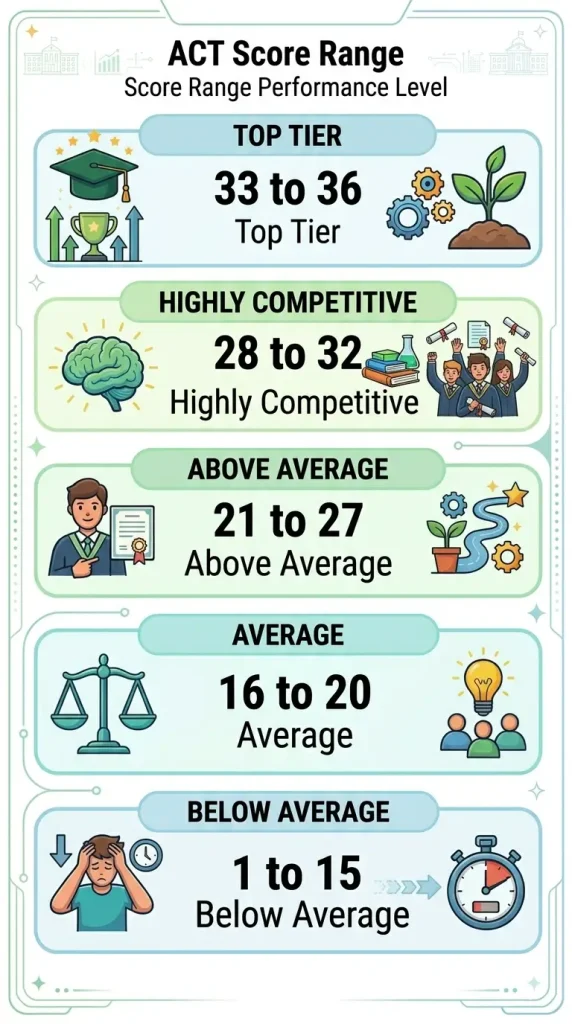
| Score Range | Performance Level |
| 33 to 36 | Top Tier |
| 28 to 32 | Highly Competitive |
| 21 to 27 | Above Average |
| 16 to 20 | Average |
| 1 to 15 | Below Average |
Also Read: Average ACT Score for MIT
What Is ACT Superscore?
ACT superscoring can help you show your best possible score to colleges. Instead of looking at just one test attempt, colleges will use your highest section scores from different ACT attempts and combine them into one stronger score. So, it basically means that one bad day will not ruin your chances if you perform better in later tests. Now, let’s understand how it works.
How ACT Superscore Works
ACT superscore works by picking your best score from each section across multiple test dates. Then those best scores are combined to create a new composite score. This means colleges do not always use your score from just one exam sitting if they accept superscoring. For example, imagine this:
- In Test 1, you scored 28 in English, 32 in Math, and 26 in Reading
- In Test 2, you scored 34 in English, 30 in Math, and 31 in Reading
Then, your superscore will take the best from both tests, which will give you a new average of 32, even though your original single-test scores were lower.
- English: 34
- Math: 32
- Reading: 31
Colleges That Accept ACT Superscore
Many top universities accept ACT superscores because they want to see your best academic performance. Still, not every college follows the same rule, so you should always check the official admissions website before applying because policies can change. Here are the colleges.
- Massachusetts Institute of Technology
- Stanford University
- Johns Hopkins University
- University of Chicago
- Georgia Institute of Technology
ACT Section Weightage & Question Distribution
Before studying the ACT exam syllabus, you should understand how much each section matters and how many questions come from each part. And, since the ACT uses only three core sections for the main score, each one has equal value in your final result. So, knowing the question pattern can help you prepare better.
ACT Section Breakdown Table
Every ACT section has its own time limit, question count, and focus area. Some sections affect your final composite score, while optional ones are scored separately. So before you start preparing, you should know exactly how the full paper is divided.
| Section | Questions | Time | Key Topics | Weight in Composite |
| English | 50 | 35 Minutes | Grammar, sentence flow, punctuation, writing style | 33.3% |
| Mathematics | 45 | 50 Minutes | Algebra, geometry, trigonometry, statistics | 33.3% |
| Reading | 36 | 40 Minutes | Reading comprehension, tone, inference, & passage analysis | 33.3% |
| Science | 40 | 40 Minutes | Data analysis, experiments, & scientific reasoning | Not Included |
| Writing | 1 Essay | 40 Minutes | Argument building and essay writing | Not Included |
English and Math Topic Weightage
Not every topic inside the ACT exam syllabus is equally covered in the paper. Some areas appear much more often than others, especially in English and Math. If you know which topics carry more weight, you can focus more on them and improve your score faster.
| Topic | Approx Weightage |
| English Grammar and Usage | 51% to 55% |
| English Writing and Organisation | 29% to 32% |
| English Language Style | 15% to 19% |
| Math Higher Level Concepts | 52% to 60% |
| Math Essential Skills | 40% to 48% |
| Math Real World Modelling | 25%+ Across Questions |
ACT Preparation Strategy 2026
Preparing for the ACT exam syllabus is all about being smart because each section tests a different skill and requires the best ACT study guide. Since the new ACT is shorter, students can lose more marks from silly mistakes than from running out of time. That is why your preparation should focus on accuracy, timing, and a section-wise strategy together. Here is what you should do.
English Preparation Strategy
You should practice grammar rules every day, but do not just do boring, random exercises. Instead, solve full passage-based questions because that is how the ACT will test you. Always read the full sentence before picking an answer because one small word can change the whole meaning. As you practice, train yourself to quickly spot grammar mistakes, weird wording, and extra phrases that do not need to be there.
Math Preparation Strategy
You should break your math practice into easy, medium, and hard questions so your speed builds naturally over time. Start by learning the formulas early because the ACT will not give you a formula sheet in the exam. Also, try solving questions without a calculator first so your basics get strong. Then use the calculator only when the math gets long or messy.
Reading Preparation Strategy
You need to get comfortable reading quickly while still understanding what the passage is saying. Do not try to remember every single line because that wastes time. Instead, practice going back and finding answers directly from the passage when needed. You should also work on understanding the author’s tone, hidden meaning, and why certain lines were written.
Science Preparation Strategy
For ACT Science, you should spend more time on charts, graphs, and experiment questions than memorising textbook facts. The section is more about reading data than knowing deep science theory. Practice spotting patterns fast, comparing numbers, and understanding what changes in an experiment. If you treat it like a logic puzzle instead of a science class test, it becomes much easier.
Writing Preparation Strategy
You should practice planning your essay before you start writing because that keeps your ideas neat and easy to follow. Build a habit of writing in proper order with an intro, body, and conclusion every time. Also, learn how to explain your points with logic and examples instead of just saying what you feel. Strong structure usually scores better than fancy words.
Also Read: ACT Scholarships for Indian Students: Your Guide to Studying in the USA
ACT vs SAT: Which Exam Should You Choose?
Many students get confused between the SAT and the ACT exam syllabus. The truth is, neither exam is better for everyone. The right choice depends on how you think, how fast you solve questions, and what type of test style feels comfortable to you.
Some students do better in the ACT because it is direct and fast, while others prefer the SAT because it gives a slightly calmer pace. The best exam for you is the one that matches your strengths.
Both exams are accepted by most universities, but they feel very different when you actually sit down and take them. The ACT moves faster and tests more questions in less time, while the SAT gives you fewer questions but often makes them more logic-based. Here is a comparison.
| Factor | ACT | SAT |
| Total Duration | Around 125 Minutes | Around 134 Minutes |
| Total Questions | 131 Questions | 98 Questions |
| Math Structure | 4 Choices, No Formula Sheet | Formula Sheet Provided |
| Calculator Use | Allowed for Full Math Section | Allowed for Full Math Section |
| Science Section | Separate Optional Section | No Separate Science Section |
| Reading Style | Longer Passages | Shorter Paragraph-Based Questions |
| Scoring Scale | 1 to 36 | 400 to 1600 |
| Test Format | Fixed Pattern | Adaptive Format |
ACT Exam Dates for 2026
If you are planning your ACT exam preparation, then choosing the right test date is very important. But you should remember that ACT dates can sometimes change based on testing center availability or official updates. That is why you should always double-check the latest exam schedule before registering. For now, this is the 2026-2027 test dates schedule.
| Test Date | Registration Deadline (Late Fee Applies After This Date) | Late Deadline | Photo Upload & Standby Deadline | Initial Score Release |
| September 19, 2026 | August 14 | September 1 | September 14 | October 6 |
| October 17, 2026 | September 11 | September 29 | October 12 | October 27 |
| December 12, 2026 | November 6 | November 29 | December 7 | December 22 |
| February 27, 2027 | January 22 | February 9 | February 22 | March 16 |
| April 10, 2027 | March 5 | March 23 | April 5 | April 20 |
| June 12, 2027 | May 7 | May 25 | June 7 | June 22 |
| July 10, 2027* | June 4 | June 22 | July 5 | July 20 |
FAQs
The ACT exam has three main sections in its core format: English, Math, and Reading. These three sections are required for every student. You can also choose Science and Writing as optional sections if your college asks for them. Most students only take the optional parts when their target university specifically needs them.
A 75th percentile ACT score is usually around 24. This means you scored better than about 75 percent of students who took the exam. A 24 is considered a solid score for many good universities. It can help you stay competitive for regular admissions.
The ACT is not harder than the SAT, but many students feel it moves much faster. You get less time per question, so speed matters a lot. The SAT gives you a little more time to think through each answer. If you work fast under pressure, the ACT may feel easier for you.
Yes, 2 months can be enough if you study properly and stay consistent. Most students can prepare well by studying for a few hours every week. You should spend time learning concepts first and then practice with mock tests. Good planning matters more than just studying for long hours.
Yes, a 27 is a very good ACT score. It can place you above the average range of most test takers. Many well-ranked universities accept students with this score. It can also help you qualify for some scholarships.
The ACT can feel difficult mainly because it is very time-based. The questions themselves are mostly based on high school topics. What makes it challenging is how fast you need to answer everything. If you practice timing well, the exam becomes much easier to manage.
A 1600 SAT and a 36 ACT are both perfect scores. Colleges treat them as equal in value. One is not better than the other in admissions. Both show top-level academic performance.
Yes, Math is compulsory in the ACT. It is one of the three required core sections of the exam. Your Math score directly affects your final composite score. You cannot skip it if you are taking the ACT.
A good ACT score depends on where you want to apply. In general, anything above 21 is considered decent because that is around the average. If you want to attend top universities, you should aim for 30 or higher. Higher scores always give you stronger chances.
A 35 ACT and 1550 SAT are almost equal in admissions value. Both scores place you among the top students globally. Colleges see both as excellent results. Neither gives a major advantage over the other.
Neither exam is better for everyone because both test different strengths. The ACT is great for students who work quickly and manage time well. The SAT is often better for students who like slower pacing and deeper thinking questions. You should choose the one that matches your style.
Relatable Reads
To do well in the ACT exam, you need more than just subject knowledge. So, you should stop treating every question equally because not all questions deserve the same time. Also, after completing the ACT exam syllabus, you should track your weak topics after every mock test instead of just checking your total score because your mistakes tell you exactly what needs work. Another thing, you should practice in real exam timing because knowing the answer is useless if you cannot find it fast enough on test day.
Keep learning and stay connected with the Test Preparation page on Leverage Edu for more helpful and student-friendly blogs. And if this helped you, don’t forget to share, rate, and drop a comment. Your support helps more students find the good stuff. For personalized guidance, you can also call 080 6901 2014.

 2,00,000+ students realized their study abroad dream with us. Take the first step today.