

 One app for all your study abroad needs

















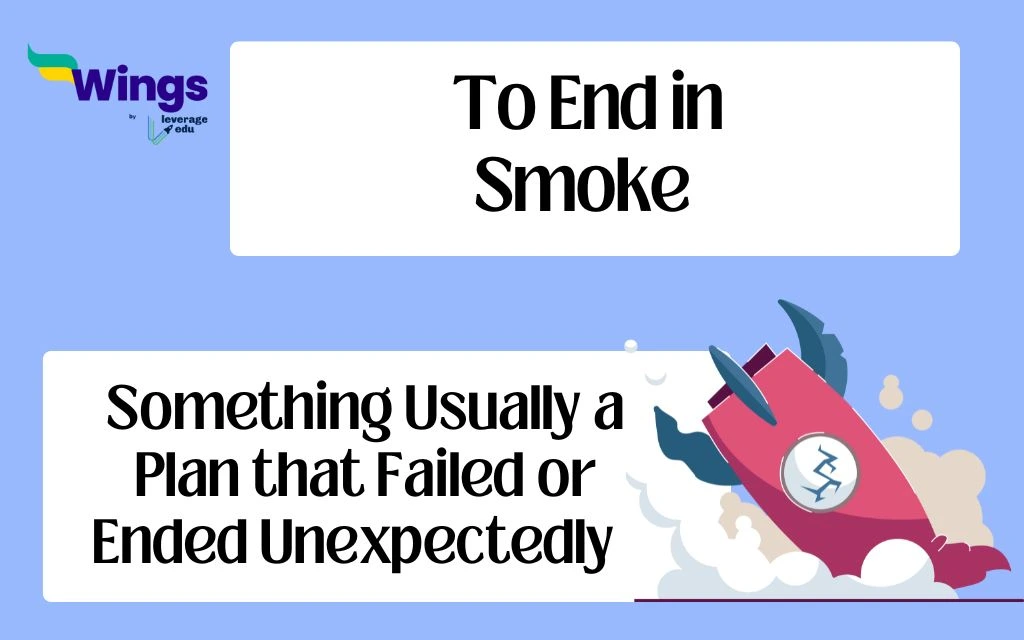
Have you ever worked really hard on something, only to see all your efforts fail in the end? This is exactly what the expression “to end in smoke” describes. In this guide on To End in Smoke Idiom Meaning with Example, you will discover how this popular idiom is used in everyday English, what it truly means, and how you can apply it correctly in your own sentences. Through clear explanations, real-life situations, and a fun quiz, this lesson on To End in Smoke Idiom Meaning with Example will help students understand the phrase easily and use it with confidence in both writing and speaking.
This Blog Includes:
What Does “To End In Smoke Idiom” Mean?
The idiom “to end in smoke” means to fail completely or to come to nothing, even after a lot of effort, planning, or hope has been put into something. In simple words, when a plan, project, or idea ends in smoke, it means that everything falls apart and no successful result is achieved in the end, just like smoke disappears into the air without leaving anything behind.
To End In Smoke Idiom: Usage With Examples
It’s a common expression in English and can be used in casual conversations, formal discussions, and written texts. Here are a few examples of where you might come across this idiom:
- After months of preparation, their grand business venture was to end in smoke when they couldn’t secure the necessary funding.
- His ambitious dreams of becoming a famous actor eventually came to an end in smoke as he struggled to get even minor roles.
- The political negotiations that were expected to bring about peace sadly ended in smoke, leading to further conflict.
Also Read: Cut The Mustard Meaning, Examples, Synonyms
Synonyms for To End In Smoke Idiom
Let us look at the following list synonyms for ‘to end in smoke’ idiom which you will be able to use in the formation of sentence.
- To come to nothing
- To fizzle out
- To fall through
- To be in vain
- To fail miserably
To Smoke In End Idiom Quiz
Instructions: Select the correct answer from the following questions provided below.
Question: What does the idiom “to go up in smoke” primarily mean?
- a) To be physically burned.
- b) To disappear mysteriously.
- c) To fail or come to nothing.
- d) To become very angry.
- Answer: c) To fail or come to nothing.
Question: Which of the following scenarios best illustrates the idiom “to go up in smoke”?
- a) A firefighter extinguishing a house fire.
- b) A carefully planned vacation that is canceled at the last minute.
- c) A person enjoying a cigarette.
- d) A magician’s disappearing act.
- Answer: b) A carefully planned vacation that is canceled at the last minute.
Question: The phrase “to go up in smoke” is often used to describe:
- a) Successful ventures.
- b) Plans that are realized.
- c) Efforts that are wasted.
- d) Events that are predictable.
- Answer: c) Efforts that are wasted.
Question: In the sentence, “All our hopes for the project seemed to go up in smoke,” what does “go up in smoke” suggest?
- a) The project was successful.
- b) The project was destroyed by fire.
- c) The project failed completely.
- d) The project was delayed.
- Answer: c) The project failed completely.
Question: Which of the following is a synonym for “to go up in smoke”?
- a) To flourish.
- b) To succeed.
- c) To come to naught.
- d) To materialize.
- Answer: c) To come to naught.
Question: If someone says, “Their business plans went up in smoke,” they mean:
- a) Their business expanded rapidly.
- b) Their business was destroyed by a fire.
- c) Their business failed.
- d) Their business changed locations.
- Answer: c) Their business failed.
Question: The idiom “to go up in smoke” implies:
- a) A positive outcome.
- b) A neutral result.
- c) A negative outcome.
- d) An uncertain situation.
- Answer: c) A negative outcome.
Question: Which of these sentences uses the idiom “to go up in smoke” correctly?
- a) “The smoke went up the chimney.”
- b) “The plan went up in smoke when the funding was withdrawn.”
- c) “He went up in smoke after the party.”
- d) “The building went up in smoke, and it was beautiful.”
- Answer: b) “The plan went up in smoke when the funding was withdrawn.”
Question: The origin of the phrase relates to the idea of:
- a) the solid becoming gas, and therefore dissapearing.
- b) the action of cooking food.
- c) the action of a strong wind.
- d) the action of building a fire.
- Answer: a) the solid becoming gas, and therefore dissapearing.
Question: Which of the following is the closest meaning to “The teams chances of winning the championship went up in smoke.”
- a) The team won the championship.
- b) The team lost the championship.
- c) The team’s chances were greatly reduced, and likely lost.
- d) The team decided to stop playing.
- Answer: c) The team’s chances were greatly reduced, and likely lost.
Also Read: List of Idioms and Phrases for IELTS
Read more grammatical blogs here!
FAQs
It means that a plan, effort, or project has failed to produce the desired result and has come to nothing. It implies a disappointing or futile outcome.
Yes, they are essentially interchangeable and have the same meaning.
You would use it when you want to express that something has failed or been wasted, especially after a period of effort or expectation.
It’s generally considered an informal idiom, suitable for everyday conversation and writing.
The idiom’s origin is somewhat uncertain, but it likely stems from the idea of smoke dissipating and vanishing, leaving nothing behind. It evokes the image of something substantial disappearing into thin air.
This was all about the To end in smoke idiom meaning and example. Hopefully, you understood the concept where it’s used. For more such blogs, explore the Learn English page of Leverage Edu.

 60,000+ students trusted us with their dreams. Take the first step today!