

 One app for all your study abroad needs














Chartered Accountancy or commonly known as CA, is a professional course that equips one with technical knowledge to manage finance, accounting and taxation for an organization or any business entity. Chartered Accountancy is not just a course but a social responsibility for which individuals are trusted by the public, corporate firms, government authorities and other pillars of the economy. With a reputation of being one of the highest degrees of integrity and professionalism in the country, Chartered Accountants (CA) are considered to be the most prestigious experts in the field of business and finance. Are you willing to take the opportunity to pursue this valuable course? Are you looking for CA subjects that you should master to crack all the levels of this one of the toughest exams in the world? Then here’s a comprehensive guide on Chartered Accountancy and various subjects that are a part of the CA examination curriculum.
This Blog Includes:
- BCA subjects List
- CA Subjects and Syllabus
- CA Final Group 1 Subjects
- CA Final Group 2 Subjects
- Who is a Chartered Accountant?
- How to Become a Chartered Accountant?
- Path to Become a Chartered Accountant?
- CA Selection Process and Structure
- Skills Required to Become a CA
- Why Pursue a Professional Career in CA?
- CA Advancing Studies and Courses
- FAQs
BCA subjects List
The Bachelor of Computer Applications (BCA) is a three-year undergraduate degree program that focuses on computer science and applications. The subjects may vary slightly from one university to another, but generally, the BCA curriculum covers the following subjects:
- Programming Languages (such as C, C++, Java, Python)
- Data Structures
- Database Management Systems
- Computer Networks
- Operating Systems
- Web Technologies (HTML, CSS, JavaScript)
- Software Engineering
- Object-Oriented Programming
- Computer Architecture
- Mathematics for Computing
- Digital Electronics
- System Analysis and Design
- Data Communication and Networking
- Artificial Intelligence
- Mobile Application Development
- Information Security
- Cloud Computing
- Multimedia Systems
- E-commerce
- Project Management
Please note that the exact subjects can vary depending on the university or institution offering the BCA program. It’s always advisable to refer to the specific course curriculum of the institution you are interested in to get accurate and up-to-date information.
CA Subjects and Syllabus
In order to become a successful Chartered Accountant, one needs to combine innovative education with mentored work experience. This helps to develop the ability to analyse and interpret business problems and find out dynamic solutions. Perhaps, this is the reason why a CA has the edge over its counterparts. Here is the complete CA syllabus:
| CA Level | Subjects | Marking Scheme |
| CA Foundation | 1. Principles and Practices of Accounting 2. Business Law & Business Correspondence and Reporting and Reporting 3. Business Mathematics and Logical Reasoning & Statistics 4. Business Economics & Business and Commercial Knowledge | 100 Marks each [400 Marks] |
| CA IPCC | 1. Accounting 2. Business Laws, Ethics and Communication 3. Cost Accounting and Financial Management 4. Taxation 5. Advanced Accounting 6. Auditing and Assurance 7. Enterprise Information System & Strategic Management | 100 Marks each [700 Marks] |
| CA Final | 1. Financial Reporting 2. Strategic Financial Management 3. Advanced Auditing and Professional Ethics 4. Corporate Laws and Economic Laws 5. Strategic Cost Management and Performance Evaluation 6. Electives 7. Direct Tax Laws and International Taxation 8. Indirect Tax Laws | 100 Marks each [800 Marks] |
Below are the important CA subjects and topics covered in each of its examination modules:
CA Foundation or CPT Subjects
Given below is the list of subjects in CA Foundation or CPT:
| Paper Number | Subject Name | Marks |
| Paper 1 | Principles and Practices of Accounting | 100 Marks |
| Paper 2 | Business Law & Business Correspondence and Reporting Part I: Business Law [60 Marks] Part II: Business Correspondence and Reporting [40 Marks] | 100 Marks |
| Paper 3 | Business Mathematics and Logical Reasoning & Statistics Part I: Business Mathematics [40 Marks] Part II: Logical Reasoning [20 Marks] Part III: Statistics [40 Marks] | 100 Marks |
| Paper 4 | Business Economics & Business and Commercial Knowledge Part I: Business Economics [60 Marks] Part II: Business and Commercial Knowledge [40 Marks] | 100 Marks |
CA Intermediate or IPCC Subjects
The table given below covers all the CA subjects for IPCC:
| Paper Number | Subject Name | Marks |
| Paper 1 | Accounting | 100 Marks |
| Paper 2 | Business Laws, Ethics and Communication Part I: Business Laws [60 Marks] Part II: Ethics [20 Marks] Part III: Communication [20 Marks] | 100 Marks |
| Paper 3 | Cost Accounting and Financial Management Part I: Cost Accounting [50 Marks] Part II: Financial Management [50 Marks] | 100 Marks |
| Paper 4 | Taxation Part I: Income Tax Law [50 Marks] Part II: Indirect Tax Laws [50 Marks] | 100 Marks |
| Paper 5 | Advanced Accounting | 100 Marks |
| Paper 6 | Auditing and Assurance | 100 Marks |
| Paper 7 | Enterprise Information System & Strategic Management Part I: Enterprise Information System [50 Marks] Part II: Strategic Management [50 Marks] | 100 Marks |
CA Final Subjects
The CA subjects in the final level of the exam are grouped into 2 categories, namely Group 1 and Group 2. Both of which contain 4 papers each.
| Paper Number | Subject Name | Marks |
| Paper 1 | Financial Reporting | 100 Marks |
| Paper 2 | Strategic Financial Management | 100 Marks |
| Paper 3 | Advanced Auditing and Professional Ethics | 100 Marks |
| Paper 4 | Corporate Laws and Economic Laws Part I: Corporate Laws [70 Marks] Part II: Economic Laws [30 Marks] | 100 Marks |
| Paper 5 | Strategic Cost Management and Performance Evaluation | 100 Marks |
| Paper 6 | Elective [Refer to the table given below] | 100 Marks |
| Paper 7 | Direct Tax Laws and International Taxation Part I: Direct Tax Laws [70 Marks] Part II: International Taxation [30 Marks] | 100 Marks |
| Paper 8 | Indirect Tax Laws Part I: Goods and Services Tax [75 Marks] Part II: Customs and FTP [25 Marks] | 100 Marks |
| Paper 6A: Risk Management | Paper 6C: International Taxation | Paper 6E: Global Financial Reporting Standards |
| Paper 6B: Financial Services and Capital Markets | Paper 6D: Economic Laws | Paper 6F: Multidisciplinary Case Study |
CA Final Group 1 Subjects
- Financial Reporting
- Strategic Financial Management
- Advanced Auditing and Professional Ethics
- Corporate and Allied Laws
CA Final Group 2 Subjects
- Advanced Management Accounting
- Information Systems Control and Audit
- Direct Tax Laws
- Indirect Tax Laws
Who is a Chartered Accountant?
A designation of Chartered Accountant is worldwide referred to as a professional accountant or Certified Public Accountant (CPA). This qualification opens the door to a vast range of exciting career opportunities in the sphere of business and finance. These professionals can wear a number of hats but the specialization and the CA subjects they choose determines under which umbrella they will work. There are typically 4 areas in which professional accountants serve:
- Taxation
- Applied Finance
- Financial Accounting and Reporting
- Management Accounting
How to Become a Chartered Accountant?
ICAI conducts the CA exams list in India consisting of 3 names – CA Foundation, IPCC and CA Final. Candidates need to clear the entire CA exam list in order to become a professional in this field.
If you wish to pursue Chartered Accountancy in India, then, you will have to register under the CA course offered by ICAI. CA course in India consists of three levels:
- CA Foundation
- CA IPCC
- CA Final
ICAI organises CA exams twice a year that is in the months of May and November. The duration for becoming a CA in India is 4 to 5 years long which includes a mandatory period of Articleship. ICAI allows candidates to pursue a CA course after completion of class 12th as well as after graduation only if the candidate has pursued a relevant course. Recently, it has also been announced that candidates can register for the chartered accountant’s course after completing class 10th.
These exams are conducted twice a year, check out the diagram given below for a better understanding:
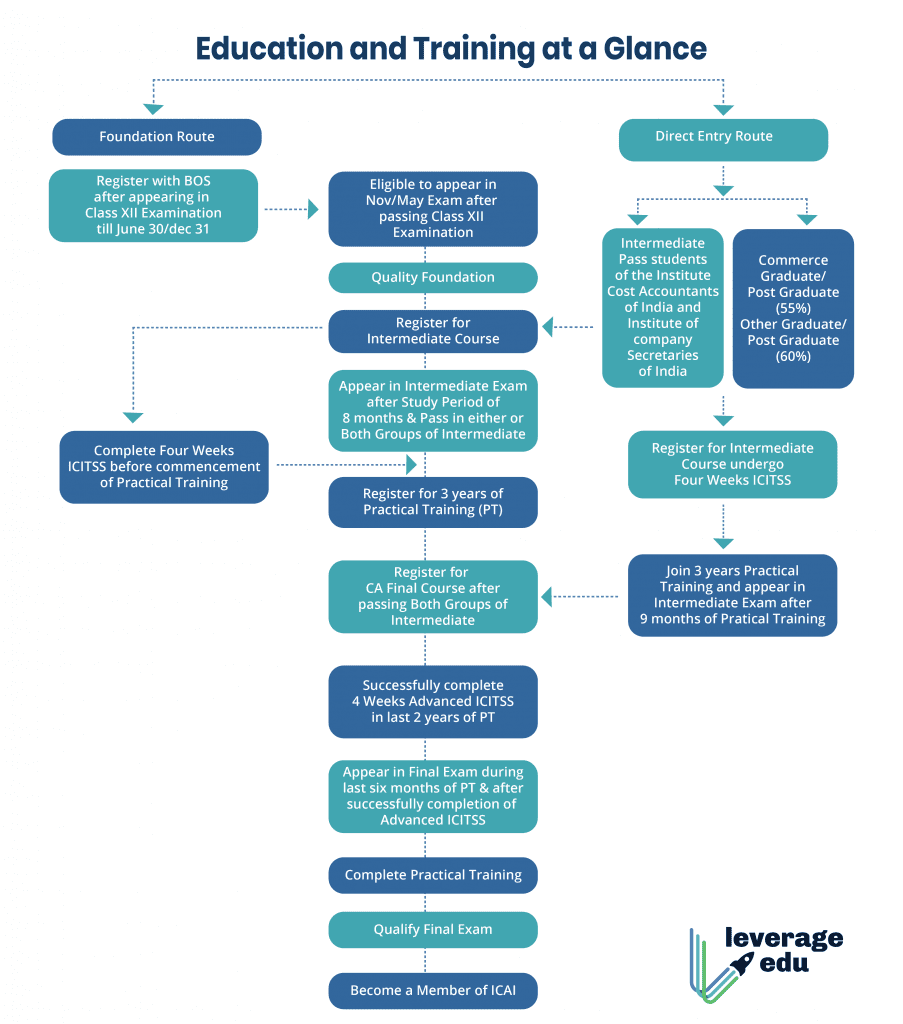
Path to Become a Chartered Accountant?
Now that you are familiarised with the eligibility of the CA course, we have detailed a complete guide on how to become a Chartered Accountant in the following sections:
Choose a Career Path
There are different paths available for those aspiring for a career in Chartered Accountancy. This field constitutes of various job roles such as a Chartered Accountant, Chartered Management Accountant, Chartered Accountant (Audit), Chartered Certified Accountant, Public Accountant, Business Accountant, Finance Manager, etc. These career paths vary according to the professional training and knowledge an individual has gained. To explore these opportunities, you can choose from numerous quality education programs offered around the world in the field of Finance and Accountancy.
Register for CPT
A Common Proficiency Test authorized by the Institute of Chartered Accountants of India is the primary level exam of Chartered Accountancy. Clearing this test, you will become eligible to appear for the second-level entrance exam which is integral for becoming a CA.
Register for IPCC
Candidates who have successfully passed the CPT exam can apply for the next level Integrated Professional Competence Course. IPCC comprises a total of 7 exams in the form of groups (Group 1+ Group 2). Candidates are required to qualify for a minimum of one group in order to proceed to the following level.
ITT and Orientation
The information Technology Training and Orientation program is compulsory for candidates aspiring to become a CA. The program introduces you to the essential skills and knowledge of the Accounting industry. The only major concern regarding the ITT and orientation is their registration process. Hence, it becomes important to apply for the ITT and orientation program prior to registering for the Articleship.
Registering for Articleship
Articleship is a critical part of the procedure of how to become a Chartered Accountant because it equips students with vital exposure to the Accounting industry. Those aspiring to work as CA are required to register for article assistance for a period of 3 years with any practising chartered accountant. To begin with, individuals can start working in financial and accounting firms which will provide them with a real-time experience of handling clients and executing financial programs. By gaining proper professional experience, you will be deemed qualified for the final CA exam.
Qualify for CA Final Course
Candidates are required to appear for the CA final examination during the last six months of their article training period. This is the last step of the process of becoming a CA after which you can step into the industry to gain further experience.
Get Additional Professional Experience
Completing just a CA course or graduation degree is not enough. Today, top recruiters and business firms look for professionals with specialised knowledge and skills. You need to take a specialisation to discover career prospects in your chosen field of interest. You can choose from a wide range of Finance courses offered around the globe and opt for a specialisation that fits your preferences and interests.
CA Selection Process and Structure
Here are the important details which you should know about how to become a Chartered Accountant along with some important CA subjects:
- The students should register with the recognized authority governing CA programs like ICAI.
- They need to qualify for 3 modules of the course: CA Foundation Exam, Intermediate Course (2 groups) and CA Final which consists of numerous CA subjects.
- After you have cleared the first level i.e., the CA Foundation Exam and the first group of the Intermediate Course, you are eligible to begin your articles under a CA firm or a practising CA.
- Till the time you complete 3 years of practical training, your CA Final is due which you must clear.
- Other than this, you have to complete computer-related training and an Orientation Course (OC) to improve your information technology and for soft skill development.
- Once everything is complete, students will attain their professional CA degree.
Note: If you are wondering about how to pursue CA after Graduation then the undergraduate degree holders can skip the CA Foundation exam and enrol directly with the ICAI for the Intermediate Course.
Skills Required to Become a CA
Now that you are familiar with what is the full form of CA along with a basic understanding of the journey of the course, let us take a quick look at what are the important skills that one must have to become a CA-
- Deliverance and determination
- A knack for numbers
- Conceptual understanding
- Analytical skills
- Ability to handle manifold tasks under pressure
Why Pursue a Professional Career in CA?
Chartered Accountants are recognized for their professional standards, technical competence and veracity. There is a constant demand for these professionals all around the world, because of tremendous growth in the business and finance sector.
The Chartered Difference
You do not need prior work experience to pursue a course in CA. However, you get an opportunity to undergo articleship and training while pursuing the course. And the latter part is important to get a license to professionally work as a CA.
Recognized Qualification
A professional qualification in Chartered Accountancy has true global mobility with its education and crucially the training recognized internationally.
Exam Success
The chartered accountant has an increasing career opportunity due to its global recognition as one of the highest-respected positions. After successfully clearing all the stages in the CA examination along with subsequent training, there are ample well-paying jobs for individuals in any of the top business and finance companies.
The Flexibility of the Study Programme
If you’re planning to enrol for a chartered accountant course, you must know that CA is a full-fledged professional degree offered by a recognized institute governing the CA program in a specific country. However, there is no compulsion to attend classes regularly which opens up the feasibility for students to study various CA subjects at their own pace.
CA Advancing Studies and Courses
Undoubtedly, you gain almost everything you wished for in your life after becoming a chartered accountant. But the knowledge acquired through CA subjects when combined with some other courses can give an edge over the other roles in an organization:
- Chartered Financial Analyst (CFA course)
- Certified Financial Planner (CFP)
- Financial Risk Manager (FRM)
- Company Secretary (CS)
- Cost and Work Accountants (CWA)
- MBA in Finance
- Actuarial Science
- LLB
Also Read: How to Become a Company Secretary?
FAQs
There are 3 CA exams which are CA Foundation, CA Intermediate and CA Final. A student can become a Chartered Accountant after they clear all these levels of CA exams.
All those who have completed 2.5 years of articles and have cleared the previous levels are eligible. Further, if the applicant has never appeared for the old scheme and is planning to do it for the new scheme then it is mandatory to complete AICITSS.
Advanced Integrated Course on Information Technology and Soft Skills or AICITSS consist of management skills and IT course which has been introduced in the new scheme and is in existence since 2017.
Yes. It is sent to the qualifying as well as non-qualifying candidates. Those who applied but didn’t appear for any of the CA subjects will not receive it.
The final exam of CA includes eight papers and 2 groups. Each paper is of 100 marks.
No. Pursuing BCom is not a mandatory requirement. One can start with the course on completion of class 12th.
If you’re considering becoming a Chartered Accountant, you should be familiar with all the CA subjects covered in various stages of the CA examination. Take this opportunity to reach out to our experts at Leverage Edu to find out more about the entry routes, in order to build an exciting career path towards the industry of your choice, anywhere in the world. Call us immediately at 1800 57 2000 for a free 30-minute counselling session.


 60,000+ students trusted us with their dreams. Take the first step today!
14 comments
Well done 👍
Thank you!
பயனளிக்கும் வகையில் உள்ளது நன்றி
CA பாடங்களில் எங்கள் வலைப்பதிவை நீங்கள் விரும்பினீர்கள் என்பதை அறிந்து நாங்கள் மகிழ்ச்சியடைகிறோம்! அமெரிக்கா, இங்கிலாந்து மற்றும் கனடா போன்ற நாடுகள் சிறந்த படிப்புகள், வேலைகள் மற்றும் CA நிபுணர்களுக்கு வெளிப்பாடு வழங்குகின்றன என்பது உங்களுக்குத் தெரியுமா? நீங்கள் வெளிநாட்டில் CA படிப்புகள் மற்றும் தொழில் வாழ்க்கையை ஆராய விரும்பினால், எங்கள் நிபுணர்களை 1800 57 2000 என்ற எண்ணில் அழைக்கவும்.
மேலும் அறிய இந்த வலைப்பதிவுகளைப் பாருங்கள்:
https://leverageedu.com/blog/how-to-become-a-chartered-accountant/
https://leverageedu.com/blog/ca-course/
Super
Tanq for ur guiding about CA course
Thank you for the comment!
Sir /man I am a bcom graduate percentage I Score 57.85percent as aggregate and my age is about 41 years. Can I join the direct entry scheme of ipcc.it is my dream to become a chattered accountant but till I can’t do it for my different reasons of family life. If I try to the best of my mind I believe it is possible. GIVE ME DETAILS ABOUT YOUR COACHING CLASSES AND IT’S FEES IF POSSIBLE. THANKS IN ADVANCE.
Thank you for sharing a useful knowledge regarding CA. Could u please share the content regarding ACCA in same manner.
Hi Lipakshi!
Please check out this blog- https://leverageedu.com/blog/acca-exams/
The information U provided here is realy very useful for starters it gives an idea about what we want to do and how to move on
Thank you Pooja, for sharing your feedback!
Can I pursue CA course along with my regular collage?
This was so good and informative 👏🏻😌