

 One app for all your study abroad needs


















Article Summary
- LLM programs in Canada cost CAD 9,500–54,040 per year (INR 6–32.4 lakh), with the University of Toronto being the most expensive at CAD 54,040 and the University of Montreal the most affordable at CAD 23,997 — all as 1–2 year programs that include a 3-year PGWP, making Canada significantly more cost-effective than the USA while offering clearer PR pathways than the UK.
- Indian lawyers need an LLB or JD with 65–70% marks and IELTS 7.0–7.5 to apply, and can use NCA-aligned LLM programs at universities like University of Toronto, Osgoode Hall, UBC, and University of Ottawa to satisfy NCA subject requirements — a crucial step toward practicing law in Canada that takes 2–3 years, including NCA exams, Bar exams, and articling training.
- LLM graduates in Canada earn CAD 85,000–125,000 annually, with Corporate Counsel roles at TD Bank, Amazon Canada, and Shopify reaching CAD 113,000–158,000 — with PR accessible through Express Entry and Provincial Nominee Programs after completing the 3-year PGWP work period, making Canada the most balanced option for Indian lawyers compared to the UK’s limited post-study stay or the USA’s H-1B lottery dependency.
A master’s in Law in Canada is a 1 to 2-year LLM program that can give an NCA pathway for Indian lawyers, along with better job and PR opportunities. You can study at top universities like the University of Toronto and McGill University. Fees for the LLM program in Canada range between CAD 9,500 and 47,000 per year. But you will need an LLB or JD degree with a minimum of 65-70% marks and IELTS 7.0 or higher to apply.
This degree will help you enter fields like corporate law, tech law, and international law, and you can also move toward the Canadian Bar through NCA if you plan it right. In this blog, you will learn everything about master’s in Law in Canada, colleges, fees, eligibility, scholarships, and career scope. You can use it to compare options, understand costs, and plan your next step.
This Blog Includes:
- Master’s in Law in Canada: Quick Overview
- Why Study a Master’s in Law in Canada?
- Top Universities for Master’s in Law in Canada
- Types of Master’s in Law in Canada
- Best LLM Specializations for Master’s in Law in Canada
- Eligibility Requirements for Master’s in Law in Canada
- Admission Process for Master’s in Law in Canada
- Cost of Studying a Master’s in Law in Canada
- Scholarships for Master’s in Law in Canada
- NCA Accreditation for Master’s in Law in Canada
- Career Opportunities After a Master’s in Law in Canada
- PR Pathway After Master’s in Law in Canada
- Canada vs UK vs USA for LLM
- FAQs
Master’s in Law in Canada: Quick Overview
A master’s in Law in Canada is a 1 to 2-year program that can help you move toward Canadian legal practice. You can choose top universities like Toronto or McGill for better career outcomes. Tuition will vary based on the university, but it stays within a wide range. After studying, you can also get a work permit and apply for PR. Here is a quick overview.
| Course Name | Master’s in Law in Canada (LLM) |
| Program Duration | 1 to 2 years |
| Average Tuition Fees | CAD 9,500 to 47,000 |
| Eligibility | LLB or JD with around 65% and IELTS 7.0+ |
| Top Specializations | Corporate Law, Tech Law, International Law |
| Post Study Work Permit | Up to 3 years (PGWP) |
| Average Salary | CAD 85,000 to 125,000 |
| PR Pathway | Express Entry and Provincial Nominee Programs |
Why Study a Master’s in Law in Canada?
A master’s in Law in Canada will help you build a legal career in Canada with job and PR opportunities. Here are some popular reasons why you should pursue your law studies in Canada.
- You can use LLM to complete the NCA pathway and practise law in Canada
- You can get up to 3 years of PGWP after your course
- You will see high demand for legal jobs, especially in corporate and tech law
- You will live in a safe and multicultural country with a strong Indian community
Top Universities for Master’s in Law in Canada
For a Master’s in Law in Canada, you will find top universities like Toronto, UBC, and McGill. Most courses will finish in 1 year, but some research options can take longer. Fees can range a lot, so you need to compare costs with specialization and ranking. Here is a list of top universities and fees in Canada.
| University Name | QS Ranking 2026 | Course Name | Duration | Average Annual Fees (CAD) | Average Annual Fees (INR) |
| University of Toronto | #29 | Master of Laws (LLM) | 1 Year | CAD 54,040 | INR 32.4 lakhs |
| McGill University | #27 | Master of Laws (LLM) | 1 Year | CAD 46,904 | INR 28.1 lakhs |
| University of British Columbia | #40 | Master of Laws (LLM) | 1-2 Years | CAD 45,054 | INR 27 lakhs |
| University of Ottawa | #219 | LLM (Course-based) | 1 Year | CAD 30,000 | INR 18 lakhs |
| York University | #333 | Research LLM | 1 Year | CAD 52,972 | INR 31.7 lakhs |
| University of Montreal | #168 | Master of Laws (LLM) | 1 Year | CAD 23,997 | INR 14.3 lakhs |
Disclaimer: The CAD to INR conversion in this blog is based on current market rates as of April 2026. Currency rates are subject to change, so check the latest exchange rates before making any financial decisions.
Types of Master’s in Law in Canada
A master’s in Law in Canada has four options. LLM generally is for law graduates who want broad legal knowledge and the NCA pathway. LLM specialized is for law graduates who want a single niche, such as business or tech law.
On the other hand, an MA in Law is for non-law students seeking research or policy roles, and an MSL is for professionals who need practical legal knowledge for business. Here is more detail on these four.
| Program Type | Who Can Apply | Core Focus | Duration | Career Options |
| LLM (General) | LLB/JD | Broad law, Canadian legal system | 1 Year | Legal Consultant, Academic |
| LLM (Specialized) | LLB/JD | Niche law, Business, Tax, IP | 1 Year | Specialist Lawyer, Corporate Counsel |
| MA in Law | Non-law | Law + policy + research | 1-2 Years | Policy Analyst, Research |
| MSL (Master of Studies in Law) | Non-law | Practical legal knowledge | 1 Year | Compliance, HR, Management |
Best LLM Specializations for Master’s in Law in Canada
There are a lot of high-demand specializations for master’s in Law in Canada, like corporate, international, IP, criminal, tech, etc. So, you should pick one that fits the market needs and your interests. Here is a list of popular ones.
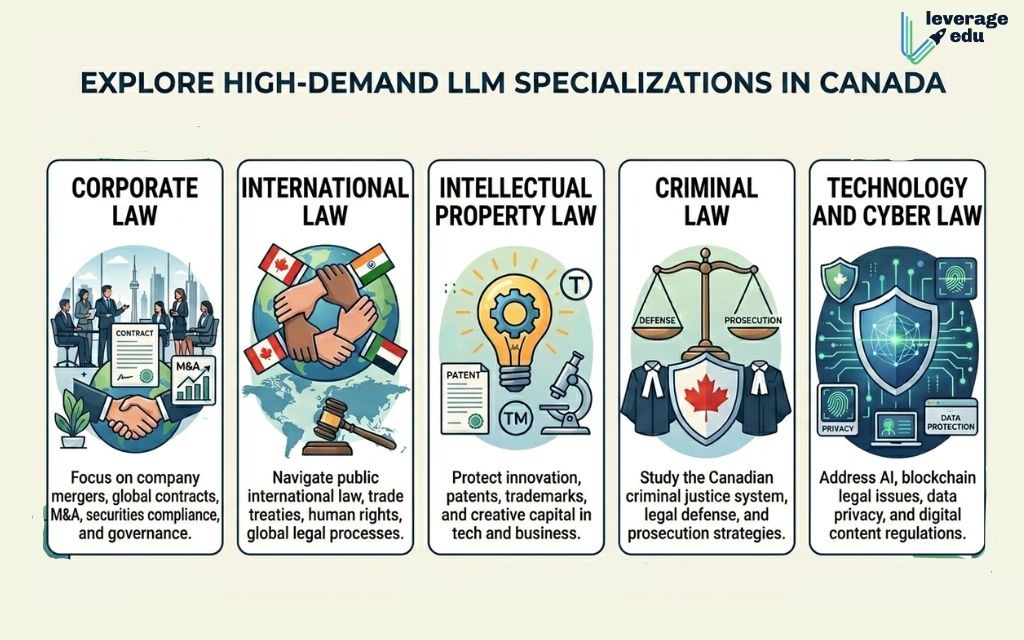
| Specialization | Topics Covered |
| Corporate Law | Mergers and acquisitions, corporate governance, securities law, financial contracts, competition law |
| International Law | Public international law, human rights, global trade law, treaties, and dispute resolution |
| Intellectual Property Law | Patent law, copyright, trademarks, licensing, and biotechnology law |
| Criminal Law | Criminal procedure, evidence law, sentencing, youth justice, white-collar crime |
| Technology and Cyber Law | AI regulation, privacy law, cybersecurity, data protection, digital ethics |
Eligibility Requirements for Master’s in Law in Canada
To apply for a master’s in Law in Canada, you need a law degree, good marks, and valid English scores. Universities will check your academics, test scores, and documents before giving admission. Here is a complete list of requirements.
Academic Requirements
You need a proper law degree to apply for LLM programs in Canada. Universities will check your marks and your previous subjects. Good scores will help you get into better universities. You need to keep these in mind.
- You need an LLB or JD from a recognised university
- Must have around 60 to 70% or a first class
- You need around a 3.0 GPA on a 4.0 scale
Language Requirements
You need to show good English skills because the law requires proper reading and writing. Most universities ask for high scores in IELTS or TOEFL. Your score should be recent (at least 2 years) and valid at the time of application.
Work Experience
Work experience is not always required for a master’s in Law in Canada, but it can help your profile. General LLM programs usually accept fresh graduates, while some professional programs may ask for one to two years of experience. Internships and legal training can also add value and improve your chances of admission.
Documents Required
You need to submit documents for both university admission and a Canada student visa. Here is a complete list of required documents.
- Statement of Purpose (SOP)
- Letters of Recommendation (LOR)
- Resume or CV
- Academic transcripts
- Valid passport
- Degree certificate
- English test score
- Offer letter from the university
- Proof of funds
- Medical report
- Police clearance certificate
Also Read: Study in Canada Without IELTS for International Students
Admission Process for Master’s in Law in Canada
The admission process for a master’s in Law in Canada is simple, but early application is important because seats are limited and deadlines close fast. Universities will review your full profile before giving admission, so you need to do this carefully. Here is how the process looks.
- Shortlist universities and apply online on their official portals
- Upload documents like SOP, LOR, and academic transcripts
- Send English test scores directly through the test agency
- Receive the offer letter after selection by the university
- Apply for a study visa after getting the offer letter
Cost of Studying a Master’s in Law in Canada
The cost of a master’s in Law in Canada includes tuition fees and living expenses. Fees will change based on the university type and the city you choose. Big cities will cost more for rent and daily life. So you need to plan your budget before applying. Let’s discuss the detailed cost of studying in Canada.
Tuition Fees
Tuition fees depend on whether you choose a public or private university. Public universities are usually cheaper than private ones. Professional LLM programs can cost more because they focus on career outcomes.
| University Type | Average Annual Cost (CAD) | Average Annual Cost (INR) |
| Public University | CAD 15,000 to 54,040 | INR 9.0 to 32.4 lakhs |
| Private University | CAD 25,000 to 45,000 | INR 15.0 to 27.0 lakhs |
Living Costs
Living costs include rent, food, transport, and basic daily expenses. The government also asks you to show a minimum of funds for a visa. Actual cost will depend on the city and lifestyle. Here is a city-wise cost list.
| City | Average Annual Cost (CAD) | Average Annual Cost (INR) |
| Toronto | CAD 27,600 to 34,500 | INR 16.6 to 20.7 lakhs |
| Vancouver | CAD 26,400 to 33,200 | INR 15.8 to 19.9 lakhs |
| Ottawa | CAD 19,800 to 24,500 | INR 11.9 to 14.7 lakhs |
| Montreal | CAD 17,200 to 22,100 | INR 10.3 to 13.3 lakhs |
| Calgary | CAD 17,100 to 21,800 | INR 10.3 to 13.1 lakhs |
Also Read: List of Student Discounts in Canada for International Students in 2025-26
Scholarships for Master’s in Law in Canada
A master’s in Law in Canada comes with many scholarships that can reduce your tuition cost. You can get funding based on merit, research, or university selection. Some scholarships are automatic, and some require an application. These awards will help you manage fees and living costs in Canada. Here is a list of popular Canada scholarships for Indian students.
| Scholarship Name | Scholarship Type | Amount and Benefit | Eligibility | Official Website |
| Ontario Graduate Scholarship (OGS) | Provincial | CAD 10,000 to 15,000 per year | Master’s students in Ontario, including international students | https://www.sgs.utoronto.ca/awards/ontario-graduate-scholarship/ |
| UBC International Tuition Award | University | Up to CAD 3,200 per year | Research-based LLM students at UBC | https://www.grad.ubc.ca/awards/international-tuition-award |
| McCall MacBain Scholarship | University | Full tuition plus CAD 2,000 monthly stipend | High merit students at McGill | https://mccallmacbainscholars.org/apply? |
| CELF Graduate Scholarship | Private | Up to CAD 10,000 | Students in Canadian Energy Law research | https://www.energylawfoundation.ca/scholarship-program/ |
| Osgoode Entrance Awards | University | CAD 1,000 to 45,000 | Strong academic LLM applicants at York University | https://www.osgoode.yorku.ca/programs/juris-doctor/access-and-support/financial-services/funding-sources/scholarships-awards-and-prizes/entrance-scholarships-awards/ |
| CGRS Doctoral (CGRS-D) | Government | CAD 40,000 per year | Doctoral law research students in Canada | https://nserc-crsng.canada.ca/en/funding-opportunity/canada-graduate-research-scholarship-doctoral-program |
NCA Accreditation for Master’s in Law in Canada
NCA is the body that checks if your foreign law degree matches Canadian standards so you can practise law. If you do a master’s in Law in Canada, you can use it to complete NCA subjects and move closer to getting a licence. This matters because without NCA approval, you cannot become a lawyer in Canada. The process is simple: you submit your degree, get the required subjects, and complete them through exams or LLM courses. After that, you get a certificate and can apply for the bar exams. Here is a list of universities offering NCA-Aligned programs.
- University of Toronto
- York University (Osgoode Hall)
- University of British Columbia
- University of Ottawa
- University of Manitoba
- Queen’s University
Career Opportunities After a Master’s in Law in Canada
A master’s in Law in Canada will open doors to high-paying legal and corporate jobs. You can work in law firms, banks, tech companies, or government offices. Here is a list of high-paying roles in law, average salary in Canada & top job opportunities, and top recruiters.
| Job Role | Average Annual Salary (CAD) | Average Annual Salary (INR) | Top Recruiters |
| Associate Lawyer | CAD 94,375 to 126,500 | INR 56.6 to 75.9 lakhs | Blake, Cassels & Graydon LLP, Stikeman Elliott, Fasken |
| Corporate Counsel | CAD 113,000 to 158,000 | INR 67.8 to 94.8 lakhs | TD Bank, RBC, Deloitte, Amazon Canada, Shopify |
| Legal Consultant | CAD 88,778 to 138,593 | INR 53.3 to 83.2 lakhs | PwC, KPMG, Life After Law, Robert Walters |
| Compliance Officer | CAD 83,300 to 126,000 | INR 50.0 to 75.6 lakhs | Scotiabank, Sun Life Financial, BMO Financial Group |
| IP Lawyer / Specialist | CAD 98,000 to 147,000 | INR 58.8 to 88.2 lakhs | Smart & Biggar, Gowling WLG, Norton Rose Fulbright |
Also Read: How To Study and Work in Canada?
PR Pathway After Master’s in Law in Canada
A master’s in Law in Canada will allow you to work part-time jobs in Canada during studies for up to 24 hours per week, and you can earn around CAD 16 to CAD 18 per hour. During holidays, you can work full-time without limits.
And, after graduation, you can get a Post-Graduation Work Permit for up to 3 years. This work experience will help you apply for PR through Express Entry or PNP routes. Here are the popular pathways.
| Pathway | Duration or Validity | Details |
| Post-Graduation Work Permit (PGWP) | Up to 3 years | You can work full-time in Canada after graduation. You must complete a program from a valid DLI and meet language rules. |
| Express Entry System | 6 to 12 months | You can apply for PR based on points like education, work experience, and language score. Canadian work experience will increase your points. |
| Provincial Nominee Programs (PNP) | Varies by province | Provinces can select you if you have studied or worked locally. It gives faster PR chances in high-demand fields. |
Also Read: How Do I Apply for a Canada Study Permit Extension in 2025?
Canada vs UK vs USA for LLM
A master’s in Law in Canada can give you a balanced option with lower cost than the USA and better long-term settlement chances. You also get a 3-year work permit after study, which is not available in the UK or the USA. The UK is faster but gives limited stay options after study. The USA pays more but has high fees and a tough visa lottery system, so it is less stable for most students. Here is a complete comparison between the UK vs Canada vs USA.
| Country | Duration | Average Annual Fees | Average Annual Salary | PR Difficulty |
| Canada | 12 to 24 Months | INR 14.4 to 32.4 lakhs | INR 51.0 to 101.4 lakhs | Moderate, clear PR routes through Express Entry and PNP |
| UK | 12 Months | INR 20.9 to 47.1 lakhs | INR 41.5 to 91.6 lakhs | High, limited stay after study and no direct PR path |
| USA | 9 to 12 Months | INR 29.4 to 68.9 lakhs | INR 113.9 to 193.3 lakhs | Very High, depends on H-1B lottery and visa approval |
FAQs
A master’s in Law in Canada usually takes 1 year if you choose a course-based program. Some research-based programs can take up to 2 years. Most students finish it in around 12 to 16 months, depending on the university and structure.
An LLM in Canada costs between CAD 9,500 and CAD 47,000 per year. Top universities like Toronto or McGill are more expensive. For Indian students, this comes to around INR 6.0 lakhs to INR 32.4 lakhs per year.
You need an LLB or JD degree from a recognised university. Most universities ask for around 65-70% or a 3.0 GPA. You also need IELTS 7.0 or higher for English proof.
Yes, it is valid in India for jobs in companies, universities, and policy roles. But you cannot directly practice in Indian courts with only an LLM. You still need Bar Council registration for litigation.
Yes, lawyers in Canada earn high salaries. Fresh lawyers usually earn around CAD 85,000 to CAD 125,000 yearly. Senior lawyers and corporate counsel can earn much more with experience.
Yes, you can stay using a Post-Graduation Work Permit for up to 3 years. This lets you work full-time in Canada. Many students use this time to apply for PR.
It usually takes 2 to 3 years after your LLM. You need to clear the NCA exams and then pass the Bar exam. After that, you complete articling training before full licensing.
An LLM is better if you already have an LLB from India. JD is for students who are starting law from scratch. LLM is shorter and more focused on specialisation.
Relatable Reads
A master’s in Law in Canada will open many doors if you plan it smartly and early. Also, you should think beyond just studying. You should plan your career steps from day one, like how you will get Canadian work experience and how you will move toward PR. This small planning habit will help you avoid confusion later and keep your path smooth in Canada.
Keep learning and stay connected with the Study Abroad page on Leverage Edu for more helpful and student-friendly blogs. And if this helped you, don’t forget to share, rate, and drop a comment. Your support helps more students find the good stuff. For personalized guidance, you can also call 080 6901 2014.

 2,00,000+ students realized their study abroad dream with us. Take the first step today.