

 One app for all your study abroad needs

















Article Summary
- MBBS in Nepal for Indian students offers a 5.5-year course with a curriculum similar to India, English-medium instruction, and recognition by NMC and WHO, making it a practical alternative when Indian medical seats are limited.
- Admission for MBBS in Nepal primarily requires NEET qualification for Indian students, while MECEE-BL is optional for better college priority; total seats are around 2,635, with approximately 749 under the foreign quota dominated by Indian applicants.
- MBBS in Nepal fees are government-regulated at about USD 75,000 (≈NPR 18,20,455) for the full course, with monthly living costs ranging NPR 30,000–48,000, and graduates must clear FMGE or upcoming NExT to practice in India.
Finding a medical seat in India feels harder every year because seats are limited, but the number of students keeps increasing. If you feel stuck, an MBBS in Nepal can be your most practical option right now. It is close to India, the cost is controlled by the government, and the degree is valid in India if you follow the NMC rules. You will study almost the same syllabus that Indian colleges follow for MBBS, so you can prepare better for FMGE or NExT.
But most students get confused between NEET and Nepal exams, so in this blog, we will help you understand everything about MBBS in Nepal with top colleges, fees set by MEC, eligibility rules, and the full admission process, so that you can make the right decision for yourself.
This Blog Includes:
- A Quick Overview of MBBS in Nepal
- Why Study MBBS from Nepal?
- Curriculum and Subjects of MBBS in Nepal
- Admission System for MBBS in Nepal
- Admission Process for MBBS in Nepal
- Eligibility of MBBS in Nepal for Indian Students 2026
- Top NMC-Approved Medical Colleges in Nepal
- MBBS Seats in Nepal for Indian Students
- Fees Structure for MBBS in Nepal: Tuition and Living Costs
- Career and Practice in India After MBBS in Nepal
- MBBS in Nepal vs Other Abroad Destinations
- FAQs
A Quick Overview of MBBS in Nepal
An MBBS from Nepal is one of the most trusted abroad options for Indian students because the whole medical system is very close to India. The course has a similar syllabus and uses English as the teaching language. Before we go into details, here is the quick overview for you.
| Course Duration | 5.5 years total, including 1 year internship |
| Academic Eligibility | 50% marks in Physics, Chemistry, and Biology in 12th |
| Minimum Age | 17 years at admission |
| Main Entrance Exam | MECEE-BL for Nepal entrance route |
| Alternative Entrance Route | NEET Exam-qualified students can apply to many colleges |
| NEET Required for India Practice | Yes, compulsory for Indian students |
| Total MBBS Seats in Nepal | Around 2,635 seats |
| Foreign Quota | Available in both government and private colleges |
| Total Course Fee | Around NPR 18,20,455 for the full course |
| Medium of Teaching | English |
| Degree Recognition | Valid under NMC, WHO, and WDOMS-listed colleges |
| Governing Authority | Medical Education Commission (MEC), Nepal |
| Main University Affiliations | TU, KU, BPKIHS, PAHS |
| Licensing Exam for India | Currently, FMGE and NExT are expected for later |
| Visa Requirement | No visa needed for Indian students |
| Admission Intake | Usually starts between August and October |
| Average Living Cost | Around NPR 12,000 to 18,000 monthly |
| Career in India | Eligible after clearing FMGE or NExT and registration |
| PG After MBBS | Can apply for NEET PG or future NExT PG route |
Why Study MBBS from Nepal?
Getting an MBBS seat in India is very tough, and because of this, many students start looking for options outside India. MBBS in Nepal is one of the most practical choices right now. It will give you a similar education at a lower cost, and a system that feels very close to home. Here are some other benefits.
- Indian students do not need a visa to study in Nepal. Entry, stay, and education are all allowed without extra formalities.
- Nepal is the closest MBBS abroad destination. Travel is quick, simple, and does not cost much compared to other countries.
- The medical curriculum follows a structure similar to India. This makes NExT preparation easier later.
- Culture feels familiar with similar food, festivals, and daily lifestyle. Hindi and English are commonly understood.
- Degrees from Nepal are recognised by NMC and WHO. This allows graduates to practice in India after clearing NExT.
- Admission does not require an IELTS or TOEFL Exam. The process is merit-based, and there are no donation charges involved.
Curriculum and Subjects of MBBS in Nepal
The MBBS rules in Nepal are set by Nepal’s medical authorities, so the quality is high. The full course takes 5.5 years, where 4.5 years are for study and 1 year is for internship. The syllabus is very similar to what you will study in India. Most subjects and topics are the same, so it becomes easier if you plan to come back and practice. Clinical exposure also starts early, so you can slowly get used to hospital work.
Although for MBBS in Nepal, curricula can vary slightly from university to university, overall, it stays same. Here is what you will usually study.
| Year | Subjects Covered |
| First and Second Year | Anatomy, Physiology, Biochemistry, Microbiology, Pathology, Pharmacology, Community Medicine |
| Third Year | Forensic Medicine, Community Medicine, Clinical Rotations |
| Fourth and Fifth Year | Medicine, Surgery, Pediatrics, OBG, ENT, Ophthalmology, Orthopaedics, Psychiatry, Dermatology |
| Internship (1 Year) | Rotations in all departments |
Admission System for MBBS in Nepal
The admission system for MBBS from Nepal involves two distinct exam routes: NEET (India’s national medical entrance exam) and MECEE-BL (Nepal’s own centralised medical entrance exam). Understanding how each route works and which one applies to your situation is essential before you begin the application process. Let’s understand them:
What is NEET and How Does It Apply to Nepal Admissions for MBBS?
NEET (National Eligibility cum Entrance Test) is the main exam that Indian students will use for admission in Nepal. It is also compulsory if you want to practice in India after completing your degree. Once you qualify for NEET, you can apply to many medical colleges in Nepal without giving any other entrance exam. Colleges accept NEET scores as a valid way to offer admission, so it becomes the easiest path to follow.
What is MECEE-BL (Nepal’s Medical Entrance Exam)?
MECEE (Medical Education Common Entrance Examination – Bachelor Level) is Nepal’s own medical college admission test, and it is conducted by the Medical Education Commission. It is a common exam for both Nepali and international students. If you give this exam, you can get better priority during seat allotment. It is mainly useful if you are aiming for the top government colleges in Nepal.
Which Entrance Route Should Indian Students Choose?
In most cases, Indian students will only need NEET for admission. MECEE is not compulsory for everyone, but it can be helpful if you want to increase your chances of getting into a better college. Here is a table for more clarity.
| Feature | NEET Route | MECEE Route |
| Who should choose | Students with an NEET qualification | Students aiming for top or government colleges |
| Exam location | India | Nepal |
| Priority in admission | Lower priority | Higher priority |
| Requirement | Mandatory for Indian students | Optional but useful |
| Validity | Current academic year | Current academic year |
Also, please note that along with the exam, there are a few more things you will need to complete. You will have to register on Nepal’s official admission portal for seat matching. You will also need a No Objection Certificate from the Indian Embassy in Nepal.
Admission Process for MBBS in Nepal
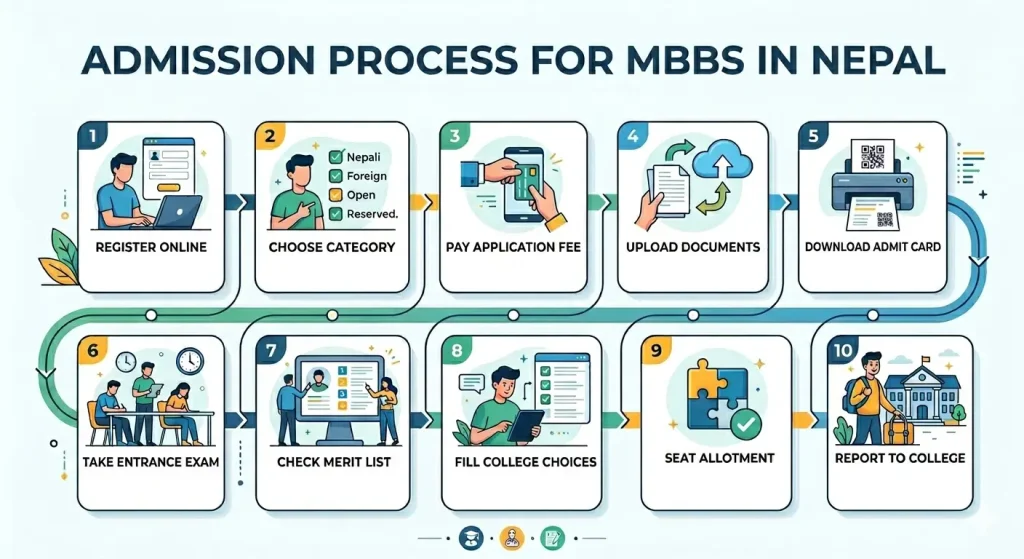
The admission process for MBBS in Nepal is simple. Everything is handled through one central system. You can apply using NEET, or you can choose MECEE if you want a higher priority. Seats are given based on your rank and your college choices, so you need to plan smartly.
Here is the step-by-step process.
| Step | Action Required |
| 1. Register Online | Create an account on the official MEC portal using your email address |
| 2. Choose Exam Route | Select the NEET route or MECEE-BL route based on your plan |
| 3. Pay Application Fee | Pay approximately NPR 8,000 online and save your payment confirmation |
| 4. Upload Documents | Submit NEET scorecard, Class 12 mark sheet, and ID proof |
| 5. Download Admit Card | Required only if you are appearing for the MECEE exam |
| 6. Check Merit List | Your rank is published based on your NEET score or MECEE result |
| 7. Fill College Preferences | Select and rank your preferred colleges on the portal |
| 8. Receive Seat Allotment | A college is assigned based on your rank and preferences |
| 9. Report to College | Visit the college with your original documents and confirm your admission |
Eligibility of MBBS in Nepal for Indian Students 2026
If you are planning to study MBBS in Nepal, you need to understand the eligibility rules. These rules are set by both Nepal and India, so you have to follow both. The most important thing you should know is about NEET. If you do not qualify for NEET, you will not be allowed to practice in India later. So if your goal is to come back and work in India, qualifying for NEET is not optional.
| Academic Requirements | You need to pass Class 12 with Physics, Chemistry, Biology, and English from a recognised board |
| Minimum Marks | You should have at least 50% in PCB subjects. If you are from a reserved category, 40% is acceptable |
| Entrance Exam | You must qualify for NEET if you want to practice in India. Some colleges may also accept MECEE for seat priority |
| Age Limit | You should be at least 17 years old by 31st December of the admission year |
| Language | You do not need IELTS or TOEFL. Classes are in English, but basic Hindi or Nepali will help during hospital training |
| Work Experience | You do not need any work experience because this is an undergraduate course |
| Documents for Admission | You will need 10th and 12th mark sheets, NEET scorecard, birth certificate, and passport-size photos |
| Travel Documents | You do not need a visa. You can travel using a valid passport or voter ID card |
Top NMC-Approved Medical Colleges in Nepal
Choosing the right college is one of the most important steps when you plan to study MBBS in Nepal. Not every college will give you the same level of clinical exposure and training. But to decide that, you will have to see what the available options are. Well, here is the list.
Government and Semi-Government Colleges
Government and semi-government colleges in Nepal are known for good clinical exposure. These colleges are attached to large hospitals where many patients come daily. Admission in these colleges is more competitive, and seats for foreign students are limited. Most of these colleges require MECEE for better chances of selection. Here is the list of colleges.
| College Name | Course | Duration | Avg Annual Fees (NPR) | Avg Annual Fees (INR) |
| IOM, Maharajgunj (Tribhuvan University) | MBBS | 5.5 Years | NPR 18,20,455 | INR 11,37,784 |
| B.P. Koirala Institute of Health Sciences | MBBS | 5.5 Years | NPR 20,36,363 | INR 12,72,727 |
| Patan Academy of Health Sciences | MBBS | 5.5 Years | NPR 19,09,090 | INR 11,93,181 |
| Nepalese Army Institute of Health Sciences | MBBS | 5.5 Years | NPR 18,20,455 | INR 11,37,784 |
Leading Private Medical Colleges
Private medical colleges in Nepal are the main option for most Indian students. These colleges are well-equipped and are linked with teaching hospitals, so students can get good practical exposure. Admission is easier compared to government colleges, and most students can apply using NEET scores. Here is the list of colleges.
| College Name | Course | Duration | Avg Annual Fees (NPR) | Avg Annual Fees (INR) |
| Kathmandu Medical College | MBBS | 5.5 Years | NPR 18,20,455 | INR 11,37,784 |
| Manipal College of Medical Sciences | MBBS | 5.5 Years | NPR 18,13,151 | INR 11,33,220 |
| Nepal Medical College | MBBS | 5.5 Years | NPR 16,00,000 | INR 10,02,418 |
| College of Medical Sciences | MBBS | 5.5 Years | NPR 20,20,947 | INR 12,66,146 |
| Nobel Medical College | MBBS | 5.5 Years | NPR 16,00,000 | INR 10,02,418 |
Note: The total course fee is fixed by Nepal’s medical authority for foreign students, so most colleges follow a similar fee range. Small extra costs like hostel or exam fees can be added separately, so it is always better to confirm details with the college before applying.
Also Read: 300+ MCI-Approved Medical Colleges Around the World
MBBS Seats in Nepal for Indian Students
If you are planning to study MBBS in Nepal, you need to understand that Nepal does not have a separate quota just for Indian students. All foreign students compete in one common pool. This is called the foreign quota Nepal MBBS system. Seats are limited, so competition is real, especially for top colleges.
Total Seats and Foreign Quota Breakdown
Nepal has a fixed number of MBBS seats every year, and only a part of those are available for foreign students. Out of all seats, some are reserved for Nepali students, and the rest are divided between local and foreign categories. Indian students fall under this foreign quota, and most applicants in this group are from India.
| Category | Seats | Details |
| Total MBBS Seats | 2,635 | Across all colleges in Nepal |
| Scholarship Seats | 691 | Only for Nepali students |
| Estimated Foreign Quota Seats | Around 749 | Open for all international students |
| Indian Student Share | Around 85 to 90% | The majority of foreign applicants |
Government vs Private College Seats for MBBS
IN Nepal, government colleges for MBBS have fewer seats and a very small foreign quota, so getting in is very tough. These usually need a top MECEE rank. Private colleges have more seats for foreign students, so they are easier to get into.
| Feature | Government Colleges | Private Colleges |
| Total Seats per College | Around 50 to 100 | Around 60 to 130 |
| Foreign Seats per College | Around 4 to 8 | Around 20 to 65 |
| Admission Route | Mostly MECEE | NEET or MECEE |
| Competition Level | Very high | Moderate |
| Accessibility | Very limited | More options available |
Also Read: Top 10 Highest Paying Jobs In Nepal For 2026
Fees Structure for MBBS in Nepal: Tuition and Living Costs
Fees are one of the biggest things you need to look at before choosing an MBBS from Nepal. The good part is that Nepal has a fixed fee system for foreign students. This means colleges cannot charge random amounts or ask for donations. This makes MBBS in Nepal easier to plan because you already know how much you will spend.
College-wise Fees Table
The total course fee is fixed at around USD 75,000 for the full 5.5 years. Colleges usually take this amount in parts, so you will not need to pay everything at once. Even though colleges are different, the tuition fee stays almost the same because of strict rules.
| College Type | Course Duration | Avg Annual Fee (NPR) | Avg Annual Fee (INR) |
| Government Colleges | 5.5 Years | NPR 18,20,455 | INR 11,37,784 |
| Private Colleges | 5.5 Years | NPR 18,20,455 | INR 11,37,784 |
Remember, you may see some extra charges like hostel or exam fees, so it is always a good idea to check this with the college before you confirm your seat.
Living Cost Breakdown
The living costs in Nepal are manageable for most students. It is quite similar to Indian cities, so you will not feel a big difference. Your total expense will depend on your lifestyle and the city you live in. Bigger cities will cost more, while smaller cities will be more budget-friendly.
| Expense Type | Monthly Cost (NPR) | Monthly Cost (INR) | Yearly Cost (INR) |
| Hostel and Accommodation | NPR 15,000 to 25,000 | INR 9,375 to 15,625 | INR 1,12,500 to 1,87,500 |
| Food and Mess | NPR 10,000 to 15,000 | INR 6,250 to 9,375 | INR 75,000 to 1,12,500 |
| Transport and Misc | NPR 5,000 to 8,000 | INR 3,125 to 5,000 | INR 37,500 to 60,000 |
| Total | NPR 30,000 to 48,000 | INR 18,750 to 30,000 | INR 2,25,000 to 3,60,000 |
City-wise Living Cost
Your city choice will also directly affect your monthly expenses. Some cities are more developed, so costs are higher there. Others are quieter and more affordable. If you stay in Kathmandu or Pokhara, you will spend a bit more because these are bigger cities. If you choose places like Dharan or Birgunj, your monthly cost will be lower and easier to manage. Here is the list.
| City | Monthly Cost (NPR) | Monthly Cost (INR) | Cost Level |
| Kathmandu | NPR 40,000 to 48,000 | INR 25,000 to 30,000 | Higher |
| Pokhara | NPR 35,000 to 45,000 | INR 22,000 to 28,000 | Medium to High |
| Biratnagar | NPR 30,000 to 38,000 | INR 18,750 to 24,000 | Medium |
| Dharan | NPR 30,000 to 35,000 | INR 18,750 to 22,000 | Lower |
| Birgunj | NPR 30,000 to 36,000 | INR 18,750 to 22,500 | Lower |
Career and Practice in India After MBBS in Nepal
Choosing an MBBS in Nepal makes your return to India much smoother because the study system is already very close to Indian medical education. But graduating alone is not enough if you want to work here. After completing MBBS from Nepal, you need to clear India’s medical licensing exam and complete registration steps before you can legally practice. Once you do that, your degree can open the same career paths as an Indian MBBS degree.
What is the NExT Exam?
Right now, foreign medical graduates usually need to clear the FMGE exam to practice in India. In the future, India plans to replace FMGE with NExT, which stands for National Exit Test. This exam will work as both a medical license exam and a postgraduate entrance exam. But no matter which exam applies, clearing it will be compulsory before practice in India.
| Feature | Current System | Future NExT System |
| Exam Name | FMGE | NExT |
| Purpose | License for foreign graduates | License + PG admission |
| Passing Marks | 50% | Expected 50%+ |
| Status | Active Now | Expected in the coming years |
Career Options After MBBS
After you clear the licensing process, an MBBS in Nepal gives you many career paths in India and abroad. You can apply for jobs, higher studies, or even open your own clinic after registration.
| Career Path | What You Can Do |
| Government Jobs | Apply for UPSC CMS, railways, ESIC, and state medical officer posts |
| PG Entrance | Prepare for NEET PG or future NExT PG ranking for MD or MS |
| Private Practice | Work in hospitals or start your own clinic after registration |
| Abroad Options | Apply for exams like USMLE, PLAB, or AMC for other countries |
Also Read: Student Guide For Part-Time Jobs In Nepal
MBBS in Nepal vs Other Abroad Destinations
When you compare MBBS from Nepal with other countries, you need to look at what actually matters for your future. It is not just about fees. You also need to think about the syllabus, exam difficulty, lifestyle, and how easy it will be to come back to India. MBBS in Nepal is often the most practical option because everything feels familiar. You will not need to adjust too much, and that saves a lot of time and effort during your studies. Here is a quick comparison.
| Factor | Nepal | Russia | Kazakhstan | Georgia |
| Curriculum | Very similar to India | Slightly different | Different | Moderately different |
| NExT or FMGE Prep | Easier | Moderate difficulty | More difficult | Moderate |
| Course Duration | 5.5 years | 6 years | 5 to 6 years | 6 years |
| Visa | Not required | Required | Required | Required |
| Clinical Exposure | High and relevant to India | High but different cases | Moderate | Moderate |
| Total Cost | Medium range | Lower to medium | Lower | Medium |
| Language | Hindi and English work | Need Russian | Local language needed | English but local mix |
| Travel Distance | Very close | Far | Far | Far |
MBBS in Nepal offers Indian students a rare combination: proximity to home, a familiar curriculum, government-regulated fees, and a degree that is valid for practice in India after clearing the required licensing exam. For students who qualify for NEET but cannot secure a seat in India, Nepal is consistently one of the most sensible and practical options available.
FAQs
The total cost for MBBS in Nepal is fixed by the government, so you will not face hidden charges. It is around USD 75,000 for the full 5.5 years. This equals roughly NPR 1,00,12,500 or about INR 62 to 63 lakhs. You will usually pay this in parts over the first few years, so it becomes easier to manage.
Yes, the degree of MBBS from Nepal is valid in India if you follow the rules properly. You need to clear NEET before taking admission; you will not be allowed to practice in India later. After finishing your degree, you also need to pass FMGE or NExT. Once you do that, you can register and work as a doctor in India.
There is no single country that is best for everyone, but Nepal works best for most Indian students. The system, syllabus, and patients are very similar to those in India, so you can learn better. Countries like the USA and UK are top for research, but they cost much more. For practical results and an easier return to India, Nepal is often the smartest choice.
MBBS in Nepal takes 5.5 years in total. You will study for 4.5 years and then complete 1 year of internship. This structure matches the Indian system, so you will not face problems later. The timeline also meets all NMC rules.
The disadvantage of MBBS in Nepal is the cost, which is higher than in some countries like Kazakhstan or Kyrgyzstan. Seats in top government colleges are very limited, so competition is tough. You may also get fewer high-end research opportunities compared to Western countries. Still, for Indian students, the pros usually outweigh these points.
Countries like Kazakhstan, Kyrgyzstan, and Uzbekistan are the cheapest options. The total cost can start from around INR 20 to 30 lakhs. But you need to understand that lower cost can also mean more language issues and lower exam passing rates. So you should choose carefully, not just based on price.
Yes, an MBBS from Nepal is worth it if you want a safe and practical option. You will study in a system very similar to India, so you can prepare better for exams like FMGE or NExT. You also save money compared to private colleges in India. That is why many Indian students choose Nepal.
For MBBS in Nepal, most colleges will ask you to stay in the hostel for the first one or two years. This helps you stay close to classes and hospitals. It also makes attendance and safety easier to manage. Later, some colleges may allow you to move out if you get permission.
Most students find Anatomy and Biochemistry tough in the beginning. These subjects need a lot of memory and regular revision. Later, subjects like Medicine and Pathology become challenging because they need a deep understanding. But with regular study, you can manage all of them.
Most countries follow a 5 to 6-year MBBS system. Some places earlier had shorter courses, but now the rules have changed. India requires at least 5.5 years, including internship, for validity. So Nepal’s 5.5-year course fits perfectly and keeps you safe for future practice.
Relatable Reads
So now you can see how MBBS in Nepal is more like an extension of India, but with better chances of getting a seat. If your NEET score is average and you still want a solid medical career, this is one of the smartest paths you can take. Also, plan your next step early. While studying MBBS in Nepal, you should already start thinking about NExT. If you stay consistent from the first year, you will not struggle later, as many students do.
Keep learning and stay connected with the Study Abroad page on Leverage Edu for more helpful and student-friendly blogs. And if this helped you, don’t forget to share, rate, and drop a comment. Your support helps more students find the good stuff. For personalised guidance, you can also call 080 6901 2014.

 2,00,000+ students realized their study abroad dream with us. Take the first step today.