

 One app for all your study abroad needs













Idioms and metaphors look similar but work differently. Idiom vs Metaphor is not about memorising fancy terms. It is about knowing how meaning works in real English. Idioms hide their meaning. Metaphors explain ideas by comparison. Once this clicks, reading, writing, and speaking get easier. This blog breaks down idiom vs metaphor using simple words, examples, tables, and mistakes students actually make. Let’s dive in.
This Blog Includes:
- Idiom vs Metaphor: Meaning With Examples
- Idiom vs Metaphor: Origin
- What Is the Difference Between an Idiom and a Metaphor?
- How Idiom vs Metaphor Are Used in Daily English
- How to Recognize Idiom vs Metaphor in a Sentence
- Common Mistakes Students Make Between Idioms and Metaphors
- Idiom vs Metaphor Examples You Actually Hear
- Idiom vs Metaphor Quiz With Answers
- FAQs
Idiom vs Metaphor: Meaning With Examples
An idiom is a common phrase used in English. The meaning of an idiom is different from the meaning of the individual words. You cannot understand an idiom by translating it word by word. Idioms are learned by use and practice. They are often used in daily conversation and informal writing.
Examples of Idioms
- Break the ice: To start a conversation in a friendly way
- Spill the beans: To share a secret
- Hit the nail on the head: To say something exactly right
- Under the weather: Feeling sick or unwell
- Piece of cake: Something very easy
A metaphor is a figure of speech. It compares one thing with another to explain an idea clearly. A metaphor does not use words like “as” or “like”. It directly says one thing is another to create a clear picture in the reader’s mind. Metaphors are used in stories, poems, speeches, and even everyday English.
Examples of Metaphors
- Time is a thief: Time steals moments from our life
- The classroom was a zoo: The classroom was very noisy
- Her voice is music to my ears: Her voice sounds very pleasant
- The exam was a mountain to climb: The exam was very difficult
- His words were a sharp knife: His words were hurtful
Here is the list of some more examples used in senetnces for better understanding.
| Idiom | Metaphor |
| To start the meeting, she told a joke to break the ice. | Her smile is sunshine, brightening everyone’s day. |
| He had to bite the bullet and face the challenging project. | Time is a thief that steals our moments. |
| She accidentally spilt the beans about the surprise party. | Despite her pleas, he remained unmoved, encased in an icy fortress. |
| Losing that job was a blessing in disguise because it led me to a much better career. | The world is a stage, and we are merely players. |
| To break the ice, she told a funny story at the beginning of the meeting. | His words were a double-edged sword, cutting both ways. |
| He decided to bite the bullet and start his own business despite the risks. | The classroom was a zoo during the last period. |
| When you said we need more staff to handle the workload, you hit the nail on the head. | Life is a rollercoaster, full of ups and downs. |
| She accidentally let the cat out of the bag about the surprise party. | His heart is a cold iron, unyielding and unforgiving. |
| He only goes to the movies once in a blue moon. | The storm was a raging bull, unstoppable and wild. |
| The math test was a piece of cake; I finished it in no time. | The city’s lights were a blanket of stars in the night. |
| I’ve been feeling a bit under the weather, so I might not come to the party. | Her voice was music to his ears, soothing and melodious. |
Idiom vs Metaphor: Origin
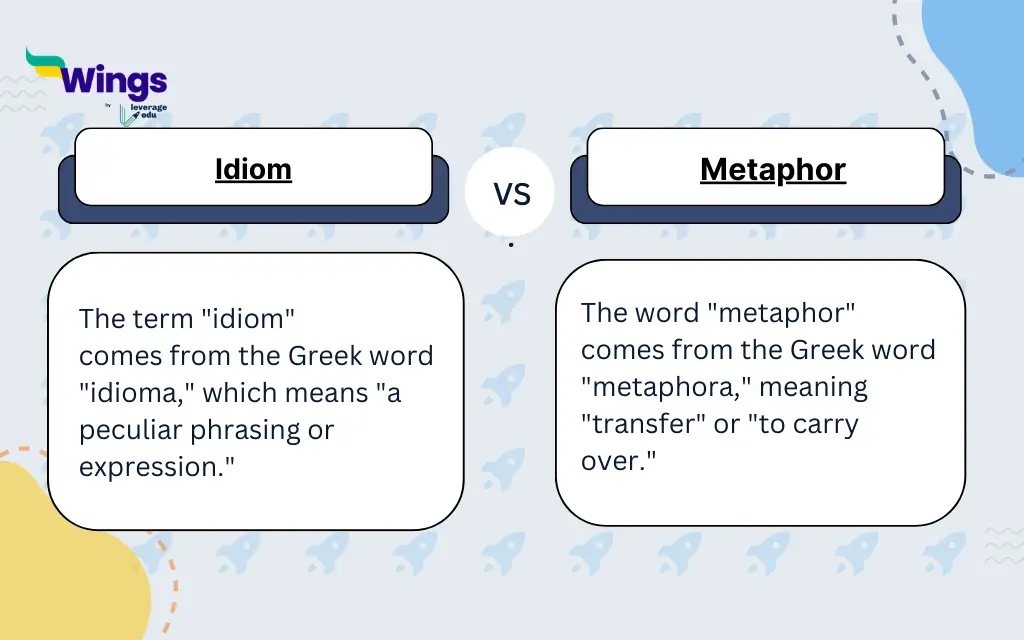
The idioms and metaphors both come from the Greek world, here are their meanings as per their Greek origins.
What Is the Difference Between an Idiom and a Metaphor?
The difference between idiom vs metaphor is mainly about how meaning is created in a sentence. An idiom is a fixed expression whose meaning cannot be understood by looking at the individual words. You must already know the idiom to understand it.
A metaphor, on the other hand, explains an idea by directly comparing two different things. Its meaning can usually be understood by thinking about the comparison. Both idioms and metaphors are used to make English more expressive, but they work in very different ways.
| Basis of Comparison | Idiom | Metaphor |
| Meaning | The meaning is different from the literal meaning of the words | The meaning comes from comparing two different things |
| Understanding | Cannot be guessed from the words | Can often be understood by the comparison |
| Nature | Fixed phrase with a set meaning | Creative expression that can change |
| Literal Sense | Does not make sense if taken literally | May make sense when imagined |
| Learning Method | Must be memorised | Can be understood through thinking |
| Usage | Common in daily conversation | Common in writing, speeches, and stories |
| Flexibility | Words usually cannot be changed | Words can be changed or created |
| Example | Kick the bucket means to die | Life is a journey |
Also Read: Best Idioms with Examples and Meanings
How Idiom vs Metaphor Are Used in Daily English
Idioms and metaphors are used every day to make English sound natural and expressive. People often use them while speaking with friends, writing messages, or explaining ideas in a simple way. They help save time and add emotion to sentences. Without idioms and metaphors, English would sound plain and boring.
Use of Idioms in Daily English
Idioms are mostly used in spoken English and informal writing. People use idioms to sound friendly and confident. Native speakers often use idioms without even thinking about them. Idioms are commonly used:
- In conversations with friends and family
- In movies, TV shows, and social media
- To express feelings quickly
- To make speech sound natural
Example sentences:
- I was over the moon after hearing the news.
- He told me the secret, but I promised not to spill the beans.
Use of Metaphors in Daily English
Metaphors are used to explain ideas clearly by creating mental pictures. They help people understand emotions, situations, and thoughts better. Metaphors are often used in both spoken and written English. Metaphors are commonly used:
- To explain emotions and feelings
- In stories, speeches, and school writing
- To describe situations clearly
- To make language more interesting
Example sentences:
- Her words were a ray of hope for me.
- That job became a heavy burden on his life.
Also Read: Idioms on Rain To Improve Your English Grammar
How to Recognize Idiom vs Metaphor in a Sentence
To understand the difference between an idiom and a metaphor in a sentence, you need to look at how the meaning is formed. Some phrases do not make sense if you read them word by word. Others make sense when you imagine the comparison. Learning how to recognize an idiom vs a metaphor helps students read faster, understand questions better, and avoid mistakes in exams and writing. Here is how to identify idiom vs metaphor in a sentence:
| Point to Check | Idiom | Metaphor |
| Literal Meaning | Does not make sense literally | Makes sense when imagined |
| Word Meaning | Words do not explain the meaning | Words help show the idea |
| Guessing Meaning | Meaning cannot be guessed | Meaning can often be guessed |
| Structure | Fixed phrase | Flexible expression |
| Use in Sentence | Sounds informal and common | Sounds descriptive or creative |
| Change of Words | Words cannot be changed | Words can be changed |
| Example | He kicked the bucket yesterday | Life is a journey |
Common Mistakes Students Make Between Idioms and Metaphors
Many students get confused between idiom vs metaphor because both are figures of speech. The problem starts when students try to understand or use them in the same way. Knowing the common mistakes helps students avoid errors in exams, writing, and daily English use. Here are some common mistakes students should avoid:
- Taking idioms literally: Students often try to understand idioms word by word. This leads to wrong meanings. Idioms do not make sense when taken literally.
- Thinking all metaphors are fixed phrases: Some students believe metaphors have one fixed form. Metaphors are flexible and can be created in many ways.
- Using idioms in formal writing: Idioms are informal. Using them in essays or academic answers can reduce writing quality.
- Confusing metaphors with similes: Students sometimes think a metaphor uses words like “like” or “as”. These words are used in similes, not metaphors.
- Changing the words of an idiom: Idioms should not be changed. Altering even one word can make the idiom incorrect or meaningless.
Also Read: Clean As A Whistle Idiom Meaning, Examples, Synonyms
Idiom vs Metaphor Examples You Actually Hear
Idioms and metaphors are not just book terms. People use them daily while talking to friends, watching shows, or sharing stories. Knowing real and common idiom and metaphor examples helps students understand spoken English better and use it naturally without confusion.
| Idioms You Actually Hear | Meaning | Metaphors You Actually Hear | Meaning |
| Burn the midnight oil | Study or work late | He is a shining star | He is very talented |
| Once in a blue moon | Very rarely | Her smile is sunshine | Her smile brings happiness |
| On cloud nine | Very happy | The office was a battlefield | The office was full of conflict |
| Cost an arm and a leg | Very expensive | His mind is a maze | He is confused |
| Bite the bullet | Face a hard situation | The news was a shockwave | The news was very surprising |
| Call it a day | Stop working | Her anger was fire | She was very angry |
| Go the extra mile | Put in more effort | Life is a roller coaster | Life has many ups and downs |
| Back to square one | Start again | His words were poison | His words were harmful |
| In hot water | In trouble | The idea took root | The idea became strong |
| Turn a blind eye | Ignore something | Hope is a candle | Hope gives light in dark times |
| The ball is in your court | Your turn to act | The city never sleeps | The city is always active |
| Cut corners | Do work cheaply | Fear is a shadow | Fear always follows |
| Hit the sack | Go to sleep | Her heart is stone | She has no sympathy |
| Up in the air | Not decided | Knowledge is power | Learning gives strength |
| Pull someone’s leg | Joke with someone | His voice was thunder | His voice was very loud |
Idiom vs Metaphor Quiz With Answers
Instruction: Pick the correct answers from the options given below.
Question 1: Which of the following is an idiom?
a) His words were fire.
b) The road was a snake.
c) Break the bank.
d) Her eyes were stars.
Answer: c) Break the bank
Question 2: Which of the following is a metaphor?
a) Under the weather
b) A piece of cake
c) The mind is a garden
d) Spill the beans
Answer: c) The mind is a garden
Question 3: Which sentence uses an idiom?
a) The office was a jungle.
b) She has a heart of gold.
c) He let the cat out of the bag.
d) Time is money.
Answer: c) He let the cat out of the bag
Question 4: Which sentence contains a metaphor?
a) In the blink of an eye
b) Her laughter is music
c) On thin ice
d) Hit the books
Answer: b) Her laughter is music
Question 5: Identify the idiom in the options below.
a) The world is a stage
b) His anger was fire
c) Jump the gun
d) Life is a race
Answer: c) Jump the gun
Question 6: Which of the following is a metaphor?
a) Bite the dust
b) A storm of emotions
c) Pull your socks up
d) In hot water
Answer: b) A storm of emotions
Question 7: Which sentence is an idiom?
a) The classroom was a zoo
b) Her mind is a puzzle
c) Call it quits
d) His voice was thunder
Answer: c) Call it quits
Question 8: Which option shows a metaphor?
a) Burn bridges
b) Hit the road
c) The idea is a seed
d) Once in a lifetime
Answer: c) The idea is a seed
Question 9: Choose the idiom from the list.
a) The city is a machine
b) A wave of sadness
c) Cold feet
d) The sun smiled
Answer: c) Cold feet
Question 10: Which sentence uses a metaphor?
a) Hit the nail on the head
b) Back against the wall
c) His memory is a library
d) At the drop of a hat
Answer: c) His memory is a library
FAQs
Ans: The difference between an idiom vs metaphor is how meaning is understood. An idiom has a fixed meaning that cannot be guessed from the words. A metaphor explains an idea by directly comparing two things. Idioms must be memorised, while metaphors can often be understood by thinking.
Ans: “Raining cats and dogs” is an idiom. Its meaning is heavy rain, not animals falling from the sky. The meaning cannot be understood literally, which makes it an idiom.
Ans: “I slept like a baby” is a simile. It uses the word “like” to compare sleep to a baby’s sleep. Metaphors do not use words like “like” or “as”.
Ans: An idiom is a phrase with a hidden meaning used in daily speech. A proverb is a short sentence that gives advice or teaches a life lesson. Proverbs often share wisdom, while idioms focus on expression.
Ans: An idiom and a metaphor are usually different, but some idioms are based on old metaphors. Over time, the metaphor meaning becomes fixed and turns into an idiom. In modern English, idioms are treated as set phrases, while metaphors remain flexible.
Related Reads
| Poetic Devices with Meaning, Examples and Uses | Idioms for IELTS Exams |
| Examples of Simile | Idioms for Busy |
| Figures of Speech with Examples, PDF | Idioms for Weather |
Understanding idiom vs metaphor becomes easy when you focus on how meaning is formed, not how complex the words look. Idioms carry hidden meanings that must be learned, while metaphors explain ideas by comparing them clearly. Keep learning and stay connected with the Learn English page on Leverage Edu for more helpful and student-friendly blogs. And if this helped you, don’t forget to share, rate, and drop a comment. Your support helps more students find the good stuff.

 60,000+ students trusted us with their dreams. Take the first step today!