

 One app for all your study abroad needs

















Everyone says, “read the newspaper to improve your English.” Cool. But which one and how due to too much political scandals, advertisements, and stock updates. If you’re stuck rereading comprehension passages that make zero sense then, this one’s for you. We have broken down the best English newspapers in India that actually help you level up your grammar, vocab, and speed.
This Blog Includes:
- Why Reading English Newspapers Still Hits Different?
- Best English Newspapers in India to Improve English
- Best English Newspapers to Prep for Various Exams
- How to Use Newspapers to Boost Your Learning?
- Reading Comprehension Exercises Based on Newspapers
- Tips to Score Higher in Reading Comprehension Using Newspapers
- Best Free Newspaper Apps and Websites for English Learners
- FAQs
Why Reading English Newspapers Still Hits Different?
Everyone’s hooked on reels and bite-sized news, but here’s the tea: best English paper In India still do what social media can’t. They make you actually think in English. Reading them trains your brain to process long texts, follow ideas, and understand tone, all skills you need for exams, essays, and interviews.
Unlike random blogs or AI notes, newspapers are written and edited by professionals who live by grammar and clarity. Every headline, every sentence is a mini English lesson. You start picking up sentence flow, vocabulary, and even formal writing styles without realizing it.
Best English Newspapers in India to Improve English
If you are asking yourself, which is the best English Newspaper in India to improve english, then these 6 newspapers are your secret weapon. Reading them daily builds grammar sense, sentence rhythm, and real-world vocabulary that no grammar app can teach. These six English newspapers are perfect for polishing your comprehension, tone, and writing flow.
The Hindu – Clean Grammar, Sharp Comprehension
Quality: Precise writing, advanced vocabulary, serious editorials.
The Hindu is the Indian best English newspaper and go-to for students who want to sound crisp and confident. Its articles follow perfect grammar and clear logic, making it ideal for improving comprehension. The editorials train you to understand long texts and analyze arguments. It is great practice for essays and reading sections in exams.
The Indian Express – Balanced Style, Clear Structure
Quality: Neutral tone, easy-to-follow writing.
The Indian Express is the best newspaper to improve English because it uses clean English with short, organized paragraphs. You learn how to explain ideas clearly without using heavy words. It’s perfect for students who want to shift from textbook English to formal, professional writing that still feels natural.
The Times of India – Modern Flow, Everyday Vocabulary
Quality: Conversational English, current slang done right.
TOI helps you learn how people actually write and speak English today. The language is lighter, faster, and more modern. It is good for improving fluency and staying updated with real-world usage. Reading it daily helps you build sentence rhythm and vocabulary that doesn’t sound robotic.
Hindustan Times – Smooth Reading, Balanced Tone
Quality: Mix of simple and formal English, perfect for mid-level learners.
HT gives you both, the readability of a lifestyle paper and the accuracy of a serious one. The articles help you learn how to shift tone depending on topic, a skill that’s super useful for essays, reports, and even social media writing.
The Telegraph – Creative Writing, Bold Headlines
Quality: Witty language, expressive phrasing.
The Telegraph is great for students who love reading but hate boring news. Its writers use humor, creativity, and punchy lines that make English fun to read. You’ll learn how to add personality to your writing while keeping it grammatically solid.
Deccan Herald – Clear English, Academic Vibe
Quality: Neutral grammar, factual writing style.
Deccan Herald is the best newspaper for English improvement because it uses clean, simple English that’s easy to follow yet refined. It helps students who prefer straightforward reporting and want to strengthen their grammar accuracy. Perfect for building discipline in reading and understanding real, well-edited English.
Not Boring. Just Useful: How to Score Full Marks in UP Board Class 8 English Exam 2025‑26?
Best English Newspapers to Prep for Various Exams
If you’re serious about exams like UPSC, SSC, or even your board English papers, then you already know, reading English newspapers isn’t optional, it’s survival. But which English newspaper is best? Here are 4 papers that train your brain for comprehension, essay tone, and general awareness all at once. These right one keeps you updated and sharpens your English naturally. Here are the top 4 newspapers that actually help with exam prep.
Business Standard – Smart English, Smarter Mindset
Quality: Precise, analytical, and data-backed writing.
Business Standard is the best English newspaper In India for students because it helps you build an academic, professional tone that examiners love. It improves your ability to process complex information. It is great for economics, business studies, and current affairs questions. The editorial section is especially useful for learning how to form logical, well-supported arguments in essays or long answers.
The Economic Times – Technical Terms, Real Context
Quality: Builds business vocabulary and real-world understanding.
The Economic Times is ideal if your exams include topics like finance, policy, or economics. It helps you learn technical English in context instead of memorizing jargon. Reading ET regularly improves your ability to read factual data and write answers that sound informed and confident.
The Pioneer – Classic English, Strong Opinions
Quality: Traditional language, detailed editorial depth.
The Pioneer is old-school in the best way, its language is formal and grammatically flawless. It’s great for UPSC and descriptive exams where tone and clarity matter more than trends. The editorials help you understand how to build perspective and structure long-form answers effectively.
The Statesman – Balanced View, Clear Writing
Quality: Neutral reporting, polished English.
The Statesman covers national and international issues in clean, formal English. It’s especially good for improving comprehension speed and summarizing skills, both critical for competitive exams. You’ll pick up how to filter key points from dense articles, just like you’ll need to do in your question papers.
Check out this video for more global newspapers to learn both Indian and International vocabulary and current affairs.
Don’t Miss This Read: Learning English Through Classic Novels: Books, Tips & Benefits
How to Use Newspapers to Boost Your Learning?
Newspapers aren’t just for news, they’re daily goldmines for improving your English and exam skills. The trick is knowing how to read them smartly. Instead of scrolling headlines or skipping to memes, treat your newspaper like a free tutor. You’ll polish your grammar, pick up vocabulary that actually fits exam answers, and stay updated on topics that often sneak into comprehension or essay questions.
Using Newspapers to Learn English
- Read Editorials Daily: They’re written in refined, exam-level English. Focus on how arguments are built, transitions are used, and opinions are expressed.
- Underline New Words: Don’t just note them, learn their usage. Write one line with each new word to fix it in memory.
- Notice Sentence Flow: Editorials and feature stories show how professional writers maintain tone, structure paragraphs, and link ideas, skills that instantly improve your writing.
- Summarize Articles: After reading a piece, write 3–4 lines summarizing it in your own words. This helps you develop clarity, structure, and confidence.
Using Newspapers for Exam Preparation
- For Comprehension: Read opinion and analysis pieces, they’re long, complex, and ideal for practicing inference and tone detection.
- For Vocabulary & Grammar: Learn phrases and idioms in context. Editorials often use exam-friendly vocabulary like therefore, consequently, however, etc.
- For Essay and Letter Writing: Observe how arguments are introduced, supported, and concluded. This gives you real examples of transitions and formal phrasing.
- For Current Affairs Questions: Especially in exams like UPSC or Boards, newspapers provide authentic facts, names, and issues that you can use as examples in your answers.
Reading Comprehension Exercises Based on Newspapers
Below are 4 short, exam-style comprehension exercises inspired by real newspaper reading, a mix of current affairs, editorial logic, and vocabulary use. Each one is followed by an Answer Sheet to check your responses and understand how to approach similar questions in tests like boards, IELTS, or UPSC.
Exercise 1: Policy and Governance (The Hindu Style)
Passage:
The National Education Policy (NEP) 2020’s latest update emphasizes skill integration and multidisciplinary learning at the undergraduate level. However, universities face a lack of trained faculty and digital infrastructure. Analysts argue that while the vision is transformative, without institutional readiness, implementation may remain on paper.
Questions:
- What is the central challenge mentioned in implementing the NEP 2020 update?
- What does the author imply by “implementation may remain on paper”?
- Identify the tone of the passage (choose one): optimistic / critical / neutral / persuasive.
- Find one word in the passage that means “revolutionary.”
Answer Sheet:
- Lack of trained faculty and digital infrastructure.
- It means the policy may not be practically applied or executed.
- Critical.
- Transformative.
Exercise 2: Economy and Society (The Indian Express Style)
Passage:
As India moves toward a digital economy, data privacy becomes a pressing concern. The new Data Protection Bill proposes tighter control over how companies use user information. Critics, however, warn that vague definitions of “consent” and “public interest” could lead to misuse of personal data under the pretext of governance.
Questions:
- What is the primary focus of the Data Protection Bill?
- Why are critics concerned about the bill?
- What does the word “pretext” suggest in the context?
- The author’s tone can best be described as _____.
Answer Sheet:
- To regulate how companies handle user data.
- Because vague terms could allow misuse of personal data.
- It means a false reason or excuse used to justify an action.
- Cautiously critical.
Exercise 3: Environment and Global Affairs (Times of India Style)
Passage:
At the recent UN Climate Summit, developing nations urged wealthier countries to fulfill their promises of climate finance. India highlighted that despite contributing less to global emissions, it faces disproportionate climate impacts. Experts believe true progress depends on equitable funding and technology sharing rather than empty pledges.
Questions:
- What demand did developing nations make at the summit?
- Why did India emphasize its lower contribution to emissions?
- What does the phrase “empty pledges” mean in this context?
- What solution do experts suggest for real climate progress?
Answer Sheet:
- They demanded wealthier countries to deliver on climate finance promises.
- To show the unfair burden it faces despite lower emissions.
- Promises made without actual action or delivery.
- Equitable funding and technology sharing.
Exercise 4: Science & Innovation (Hindustan Times Style)
Passage:
Artificial Intelligence (AI) tools are now integrated into classrooms to help personalize learning. Yet, educators warn that overreliance on AI may weaken students’ analytical thinking. The challenge lies in balancing innovation with critical engagement so that technology becomes an aid, not a replacement for human intellect.
Questions:
- What advantage does AI bring to classrooms?
- What risk do educators associate with its use?
- Explain the phrase “technology becomes an aid, not a replacement.”
- Identify the underlying theme of the passage in one short line.
Answer Sheet:
- It helps personalize learning experiences.
- It can reduce students’ analytical thinking skills.
- Technology should support, not substitute, human learning.
- Balance between AI and critical thinking.
Sounds Basic? Glad It’s Not: Easy English Books Every Student Should Read to Improve English
Tips to Score Higher in Reading Comprehension Using Newspapers
Let’s be honest, you can’t “vibe” your way through reading comprehension. You need a strategy. Newspapers are your best (and free) prep book if you know how to use them right. Here’s the cheat sheet that actually works:
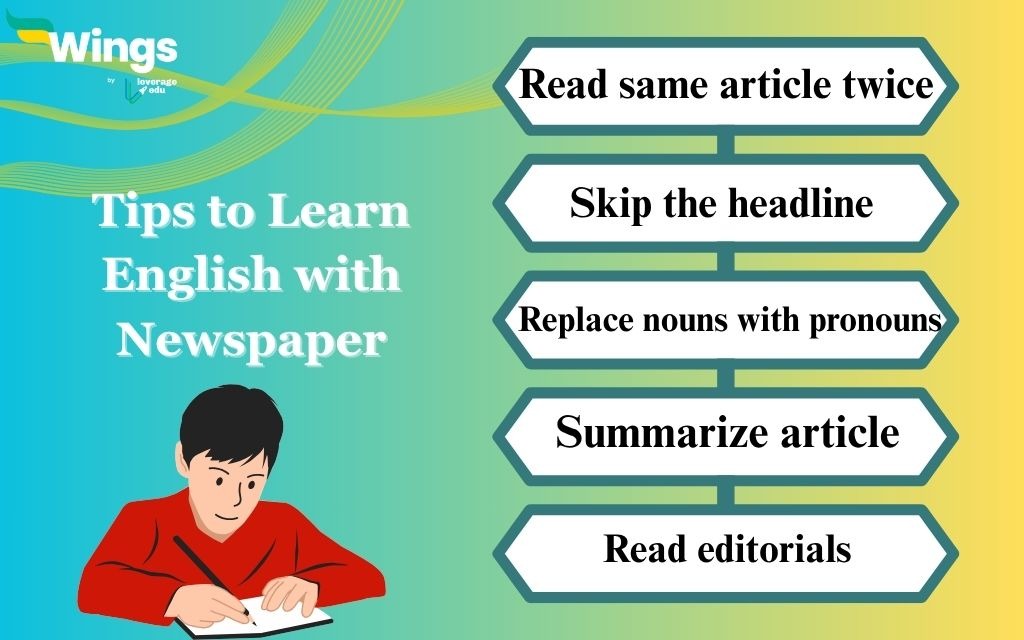
Read the same article twice but differently
First read: for meaning. Second read: for technique. Notice how the writer builds arguments, connects paragraphs, or hides opinions, that’s what exam questions secretly test.
Skip the headline, read the body first
Headlines trick you into bias. When you read the body first, you process facts neutrally, exactly how comprehension passages expect you to think.
Replace nouns with pronouns while reading
It forces your brain to track references, “he,” “they,” “this issue”, a top skill for inference-based questions.
Summarize an article in 10 words, no more
It sounds silly, but it forces you to filter fluff and find the main idea, the single hardest thing most students miss.
Read editorials aloud in news anchor mode
You’ll improve pronunciation, tone, and comprehension speed together. Plus, it trains your brain to catch sentence rhythm, something silent readers often skip.
Best Free Newspaper Apps and Websites for English Learners
If you want to get better at English without paying for fancy courses, start with newspaper apps. They give you real-world English, the kind used by writers, journalists, and exam setters. You’ll learn how ideas are structured, how arguments are built, and how words actually work in context. These free tools are your shortcut to daily English practice, whether it’s reading, writing, or comprehension.
The Hindu News App
Why it’s good: Strong grammar and serious editorials.
The Hindu app is every English learner’s gym. Its articles are packed with high-level vocabulary, clear grammar, and editorial pieces that make you think. The tone is formal, just like exam passages, perfect for UPSC or board-level comprehension prep.
The Indian Express News App
Why it’s good: Balanced writing and clean tone.
If you prefer clear, logical writing, this is your go-to. The Indian Express uses simple yet powerful language, helping you improve both your reading flow and analytical skills. It’s also great for summarizing practice and current affairs-based comprehension.
The Times of India English News App
Why it’s good: Conversational and easy-flow language.
The TOI app is for those who like lighter reads but still want to improve. Its articles cover pop culture, lifestyle, and global events, giving you exposure to modern expressions and informal English that feels natural, not textbook.
All English Newspapers – Daily ePaper
Why it’s good: Everything in one place.
This app brings together multiple Indian and international newspapers, letting you pick what fits your mood. One day The Hindu, next day The Telegraph, you’ll start spotting different writing styles and sentence patterns without switching tabs.
Inshorts
Why it’s good: Bite-sized news for fast learners.
Hate long articles? Inshorts is your fix. It breaks down complex news into 60-word summaries in simple, fluent English. It’s perfect for quick vocab upgrades and reading practice between classes.
Pro Tip: Don’t try all of them at once. Pick one app, read one article daily, and write down three new words with their meanings. Use them in your chats or essays. That’s how you turn reading into real English improvement.
FAQs
Ans: If your goal is to actually learn, not just read, The Hindu is the best English newspaper in India for improving vocabulary, comprehension, and writing tone. Its editorials are gold for students preparing for exams like UPSC or SSC. Pair it with lighter reads like Times of India for balance.
Ans: The Hindu and The Indian Express are the most trusted English newspapers in India. They’re known for accuracy, detailed reporting, and balanced opinions, perfect if you want reliable information and sharp language exposure.
Ans: Don’t just skim headlines. Read one full article daily, underline new words, and note how sentences are framed. Try summarizing the story in your own words, it’s the fastest way to build vocabulary, grammar, and comprehension naturally.
Relatable Reads Picked Just for You
So yeah, at this point, you know it, reading the best English newspapers in India isn’t about acting all studious with chai and specs but it’s about training your brain to think, read, and write like a pro. These papers won’t just boost your vocab for exams, they’ll make you sound crisp in interviews, essays, and literally everywhere words matter. For more such helpful guides on grammar, vocabulary, and competitive exam preparation, make sure to check out the Learn English page on Leverage Edu and stay updated!

 60,000+ students trusted us with their dreams. Take the first step today!