

 One app for all your study abroad needs













Unseen passages can feel tricky, and this is why this blog on unseen passages for ICSE class 9 with examples and tips is designed to help you tackle comprehension questions confidently. You will find solved examples, tips, and some unsolved questions for your practice. This practice will boost your reading skills, improve your focus, and help you answer faster during exams. With regular practice, you can turn unseen passages into one of your strongest scoring areas.
This Blog Includes:
Introduction to Unseen Passages for Class 9 Students
Unseen passages test how well you can read, understand, and answer questions from a new text within a short time. Practicing unseen passages regularly helps you improve speed, accuracy, and confidence during exams. They also train you to identify key ideas, meanings of tough words, and tone of the passage, skills that are essential for scoring full marks in comprehension sections.
5+ Unseen Passage Examples for Class 9 Students to Practice
In this section, each passage will help you understand the different types of comprehension texts that appear in exams. These examples will include simple questions to test your understanding, vocabulary, and inference skills. Before you begin, remember a few tips:
- Read the passage twice. The first time for general understanding, the second time for details.
- Highlight key points or numbers. They often hold the answers.
- Answer in your own words. Avoid copying long lines from the passage.
- Manage your time. Don’t spend more than 10 minutes on one passage during exams.
Passage 1: The Power of Nature
Nature has always been a powerful force shaping the lives of humans. From gentle rain that nourishes crops to storms that destroy entire towns, nature reminds us that we are just a small part of a vast system. The sun gives us warmth and energy, while rivers and forests provide food, water, and shelter. However, when nature’s balance is disturbed, through deforestation, pollution, or climate change, it strikes back with floods, droughts, and heatwaves.
In recent years, scientists have warned that human activities are putting too much pressure on the planet. Cutting down trees for land, burning fuels for energy, and wasting water have caused the Earth’s temperature to rise. This not only affects weather patterns but also endangers animals and plants. Yet, it’s not too late. By planting trees, using renewable energy, and reducing waste, we can live in harmony with nature again. Respecting nature’s power is the first step toward protecting our future.
Questions
Q1. What are some ways in which nature helps human life?
Q2. How does nature react when its balance is disturbed?
Q3. According to the passage, what are the main causes of climate change?
Q4. What solutions does the writer suggest to protect nature?
Q5. Find a word from the passage that means “living peacefully together.”
Answers
A1. Nature helps humans by providing warmth from the sun, water from rivers, food from forests, and shelter.
A2. When nature’s balance is disturbed, it reacts through floods, droughts, and heatwaves.
A3. The main causes of climate change mentioned are deforestation, burning fuels, and wasting water.
A4. The writer suggests planting trees, using renewable energy, and reducing waste to protect nature.
A5. The word is “harmony.”
Passage 2: A Day in the Life of a Farmer
A farmer’s day begins long before sunrise. While most people are still asleep, he steps out into the cool morning air to check his fields. The sound of birds, the rustle of leaves, and the smell of wet soil welcome him every day. He knows that every minute matters, as crops depend on careful timing for watering, ploughing, and harvesting.
Farming is not an easy job. It demands strength, patience, and hard work. Farmers face many challenges, such as unpredictable weather, rising costs, and pest attacks. Yet, they continue to work because their crops feed families across the nation. Despite the hardships, there is a sense of pride in seeing green fields and golden harvests.
As the sun sets, the farmer looks over his land once more, tired but satisfied. He knows that tomorrow will bring new tasks and new hopes. His connection with the earth teaches him the true meaning of dedication and gratitude.
Questions
Q1. When does a farmer’s day usually begin and why?
Q2. What are some challenges farmers face according to the passage?
Q3. How does the farmer feel at the end of the day?
Q4. What values or lessons can we learn from a farmer’s life?
Q5. Find a word in the passage that means “thankfulness.”
Answers
A1. A farmer’s day begins before sunrise because he needs to check his fields and start work early to make the best use of time.
A2. Farmers face challenges like unpredictable weather, high costs, and pest attacks.
A3. The farmer feels tired but satisfied at the end of the day.
A4. We can learn dedication, patience, and gratitude from a farmer’s life.
A5. The word is “gratitude.”
Also Read: Unseen Passage for Class 6: CBSE Free Worksheets
Passage 3: The Habit of Reading
Reading is one of the most rewarding habits a person can develop. It not only builds knowledge but also shapes imagination and thinking. When we read books, newspapers, or even short stories, we learn about different people, cultures, and ideas. A good book can take us to places we have never been and make us feel emotions we have never known.
In today’s fast-moving world, many students prefer spending time on their phones rather than reading. However, reading improves focus and language skills far better than scrolling through screens. It helps you write clearly, speak confidently, and understand the world deeply. Even reading for just fifteen minutes a day can make a big difference in the long run.
Building the habit of reading requires discipline. You can start small, choose books you enjoy, set a reading goal, and keep a reading journal. Over time, reading becomes a friend that stays with you for life.
Fill in the Blanks
Q1. Reading helps to build __________ and improve imagination.
Q2. In the modern world, students often spend time on their __________ instead of reading.
Q3. Regular reading improves focus, __________ skills, and understanding.
Q4. One way to build the habit of reading is to set a __________ goal.
Q5. According to the passage, reading becomes a __________ that stays for life.
Answers
A1. knowledge
A2. phones
A3. language
A4. reading
A5. friend
Passage 4: Our Changing Environment
The environment around us is changing faster than ever before. Forests are being cut down, rivers are being polluted, and the air in cities is becoming harder to breathe. These changes affect not only animals and plants but also human life. Natural disasters such as floods, droughts, and heatwaves are becoming more frequent and severe due to environmental imbalance.
Human activities are largely responsible for this rapid change. Industrialization, urbanization, and the overuse of natural resources are putting immense pressure on the Earth. However, individuals and communities can make a difference. Planting trees, reducing plastic use, conserving water, and using public transport are small but effective steps to protect the environment.
Caring for the environment is not just a responsibility but a necessity for survival. Every action counts, and even small efforts can collectively lead to significant improvements. By understanding and respecting nature, we can ensure a healthier and safer planet for future generations.
True or False
Q1. The environment is changing slowly and gradually.
Q2. Deforestation and pollution affect both animals and humans.
Q3. Natural disasters are becoming less frequent due to environmental awareness.
Q4. Using public transport and reducing plastic use are suggested ways to protect the environment.
Q5. Every individual’s effort can contribute to improving the environment.
Answers
A1. False
A2. True
A3. False
A4. True
A5. True
Passage 5: The Value of Kindness
Kindness is one of the simplest yet most powerful qualities a person can have. A small act of kindness can brighten someone’s day, inspire others, and create a chain of goodwill. It is not always about grand gestures, even helping a classmate with homework or speaking politely to strangers can make a big difference.
In schools and communities, kindness promotes understanding, cooperation, and harmony. People who are kind often feel happier and more confident because they contribute positively to the lives of others. Importantly, kindness is contagious. When someone experiences it, they are likely to pass it on.
Practicing kindness also helps students develop empathy and emotional intelligence. By understanding the feelings of others and responding with compassion, young people can grow into responsible, caring adults. In short, kindness is a skill that benefits both the giver and the receiver, shaping a better society for everyone.
Short-Answer Questions
Q1. How can small acts of kindness make a difference?
Q2. Why is kindness important in schools and communities?
Q3. What happens when someone experiences kindness?
Q4. How does practicing kindness help students personally?
Q5. Summarize the overall benefit of kindness according to the passage.
Answers
A1. Small acts of kindness can brighten someone’s day, inspire others, and create a chain of goodwill.
A2. Kindness promotes understanding, cooperation, and harmony in schools and communities.
A3. When someone experiences kindness, they are likely to pass it on, spreading goodwill.
A4. Practicing kindness helps students develop empathy, emotional intelligence, and social skills.
A5. Kindness benefits both the giver and receiver, contributing to a better society.
Passage 6: The Journey of Technology
Technology has changed the way we live, learn, and communicate. From the invention of the wheel to modern smartphones, every innovation has shaped human civilization. Computers, the internet, and mobile devices have made information easily accessible, connecting people across the globe.
While technology brings convenience, it also comes with challenges. Overreliance on gadgets can affect health, reduce physical activity, and limit face-to-face interactions. Additionally, rapid technological changes can make older tools and skills obsolete.
Despite these challenges, technology continues to drive progress. Innovations in medicine, transportation, and education have improved the quality of life worldwide. By using technology wisely and responsibly, we can harness its benefits while minimizing negative effects.
Multiple-Choice Questions (MCQs)
Q1. What is the main idea of the passage?
a) Technology has only negative effects
b) Technology has transformed human life in many ways
c) Technology is unnecessary in modern life
d) Technology is a waste of time
Q2. Which of the following is a challenge mentioned in the passage?
a) Access to information
b) Overreliance on gadgets
c) Improved transportation
d) Global communication
Q3. How has technology affected human civilization?
a) It has made life harder
b) It has connected people and provided convenience
c) It has stopped progress
d) It has eliminated the need for learning
Q4. According to the passage, how can technology be used effectively?
a) By ignoring it completely
b) By using it wisely and responsibly
c) By depending on it for everything
d) By avoiding all modern devices
Q5. Which field is mentioned as having improved due to technology?
a) Medicine
b) Farming only
c) Art exclusively
d) None of the above
Answers
A1. b) Technology has transformed human life in many ways
A2. b) Overreliance on gadgets
A3. b) It has connected people and provided convenience
A4. b) By using it wisely and responsibly
A5. a) Medicine
Also Read: Unseen Passage for Class 5: CBSE Worksheet
How to Solve an Unseen Passage Effectively in Exams
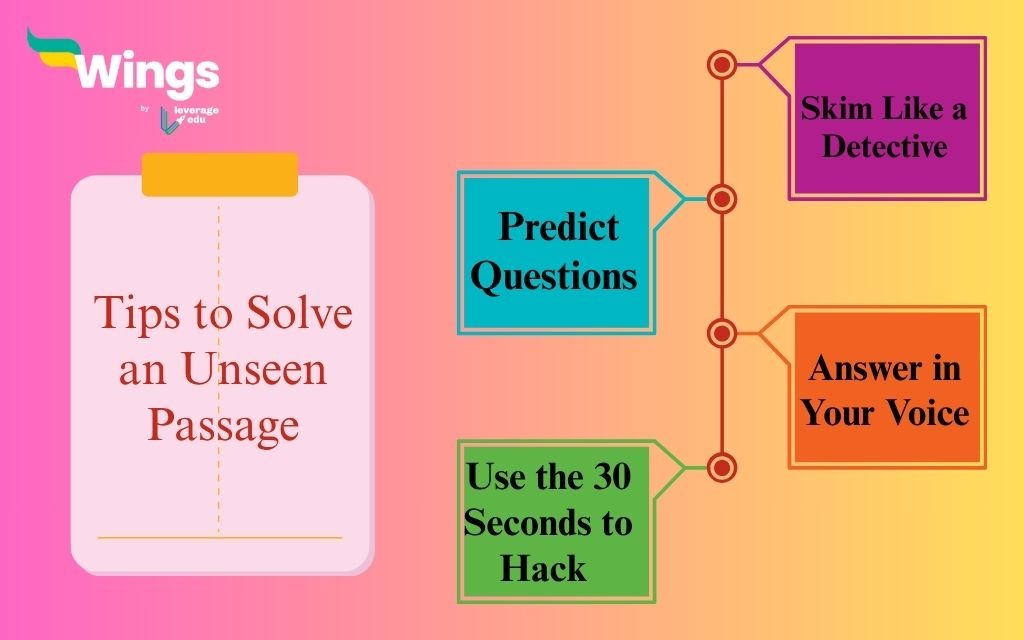
Unseen passages often feel intimidating because you have never read them before. But with the right approach, you can solve them quickly. Most students follow the usual advice, but here we will give you some cool strategies that are rarely talked about but can give you an edge in exams.
Skim Like a Detective
Don’t read word by word at first. Skim the passage like you are hunting for clues. Look for names, numbers, places, and repeated words, they usually appear in questions. Treat the passage like a mystery you need to crack.
Predict Questions
After your first skim, try to guess what questions might be asked. Is there a main idea? Any problems or solutions mentioned? This primes your brain to notice key details when you read again.
Answer in “Your Voice”
Examiners do not expect exact copying. Write answers in simple sentences using your own words, even if they are slightly casual. It’s honest, readable, and often scores better than fancy words you don’t fully understand.
Use the 30 Seconds to Hack
Before submitting, scan the passage for words you didn’t use in answers. Sometimes, questions check if you noticed a tiny fact or number. Add short notes or words from the passage to grab those hidden marks.
Unsolved Unseen Passage for Practice with Questions
These unseen passages are for practice only and do not include answers. Attempt them on your own, focus on key points, and test your comprehension skills independently.
Unsolved Unseen Passage 1: The Importance of Time Management
Time is one of the most valuable resources a student has. Managing it effectively can lead to success both in studies and personal life. Those who plan their day, prioritize tasks, and avoid procrastination often achieve more than those who work randomly. Time management also reduces stress and improves focus. Developing a daily routine and sticking to it can make studying more productive and leave room for hobbies and relaxation.
Questions:
- Why is time considered valuable for students?
- What are the benefits of managing time effectively?
- What habits can help in managing time?
- How does time management affect stress levels?
- Suggest one way students can make their study routine productive.
Unsolved Unseen Passage 2: The Life of a Volunteer
Volunteering is a rewarding activity that allows individuals to contribute to society. Volunteers help in schools, hospitals, community events, and environmental projects. They learn new skills, meet diverse people, and develop empathy. Even small contributions, like teaching underprivileged children or cleaning public spaces, can create a positive impact. Volunteering teaches responsibility, teamwork, and the value of giving without expecting anything in return.
Questions:
- In what ways can volunteers contribute to society?
- What skills can volunteers learn?
- How can small contributions make a difference?
- What values does volunteering teach?
- Why is volunteering considered rewarding?
Unsolved Unseen Passage 3: The Wonders of Space Exploration
Space exploration has fascinated humans for centuries. Satellites, telescopes, and space missions have helped us understand planets, stars, and galaxies. Scientists study space to learn about the origins of the universe, discover new planets, and develop technology that benefits life on Earth. Despite high costs and risks, space exploration inspires innovation, curiosity, and global cooperation among nations. Every mission provides knowledge that pushes the boundaries of human understanding.
Questions:
- Why has space exploration fascinated humans?
- How do scientists study space?
- What are some benefits of space research for life on Earth?
- What challenges are involved in space exploration?
- How does space exploration inspire people?
Unsolved Unseen Passage 4: Healthy Eating for Students
Eating a balanced diet is essential for the mental and physical health of students. A combination of fruits, vegetables, proteins, and carbohydrates provides the energy needed for studies and daily activities. Skipping meals or eating junk food frequently can lead to fatigue, lack of concentration, and health problems. Drinking plenty of water, avoiding sugary drinks, and maintaining regular meal timings help maintain energy levels and focus. Developing healthy eating habits early can lead to a lifetime of better health and productivity.
Questions:
- Why is a balanced diet important for students?
- What problems can result from eating junk food often?
- Which food groups are essential for energy and health?
- How does drinking water help students?
- Why is developing healthy eating habits early beneficial?
Also Read: English Unseen Passage for Class 7: CBSE Worksheet
FAQs
Ans: Unseen passages are reading texts you haven’t seen before in your textbooks. They test your comprehension, vocabulary, and ability to infer information. Regular practice helps you understand the main idea, locate key details, and answer questions confidently during exams.
Ans: Focus on skimming the passage first, highlighting keywords, and answering in your own words. Using strategies like predicting questions, understanding context clues, and managing time effectively can help you score full marks.
Ans: While the format may slightly vary, all boards test similar skills, comprehension, inference, vocabulary, and summarizing abilities. Practicing passages from different boards can make you more confident and adaptable in any exam.
Relatable Reads
This was all about unseen passages for ICSE class 9, with examples and tips, with practice passages. Consistent reading and regular practice will help you improve comprehension skills and score better in English exams. For more such helpful guides on grammar, vocabulary, and competitive exam preparation, make sure to check out the Learn English page on Leverage Edu and stay updated!

 60,000+ students trusted us with their dreams. Take the first step today!