

 One app for all your study abroad needs

















Grammar plays a big role in helping students express ideas clearly and score well in exams. This blog on English Grammar for Class 9 with important topics and practice exercises gives a complete overview of all key areas students must know. It covers tenses, modals, clauses, punctuation, and sentence transformation in an easy-to-understand way. Each topic is followed by practice exercises to strengthen understanding. The goal is to help students build strong grammar skills, write confidently, and communicate effectively in English.
This Blog Includes:
- Class 9 English Grammar Syllabus and Important Topics
- Tenses
- Modals
- Exercise: Fill in the Blanks
- Subject–Verb Agreement
- Exercise: Find the Error
- Articles and Determiners
- Exercise Type: Multiple Choice Questions (MCQs)
- Prepositions
- Exercise Type: Error Correction
- Active and Passive Voice
- Exercise Type: Sentence Transformation
- Direct and Indirect Speech
- Exercise on Direct and Indirect Speech
- Clauses
- Exercise on Clauses
- Conjunctions and Connectors
- Exercise on Conjunctions and Connectors
- Punctuation
- Exercise on Punctuation
- Sentence Reordering and Transformation
- Exercise on Sentence Reordering and Transformation
- FAQs
Class 9 English Grammar Syllabus and Important Topics
The Class 9 English Grammar syllabus focuses on helping students understand sentence structure, grammar rules, and the correct usage of words. Most boards, such as CBSE, ICSE, and State Boards, follow a similar set of grammar topics. These topics aim to improve students’ writing, comprehension, and communication skills in English.
The table below shows the complete syllabus and important topics covered under Class 9 English Grammar. Students can use this list to plan their studies and revise each topic properly.
| Topic | Key Focus Areas |
| Tenses | Present, Past, and Future forms, Continuous and Perfect tenses, consistency of tense. |
| Modals | Use of can, could, may, might, must, shall, should, will, would, need, dare, used to, ought to. |
| Subject–Verb Agreement | Rules for matching subjects and verbs, plural and singular forms. |
| Articles and Determiners | Use of a, an, the, and other determiners such as some, any, few, little, each, every. |
| Prepositions | Correct use of in, on, at, by, for, from, to, with, about, between, among. |
| Active and Passive Voice | Changing sentences from active to passive form and vice versa. |
| Direct and Indirect Speech | Reporting statements, questions, and commands correctly. |
| Clauses | Understanding main, subordinate, and relative clauses. |
| Conjunctions and Connectors | Use of coordinating, subordinating, and correlative conjunctions. |
| Punctuation | Use of commas, full stops, question marks, exclamation marks, and quotation marks. |
| Sentence Reordering and Transformation | Arranging jumbled words, changing statements to questions or negatives, and converting voices or narration. |
Tenses
Each tense has four forms, Simple, Continuous, Perfect, and Perfect Continuous, that help describe when and how an action happens.
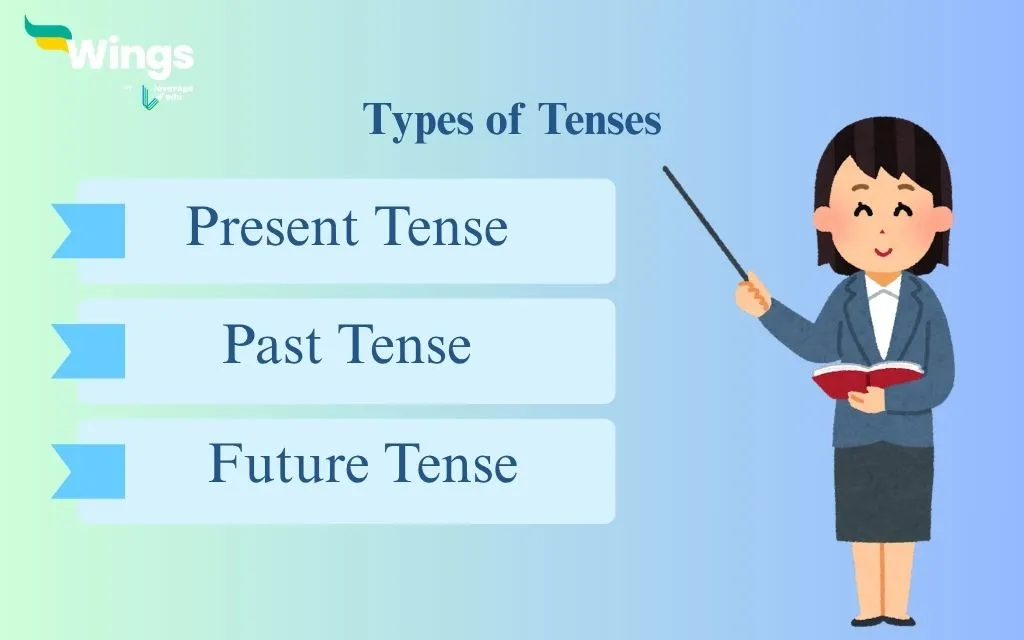
Present Tense
The Present Tense shows actions that happen now, regularly, or as a fact. It has four forms shown below.
| Form | Structure | Rule | Example |
| Simple Present | Subject + V1 (+ s/es) | Used for daily habits, facts, and general truths. | She plays the guitar. |
| Present Continuous | Subject + is/am/are + V1 + ing | Used for actions happening right now. | She is playing the guitar. |
| Present Perfect | Subject + has/have + V3 | Used for actions completed recently. | She has finished her song. |
| Present Perfect Continuous | Subject + has/have been + V1 + ing | Used for actions continuing from the past till now. | She has been practicing since morning. |
Past Tense
The Past Tense talks about actions that happened earlier or already finished.
| Form | Structure | Rule | Example |
|---|---|---|---|
| Simple Past | Subject + V2 | Used for completed actions in the past. | She played football yesterday. |
| Past Continuous | Subject + was/were + V1 + ing | Used for actions happening at a specific time in the past. | She was playing when it rained. |
| Past Perfect | Subject + had + V3 | Used for an action completed before another past action. | She had eaten before the movie started. |
| Past Perfect Continuous | Subject + had been + V1 + ing | Used for actions that continued up to a certain time in the past. | She had been studying for hours before the exam. |
Future Tense
The Future Tense shows actions that are yet to happen or are planned for later.
| Form | Structure | Rule | Example |
| Simple Future | Subject + will/shall + V1 | Used for actions that will happen in the future. | She will visit her friend tomorrow. |
| Future Continuous | Subject + will be + V1 + ing | Used for actions that will be happening at a certain time in the future. | She will be studying at 9 PM. |
| Future Perfect | Subject + will have + V3 | Used for actions completed before a future time. | She will have finished her homework by 8 PM. |
| Future Perfect Continuous | Subject + will have been + V1 + ing | Used for actions that continue up to a future point. | She will have been working here for two years next June. |
Exercise: Identify the Tense
Read each sentence carefully and identify the tense used.
- She writes in her diary every night.
- They were playing football when it started raining.
- I have finished my homework already.
- The teacher will check our notebooks tomorrow.
- He was reading a novel when I called him.
- We had reached the station before the train arrived.
- Birds fly in the sky.
- They will have completed the project by next week.
- She is watching a movie right now.
- The sun rises in the east.
Answer Sheet
- Simple Present Tense
- Past Continuous Tense
- Present Perfect Tense
- Simple Future Tense
- Past Continuous Tense
- Past Perfect Tense
- Simple Present Tense
- Future Perfect Tense
- Present Continuous Tense
- Simple Present Tense
Modals
Modals are helping verbs that show how sure, possible, or necessary an action is. You must know which modal fits the situation, whether it shows permission, ability, advice, or obligation.
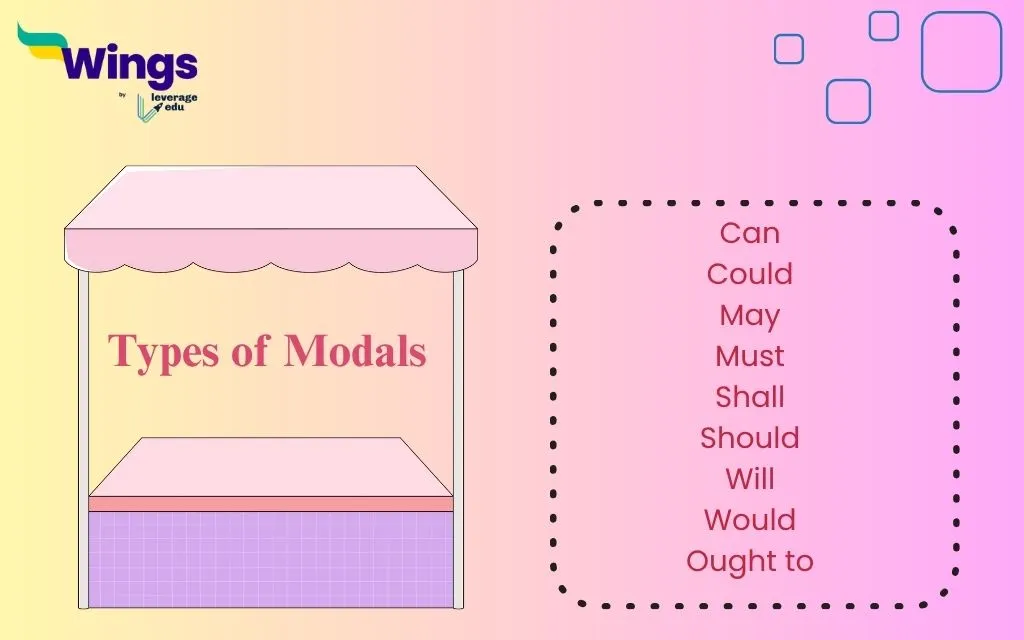
| Modal Verb | Function | Structure | Example |
| Can | Shows ability or permission | Subject + can + base verb | She can solve this problem easily. |
| Could | Past ability or polite request | Subject + could + base verb | Could you open the window, please? |
| May | Shows permission or possibility | Subject + may + base verb | You may go now. |
| Might | Weaker possibility | Subject + might + base verb | It might rain today. |
| Must | Expresses strong necessity or certainty | Subject + must + base verb | You must wear your ID card. |
| Shall | Suggests future or formal offer | Subject + shall + base verb | Shall we begin the class? |
| Should | Gives advice or duty | Subject + should + base verb | You should drink more water. |
| Will | Expresses future action | Subject + will + base verb | I will call you later. |
| Would | Polite request or conditional | Subject + would + base verb | I would help if I could. |
| Ought to | Moral duty or advice | Subject + ought to + base verb | We ought to respect elders. |
| Need to | Shows necessity | Subject + need to + base verb | You need to study harder. |
| Used to | Past habit | Subject + used to + base verb | She used to play football. |
Exercise: Fill in the Blanks
Choose the most suitable modal verb from the list: can, could, may, might, must, should, will, would, need to, ought to.
- You ___ wear a helmet while riding a bike.
- She ___ solve this math problem when she was five.
- It ___ rain today; the sky looks dark.
- You ___ speak politely to your teachers.
- ___ I borrow your pen, please?
- We ___ finish this project before Monday.
- He ___ be at home because the lights are on.
- You ___ not worry so much; everything will be fine.
- They ___ go to the park every evening when they were kids.
- I ___ help you if you ask nicely.
Answer Sheet
- must
- could
- might
- should
- May
- need to
- must
- should
- used to
- would
Subject–Verb Agreement
Subject–verb agreement means the subject and the verb in a sentence must match each other. If the subject is singular, the verb must also be singular. If the subject is plural, the verb must be plural.
- Singular subject takes a singular verb.
Example: He plays football every evening. - Plural subject takes a plural verb.
Example: They play football every evening. - Two subjects joined by “and” take a plural verb.
Example: Riya and Meena are best friends. - When two subjects are joined by “or” or “nor,” the verb agrees with the subject closer to it. Example: Either Rohan or his friends are coming today.
Example: Either his friends or Rohan is coming today. - Collective nouns such as “team,” “family,” and “group” take a singular verb when treated as one unit.
Example: The team is winning the match. - Words like “each,” “everyone,” “someone,” “nobody,” and “everybody” always take singular verbs.
Example: Everyone loves pizza. - Uncountable nouns such as “milk,” “sugar,” “money,” and “furniture” take singular verbs.
Example: The milk is cold. - Use singular verbs after “there is” or “there was” for singular nouns and plural verbs for plural nouns.
Example: There is a cat on the roof.
Example: There are cats on the roof. - Titles of books, movies, or organizations always take singular verbs.
Example: “The Avengers” is a popular movie.
Exercise: Find the Error
Identify the part of the sentence that has a subject–verb agreement error. If the sentence is correct, write “No error.”
- Riya and Meena is studying for their exams.
- Either my friends or my brother are responsible for this mess.
- The teacher explain the topic very clearly every day.
- There is many students waiting outside the class.
- Each of the players have a new jersey.
- The family are going on a vacation next week.
- Everybody love the school picnic.
- The milk are kept in the refrigerator.
- Neither of the answers seem correct.
- My shoes is too tight for me.
Answer Sheet
- is → are
- are → is
- explain → explains
- is → are
- have → has
- are → is
- love → loves
- are → is
- seem → seems
- is → are
Articles and Determiners
Articles and determiners are words placed before nouns to give more information about them. They help us understand which noun, how many, or whose we are talking about. In school exams, questions from this topic often check if you can correctly identify or use a, an, the, or other determiners like some, many, few, this, those, each, etc.
1. Articles
Articles are of two types:
- Indefinite Articles: a, an
- Definite Article: the
Indefinite Articles (a, an)
They are used when we talk about something in general or for the first time.
- ‘A’ is used before words starting with a consonant sound.
Example: a boy, a car, a university (“university” starts with a “yoo” sound) - ‘An’ is used before words starting with a vowel sound (a, e, i, o, u) or a silent ‘h’.
Example: an apple, an hour, an honest man
b. Definite Article (the)
‘The’ is used when we talk about a specific person, place, or thing, something already known or unique
Use “the” when:
- Talking about something mentioned earlier.
Example: I saw a cat. The cat was sleeping. - Referring to unique objects.
Example: the sun, the moon, the Earth - Naming mountain ranges, seas, rivers, and groups of islands.
Example: the Himalayas, the Nile, the Andaman Islands - Talking about superlatives or ordinal numbers.
Example: the best student, the first day - Referring to instruments or inventions.
Example: He can play the guitar. - Talking about nationalities or communities.
Example: the Indians, the Japanese - Referring to titles of books, newspapers, or organizations.
Example: The Times of India, The Ramayana
Do not use “the” when:
- Talking about general or plural nouns.
Example: Books are useful. (Not the books unless specific) - Before languages, meals, and sports.
Example: She speaks French. We play football after lunch.
2. Determiners
Determiners are words placed before nouns to show quantity, possession, or position. They include articles, demonstratives, possessives, quantifiers, and numbers.
Let’s understand each type:
Demonstratives
Show which thing or person we are talking about.
- This / These → for things near us
- That / Those → for things far from us
Examples:
- This book is interesting.
- Those students are from our school.
Possessives
Show ownership or belonging. Examples: my, your, his, her, its, our, their
Example:
- My bag is new.
- Their house is big.
Quantifiers
Show how much or how many. They are used with both countable and uncountable nouns.
For countable nouns: many, a few, several, each, every
For uncountable nouns: much, a little, some, any, enough
Examples:
- I have a few friends.
- There isn’t much water left.
- Do you have any sugar?
Numbers and Ordinals
Used to specify exact quantity or order. Examples: one, two, first, second, third
Example:
- She bought two dresses.
- He stood first in the race.
Distributives
Used to refer to members of a group individually. Examples: each, every, either, neither
Examples:
- Each student must bring their notebook.
- Neither answer is correct.
Exercise Type: Multiple Choice Questions (MCQs)
Choose the correct option to complete each sentence meaningfully.
- I saw ___ elephant at the zoo.
a) a b) an c) the d) no article - ___ moon looks beautiful tonight.
a) a b) an c) the d) some - There are ___ apples in the basket.
a) much b) any c) many d) every - She gave me ___ honest advice.
a) a b) an c) the d) some - ___ student in the class passed the test.
a) Each b) Much c) Some d) A - I need ___ money to buy a notebook.
a) few b) some c) many d) each - He lives in ___ same building as mine.
a) a b) an c) the d) every - ___ books on that shelf belong to my sister.
a) This b) Those c) Each d) A - We should help ___ poor and needy.
a) a b) the c) some d) every - I have ___ idea what you are talking about.
a) an b) the c) some d) no
Answer Key
1 – b) an
2 – c) the
3 – c) many
4 – b) an
5 – a) Each
6 – b) some
7 – c) the
8 – b) Those
9 – b) the
10 – a) an
Also Read: Unseen Poem for Class 9 with Questions and Answers
Prepositions
Prepositions are small words that show the relationship between a noun or pronoun and the rest of the sentence. They tell us about place, time, direction, movement, and position.
1. Prepositions of Place
They show where something is.
Common words: in, on, at, under, over, between, behind, beside
Rules:
- Use in for an enclosed space.
Example: The books are in the bag. - Use on for surfaces.
Example: The cat is on the table. - Use at for a specific point.
Example: She is at the door.
2. Prepositions of Time
They show when something happens.
Common words: at, on, in, before, after, during, since, for
Rules:
- Use in for months or years.
Example: He was born in 2010. - Use on for days or dates.
Example: The meeting is on Monday. - Use at for exact times.
Example: The train leaves at 7 p.m.
3. Prepositions of Direction and Movement
They show where something is going.
Common words: to, from, into, out of, through, across, along, up, down
Rules:
- Use to for movement towards a place.
Example: She went to school. - Use from to show starting point.
Example: He came from London. - Use into when entering something.
Example: The dog jumped into the pool.
4. Prepositions of Position or Relation
They show the relationship between two things.
Common words: above, below, near, among, between
Rules:
- Use between for two things.
Example: The ball is between the boxes. - Use among for more than two.
Example: She was sitting among her friends.
5. Prepositional Phrases
A prepositional phrase starts with a preposition and ends with a noun or pronoun.
Example: The boy in the blue shirt is my friend.
Exercise Type: Error Correction
Each sentence below has one wrong preposition. Find and correct it.
- He arrived to the airport at 5 a.m.
- The cat is sitting in the table.
- We will meet in Monday.
- She jumped on the swimming pool.
- The school is at Delhi.
- They have been waiting since two hours.
- The picture is hanging in the wall.
- He walked on the river bridge.
- She divided the cake among her two brothers.
- The child is afraid from the dark.
Answer Key
- arrived at the airport
- sitting on the table
- meet on Monday
- jumped into the swimming pool
- school is in Delhi
- waiting for two hours
- hanging on the wall
- walked over the river bridge
- divided the cake between her two brothers
- afraid of the dark
Active and Passive Voice
Every sentence in English has a doer (the one performing the action) and a receiver (the one receiving the action). When the focus is on the doer, the sentence is in the Active Voice. When the focus shifts to the receiver, the sentence is in the Passive Voice.
Basic Rule of Conversion
Active Voice: Subject + Verb + Object
Passive Voice: Object + Auxiliary Verb + Past Participle + by + Subject
Tense-wise Rules and Examples
Follow these rules.
1. Simple Present Tense
Active: She writes a letter.
Passive: A letter is written by her.
2. Present Continuous Tense
Active: They are playing football.
Passive: Football is being played by them.
3. Present Perfect Tense
Active: He has cleaned the room.
Passive: The room has been cleaned by him.
4. Simple Past Tense
Active: The police caught the thief.
Passive: The thief was caught by the police.
5. Past Continuous Tense
Active: She was reading a novel.
Passive: A novel was being read by her.
6. Past Perfect Tense
Active: They had built a bridge.
Passive: A bridge had been built by them.
7. Simple Future Tense
Active: She will deliver the message.
Passive: The message will be delivered by her.
8. Future Perfect Tense
Active: He will have completed the project.
Passive: The project will have been completed by him.
Exercise Type: Sentence Transformation
Change the following sentences from active voice to passive voice.
- She writes a letter.
- They are watching a movie.
- He has repaired the car.
- The police caught the thief.
- She will complete the work tomorrow.
- The chef is baking a cake.
- They had finished the project.
- The gardener waters the plants every morning.
- Someone has stolen my bag.
- The teacher will check your notebook.
Answer Key
- A letter is written by her.
- A movie is being watched by them.
- The car has been repaired by him.
- The thief was caught by the police.
- The work will be completed by her tomorrow.
- A cake is being baked by the chef.
- The project had been finished by them.
- The plants are watered by the gardener every morning.
- My bag has been stolen.
- Your notebook will be checked by the teacher.
Direct and Indirect Speech
In English, we can report what someone says in two ways, Direct Speech and Indirect Speech. When we use the speaker’s exact words, it’s called Direct Speech. When we report the meaning of what was said without quoting the exact words, it’s called Indirect Speech.
Direct Speech: Reporting Verb + “Quoted Speech”
Indirect Speech: Reporting Verb + that + Reported Speech
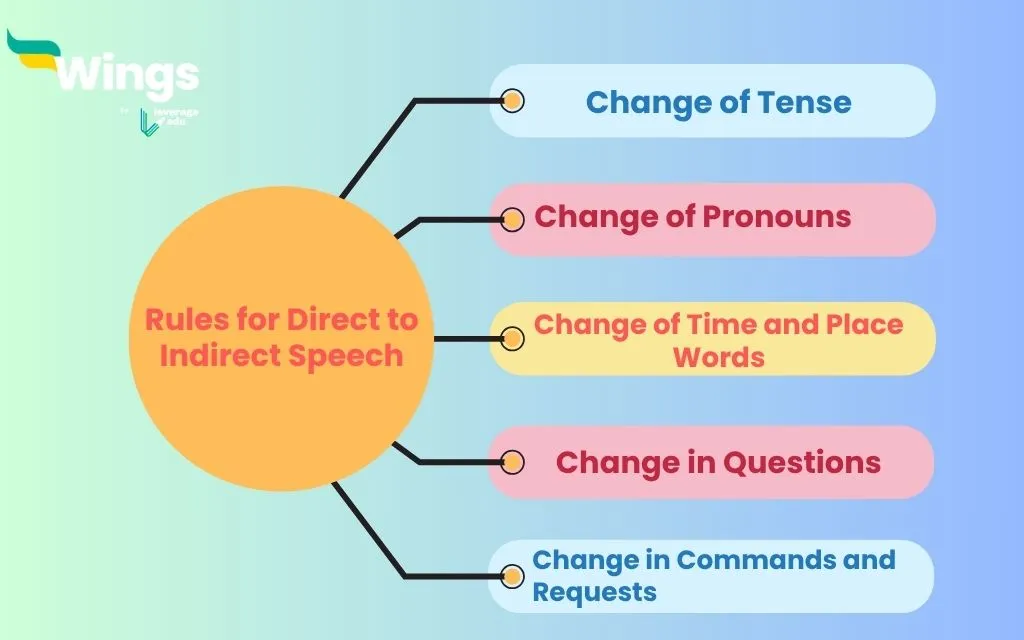
Rules for Changing Direct to Indirect Speech
Follow these rules to change the speech.
1. Change of Tense
When the reporting verb is in the past tense, the tense of the reported speech usually goes one step back.
| Direct Speech | Indirect Speech |
| am/is → was | has/have → had |
| was/were → had been | will → would |
| can → could | shall → should |
Example:
Direct: He said, “I am hungry.”
Indirect: He said that he was hungry.
2. Change of Pronouns
Pronouns change according to the subject and object of the reporting verb.
| Direct Speech | Indirect Speech |
| I → he/she | we → they |
| my → his/her | our → their |
Example:
Direct: She said, “I lost my book.”
Indirect: She said that she had lost her book.
3. Change of Time and Place Words
| Direct | Indirect |
| today → that day | tomorrow → the next day |
| yesterday → the previous day | now → then |
| here → there | this → that |
Example:
Direct: He said, “I will go tomorrow.”
Indirect: He said that he would go the next day.
4. Change in Questions
When reporting questions, remove the question mark and use if/whether (for yes-no questions) or keep the wh-word (for wh-questions).
Examples:
Direct: She said, “Are you ready?”
ndirect: She asked if I was ready.
Direct: He said, “Where do you live?”
Indirect: He asked where I lived.
5. Change in Commands and Requests
Use verbs like told, asked, requested, ordered, advised depending on the tone.
Examples:
Direct: She said, “Please open the door.”
Indirect: She requested me to open the door.
Direct: The teacher said, “Complete your work.”
Indirect: The teacher told us to complete our work.
Exercise on Direct and Indirect Speech
Change the following sentences from Direct Speech to Indirect Speech or Indirect to Direct Speech as asked.
- He said, “I am going to school.”
- She said, “My parents will arrive tomorrow.”
- The teacher said, “Honesty is the best policy.”
- Rohan said, “I finished my homework yesterday.”
- He said to me, “Can you help me with this question?”
- She said, “Where are you going?”
- The doctor said, “Don’t eat junk food.”
- They said, “We are waiting for the bus.”
- She asked me if I liked reading books. (Change to Direct Speech)
- The boy told his friend to wait outside. (Change to Direct Speech)
Answer Sheet
- He said that he was going to school.
- She said that her parents would arrive the next day.
- The teacher said that honesty is the best policy.
- Rohan said that he had finished his homework the previous day.
- He asked me if I could help him with that question.
- She asked where I was going.
- The doctor advised not to eat junk food.
- They said that they were waiting for the bus.
- She said, “Do you like reading books?”
- The boy said to his friend, “Wait outside.”
Clauses
A clause is a group of words that has a subject and a verb. It can make complete or incomplete sense depending on its type. Clauses help in building complex and meaningful sentences in English grammar.
Types of Clauses
There are three main types of clauses that students should know for Class 9 exams: Main Clause, Subordinate Clause, and Coordinate Clause.
1. Main Clause (Independent Clause)
A main clause makes complete sense on its own. It can stand alone as a sentence.
Rule:
- Has one subject and one predicate (verb).
- Can form a full sentence independently.
Examples:
- She loves reading.
- I went home after school.
2. Subordinate Clause (Dependent Clause)
A subordinate clause cannot stand alone. It depends on the main clause for complete meaning.
Rule:
- Begins with a subordinating conjunction like because, although, when, if, unless, since, etc.
- Always adds detail or reason to the main clause.
Examples:
- I stayed home because it was raining.
- She cried when she saw the result.
3. Coordinate Clause
A coordinate clause is linked to another main clause using a coordinating conjunction like and, but, or, so, for, nor, yet.
Rule:
- Both clauses are equally important.
- Joined by coordinating conjunctions.
Examples:
- I wanted to go out, but it started raining.
- She cooked dinner, and he washed the dishes.
Subtypes of Subordinate Clauses
Subordinate Clauses are further divided into three important kinds for exams:
a) Noun Clause
Acts as a noun in a sentence.
Example: I know that she is honest.
b) Adjective Clause
Describes a noun or pronoun in the main clause.
Example: The boy who won the race is my friend.
c) Adverb Clause
Modifies a verb, adjective, or another adverb.
Example: She sings because she loves music.
Exercise on Clauses
Read the sentences carefully and identify or complete the clause as directed.
Exercise 1 – Identify the Type of Clause
Identify whether the underlined part is a Noun Clause, Adjective Clause, or Adverb Clause.
- I believe that honesty is the best policy.
- The boy who topped the class lives next door.
- You will succeed if you work hard.
- I don’t know when she will arrive.
- This is the place where we met first.
Exercise 2 – Combine the Sentences Using Clauses
Join the following pairs using suitable clauses.
- She is my friend. She helped me yesterday.
- I did not attend the party. I was not invited.
- The teacher praised the girl. The girl solved the question.
- He cannot come today. He is sick.
- We stayed indoors. It was raining heavily.
Exercise 3 – Complete the Sentence with a Suitable Clause
Write a meaningful clause to complete each sentence.
- I will not go out unless __________.
- Nobody knows __________.
- The book that __________ is mine.
- She smiled when __________.
- I don’t understand why __________.
Answer Key
- Noun Clause
- Adjective Clause
- Adverb Clause
- Noun Clause
- Adverb Clause
- She is my friend who helped me yesterday.
- I did not attend the party because I was not invited.
- The teacher praised the girl who solved the question.
- He cannot come today as he is sick.
- We stayed indoors because it was raining heavily.
- …it stops raining.
- …she went away.
- …I borrowed yesterday.
- …I gave her the gift.
- …he is always late.
Also Read: 5 Prepositions Exercises for Class 9 ICSE with Answers for Practice
Conjunctions and Connectors
Conjunctions and connectors are words that join ideas, sentences, or clauses to make writing smooth and clear. They show how ideas relate, whether they add, contrast, reason, or result.
Types of Conjunctions and Connectors
There are 4 main types of conjunctions.
1. Coordinating Conjunctions
They connect two equal parts (words, phrases, or clauses).
Common words: and, but, or, so, for, nor, yet
Rule: Use them when both sides of the sentence are equally important.
Example: She wanted to go out, but it was raining.
2. Subordinating Conjunctions
They connect a dependent clause with an independent clause.
Common words: because, although, since, when, if, while, unless
Rule: Use them when one idea depends on the other.
Example: I will call you when I reach home.
3. Correlative Conjunctions
They come in pairs and join equal parts.
Common pairs: either…or, neither…nor, both…and, not only…but also
Rule: Make sure both parts of the pair match in structure.
Example: Either you study now or you will regret it later.
4. Connectors (Linking Words)
Connectors link sentences or ideas logically in writing or speech.
- Addition: moreover, also, in addition, besides
- Contrast: however, on the other hand, whereas
- Cause/Result: therefore, thus, consequently, as a result
- Time: then, afterwards, meanwhile, later
Example: She worked hard; therefore, she succeeded.
Exercise on Conjunctions and Connectors
Fill in the blanks with suitable conjunctions or connectors from the brackets.
- I wanted to go for a walk, ______ it started raining. (but / and / because)
- She didn’t come to school ______ she was sick. (although / because / so)
- You must finish your homework ______ you cannot go out to play. (and / or / otherwise)
- ______ he worked hard, he didn’t score well. (Although / Because / Since)
- The show was interesting ______ everyone clapped at the end. (so / while / because)
- ______ you study regularly, you will not forget your lessons. (If / When / Unless)
- I will call you ______ I reach the airport. (after / before / until)
- He is rich ______ he is not proud. (so / yet / for)
- We missed the train ______ we were late. (since / though / if)
- She speaks English fluently ______ she practices daily. (because / while / although)
Answer Key
- but
- because
- otherwise
- Although
- so
- If
- after
- yet
- since
- because
Punctuation
Punctuation marks are small symbols that make big changes in how we read, write, and understand sentences. They help show pauses, emotions, and structure in writing. Without them, even a simple sentence can sound confusing or funny.
1. Full Stop (.)
Used to end a sentence that makes a statement.
Example: I like reading books.
2. Comma (,)
Used to show a short pause or separate items in a list.
Example: I bought apples, bananas, and oranges.
3. Question Mark (?)
Used after direct questions.
Example: Where are you going?
4. Exclamation Mark (!)
Used to show strong emotion like surprise, joy, or anger.
Example: What a beautiful day!
5. Apostrophe (’)
Used to show possession or make contractions.
Examples:
- Possession – Riya’s bag is red.
- Contraction – It’s raining. (It is raining.)
6. Quotation Marks (“ ”)
Used to show exact words spoken by someone.
Example: She said, “I am happy today.”
7. Colon (:)
Used to introduce a list, explanation, or quotation.
Example: She packed three things: clothes, shoes, and snacks.
8. Semicolon (;)
Used to join two closely related sentences.
Example: I wanted to call him; he was already asleep.
9. Hyphen (-)
Used to join two words that act as one.
Example: She has a part-time job.
10. Capital Letters
Used at the start of sentences, names, places, and days.
Example: Monday is my favorite day.
Exercise on Punctuation
Rewrite the sentences below using the correct punctuation marks.
- what are you doing after school
- riya said i will join the dance club
- my friends bought apples bananas oranges and grapes
- it is raining lets stay inside
- wow that movie was amazing
- he said i cant find my notebook
- rahul is a kind honest and hardworking boy
- when will you come home
- i love visiting paris london and new york
- dont worry youll do great in the exam
Answer Key
- What are you doing after school?
- Riya said, “I will join the dance club.”
- My friends bought apples, bananas, oranges, and grapes.
- It is raining; let’s stay inside.
- Wow! That movie was amazing!
- He said, “I can’t find my notebook.”
- Rahul is a kind, honest, and hardworking boy.
- When will you come home?
- I love visiting Paris, London, and New York.
- Don’t worry, you’ll do great in the exam.
Sentence Reordering and Transformation
Sentence reordering and transformation are two very common grammar topics in Class 9 English exams. These topics test how well you can organize ideas and change sentence structures without changing the meaning.
1. Sentence Reordering
Sentence reordering means arranging jumbled words or sentences in the correct order to form a meaningful sentence or paragraph. It checks your understanding of sentence structure, connectors, and logical flow.
How to Solve:
- Find the subject, verb, and object in each sentence.
- Look for linking words like “because,” “then,” or “however.”
- Arrange the sentences so that they make a clear story or idea.
Example:
- Jumbled: school / to / every / goes / he / day
- Correct: He goes to school every day.
2. Sentence Transformation
Sentence transformation means changing the form of a sentence while keeping its meaning the same. This includes changing voice, speech, degree, type, or structure.
Types of Sentence Transformation:
a) Affirmative to Negative
Change a positive sentence into a negative one without changing its meaning.
Example: She is clever. → She is not dull.
b) Assertive to Interrogative
Change a statement into a question.
Example: He is your brother. → Is he your brother?
c) Simple to Complex / Compound
Use connectors like because, since, and or so that to join or separate clauses.
Example:
- Simple: He worked hard to pass.
- Complex: He worked hard because he wanted to pass.
d) Direct to Indirect Speech
Report what someone said without quoting their exact words.
Example:
- Direct: She said, “I am tired.”
- Indirect: She said that she was tired.
e) Active to Passive Voice
Change the focus from the doer to the action.
Example:
- Active: The teacher praised the student.
- Passive: The student was praised by the teacher.
Exercise on Sentence Reordering and Transformation
This exercise will help you test your understanding of how to arrange jumbled words or sentences and change sentence forms without changing the meaning. These are common in Class 9 English exams, so try them carefully.
Exercise Type 1 – Sentence Reordering
Rearrange the following jumbled words to make meaningful sentences.
- likes / he / football / playing
- the / early / morning / rises / in / sun / the
- our / respect / we / teachers / should
- lunch / I / after / my / homework / do
- in / many / are / the / flowers / garden
Answer Key
- He likes playing football.
- The sun rises early in the morning.
- We should respect our teachers.
- I do my homework after lunch.
- There are many flowers in the garden.
Exercise Type 2 – Sentence Transformation
Rewrite the following sentences as directed in the brackets.
- She is very intelligent. (Change into negative)
- I said, “I am studying now.” (Change into indirect speech)
- He eats an apple every day. (Change into passive voice)
- You are late. (Change into interrogative)
- Riya works hard to win the prize. (Change into complex sentence)
Answer Key
- She is not dull.
- I said that I was studying then.
- An apple is eaten by him every day.
- Are you late?
- Riya works hard because she wants to win the prize.
Also Read: Subject Verb Agreement Worksheet for Class 9 Students
FAQs
Ans: Every topic in English grammar is important, but tenses, subject–verb agreement, and modals form the base of correct sentence construction. Mastering these helps students write accurately and avoid common grammatical mistakes in exams and writing tasks.
Ans: Reading regularly, practicing grammar exercises daily, and revising basic rules are the best ways to improve grammar. Solving worksheets on tenses, clauses, and prepositions can help you understand usage better and gain confidence.
Ans: To score full marks, focus on understanding grammar concepts rather than memorizing them. Practice past papers, revise important rules, and attempt topic-wise exercises to strengthen accuracy and speed during exams.
Relatable Reads
This was all about English Grammar for Class 9 with important topics and practice exercises. Regular practice will help you strengthen your grammar and express your ideas confidently. For more such helpful guides on grammar, vocabulary, and competitive exam preparation, make sure to check out the Learn English page on Leverage Edu and stay updated!

 2,00,000+ students realized their study abroad dream with us. Take the first step today.