

 One app for all your study abroad needs













Coordinating conjunctions or connectives are the joining words you look for the most while connecting words, phrases, or clauses of equal grammatical rank. They may seem small, but they are a must when it comes to presenting your thoughts in an organised way. But, to use coordinating conjunctions appropriately, you would first need to learn their rules of usage. Therefore, this blog article focuses on 7 key coordinating conjunction examples of F.A.N.BOYS (For, And, Nor, But, Or, Yet, So) for easy and fun learning.
This Blog Includes:
What are the 7 Coordinating Conjunctions?
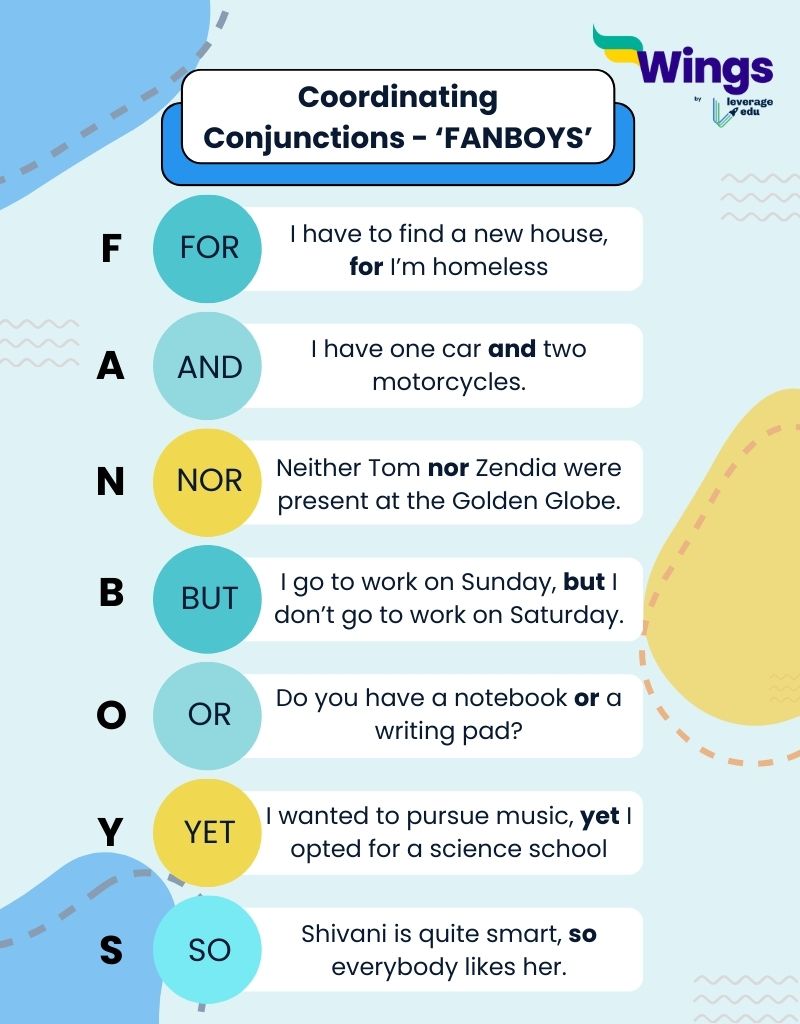
As you know, coordinating conjunctions are known for joining two equal words, clauses, or phrases in the English language. There are seven highly used coordinating conjunctions within the grammatical structure, i.e., for, and, nor, but, or, yet, and so. The first letter of each coordinating conjunction becomes a memorable acronym: FANBOYS.
Must Read: 9 Basic Rules in Grammar to Improve Your English
Usage and Examples of Coordinating Conjunctions: FANBOYS
Now, let’s explore the examples of each coordinating conjunction along with their rules of usage one by one for a better understanding.
F – ‘For’ Coordinating Conjunction Examples
‘For’ as a conjunction is used to express reason or cause. For example, I studied hard for I wanted to get a good grade. It works like “because” and gives justification for the first part of the sentence. Here are some more examples of ‘For’ within sentences.
- She loves to cook for her family and friends.
- He exercised regularly for both his physical and mental health.
- We went to the beach for some sunshine and relaxation.
- He studied French for two years before travelling to Paris.
- They saved money for a down payment on a house.
- I read the book for pleasure, not for a class.
- The team practised hard for the upcoming competition.
- She baked a cake for her friend’s birthday.
- He did the chores for his mother as a gesture of kindness.
- I stayed home, for I was feeling sick.
A – ‘And’ Coordinating conjunction Examples
‘And’ is used best to join words, phrases, or clauses in respect of addition. It joins similar ideas, actions, or items and shows continuation or combination.Take a look at the examples below:
- I love reading and writing.
- The movie was funny and heartwarming.
- She speaks English and Spanish fluently.
- He enjoys hiking and camping in the outdoors.
- They went shopping and had lunch together.
- The recipe required flour, eggs, and butter.
- He worked hard and achieved his goals.
- The cat chased the mouse and then napped in the sun.
- The city is bustling with activity and full of life.
- She loves coffee and tea equally.
N – ‘Nor’ Coordinating conjunction Examples
The usage of ‘nor’ is similar to ‘and’ but is used in negative sentences. It usually connects two negative choices.For example,
- Neither he nor she knew the answer to the question.
- The restaurant serves neither meat nor dairy products.
- I went neither to the movies nor to the party.
- She speaks neither French nor Italian.
- The house had neither heating nor air conditioning.
- He trusts neither him nor his friend.
- The cake was neither sweet nor sour.
- They received neither praise nor criticism.
- The movie was neither scary nor funny.
- She will neither speak nor smile
B – ‘But’ Coordinating conjunction Examples
The coordinating conjunction ‘But’ creates contrast or opposition between ideas. It is used to show contrast or opposition. For example,
- I like cats, but I prefer dogs.
- He worked hard, but he didn’t get the promotion.
- The weather was sunny, but it was also windy.
- She wanted to stay, but she had to leave.
- They bought a new car, but they can’t afford it.
- Coffee is bitter, but I like the taste.
- The book was long, but it was also engaging.
- He studied science, but he is now working in art.
- She is shy, but she is also very friendly.
- It is hot outside, but the pool is refreshing.
O – ‘Or’ Coordinating conjunction Examples
‘Or’ is used to offer choices or alternatives. It shows that only one option may be selected. Take a look at the examples below for reference:
- Would you like coffee or tea?
- We can go to the park or the museum.
- Do you prefer reading or watching movies?
- He can speak English or French.
- She wants to travel to Asia or Europe.
- Choose chocolate or vanilla ice cream.
- It will rain or snow tomorrow.
- Sleep now, or you will be tired in the morning.
- He needs to pay the rent, or he will be evicted.
- Take the stairs or the elevator.
Must Read: List of Conjunctions
Y – ‘Yet’ Coordinating conjunction Examples
Yet is used to introduce a contrasting statement, indicating surprise or opposition. It is similar to “but,” but with a stronger sense of surprise or unexpected outcome. For instance,
- The movie was long, yet I enjoyed it.
- He was nervous, yet he gave a great presentation.
- The restaurant was crowded, yet we got a table quickly.
- She was tired, yet she stayed up late to finish her work.
- The problem was difficult, yet we found a solution.
- The journey was long, yet the scenery was beautiful.
- He lost the game, yet he learned a valuable lesson.
- The cake looked burnt, yet it tasted delicious.
- The house was old, yet it had a lot of charm.
- He was shy, yet he made a new friend.
S – ‘So’ Coordinating conjunction Examples
‘So’ shows cause and effect or introduces a consequence. It explains what happens because of an action or situation. Let’s take a look at the following examples:
- He failed the test, so he had to retake it.
- It was raining, so we stayed inside.
- I finished my work, so I relaxed for the rest of the day.
- She was hungry, so she made a sandwich.
- She studied hard, so she got a good grade.
- The movie was funny, so everyone laughed.
- I was tired, so I went to bed early.
- The weather was nice, so we went for a walk.
- He was lost, so he asked for directions.
- She was late, so she apologised.
FAQs
Examples include: for, and, nor, but, or, yet, so, repeated in sentences like and then, but still, or else, showing common real-life usage.
Examples: I tried hard but failed. She studies and works. Stay here or leave now. He was tired so he slept. They didn’t call nor reply.
The seven coordinating conjunctions are for, and, nor, but, or, yet, and so. They are often remembered using the acronym FANBOYS.
Examples: I wanted tea but chose coffee. She cooked and cleaned. He was late, so he ran. You can stay or leave. I didn’t call nor text.
They help connect ideas clearly, make sentences smoother, and improve writing flow by linking words, phrases, or independent clauses without changing meaning.
Find more grammar reads below!
| Compound Prepositions | Branches of Linguistics |
| How to Say Hello in Different Indian Languages? | Articles and Preposition |
| Prepositions of Directions | Pictures for Preposition |
This was all about the coordinating conjunction examples in English grammar. Hope you understand the concept and know how to proceed. You can also follow Leverage Edu for more exciting and informative blogs.

 60,000+ students trusted us with their dreams. Take the first step today!