

 One app for all your study abroad needs














English grammar becomes a headache the moment active and passive sentences show up in exercises. Teachers explain it once and expect you to magically decode every tense, every rule, and every exception like your brain is a processor. One mistake and the whole sentence collapses. The Active Passive Voice Chart exists because no student deserves to fight grammar blindfolded. It shows who does the action, who receives it, and how to switch without rewriting your entire sentence from scratch.
This Blog Includes:
What is Active Voice?
Active voice is a grammatical structure in which the subject of a sentence performs the action expressed by the verb. In other words, the focus is on the doer of the action rather than the receiver. This form of writing is usually clear, direct, and more engaging for the reader.
For example, in the sentence “The teacher explained the lesson,” the subject “the teacher” is actively doing the verb “explained,” and the object “the lesson” receives the action.
Active voice is commonly used in both spoken and written English because it makes sentences easier to understand and more concise. It contrasts with passive voice, where the object of the action becomes the focus, such as in “The lesson was explained by the teacher.”
Structure of Active Voice:
In active voice, the sentence structure typically follows the pattern: subject + verb + object.
This structure helps create strong and effective communication, especially in academic writing, storytelling, and everyday conversation.
Example: The dog is chasing the ball.
What is Passive Voice?
Passive voice is a grammatical construction in which the subject of a sentence receives the action rather than performing it. In this structure, the focus shifts from the doer of the action to the receiver of the action.
For example, in the sentence “The book was read by the student,” the subject “the book” is not doing the action but rather receiving it. The real doer of the action, “the student,” comes later in the sentence, often introduced by the word “by.”
Structure of Passive Voice:
The typical structure of a passive voice sentence is: object + form of the verb “to be” + past participle + (by + subject).
Passive voice is often used when the doer is unknown, unimportant, or implied, such as in “The window was broken” or “The homework was completed.”
While passive voice can be useful in certain situations, especially in formal or scientific writing, overusing it can make sentences sound vague or wordy. Therefore, it is generally recommended to prefer the active voice for clearer and more dynamic communication.
Example: The ball is being chased by the dog.
Also Read: Active and Passive Voice Rules for All Tenses [PDF Available]
Active Passive Voice Chart with Examples
In this section, we have active passive voice chart with all the tenses, which will help you understand how you can construct sentences by incorporating the rules.
These charts are useful because they show the change in verb form and sentence structure for each tense. Students can use it to practice converting active sentences into passive ones and vice versa. It also helps improve writing skills by teaching when and how to use both voices correctly. This chart is especially useful in grammar exams and school writing tasks, making sentence transformation much easier to learn.
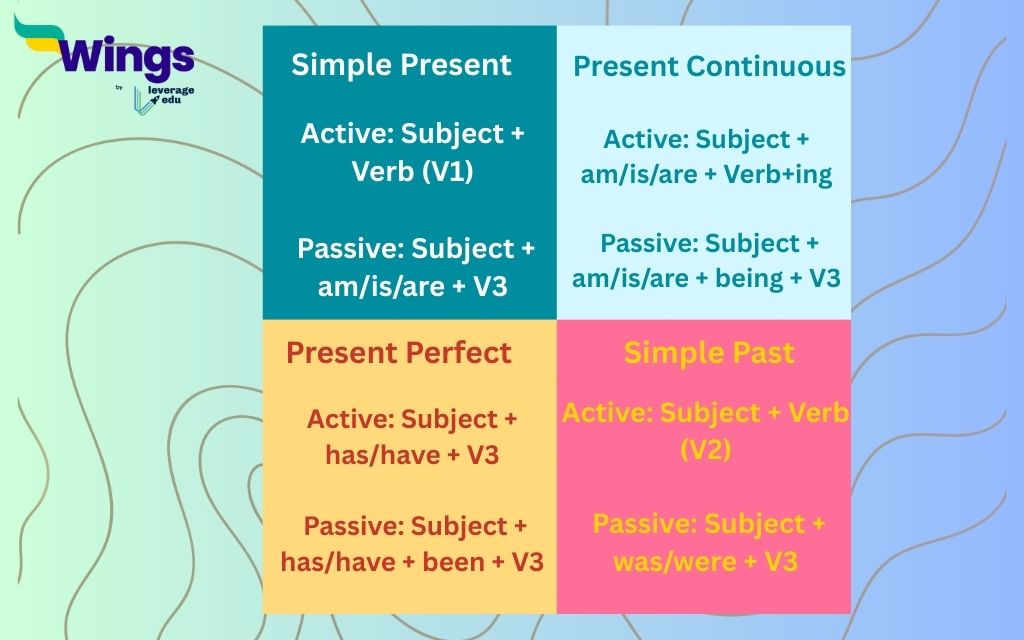
Simple Present Active Passive Voice Chart
Here is a table which has listed down the rules of Active and Passive Voice with examples for Present Simple.
| Active Voice | Passive Voice (Auxiliary Verb – is/am/are) |
| Subject + V1+s/es+ object | Object+ is/am/are+ V3+ by + subject |
| Subject + Do/does+ not + V1 + Object | Object + is/am/are+ not + V3+ by Subject |
| Does+ Subject+ V1+Object+? | Is/am/are + Object+ V3+ by subject +? |
Here are some examples of both active and passive for Present Simple Tense:
Active: She reads a novel.
Passive: A novel is read by her.
Active: She does not paint.
Passive: Painting is not done by her.
Active: They grow crops.
Passive: Crops are grown by them.
Active: She teaches me.
Passive: I am taught by her.
Present Continuous Active Passive Voice Chart
Here is a table along with examples for the Present Continuous Tense.
| Active Voice | Passive Voice |
| Subject + is/am/are+ v1+ ing + object | Object+ is/am/are+ being+ V3+ by + subject |
| Subject + is/am/are+ not+ v1+ ing+ object | Object + is/am/are+ not + being+V3+ by Subject |
| Object + is/am/are+ not + being+V3+ by Subject | Is/am/are + Object+ V3+ by subject +? |
Here are some examples of both active and passive for Present Continuous Tense:
Active: Radha is singing a song.
Passive: A song is being sung by Radha.
Active: Priya is not chopping onions.
Passive: Onions are not being chopped by Priya.
Active: The ministers are serving the poor people.
Passive: The poor people are being served by the ministers.
Active: She is disturbing Ramesh
Passive: Ramesh is being disturbed by her.
Also Read: Simple Present Tense Voice Change Exercises
Present Perfect Active Passive Voice Chart
Here is a table along with examples for the Present Perfect Active voice.
| Active Voice | Passive Voice (Auxiliary Verb- is/am/are + being) |
| Subject + has/have+ v3+ object | Object+ has/have+ been+ V3+ by + subject |
| Subject + has/have+ not+ v3+ object | Object + has/have+ not + been+V3+ by Subject |
| Has/have+ subject+ v3 + object+? | Has/Have + Object+ been+V3+ by subject +? |
Check out some examples of this tense in both active and passive voice:
Active: Manoj is singing a song.
Passive: A song is being sung by Manoj.
Active: Is Khushi buying a table?
Passive: Is a table being bought by Khushi?
Active: Rishi has created this masterpiece.
Passive: This masterpiece has been created by Rishi
Simple Past Active Passive Voice Chart
Here is a table along with examples for the Simple Past Active Passive Voice.
| Active Voice | Passive Voice |
| Subject + V2+ object | Object+ was/were V3+ by + subject |
| Subject +did+ not+v1+ object | Object + was/were+ not +V3+ by Subject |
| Did+ subject+V1+ object+? | Was/were + Object+ V3+ by subject +? |
Examples:
Active: Seema cleaned the floor.
Passive: The floor was cleaned by Seema.
Active: Aisha bought a car.
Passive: A car was bought by Aisha.
Active: I saved him from drowning.
Passive: He was saved from drowning by me.
Check out this video for more information.
How and When to Use Active and Passive Voice in Sentences?
Active and passive voice are used to show who is doing the action and who is receiving the action. Both forms are correct, but you choose them based on clarity, tone, and focus.
How to Use Active Voice?
Use active voice when you want the subject to perform the action. It keeps sentences short, strong, and easy to understand. Most daily conversations, stories, essays, and reports work best in active voice.
Examples:
• The chef cooked the meal.
• The students completed the project.
• The police caught the thief.
Use active voice when:
• You want the sentence to sound direct and clear.
• You want to highlight the doer of the action.
• You are writing school answers, emails, reports, or stories.
How to Use Passive Voice?
Use passive voice when the doer is unknown, unimportant, or better left unsaid. It is also useful when you want to focus on the action instead of the person performing it.
Examples:
• The meal was cooked.
• The project was completed on time.
• The thief was caught by the police.
Use passive voice when:
• The doer is not needed in the sentence.
• You want a formal tone, like in news, research, and instructions.
• You want to focus on results rather than who did the action.
When to Choose Which Voice?
Pick active voice for clarity and simple communication. Pick passive voice when you want the sentence to sound formal or when the action matters more than the person. Using both correctly makes writing cleaner and easier to understand.
Must Read: English for Competitive Exams [Grammar, Questions, Tips]
FAQs
Ans: The main purpose of an active passive voice chart is to help you understand how the subject, verb, and object shift when you convert a sentence. It makes the rules visual and easy to memorise. With a chart, you can quickly identify tense patterns and avoid common mistakes. It works as a fast revision tool for exams.
Ans: You identify active voice when the subject performs the action. You identify passive voice when the subject receives the action. Spot the auxiliary verbs like is, was, or been to confirm passive structures. Checking who is doing the action makes it easy every time.
Ans: Almost all tenses appear in the active passive voice chart except a few that cannot be converted, like simple future continuous and perfect continuous tenses. The chart shows which forms use be verbs and which use past participles. It also highlights exceptions you should remember. This helps avoid wrong conversions in exams.
Ans: You use passive voice when the doer of the action is unknown, unimportant, or better left unsaid. It helps maintain a formal tone in reports, news writing, and academic work. Passive voice also shifts focus to the action instead of the person. It is useful when clarity matters more than who performed the task.
Ans: The most common mistakes include using the wrong form of the verb, forgetting the past participle, and confusing the subject with the object. Students also forget to add the correct helping verb for the tense. Another mistake is adding unnecessary words that break the sentence. Using a chart helps avoid all these errors.
Related Posts
This was everything you needed to finally master the Active Passive Voice Chart with examples. Keep learning and stay connected with Learn English on Leverage Edu for more helpful and student-friendly blogs. And if this helped you, don’t forget to share, rate, and drop a comment. Your support helps more students find the good stuff.

 60,000+ students trusted us with their dreams. Take the first step today!