

 One app for all your study abroad needs

















Article Summary
- Active voice puts the subject as the doer (Subject + Verb + Object), while passive voice makes the subject the receiver (Object + helping verb + V3 + by + Subject), with the five core conversion steps being: identify subject/verb/object, interchange subject and object, change the main verb to V3, add the correct auxiliary verb, and update pronouns from subject to object form.
- Passive voice structures follow tense-specific auxiliary patterns — Present uses is/am/are + V3, Past uses was/were + V3, Future uses will be + V3, and Perfect tenses add “been” before V3 — while four tense forms (Present Perfect Continuous, Past Perfect Continuous, Future Continuous, Future Perfect Continuous) have no passive equivalent.
- Sentences without objects (intransitive verbs like “he sleeps”), stative verbs (“she resembles her mother”), and possession verbs (“he has a car”) cannot be converted to passive voice — and the most common exam errors include using V2 instead of V3, keeping subject pronouns after “by,” and unnecessarily retaining the “by + subject” phrase when the doer is unknown.
Good grammar can help you score better in exams. Many students get confused with active and passive voice rules because of tense, verb forms, and sentence structure. Active voice means the subject does the action, while passive voice means the subject receives the action. You can follow simple rules like switching subject and object, using the correct helping verb, and changing the verb to the V3 form to convert sentences easily.
But still, if tricky sentence types are confusing you, then this blog will give you all active and passive voice rules in one place with easy explanations, tense charts, and practice questions. You can use this to understand and improve your grammar.
This Blog Includes:
- What Is Active and Passive Voice?
- Active and Passive Voice Rules for Conversion
- Active and Passive Voice Rules for All Tenses
- Special Structures in Passive Voice: Active and Passive Voice Rules
- Common Errors in Active and Passive Voice Rules
- Active and Passive Voice Rules: Practice Exercises with Answers
- FAQs
What Is Active and Passive Voice?
Active and passive voice rules tell you who is doing the action and who is receiving it in a sentence. In the active voice, the subject does the action.
In passive voice, the subject receives the action. You can use both to change focus and tone easily. Once you understand this, you will find sentence conversion much easier.
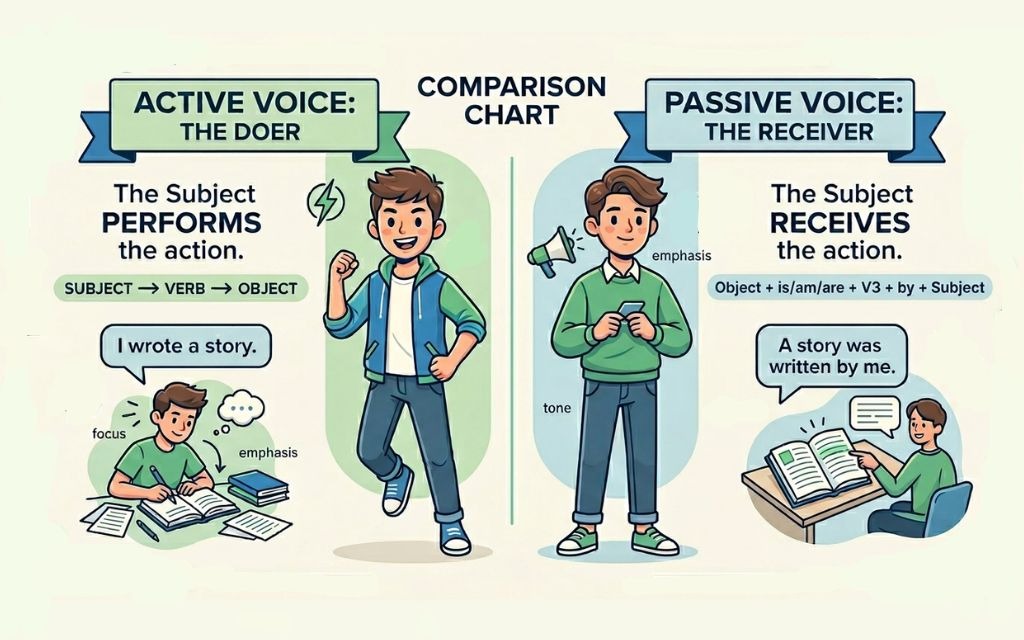
Alt Text: Active vs Passive Voice grammar infographic comparison chart.
| Feature | Active Voice | Passive Voice |
| Basic Structure | Subject + Verb + Object | Object + is/am/are + V3 + by + Subject |
| Focus | Doer of the action | Receiver of the action |
| Example | She wrote a letter | A letter was written by her |
| When to Use | You can use it for clear and direct sentences | You can use it when the doer is unknown or not important |
Also Read: Difference Between Active and Passive Voice
Active and Passive Voice Rules for Conversion
Active and passive voice rules can help you change a sentence without changing its meaning. You will switch the subject and object and fix the verb form. The verb will move to the past participle with a helping verb. If you follow these rules, you can convert any sentence easily.
Rule 1: Identify Subject, Verb, Object
First, you need to find who is doing the action, what the action is, and who is receiving it. This step makes everything clear before you convert. You can only convert sentences that have an object. If there is no object, you cannot change it into passive.
Example 1:
Active: The mechanic fixed the car.
Passive: The car was fixed by the mechanic.
Example 2:
Active: She wrote a letter.
Passive: A letter was written by her.
Rule 2: Interchange Subject and Object
Now you need to switch their positions in the sentence. The object will come to the front and become the new subject. The subject will move to the end with “by”. This step will change the focus of the sentence.
Example 1:
Active: Sarah mailed the letter.
Passive: The letter was mailed by Sarah.
Example 2:
Active: He cleaned the room.
Passive: The room was cleaned by him.
Rule 3: Change Verb to Past Participle V3
You always need to change the main verb into its third form. This rule stays the same in every tense. You will not use the base or the second form here. The helping verb will show the tense, and V3 will stay fixed.
Example 1:
Active: He writes a story.
Passive: A story is written by him.
Example 2:
Active: They eat mangoes.
Passive: Mangoes are eaten by them.
Rule 4: Use Correct Auxiliary Verb
You need to add a helping verb based on the tense of the sentence. This helps you keep the same meaning of time. Present tense uses “is, am, are”; past uses “was, were”; and future uses “will be”. This keeps your sentence correct.
Example 1:
Active: They are cleaning the room.
Passive: The room is being cleaned by them.
Example 2:
Active: She wrote a letter.
Passive: A letter was written by her.
Rule 5: Pronoun Changes
When the subject moves to the end, the pronoun will change its form. You need to use object form instead of subject form. This will help your sentence sound natural.
| Subject | Object |
| I | Me |
| We | Us |
| He | Him |
| She | Her |
| They | Them |
| You | You |
| It | It |
Rule 6: Preposition Usage
Most of the time, you will use “by” to show who did the action. But sometimes you need to use other words like “to” or “with”. This depends on the verb in the sentence. You need to choose the correct preposition.
Example 1:
Active: She knows him.
Passive: He is known to her.
Example 2:
Active: He filled the jar with water.
Passive: The jar was filled with water by him.
Example 3:
Active: She baked the cake.
Passive: The cake was baked by her.
Rule 7: Remove “by” when unnecessary
Sometimes you do not need to mention who did the action. If the doer is unknown or not important, you can remove it. This will make your sentence shorter.
Example 1:
Active: Someone stole my bag.
Passive: My bag was stolen.
Example 2:
Active: People speak English.
Passive: English is spoken.
Also Read: Future Perfect Passive Voice: A Complete Guide
Active and Passive Voice Rules for All Tenses
Active and passive voice rules can help you keep the same tense while changing the sentence form. You will change the verb with a helping verb and the V3. Most tenses can convert, but some continuous perfect forms do not have a passive. This chart will help you see all tenses clearly.
| Tense | Active Structure | Passive Structure | Example |
| Present Indefinite | Subject + V1(s/es) + Object | Object + is/am/are + V3 + by + Subject | Active: He eats an apple. Passive: An apple is eaten by him. |
| Present Continuous | Subject + is/am/are + V1 ing + Object | Object + is/am/are + being + V3 + by + Subject | Active: He is eating an apple. Passive: An apple is being eaten by him. |
| Present Perfect | Subject + has/have + V3 + Object | Object + has/have + been + V3 + by + Subject | Active: He has eaten an apple. Passive: An apple has been eaten by him. |
| Present Perfect Continuous | Subject + has/have + been + V1 ing + Object | No passive form | Active: He has been eating an apple. Passive: No passive possible. |
| Past Indefinite | Subject + V2 + Object | Object + was/were + V3 + by + Subject | Active: He ate an apple. Passive: An apple was eaten by him. |
| Past Continuous | Subject + was/were + V1 ing + Object | Object + was/were + being + V3 + by + Subject | Active: He was eating an apple. Passive: An apple was being eaten by him. |
| Past Perfect | Subject + had + V3 + Object | Object + had + been + V3 + by + Subject | Active: He had eaten an apple. Passive: An apple had been eaten by him. |
| Past Perfect Continuous | Subject + had + been + V1 ing + Object | No passive form | Active: He had been eating an apple. Passive: No passive possible. |
| Future Indefinite | Subject + will + V1 + Object | Object + will + be + V3 + by + Subject | Active: He will eat an apple. Passive: An apple will be eaten by him. |
| Future Continuous | Subject + will be + V1 ing + Object | No passive form | Active: He will be eating an apple. Passive: No passive possible. |
| Future Perfect | Subject + will have + V3 + Object | Object + will have + been + V3 + by + Subject | Active: He will have eaten an apple. Passive: An apple will have been eaten by him. |
| Future Perfect Continuous | Subject + will have been + V1 ing + Object | No passive form | Active: He will have been eating an apple. Passive: No passive possible. |
Special Structures in Passive Voice: Active and Passive Voice Rules
Active and passive voice rules also work for questions, commands, and modal sentences. You just need to change the structure, but keep the meaning the same. You will move helping verbs or add words like ‘let’ and ‘be’. If you follow these patterns, you can handle these sentences easily.
Interrogative Sentences
When you change questions, you need to keep the question form the same. The helping verb will come at the start in both active and passive. If the sentence starts with who, you will change it to by whom.
| Type | Active | Passive |
| Yes or No | Did she write the letter? | Was the letter written by her? |
| Wh-Question | Who wrote this letter? | By whom was this letter written? |
| What Question | What did she cook? | What was cooked by her? |
Imperative Sentences
Imperative sentences give orders, advice, or requests. You will use let and be to convert them into passive. If the sentence is polite, you can use you are requested to. This way, the meaning stays the same, and the sentence sounds natural.
| Type | Active | Passive |
| Positive Command | Open the door. | Let the door be opened. |
| Negative Command | Do not waste time. | Let time not be wasted. |
| Polite Request | Please submit the report. | You are requested to submit the report. |
Passive Voice with Modal Verbs
When you see modal verbs like can, must, or should, you will keep them the same. You just need to add be and then use V3. This will keep the meaning the same, and the sentence stays correct.
| Modal | Active | Passive |
| Can | She can do the work. | The work can be done by her. |
| Must | He must complete the task. | The task must be completed by him. |
| Should | You should follow the rules. | Rules should be followed by you. |
Sentences That Cannot Be Converted
Some sentences cannot be changed into passive because they do not have an object. These are called intransitive verbs. Some verbs also show state, so they do not form passive. You need to check this before you try to convert.
| Type | Active Sentence | Passive |
| No Object | He sleeps. | Not possible |
| No Object | She died. | Not possible |
| No Object | Birds fly. | Not possible |
| Stative Verb | She resembles her mother. | Not possible |
| Possession Verb | He has a car. | Not possible |
Common Errors in Active and Passive Voice Rules
Active and passive voice rules can go wrong sometimes, and this is why you need to avoid these common mistakes. Here is a list of what you need to avoid and what to do instead.
| What to Avoid | What to Do Instead |
| Using V2 instead of V3 | Always use past participle V3 |
| Trying to convert sentences without an object | Convert only sentences with an object |
| Using a subject pronoun after by | Use an object pronoun after by |
| Changing tense during conversion | Keep the same tense |
| Adding an unnecessary “by” phrase | Remove by when the doer is unknown |
| Missing helping verb | Always add the correct form of be |
| Changing modal verbs | Keep the modal verbs the same |
| Converting stative verbs | Do not convert verbs like “have” and “resemble”. |
Also Read: 20 + Exercises On Passive Voice With Modals (Free PDF)
Active and Passive Voice Rules: Practice Exercises with Answers
Active and passive voice rules become easy when you practice different sentence types. These exercises will help you test your understanding step by step. If you solve them carefully, you will get better quickly.
Exercise 1: Basic Conversion
Instruction: Convert the following active voice sentences into passive voice.
Questions:
- The teacher explained the lesson clearly.
- They are building a new bridge in the city.
- She has completed the assignment on time.
- The police will catch the thief soon.
- The artist painted a beautiful portrait.
Answer Sheet:
- The lesson was explained clearly by the teacher.
- A new bridge is being built in the city by them.
- The assignment has been completed on time by her.
- The thief will be caught soon by the police.
- A beautiful portrait was painted by the artist.
Exercise 2: Questions and Commands
Instruction: Convert the following sentences into passive voice.
Questions:
- Did she finish the work?
- Why did they cancel the meeting?
- Close the door immediately.
- Please follow the instructions carefully.
- Who wrote this story?
Answer Sheet:
- Was the work finished by her?
- Why was the meeting cancelled by them?
- Let the door be closed immediately.
- You are requested to follow the instructions carefully.
- By whom was this story written?
Exercise 3: Identify Conversion Possibility
Instruction: Check if the sentence can be converted. If yes, convert it. If not, write Not possible.
Questions:
- The baby slept peacefully.
- The company launched a new product.
- He runs very fast.
- The chef cooks delicious food.
- She owns a big house.
Answer Sheet:
- Not possible.
- A new product was launched by the company.
- Not possible.
- Delicious food is cooked by the chef.
- Not possible.
FAQs
You need to find the subject, verb, and object first. You will switch the subject and the object. You will change the verb to the V3 form. You need to add the correct helping verb. You also need to change pronouns properly.
Active voice uses Subject + Verb + Object. Passive voice uses the object + helping verb + V3 + ‘by’ + Subject. You will always keep the same tense. The helping verb will show the tense clearly.
In the active voice, the subject does the action. In passive voice, the subject receives the action. For example, she writes a letter. A letter is written by her. You can see how the focus changes.
You need to find who is doing the action and what is affected. You will move the object to the front. You will add ‘is’, ‘am’, or ‘are’ with V3. You can use simple sentences to understand easily.
You will see passive in the present, past, and future tenses. These include present simple, present continuous, present perfect, past simple, past continuous, past perfect, and future simple. Some continuous perfect forms do not have a passive.
You need to keep the tense the same. You must use the V3 form of the verb. You should not change modal verbs. You need to remove it when it is not needed.
You can check who is doing the action. If the subject is doing it, it is the active voice. If the subject is receiving it, it is passive voice. You will also see helping verbs like ‘is’, ‘was’, or ‘been’ in the passive.
V1 is the base form, like eat, write, and go. V2 is the past form, like ‘ate’, ‘wrote’, and ‘went’. V3 is the past participle, like eaten, written, and gone. You will always use V3 in passive voice.
You can look for a helping verb and V3 together. You will often see words like ‘is’, ‘was’, or ‘been’. The subject will receive the action. You can also see it in the plus door sometimes.
She writes a letter.
They play cricket.
He eats an apple.
The teacher explains the lesson.
We watch a movie.
Relatable Reads
Now you know the active and passive voice rules, so you can control how your sentence sounds. When you feel confused, just ask yourself one thing: who is doing the action? This one check will save you in exams. Also, you can skip “by + subject” in many answers and still be correct, so do not waste time writing extra words. In exams, you can quickly find the object first, then build the passive around it. This shortcut will help you solve questions faster and with fewer mistakes.
Keep learning and stay connected with the Learn English page on Leverage Edu for more helpful and student-friendly blogs. And if this helped you, don’t forget to share, rate, and drop a comment. Your support helps more students find the good stuff.

 2,00,000+ students realized their study abroad dream with us. Take the first step today.