

 One app for all your study abroad needs














A notice is a formal written announcement used to share important information with a specific group of people. It is brief, clear, and structured so that readers immediately understand what is being communicated, who is issuing the notice, and what action is expected from them. Students often see notices on school boards announcing events, competitions, meetings, or holidays, making it a familiar yet important form of communication.
In academic learning, notice writing is introduced as a kesy component of formal writing for students from Class 6 to Class 12. Schools include it in assignments and examinations to help students develop clarity, precision, and proper presentation skills. Learning how to write a notice correctly not only improves exam performance but also prepares students to communicate effectively in organised academic and professional environments.
Contents
- 1 Purpose and Importance of Notice Writing in Academics
- 2 Notice Writing Format
- 3 Examples of Notice Writing
- 3.1 1. Event / Programme / Competition / Activity Notice
- 3.2 2. Lost and Found Notice
- 3.3 3. Meeting / Assembly / Committee Notice
- 3.4 4. Appeal / Campaign / Awareness Notice
- 3.5 5. Information / Announcement / Circular Notice
- 3.6 4. Appeal / Campaign / Awareness Notice
- 3.7 5. Information / Announcement / Circular Notice
- 3.8 6. Invitation / Participation Notice
- 3.9 7. Warning / Advisory Notice
- 4 Types of Notice Writing Format
- 5 Difference Between Formal and Informal Notice Format
- 6 Notice Writing Format for Different Education Boards
- 7 Class-Wise Notice Writing Format (Class 6 to 12)
- 8 Questions for Notice Writing Practice
- 9 Common Mistakes to Avoid in Notice Writing
- 10 Tips to Score Full Marks in Notice Writing
- 11 FAQs
Purpose and Importance of Notice Writing in Academics
Notice writing is an important academic exercise that connects classroom learning with real-world communication. It trains students to present information clearly, organise details logically, and communicate with purpose within a strict word limit. This skill supports both examination performance and effective formal communication in academic and professional settings.
The format demands accuracy and structured thinking. Working within a typical limit of 50 to 80 words requires students to prioritise essential details such as date, time, venue, and instructions while avoiding unnecessary explanation. This disciplined approach strengthens concise expression and improves clarity across other academic tasks, including essays, reports, and formal emails.
Further, notice writing also mirrors authentic communication practices. Schools, colleges, and public institutions rely on notices to share important updates with large groups. Regular practice helps students develop audience awareness and adjust tone and vocabulary according to the intended readers, whether classmates, teachers, or parents.
From an examination perspective, notice writing offers a clear advantage. In CBSE and ICSE board exams, it remains a reliable scoring section that usually carries 4 to 6 marks. Its fixed structure and predictable evaluation criteria allow students to secure full marks through consistent practice and accurate presentation.
Notice Writing Format
With a clear understanding of why notice writing matters, students must now focus on presenting it in the correct structure. Examiners in CBSE and ICSE boards evaluate notices strictly on format, clarity, and completeness.
Following the standard layout ensures that information appears organised and easy to read, which directly improves scoring potential.
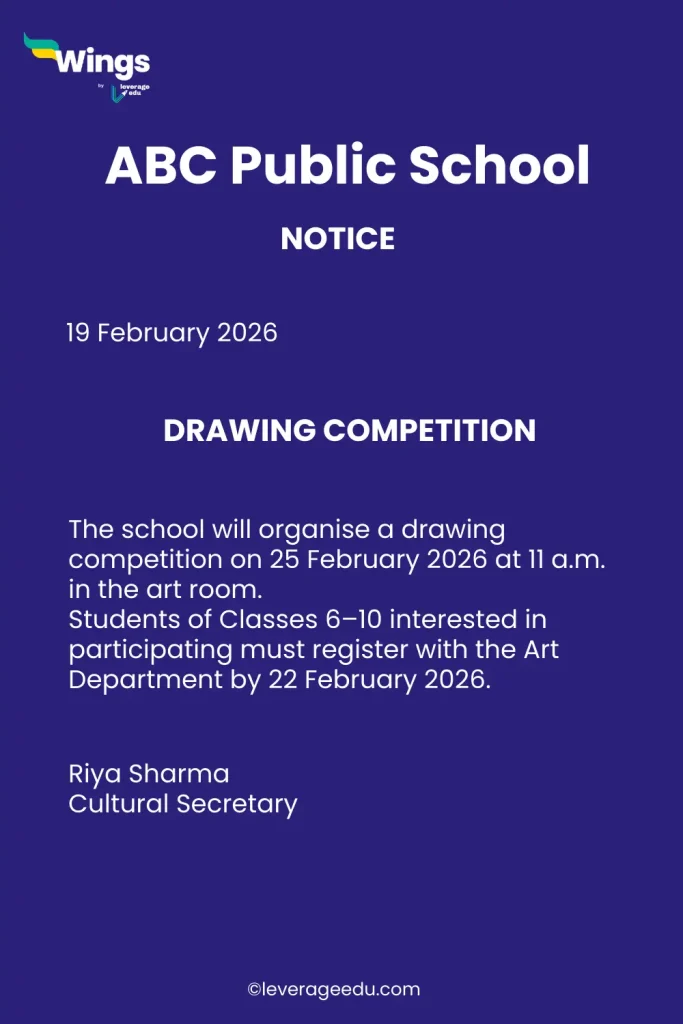
Standard Notice Writing Format
| Left Aligned | Centre Aligned | Right Aligned |
| Name of School / Organisation | ||
| NOTICE (in capitals) | ||
| Date | ||
| Heading / Title (in capitals) | ||
| Body of the Notice (Who, What, When, Where, How) | ||
| Signature (Name of issuing authority) | ||
| Designation (Head Boy/Secretary/Principal) |
Once the layout is clear, students must understand what each part of the notice includes. Every component serves a specific purpose and helps readers grasp the message quickly and accurately.
The following breakdown explains how each part should be written to ensure accuracy and proper presentation in examinations.
1. Name of Institution
The name of the school, organisation, society, or institution appears at the top of the notice. It establishes the authority responsible for the announcement and gives the document official value.
Example: Delhi Public School, Rohini or Sunrise Apartments Residents’ Welfare Association.
2. Title NOTICE
The word NOTICE appears in bold capital letters at the centre of the page. It signals immediately that the document contains an official announcement meant for a specific group.
3. Date of the Notice
The date is written on the left side below the word NOTICE. A complete format, such as DD Month YYYY, maintains clarity and helps readers identify when the notice was issued.
Example: 15 March 2025.
4. Heading or Title
Provide a short and direct heading that explains the purpose of the notice. Readers should understand the topic instantly by looking at the title.
Examples: SCIENCE EXHIBITION, INTER-SCHOOL DEBATE, or HOLIDAY DECLARATION. Keep the heading in capital letters or underline it for emphasis.
5. Body of the Notice
The body of the notice presents all the important details in a concise paragraph. It must answer the five Ws:
- What: Event or information
- Who: Individuals concerned
- When: Date and time
- Where: Venue
- Why: Purpose or required action
It is suggested to maintain a formal tone and the information within 50 to 80 words, unless stated otherwise.
6. Name and Designation of the Writer
Conclude the notice with the signature, name, and designation of the issuing authority at the bottom right. This may include roles such as Cultural Secretary, Head Boy, or Principal. Adding this information confirms authenticity and completes the notice format.
Also Read: Letter Writing Topics for School Students
Examples of Notice Writing
In school English across CBSE, ICSE, and most state boards from Class 6 to Class 12, notice writing does not follow rigid categories such as formal or informal writing. Instead, notices are classified according to purpose and content. Students must identify the purpose quickly and present accurate details using the correct format. Each example focuses on a specific situation and requires clear, concise information that readers can understand immediately.
1. Event / Programme / Competition / Activity Notice
Event-based notices appear most frequently in school exams. Students write such notices to announce sports day, debate competitions, cultural programmes, workshops, excursions, and quizzes. Each notice must present event details in a structured and direct manner.
List of important details to include:
- Nature of the event or programme
- Date and time
- Venue
- Eligibility or participants
- Registration process and contact person
Example:
ABC Public School
NOTICE
12 July 2026
INTER-SCHOOL DEBATE COMPETITION
The school will organise an inter-school debate competition on 20 July 2026 at 10 a.m. in the auditorium. Students of Classes 9–12 interested in participating must register with the English Department by 16 July 2026.
Riya Sharma
Cultural Secretary
2. Lost and Found Notice
Lost and found notices remain common for Classes 6–10. Students draft notices reporting missing items such as books, bags, or identity cards, or announcing items that someone has found. Clear description helps the rightful owner identify and claim the item.
List of important details to include:
- Description of the lost or found item
- Place where it was lost or located
- Instructions to claim or return
- Contact details of the concerned person
Example:
Green Valley School
NOTICE
5 August 2026
LOST WATER BOTTLE
A blue Milton water bottle was lost in the school playground during recess on 4 August 2026. The student who finds it is requested to submit it to Class 7-B or the school office.
Aman Verma
Class 7-B
3. Meeting / Assembly / Committee Notice
Meeting notices inform specific groups about scheduled meetings or assemblies. Schools use such notices for student council meetings, club discussions, or committee briefings. Accuracy in the agenda and timing ensures proper participation.
List of important details to include for meeting or assembly notice writing:
- Purpose or agenda of the meeting
- Date and time
- Venue
- Names or groups required to attend
Example:
Sunrise Public School
NOTICE
10 September 2026
STUDENT COUNCIL MEETING
A meeting of the student council will be held on 12 September 2026 at 11 a.m. in the conference room to discuss preparations for the Annual Day. All council members must attend.
Arjun Mehta
Head Boy
4. Appeal / Campaign / Awareness Notice
Awareness and campaign notices encourage participation in school or community initiatives. Students may write notices for tree plantation drives, cleanliness campaigns, charity collections, or social awareness programmes. The language must motivate readers to contribute actively.
List of important details to include for an appeal, campaign, or awareness notice:
- Purpose of the campaign
- Date and venue
- Participation instructions
- Contact or organising authority
Example:
City Model School
NOTICE
3 June 2026
TREE PLANTATION DRIVE
The Eco Club will organise a tree plantation drive on 5 June 2026 to mark World Environment Day. Students of all classes are encouraged to participate and bring one sapling each.
Neha Kapoor
Eco Club Secretary
5. Information / Announcement / Circular Notice
Informational notices share important updates with students. Schools issue such announcements for holiday declarations, timetable changes, examination schedules, or fee reminders. Clarity and accuracy remain essential for effective communication.
List of important details to include for information or circular notice:
- Nature of the announcement
- Effective date or schedule
- Additional instructions if required
Example:
Bright Future School
NOTICE
18 October 2026
HOLIDAY DECLARATION
The school will remain closed on 20 October 2026 on account of Diwali. Regular classes will resume on 21 October 2026 as per the timetable.
Principal
4. Appeal / Campaign / Awareness Notice
Awareness and campaign notices encourage participation in school or community initiatives. Students may draft such notices for tree plantation drives, cleanliness campaigns, charity collections, or social awareness programmes. Language should motivate readers to contribute actively and support the initiative.
List of important details to include for an appeal, campaign, or awareness notice:
- Purpose of the campaign
- Date and venue
- Participation instructions
- Contact or organising authority
Example:
City Model School
NOTICE
3 June 2026
TREE PLANTATION DRIVE
The Eco Club will organise a tree plantation drive on 5 June 2026 to mark World Environment Day. Students of all classes are encouraged to participate and bring one sapling each.
Neha Kapoor
Eco Club Secretary
5. Information / Announcement / Circular Notice
Informational notices communicate important updates that students must know and follow. Schools issue announcements for holidays, timetable changes, examination schedules, or fee reminders. Clear and accurate wording ensures that every reader understands the message immediately.
List of important details to include for information, announcement, or circular notice:
- Nature of the announcement
- Effective date or schedule
- Additional instructions if required
- Name and designation of issuing authority
Example:
Bright Future School
NOTICE
18 October 2026
HOLIDAY DECLARATION
The school will remain closed on 20 October 2026 on account of Diwali. Regular classes will resume on 21 October 2026 as per the timetable.
Principal
6. Invitation / Participation Notice
Invitation or participation notices invite students to take part in competitions, auditions, or selection trials. Clear eligibility criteria and registration instructions help interested students respond within deadlines and prepare accordingly.
List of important details to include for invitation or participation notice:
- Event or opportunity
- Eligibility criteria
- Registration or selection process
- Deadline and contact details
Example:
Harmony School
NOTICE
2 August 2026
MUSIC AUDITIONS
Auditions for the inter-school music competition will be held on 6 August 2026 in the music room at 1 p.m. Students interested in participating should give their names to the music teacher by 4 August 2026.
Music Club In-Charge
7. Warning / Advisory Notice
Advisory notices communicate discipline rules and safety instructions within the school environment. Schools issue such notices regarding punctuality, campus behaviour, or safety guidelines during events. Direct language ensures that readers understand and follow instructions without confusion.
List of important details to include for warning or advisory notice:
- Nature of the warning or advisory
- Reason for issuing the notice
- Instructions students must follow
- Name and designation of issuing authority
Example:
Greenfield School
NOTICE
14 November 2026
DISCIPLINE DURING BREAK
Students are advised not to run in the corridors during recess as it may cause accidents. All students must follow safety rules and maintain discipline on campus.
Discipline In-Charge
Types of Notice Writing Format
Notices are broadly divided into two categories, formal and informal. Understanding the difference helps students choose the correct tone, language, and structure for each situation. Schools, institutions, and public organisations usually require formal notices, while communities and small groups may use informal notices for internal communication.
Formal Notice Writing Format
Formal notices follow a fixed structure and maintain an official tone. Schools, government offices, and organisations use such notices to communicate important information to a large group. Language remains clear, concise, and professional.
Common examples of formal notice writing include:
- Annual Day or Cultural Fest announcements
- Government and Public Notices
- Official Announcements
- Examination schedules and date sheets
- Parent-Teacher Meeting (PTM) invitations
- Sports Day, Science Fair, or Debate Competition notices
- Holiday announcements
- Lost and found items
1. Annual Day or Cultural Fest announcements
Example:
KENDRIYA VIDYALAYA, DELHI
NOTICE
Date: 10 January 2026
ANNUAL SCIENCE EXHIBITION
All students of Classes 6 to 10 are informed that the Annual Science Exhibition will be held on 25 January 2025 in the school auditorium from 10:00 a.m. onwards. Students who wish to participate must submit their project titles to their respective class teachers by 15 January 2025. Active participation is encouraged.
Ananya Mehta
School Captain
2. Government and Public Notice
Example:
Municipal Corporation of Delhi
NOTICE
5 March 2026
WATER SUPPLY INTERRUPTION
Residents of Rohini Sector 8 are informed that water supply will remain suspended on 7 March 2026 from 10:00 a.m. to 4:00 p.m. due to maintenance work. Residents are advised to store sufficient water in advance. Inconvenience caused is regretted.
Executive Engineer
Water Department
3. Official Announcement
Example:
Sunrise International School
NOTICE
15 July 2026
CHANGE IN SCHOOL TIMINGS
All students are informed that the school timing will change from 8:00 a.m.–2:00 p.m. to 7:30 a.m.–1:30 p.m. with effect from 1 August 2026. Students must report to school accordingly.
Principal
4. Examination Schedule Notice
Example:
Bright Future School
NOTICE
10 September 2026
HALF-YEARLY EXAMINATION SCHEDULE
The Half-Yearly Examinations for Classes 6–10 will begin on 25 September 2026. The detailed date sheet has been uploaded on the school website and displayed on the notice board. Students must check the schedule and prepare accordingly.
Examination In-charge
5. Parent-Teacher Meeting (PTM) Invitation
Example:
Delhi Public School, Noida
NOTICE
2 August 2026
PARENT-TEACHER MEETING
A Parent-Teacher Meeting for Classes 6–12 will be held on 10 August 2026 from 9:00 a.m. to 12:00 noon in the school premises. Parents are requested to attend the meeting to discuss their ward’s academic progress.
Principal
6. Sports Day / Science Fair / Debate Competition Notice
Example:
City Model School
NOTICE
8 January 2026
INTER-SCHOOL DEBATE COMPETITION
An inter-school debate competition will be held on 20 January 2026 in the school auditorium at 10:00 a.m. Students of Classes 9–12 interested in participating must register with the English Department by 12 January 2026.
Arjun Mehta
Head Boy
7. Holiday Announcement
Example:
Harmony Public School
NOTICE
18 October 2026
HOLIDAY NOTICE
The school will remain closed on 24 October 2026 on account of Dussehra. Regular classes will resume on 25 October 2026 as per the timetable.
Principal
8. Lost and Found Notice
Example:
Evergreen School
NOTICE
4 August 2026
LOST SCHOOL ID CARD
A school ID card belonging to a student from Class 8-B has been lost in the school playground on 3 August 2026. The student who finds it is requested to submit it to the school office.
Rahul Verma
Class 8-B
Informal Notice Writing Format
Informal notices format follows a simpler and more flexible structure than formal notices. Such notices are written for communities, neighbourhoods, clubs, or social groups where communication remains organised but not strictly official. The tone stays polite and friendly, yet the message must remain clear and direct so that readers understand the information easily.
Common examples of informal notice writing include:
- Community or society notices
- Housing society or neighborhood notices
- Personal/semi-formal notices
1. Community or Society Notices
Example:
Sunshine Apartments Residents’ Welfare Association
NOTICE
10 May 2026
MONTHLY RESIDENTS’ MEETING
A meeting of all residents will be held on 15 May 2026 at 6:00 p.m. in the community hall to discuss maintenance and security arrangements. All residents are requested to attend.
Secretary
2. Housing Society or Neighbourhood Notices
Example:
Green Park Housing Society
NOTICE
22 July 2026
WATER SUPPLY INTERRUPTION
Water supply will remain suspended on 24 July 2026 from 9:00 a.m. to 2:00 p.m. due to pipeline maintenance work. Residents are requested to store sufficient water in advance.
Maintenance Committee
3. Personal / Semi-Formal Notices
Example:
Star Dance Academy
NOTICE
5 August 2026
DANCE PRACTICE SESSION
A special dance practice session will be held on 7 August 2026 at 4:00 p.m. in the studio for all competition participants. Students must attend the rehearsal without fail.
Instructor
Also Explore: How to Turn Notes into Essays
Difference Between Formal and Informal Notice Format
After understanding the types of notices and where they are commonly used, students must recognise the difference between formal and informal notice formats. Both formats follow a similar basic structure, yet differences in tone, presentation, and purpose determine how each notice should be written. Identifying the correct format helps students present information accurately and avoid losing marks in examinations.
| Point of Difference | Formal Notice Format | Informal Notice Format |
| Purpose | Used for official communication in schools, institutions, and organisations | Used for community, society, or personal group communication |
| Issuing Authority | School, college, government office, institution, company | Residents’ association, club, neighbourhood group, individual |
| Audience | Students, staff, parents, general public | Residents, community members, small groups |
| Structure | Strict and fixed format must be followed | Basic format similar but slightly flexible |
| Box Format | Mandatory in CBSE and ICSE exams | Recommended but not always compulsory outside exams |
| Tone | Formal, official, and professional | Friendly, polite, and semi-formal |
| Language | Precise, clear, and objective | Simple and conversational but clear |
| Opening Style | Direct and formal (Example: Students are informed) | Slightly friendly (Example: All residents are requested) |
| Content Style | Focus on facts and instructions only | May include polite requests or invitations |
| Word Limit | Usually, 50 to 80 words in examinations | Flexible outside exams |
| Designation of Writer | Always required at the end | Usually included but less strict |
| Common Use | Exams, meetings, competitions, official announcements | Society meetings, events, and local announcements |
| Importance in Exams | High-scoring section; format strictly evaluated | Rare in exams; format slightly flexible |
Notice Writing Format for Different Education Boards
Notice writing guidelines vary slightly across education boards, even though the basic structure remains similar. Students preparing for school and board examinations must understand how CBSE and ICSE evaluate notice writing so that format, tone, and presentation match board-specific expectations.
CBSE Notice Writing Format
The Central Board of Secondary Education follows a clearly structured notice writing format. Students must present notices inside a box and maintain a formal tone and concise language throughout. Correct placement of each element plays an important role in scoring marks.
List of requirements in CBSE notice writing format:
- The notice must be enclosed within a box
- The word NOTICE should appear at the top in capital letters
- The date must be written on the left below the word NOTICE
- Word limit is usually restricted to 50 to 80 words
- Marks are generally divided as: Format (1 mark), Content (2 marks), Expression (1 mark)
- Language should remain clear, direct, and formal
- Third-person usage is preferred
- Avoid decorative or unnecessary wording
ICSE Notice Writing Format
The Indian Certificate of Secondary Education follows a similar structural pattern but gives greater importance to language accuracy and expression. Students must maintain a consistently formal tone while presenting information clearly and grammatically.
List of requirements in ICSE notice writing format:
- Formal tone must remain consistent throughout
- Strong emphasis on grammar and sentence accuracy
- Titles and headings are usually underlined
- Expression and vocabulary carry higher weightage
- Sentences should reflect clarity and correctness
Class-Wise Notice Writing Format (Class 6 to 12)
Notice writing develops step by step from Class 6 to Class 12, with expectations increasing at each level. Schools introduce the basic format in middle classes and gradually focus on accuracy, formal tone, and word limit as students move toward board examinations. Understanding class-wise requirements helps students practise with the right level of detail and presentation.
In Classes 6 to 8, emphasis remains on learning the structure and presenting clear information about simple topics such as school events, lost and found items, or competitions. By Classes 9 and 10, notice writing becomes exam-oriented, and students must follow the correct box format, maintain formal language, and stay within the 50 to 80 word limit. Senior classes require precision, complete details, and proper designation to secure full marks.
The following sections explain the notice writing format for each class with relevant examples and commonly asked topics.
Notice Writing Format Class 6
Class 6 marks the beginning of formal notice writing practice. Students learn how to present information in a clear and organised format using simple language and short sentences. At this stage, the main goal is to understand the structure of a notice and include all essential components correctly.
Students should focus on placing the school name, date, heading, body, and name of the issuing authority in the correct order. Word limit is usually flexible, but the notice must remain concise and easy to read. Teachers expect clarity rather than complex vocabulary at this level.
Common topics for Class 6 notice writing:
- Lost and found items
- School picnic announcements
- Inter-class competitions
- Library book return reminders
Example:
SUNRISE PUBLIC SCHOOL
NOTICE
Date: 3 April 2026
SCHOOL PICNIC
All students of Class 6 are informed that a school picnic to Lodhi Garden, New Delhi, has been arranged on 12 April 2026. Students must report to school by 7:30 a.m. Permission slips signed by parents must be submitted to the class teacher by 8 April 2025.
Priya Nair
Class Teacher, 6A
Notice Writing Format Class 7
By Class 7, notice writing moves beyond basic structure and begins to focus on clarity, accuracy, and organised presentation. Students are expected to present complete information using precise vocabulary and well-formed sentences. The format remains unchanged, but the body should include all relevant details such as event purpose, schedule, and participation instructions without missing key points.
Teachers assess how clearly students communicate information and whether the notice answers all necessary questions. Presentation must remain neat, and the heading should reflect the purpose of the notice accurately.
Common topics for Class 7 notice writing:
- Book fair announcements
- Yoga Day activities
- Cleanliness campaigns
- Debate or reading competitions
Example:
LITTLE FLOWERS SCHOOL, AGRA
NOTICE
Date: 18 June 2025
INTER-CLASS DEBATE COMPETITION
An inter-class debate competition for Class 7 will take place on 25 June 2025 at 11:00 a.m. in the school auditorium. Students interested in participating must give their names to the English teacher by 21 June 2025. The topic for the debate will be shared during class.
Rohit Sharma
Head Boy
Notice Writing Format Class 8
Class 8 introduces students to a more formal and structured approach to notice writing. Notices must now reflect a clear official tone with well-organised content and complete details. Students are expected to use precise vocabulary and maintain third-person narration throughout the notice.
The body should present information in a logical sequence, covering the event, schedule, venue, and participation instructions. Presentation and accuracy become more important as teachers begin to evaluate both format and expression carefully.
Common topics for Class 8 notice writing:
- Annual day auditions
- Mathematics Olympiad
- Teacher’s Day celebrations
- Eco club activities
Example:
ST. MARY’S CONVENT SCHOOL, PUNE
NOTICE
Date: 2 September 2025
TEACHER’S DAY CELEBRATION
Students of Class 8 are informed that Teacher’s Day will be celebrated on 5 September 2025 in the school hall from 10:00 a.m. to 12:00 p.m. Cultural performances, including dance, music, and drama, will be presented by students. Those willing to volunteer for the programme may contact the Cultural Secretary by 3 September 2025.
Meghna Iyer
Cultural Secretary
Notice Writing Format Class 9
Class 9 introduces exam-oriented notice writing where accuracy and presentation carry greater importance. Students must follow the standard box format, maintain a formal tone, and stay within the 50 to 80-word limit. The body should clearly include all essential details so that readers understand the purpose and instructions immediately.
At this level, notices must answer all key questions related to the event or information. Proper placement of the date, heading, content, and designation becomes essential, as teachers begin evaluating notices according to board-level expectations.
Common topics for Class 9 notice writing:
- School magazine submissions
- Inter-school quiz competitions
- NCC or NSS camps
- Blood donation or awareness drives
Example:
RYAN INTERNATIONAL SCHOOL, MUMBAI
NOTICE
Date: 7 November 2025
BLOOD DONATION CAMP
All students and staff are informed that a blood donation camp will be organised on 14 November 2025 in collaboration with City Hospital. The camp will take place in the school gymnasium from 9:00 a.m. to 1:00 p.m. Staff members and students above 18 years of age are encouraged to participate. For registration, contact the NCC teacher.
Arjun Kapoor
NCC In-charge
Notice Writing Format Class 10
Class 10 is a crucial academic year, and notice writing becomes a scoring component in board examinations. Students must follow the correct format with precision, maintain a formal tone, and stay within the 50 to 80-word limit. Examiners assess format accuracy, content completeness, and language clarity, so every element must be presented carefully.
Notices at this level should include all necessary details without extra explanation. Grammar must remain error-free, and presentation should follow the standard box format used in board exams. Clear headings and proper designation at the end of the notice help secure full marks.
Common topics for Class 10 notice writing:
- Farewell party announcements
- Board exam revision schedules
- English-speaking club activities
- Alumni meet or school events
Example:
DAV PUBLIC SCHOOL, CHANDIGARH
NOTICE
Date: 5 January 2025
SPECIAL REVISION CLASSES
All students of Class 10 are informed that special revision classes for the forthcoming board examinations will commence from 13 January 2025. Classes will be conducted from 7:00 a.m. to 8:30 a.m. on all school days. Attendance is compulsory. Students must bring their textbooks and practice papers daily.
Rekha Gupta
Academic Coordinator
Notice Writing Format Class 11
presentation. Students must handle more formal and institutional topics while maintaining clarity and precision. Notices at this level should demonstrate structured expression, accurate details, and consistent formal tone throughout the body.
Teachers expect students to present complete information using well-formed sentences and appropriate vocabulary. Format accuracy, proper designation, and concise writing remain essential. Notices should clearly communicate purpose, schedule, and instructions without unnecessary explanation.
Common topics for Class 11 notice writing:
- Commerce or Science fest announcements
- Scholarship notifications
- Career counselling sessions
- Industrial or educational visits
Example:
AMITY INTERNATIONAL SCHOOL, NOIDA
NOTICE
Date: 20 August 2025
CAREER COUNSELLING SESSION
All students of Classes 11 and 12 are informed that a career counselling session will be conducted on 27 August 2025 in the conference hall from 11:00 a.m. to 1:00 p.m. Professionals from the fields of medicine, engineering, law, and commerce will guide students regarding future career options. Attendance is mandatory. Students may submit their queries in advance to the school counsellor.
Vikram Singh
Student Coordinator
Notice Writing Format Class 12
Class 12 represents the highest level of notice writing expected in school education. Students must demonstrate complete accuracy in format, language, and presentation. Notices should reflect professional-level formal writing with clear structure, precise vocabulary, and error-free grammar. Examiners expect students to include all essential details within the prescribed word limit while maintaining a consistent formal tone.
At this level, notices often relate to official academic matters and institutional communication. Proper placement of the heading, date, content, and designation remains essential. Clarity and completeness determine scoring, as even minor omissions can reduce marks.
Common topics for Class 12 notice writing:
- Farewell programme announcements
- Scholarship application notices
- Board exam admit card collection
- Alumni association meetings
Example:
MODERN SENIOR SECONDARY SCHOOL, DELHI
NOTICE
Date: 10 February 2025
COLLECTION OF BOARD EXAMINATION ADMIT CARDS
All students of Class 12 are informed that CBSE admit cards for the 2025 board examinations are available for collection from the school office. Students must collect their admit cards between 12 February and 15 February 2025 from 9:00 a.m. to 1:00 p.m. Students must carry their original school identity card at the time of collection.
Shweta Malhotra
Principal
Also Read: Notice Writing for Class 8
Questions for Notice Writing Practice
Regular practice for notice writing helps students master format, tone, and word limit. Attempt the following questions using the correct notice writing format and formal language.
Class 6 to 7 Notice Writing Questions
- You are the Sports Captain of Sunrise Public School. Write a notice informing students about an inter-class football tournament to be held next week.
- A water bottle has been found in the school library. As the Prefect, write a notice asking the owner to collect it from the lost and found section.
- Your school is organising a drawing competition for junior classes. Write a notice inviting students of Classes 6 and 7 to participate.
- The school library will remain closed for two days for stock verification. Draft a notice informing students about the same.
- Your class teacher has planned a school picnic for Class 7. Write a notice informing students about the date, venue, and submission of permission slips.
Class 8 to 9 Notice Writing Questions
- As the Cultural Secretary, write a notice informing students about auditions for the annual day programme.
- Your school is organising an inter-school quiz competition. Draft a notice inviting students to register their names for selection.
- The computer lab will remain closed for maintenance for one week. As the school administrator, write a notice informing students.
- Write a notice informing students about a yoga workshop to be conducted in the school auditorium.
- Your school is launching a tree plantation drive. Write a notice inviting students to volunteer for the campaign.
Class 10 Notice Writing Questions
- You are the Head Boy/Head Girl of your school. Write a notice informing Class 10 students about special revision classes for board examinations.
- As the Secretary of the Science Club, write a notice inviting students to participate in the upcoming science exhibition.
- Write a notice informing students about an educational trip to a historical monument being organised by the school.
- The school is organising an English-speaking workshop for Class 10 students. Draft a notice with all necessary details.
- Write a notice informing students about a farewell function being organised for outgoing students.
Class 11–12 Notice Writing Questions
- You are the President of the Literary Club. Write a notice inviting entries for the school magazine from senior students.
- As the School Captain, write a notice informing students about a scholarship test conducted by a national organisation.
- Draft a notice inviting students to participate in an inter-school debate competition to be hosted by your school.
- Your school is organising a career counselling session for Classes 11 and 12. Write a notice with complete details.
- Write a notice informing students about registrations for the annual sports meet for senior classes.
Common Mistakes to Avoid in Notice Writing
Even well-prepared students lose marks due to avoidable errors in format, language, and presentation. Paying attention to the following points helps maintain accuracy and secure full marks in examinations.
- The heading NOTICE must appear at the top in capital letters. Skipping it leads to loss of format marks even if the content is correct.
- Every notice must include a properly written date in the format DD Month YYYY. Writing short forms such as 10/02/25 instead of 10 February 2025 counts as a formatting error.
- A clear title informs readers about the subject immediately. Notices without a heading appear incomplete and confusing.
- Most examination notices require 50 to 80 words. Writing lengthy paragraphs reduces clarity and may result in the deduction of expression marks.
- Formal notices follow third-person construction. Replace lines like I am informing you with Students are hereby informed to maintain an official tone.
- Avoid conversational phrases and contractions such as don’t, can’t, or Hey everyone. Formal vocabulary maintains credibility and clarity.
- The notice must end with the writer’s name and designation. Writing only the name without the role, such as Head Girl or Principal, results in an incomplete format.
- CBSE and ICSE formats require the notice to be enclosed within a box. Absence of the box affects presentation marks.
- Notices must include specific information. Replace vague statements like the event will be held soon with an exact date, time, and venue.
- Every notice must clearly answer What, Who, When, Where, and Why. Missing any of these details makes the notice incomplete and reduces content marks.
Tips to Score Full Marks in Notice Writing
Notice writing can become one of the most scoring sections in the English paper when students follow a structured approach. Paying attention to format, clarity, and accuracy helps secure full marks consistently.
1. Follow the format exactly as prescribed: Write the name of the institution, the word “NOTICE,” date, title, body, and sign-off in the correct order. Always draw a box around the notice.
Example: If you skip writing NOTICE and begin directly with Annual Sports Day, format marks will be deducted even if the content is correct.
2. Create a quick mental checklist before writing: Before starting, confirm that the notice includes the authority name, date, a clear title, a body with complete details, and the name with designation.
Example: A notice about a debate competition must include the event name, date, venue, eligibility, and the last date for registration.
3. Use simple and formal language: Keep sentences clear and direct. Avoid decorative or conversational expressions.
Example:
Write: Students are requested to submit entries by 5 July 2026.
Avoid: Hey everyone, please send your entries soon!
4. Stay within the prescribed word limit: Most exam notices require 50–80 words. Practise writing concise content that includes all details without repetition.
Example: Instead of writing long descriptions about a cultural fest, mention only key details such as date, venue, and registration process.
5. Maintain third-person and formal tone: Use third-person construction throughout the notice.
Example:
Correct: All students are informed that the library will remain closed.
Incorrect: I am informing you that our library will be closed.
6. Underline or clearly present the title: A short, precise title helps the reader identify the purpose immediately. Leave the details for the body of the notice.
Example: INTER-SCHOOL QUIZ COMPETITION is clearer and more effective than writing a long descriptive heading such as Quiz Competition Being Held Between Different Schools of Our District.
7. Check spelling and grammar carefully: Incorrect spelling of dates, names, or venues reduces expression marks.
Example: Writing Febuary instead of February, or Auditoruim instead of Auditorium.
8. Practise writing within time limits: During exams, students usually get about 10–12 minutes for notice writing. Regular timed practice builds speed and accuracy.
Example: Practise drafting a 60-word notice about a science exhibition within 10 minutes to improve exam readiness.
Explore: Notice Writing Format, Examples and Topics PDF
Notice writing remains one of the most practical and scoring forms of formal writing taught in school. Students from Class 6 to Class 12 encounter notice writing in examinations, school communication, and everyday institutional settings. Mastering the correct notice writing format helps students present information clearly, organise ideas logically, and communicate with confidence.
FAQs
Ans. Notice writing is a formal method of communicating important information to a specific group. It is important because it develops formal communication skills, improves concise writing, and forms a scoring section in school examinations.
Ans. The standard format includes the name of the institution, the word “NOTICE,” date, title, body containing key details, and the name with designation of the issuing authority. The notice must be written within a box and kept within 50–80 words.
Ans. In most CBSE and ICSE English papers, notice writing carries around 4–6 marks. Students can secure full marks by following the correct format, maintaining formal tone, and including all necessary details.
Ans. Common topics include school events, competitions, meetings, holiday announcements, lost and found items, awareness campaigns, and examination schedules. Questions may vary by class level and examination board.
Ans. Students can improve by practising regularly, following the correct format, maintaining formal language, staying within the word limit, and reviewing sample notices. Timed practice and checking for spelling or format errors also help in scoring full marks.
Explore More Interesting Notice Topics

 60,000+ students trusted us with their dreams. Take the first step today!