

 One app for all your study abroad needs













The internet actively transforms how businesses thrive, connecting people globally and streamlining commercial activities. Online shopping and digital transactions now drive efficiency and accessibility. Two terms, E-Commerce and E-Business, often confuse people, but they differ significantly. Grasping the difference between E-Commerce and E-Business helps you navigate the digital marketplace with confidence.
This blog explores the difference between E-Commerce and E-Business, their types, key distinctions, and how they leverage digital platforms to drive success. Whether you’re a business owner, student, or curious learner, understanding these concepts can help you navigate the evolving digital economy. Let’s dive in!
This Blog Includes:
Key Differences Between E-Commerce and E-Business
Understanding the difference between E-Commerce and E-Business is critical for leveraging their potential effectively. Below, we outline the distinctions based on several criteria, presented in a clear and concise table for easy reference.
| Criteria | E-Commerce | E-Business |
|---|---|---|
| Definition | Focuses on online commercial transactions like buying and selling goods/services. | Encompasses all business activities conducted via digital platforms, including transactions and operations. |
| Scope | Narrow, limited to monetary transactions. | Broad, includes monetary and non-monetary activities like CRM and ERP. |
| Approach | Extroverted, involving external parties like customers and suppliers. | Ambivert, covering both external and internal business processes. |
| Key Components | Requires a website or platform for transactions. | Requires a website, CRM, ERP, and other digital systems for operations. |
| Internet Usage | Primarily uses the internet for transactions. | Uses the internet, intranets, and extranets for comprehensive connectivity. |
| Business Model | Often requires a specific online sales model. | Can transform traditional businesses into digital ones without a new model. |
Scope of Operations
E-Commerce is a subset of E-Business that focuses solely on monetary transactions, such as online sales or payments. Whereas the E-Business includes a wider range of activities, such as marketing, inventory management, etc.
Approach to Stakeholders
E-Commerce adopts an extroverted approach, in which the external stakeholders, like customers, suppliers, and distributors, are engaged. Whereas E-Business balances external and internal processes, and in this, tools like CRM and ERP are integrated to manage both customer-facing and backend operations.
Technological Requirements
E-commerce relies on a website or app to facilitate transactions. For example, the Shopify stores focus on applications or websites for sales. On the other hand, the E-Business requires a robust digital infrastructure, which includes websites, CRM systems (e.g., Salesforce), and ERP software (e.g., SAP), to manage the business.
Use of Digital Networks
E-Commerce relies on the internet for transactions, whereas E-Business uses a combination of the internet, intranets (internal networks), and extranets (networks with partners) for operations.
Business Model Adaptability
E-Commerce often necessitates a tailored business model to support online sales, such as dropshipping or subscription services. E-Business, however, can adapt existing offline models to digital platforms without requiring a complete overhaul, enabling traditional businesses to transition online.
Also Read: MBA in Russia for International Students
Now that you have understood the key differences between E-Commerce and E-Business, let’s explore each term in detail, one by one:
What is E-Commerce?
E-Commerce stands for Electronic Commerce. It refers to the buying and selling of goods and services on online platforms. E-commerce focuses on commercial transactions that are done with the help of the internet. It enables businesses to reach global audiences with the help of the internet without a physical presence.
For example, Amazon, Flipkart, and eBay are prime examples of platforms that facilitate e-commerce.
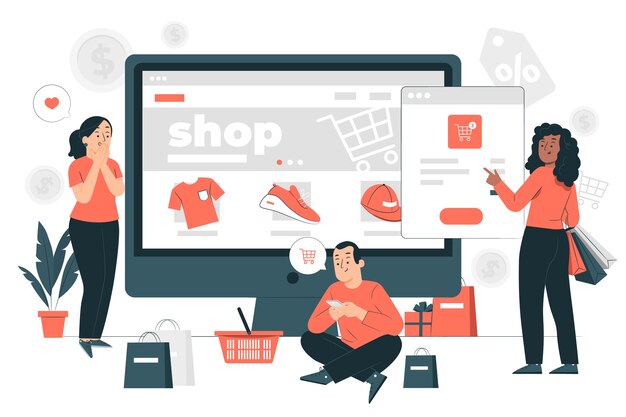
Types of E-Commerce
E-Commerce includes several models, each tailored to specific transactional relationships. Below, we explore the four primary types of E-Commerce activities, explaining them clearly to highlight their role:
- Business-to-Business (B2B): It involves transactions between businesses, such as wholesalers selling to retailers. Example: Alibaba and Oracle, which connect businesses for bulk purchases.
- Business-to-Consumer (B2C): This type of E-Commerce activity involves direct transactions between businesses and individual customers. Example: Companies like Amazon and Dell sell products directly to consumers via their websites.
- Consumer-to-Consumer (C2C): Platforms where consumers sell to other consumers, such as eBay or Etsy, facilitating peer-to-peer transactions.
- Consumer-to-Business (C2B): In this type of online commerce platform, a customer makes their products or services available for businesses to buy. Examples: freelancers on Upwork or customer reviews influencing business decisions.
What is E-Business?
E-Business, or Electronic Business, is a broader concept that encompasses all business activities conducted through digital platforms. Beyond transactions, it includes processes like customer relationship management (CRM), supply chain management, and internal operations.
Types of E-Business
E-business models vary based on their operational structure. Here are the two main types of Business:
- Pure-Play: It refers to those e-businesses that have a complete electronic and digital existence. Example: Booking.com, Oyo, Amazon, etc.
- Brick-and-Click: This type of e-business encompasses both electronic(online) and physical businesses. A chain of stores that conducts their business online and offline is the best example of this e-business model.
Popular Course in E-Commerce and E-Business
For those interested in pursuing careers in E-Commerce or E-Business, numerous courses offer specialized knowledge. Below is a curated list of popular programs:
| Criteria | E-commerce | E-business |
| Meaning | E-Commerce is a trading activity taking place through electronic devices. | A business that is run through the internet is known as an E-business. |
| Transactions | It carries out commercial transactions. | It carries out business transactions |
| Approach | It has an extroverted approach. | It has an ambivert approach. |
| Key Operational Component | It requires a website to run. | It requires a website, CRM, and ERP to run. |
| Use of the Internet | Mainly Internet is used for e-commercing activities | Here intranet, extranet as well and the internet are used. |
Top Universities Offering E-Commerce Or E-Business Programs
For pursuing the aforementioned courses, here are the major universities you can consider:
| Name of University | QS World University Ranking 2025 |
| Newcastle University | 129 |
| Lancaster University | 141 |
| Nottingham Trent University | 592 |
| Dublin Institute of Technology | – |
| Riverside City College | – |
| University System of Maryland | – |
| University of California, Berkeley | 12 |
| University of Wollongong | 167 |
| Brunel University London | 342 |
| Birmingham City University | 1001-1200 |
Note: Rankings sourced from QS World University Rankings 2025. Some institutions, like the Dublin Institute of Technology, may not have current QS rankings but are recognized for relevant programs.
Also Read: Job vs Business – What is Better?
The difference between E-Commerce and E-Business lies in their scope, approach, and operational requirements. E-Commerce focuses on online transactions, while E-Business encompasses all digital business activities. By understanding these distinctions, businesses and professionals can make informed decisions to thrive in the digital economy.
FAQs
The main types of E-Commerce include:
Business-to-Business (B2B): Transactions between businesses.
Business-to-Consumer (B2C): Businesses selling directly to consumers.
Consumer-to-Consumer (C2C): Individuals selling to other individuals.
Consumer-to-Business (C2B): Individuals offering products or services to businesses.
Business-to-Administration (B2A): Transactions between businesses and public administration.
Consumer-to-Administration (C2A): Individuals interacting with government or public administration services.
E-Business offers several advantages, including a faster buying process, reduced operational costs, wider market reach, improved customer convenience, and efficient inventory management.
The main difference between E-Commerce and E-Business is that E-Commerce focuses on online buying and selling, while E-Business includes all digital business activities, such as CRM and supply chain management.
Yes, many businesses combine E-Commerce (for sales) with E-Business (for operations) to create a comprehensive digital strategy.
Companies like Amazon (Pure-Play) and Walmart (Brick-and-Click) exemplify E-Business models.
Related Reads
Hopefully, this blog helped you understand the integral points of difference between E-commerce and E-business. Planning to study a course in E-Commerce and E-Business? Take the assistance of our experts at Leverage Edu by signing up for an e-meeting with us, and we will guide you in selecting the right programme and university that aligns with your interests and career goals!


 60,000+ students trusted us with their dreams. Take the first step today!