

 One app for all your study abroad needs

















A Letter of Recommendation (LOR) plays an important role in the admission process for Dutch universities, offering an authentic insight into a student’s academic performance, skills, and personal qualities. Whether you are applying for a bachelor’s, master’s, or PhD program in the Netherlands, top institutions like TU Delft, Leiden University, or Erasmus University Rotterdam often require one or more LORs to evaluate your suitability for their programs. A well-crafted LOR, written by a professor, mentor, or employer, highlights your strengths, achievements, and potential from an external perspective. It helps admissions committees understand not just what you have accomplished, but how you have contributed, learned, and grown in your academic or professional journey.
This blog explains the importance, format, important elements, and detailed samples of both academic and professional LORs to help you prepare a strong and impactful recommendation for Dutch university applications.
This Blog Includes:
- What is a Letter of Recommendation (LOR)?
- Types of Letter of Recommendation (LOR) for Dutch Universities
- Importance of LOR for Dutch Universities
- Format of a Letter of Recommendation (LOR) for Dutch Universities
- Sample Academic LOR for Dutch Universities
- Sample Professional LOR for Dutch Universities
- Important Tips for Writing a Strong LOR for Dutch Universities
- FAQs
What is a Letter of Recommendation (LOR)?
A Letter of Recommendation (LOR) is a formal document written by someone, usually a professor, teacher, employer, or supervisor, who can attest to your academic abilities, skills, achievements, and character. It provides universities with an objective evaluation of your performance and potential from a third-person perspective.
For Dutch universities, a LOR serves as proof of your readiness and suitability for the chosen course or program. It helps the admission committee understand how you approach learning, handle responsibilities, collaborate with others, and demonstrate leadership or innovation.
There are typically two main types of LORs:
- Academic LOR – Written by teachers or professors who have taught or supervised you in academic settings.
- Professional LOR – Written by employers or managers who have worked with you professionally.
Types of Letter of Recommendation (LOR) for Dutch Universities
Dutch universities generally require one or more Letters of Recommendation (LORs) as part of their admission process. These letters help the admissions committee evaluate your abilities, work ethic, and personality from the perspective of someone who has worked closely with you. Depending on your background and the program you’re applying to, there are mainly two types of LORs required by Dutch universities:
1. Academic Letter of Recommendation
An Academic LOR is written by a professor, lecturer, or academic supervisor who has taught or guided you during your studies. It highlights your academic achievements, intellectual curiosity, analytical skills, and research aptitude. This type of LOR is usually required for applicants to bachelor’s, master’s, or research-based programs such as engineering, science, social sciences, or humanities.
Important Focus Areas:
- Academic performance and consistency
- Subject knowledge and classroom participation
- Research or project involvement
- Creativity, critical thinking, and problem-solving ability
- Motivation for higher studies and contribution to academic discussions
Example: A professor writing about your performance in a key subject, research paper, or thesis project.
2. Professional Letter of Recommendation
A Professional LOR is written by a manager, supervisor, or team leader from your workplace or internship. It is usually required for MBA, professional master’s, or postgraduate diploma programs where work experience is valued. This letter assesses your practical knowledge, leadership, teamwork, and communication skills in a real-world environment.
Important Focus Areas:
- Job responsibilities and work ethics
- Leadership and teamwork abilities
- Problem-solving and project management skills
- Adaptability and learning attitude
- Achievements and impact in professional settings
Example: A manager writing about your contribution to a project, leadership in a team, or innovation at work.
Importance of LOR for Dutch Universities
Dutch universities emphasize holistic evaluation. Your grades, SOP, and resume show what you’ve done, but your LOR shows how you did it and how others perceive you.
An effective LOR helps universities evaluate:
- Your academic curiosity and motivation for higher learning.
- Research skills, teamwork, and leadership qualities.
- Professional ethics and practical experience (for master’s or MBA applicants).
- Compatibility with the chosen course and university environment.
For programs like Engineering, Business Analytics, Public Health, or International Law, universities such as Utrecht University or Wageningen University & Research may require two to three LORs, often a mix of academic and professional.
Also Read: 5 Steps that Professionals Follow When Writing LOR
Format of a Letter of Recommendation (LOR) for Dutch Universities
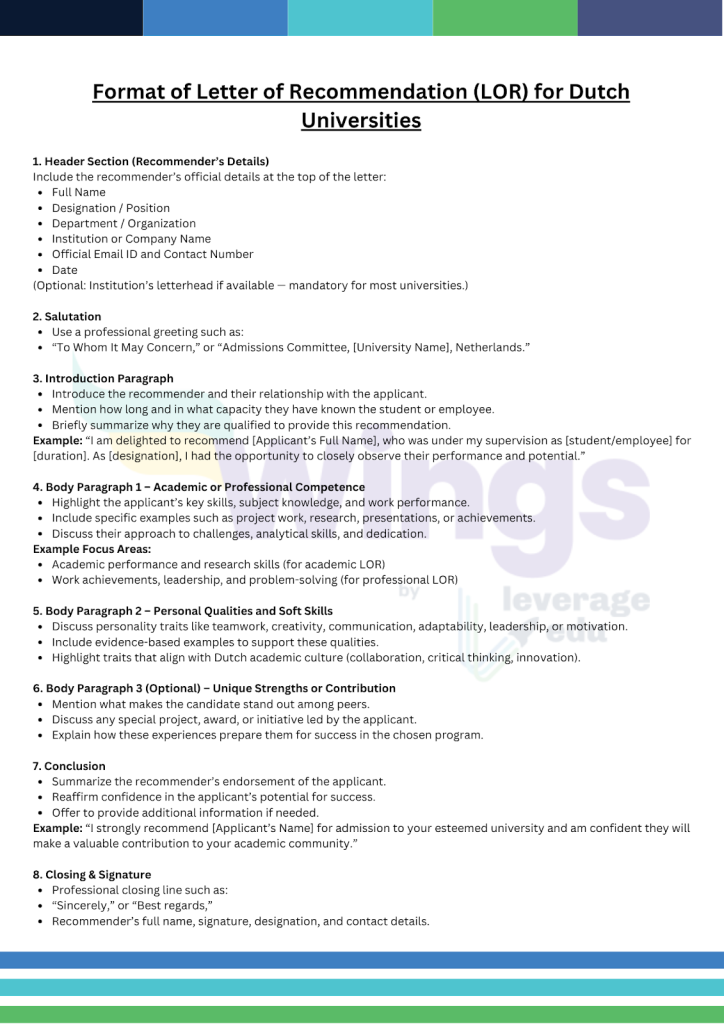
A Letter of Recommendation (LOR) for Dutch universities should follow a clear, formal, and organized structure. Admissions committees prefer letters that are concise, evidence-based, and personalized, typically around 400–500 words in length. Below is the ideal format and structure you should follow when drafting an effective LOR:
| Section | Description | Example Content |
| Header | Recommender’s details | Name, position, institution |
| Salutation | Greeting | “To Whom It May Concern” |
| Introduction | Relationship + duration | “Taught the applicant for 2 years in Environmental Studies” |
| Body 1 | Academic/professional skills | “Demonstrated analytical and research excellence…” |
| Body 2 | Personal traits | “Shows strong teamwork and leadership qualities…” |
| Conclusion | Strong recommendation | “I wholeheartedly recommend…” |
| Signature | Authenticity | Name, signature, contact info |
Sample Academic LOR for Dutch Universities
Here is a sample Academic Letter of Recommendation (LOR) perfectly tailored for a Dutch university application, featuring an Indian applicant and specific details to demonstrate academic excellence and research potential.
| [PROFESSOR/INSTITUTION LETTERHEAD] Date: November 7, 2025 To the Admissions Committee MSc in Electrical Engineering – Microelectronics Delft University of Technology (TU Delft) [TU Delft Address, Netherlands] Subject: Letter of Recommendation for Mr. Rohan Sharma Dear Admissions Committee, I am writing to enthusiastically recommend Mr. Rohan Sharma for the Master of Science program in Electrical Engineering with a specialization in Microelectronics at TU Delft. I have known Rohan for the past four years in my capacity as his Professor of Electronic Devices and Circuits and his Project Supervisor at the Department of Electrical Engineering, Indian Institute of Technology (IIT) Bombay. Rohan is an exceptionally bright and dedicated student. I taught him in two advanced core courses: Semiconductor Device Physics and VLSI Design. In both subjects, he demonstrated an outstanding grasp of complex theoretical concepts and ranked among the top 5% of a highly competitive class of 110 students, achieving a grade of 9.5/10 and 9.7/10, respectively. His analytical rigor and intellectual curiosity are truly remarkable. His final year undergraduate project, which I supervised, focused on “Optimisation of Power Consumption in FinFET Architectures.” This project required significant independent research and technical ingenuity. I was particularly impressed by Rohan’s autonomous development of a novel simulation model to test various scaling effects. This demonstrated his profound problem-solving ability and his skill in moving beyond textbook knowledge to generate practical, innovative solutions. His final thesis report was recognized within the department for its clarity, methodological depth, and high potential for publication. Beyond his technical prowess, Rohan possesses the maturity and proactive work ethic essential for a demanding program like yours. He is not afraid to challenge conventional approaches, yet he is highly collaborative, often assisting his peers with complex circuit analysis concepts. His ability to work independently and persevere through challenging technical obstacles makes him ideally suited for TU Delft’s research-intensive environment.I believe Rohan Sharma has all the foundational knowledge, research aptitude, and drive necessary to excel in the MSc in Electrical Engineering at TU Delft and make significant contributions to the field of microelectronics. I recommend him without any hesitation. Please feel free to contact me if you require further information. Sincerely, [Manual Signature] Dr. Alok Varma Professor and Head of Department, Electrical Engineering Indian Institute of Technology (IIT) Bombay, Mumbai, Institutional Email Address Office Phone Number |
Sample Professional LOR for Dutch Universities
| [COMPANY LETTERHEAD] TechSolutions India Pvt. Ltd. [Company Address, City, Pincode] Date: November 7, 2025 To the Admissions Committee MSc in Business Analytics Erasmus University Rotterdam (EUR) [EUR Address, Rotterdam, Netherlands] Subject: Professional Letter of Recommendation for Ms. Priya Singh Dear Admissions Committee, I am writing to strongly recommend Ms. Priya Singh for the Master of Science program in Business Analytics at Erasmus University Rotterdam. I have had the distinct pleasure of serving as Priya’s Direct Supervisor and Senior Manager of the Data Strategy Division at TechSolutions India for the past two and a half years, from May 2023 to the present. Priya began her tenure as a Junior Analyst and quickly distinguished herself through her exceptional quantitative skills and proactive problem-solving approach. While her academic background provided a solid theoretical foundation, it was her practical application of analytical rigor that truly impressed me. Specifically, she was the key individual responsible for the data cleaning and pipeline development during our major internal project, “Predictive Inventory Optimization (PIO).”This project was highly complex, involving the synthesis of data from multiple siloed internal platforms to forecast future stock requirements. Instead of merely executing the required tasks, Priya took the initiative to streamline our data quality checks, reducing the necessary processing time by 20% and subsequently lowering the model’s forecast error rate by a verifiable 18%. This single contribution resulted in an estimated €50,000 in Q3 cost savings related to inventory overhead. This incident demonstrates her ability to move beyond mere computation and deliver tangible, measurable business value. Furthermore, Priya possesses the independence and leadership maturity that your rigorous program requires. During a critical period when our team faced high workload pressure, Priya voluntarily undertook the responsibility of standardizing our team’s data visualization dashboards. This task was outside her core important Performance Indicators, yet she saw the operational need and successfully implemented a unified system, reducing reporting time for the entire division by several hours per week. She then trained three junior colleagues on the new standard, showcasing effective peer leadership and communication skills.In comparing Priya with the 45 junior analysts I have mentored over the last decade, I can confidently place her in the top 3% of individuals I have supervised. Her intellectual curiosity, coupled with her demonstrated ability to execute complex analytical tasks autonomously, makes her an outstanding candidate. I believe her desire to pursue advanced studies in the Netherlands aligns perfectly with her aptitude for independent, research-driven exploration. I am certain she will thrive in EUR’s demanding academic environment and contribute significantly to your research community.I recommend Ms. Priya Singh without any reservation for admission to your MSc in Business Analytics program. Please feel free to contact me for any further information. Sincerely, [Manual Signature] Mr. Vijay Menom Senior Manager Data Strategy Division TechSolutions India Pvt. Ltd. [Official Company Email][ Office Phone Number] |
Important Tips for Writing a Strong LOR for Dutch Universities
Writing a compelling Letter of Recommendation (LOR) for Dutch universities requires clarity, authenticity, and alignment with the institution’s academic culture. Dutch universities value evidence-based assessments, teamwork, and intellectual curiosity, so your LOR should reflect these qualities clearly and concisely. Below are the most important tips to craft a powerful and effective LOR:
1. Choose the Right Recommender: Select someone who knows you well and can speak specifically about your skills, achievements, and personality.
- For an Academic LOR, choose a professor or supervisor familiar with your academic work.
- For a Professional LOR, select a manager or senior colleague who has closely supervised your work. Avoid choosing high-ranking officials who don’t know you personally.
2. Keep It Honest and Authentic: Dutch universities appreciate genuine and evidence-based recommendations. Avoid exaggeration or overly generic praise. The recommender should provide real examples and measurable results to support every claim.
3. Maintain a Clear Structure: Follow a professional and organized format:
- Introduction (recommender’s background and relationship with applicant)
- Body (skills, achievements, examples, personal qualities)
- Conclusion (endorsement and contact details)
Ensure smooth transitions and logical flow between paragraphs.
4. Include Specific, Measurable Examples: Back up statements with quantifiable achievements or concrete experiences. For example: Instead of saying “She is hardworking,” write “She led a sustainability project that reduced paper waste by 30% in six months.”
5. Focus on Relevant Qualities: Align the LOR with the program you’re applying for.
- For technical courses – emphasize analytical, problem-solving, and research skills.
- For management or business courses – focus on leadership, communication, and teamwork.
- For creative or research-based fields – highlight innovation, curiosity, and independence.
6. Reflect Dutch Academic Values: Dutch education emphasizes collaboration, creativity, and self-direction.
Mention traits like:
- Independent learning
- Team collaboration
- Open-mindedness
- Critical and analytical thinking
These qualities resonate strongly with Dutch universities.
7. Keep It Concise and Professional: Your LOR should ideally be 400–500 words, written in formal language and free from grammatical errors. Avoid overly emotional or repetitive descriptions.
8. Use Official Letterhead and Signature: A LOR must be printed on official institution or company letterhead, dated, and signed by the recommender. This enhances authenticity and credibility.
9. Avoid Repetition with the SOP: Ensure your LOR complements, not repeats, your Statement of Purpose (SOP). The SOP reflects your own voice, while the LOR reflects an external perspective on your abilities and achievements.
10. Request It Early: Give your recommender ample time (2–3 weeks) to write the letter. Provide them with your resume, SOP draft, and course details to help them tailor the letter effectively.
Also Read: Conditions for Conditional Offer Letter for UK Universities
FAQs
Yes, the Netherlands generally requires Letters of Recommendation (LORs) for most competitive and selective university programs, especially for Master’s and PhD applications. While some non-selective Bachelor’s programs might occasionally waive them, LORs are considered a standard, important document used by Dutch admissions committees to assess an applicant’s academic potential, research aptitude, and professional maturity beyond grades. They are essential for demonstrating a credible external endorsement of your suitability.
A Letter of Recommendation (LOR) is a formal document written by a professor, supervisor, or mentor that validates your skills, qualifications, and character to an admissions committee or employer. It provides an objective, third-party assessment using specific examples and evidence to affirm your suitability and potential for the program or position.
In situations where an applicant requires a letter urgently or feels their supervisor lacks the necessary detail about their achievements, providing a detailed outline or “brag sheet” of their accomplishments is standard practice. This approach allows the applicant to highlight specific strengths and quantitative achievements relevant to the program. However, it is essential that the recommender uses this draft as a starting point, rewriting and personalizing the content before formally signing and submitting the final letter to ensure the document retains its required integrity and objective voice.
Related Reads
We hope that this blog was able to provide you with all the information regarding the “Letter of Recommendation (LOR) for Dutch Universities”. Many Indian students dream of pursuing education in foreign nations due to the exposure and career growth they offer. Consider joining a free counselling session with Leverage Edu if you plan to study abroad.

 60,000+ students trusted us with their dreams. Take the first step today!