

 One app for all your study abroad needs













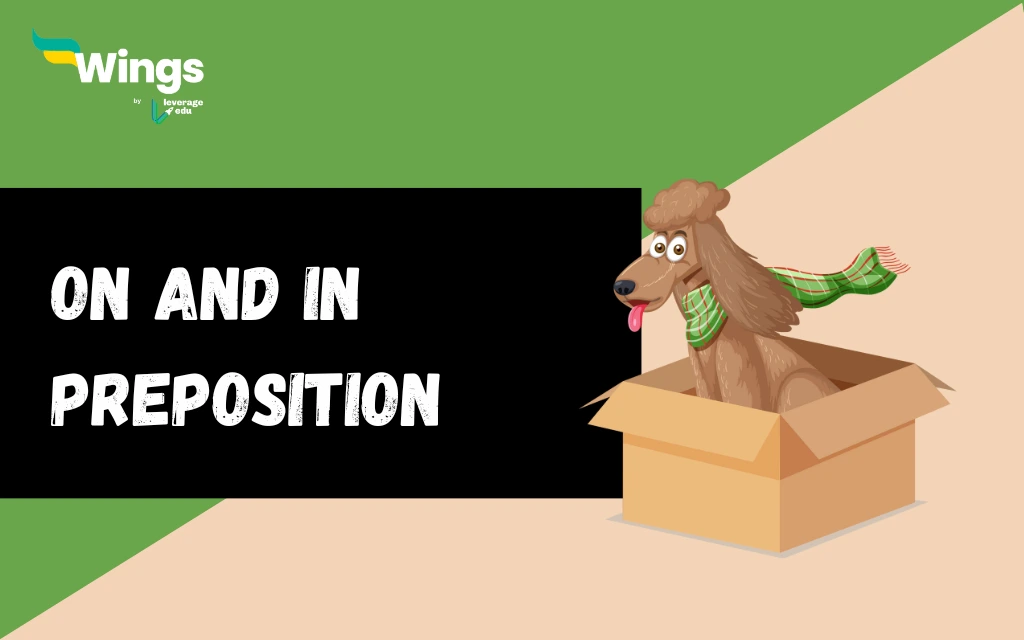
On and In Preposition: Prepositions play an extensive role in the English language, providing essential information about the relationships between different elements in a sentence. Prepositions are words used to denote the time, location, direction, etc. of a noun or a pronoun in a sentence.
Two commonly used prepositions, “in” and “on,” are versatile and have diverse applications in various contexts. While “in” often signifies containment or immersion within something, “on” typically indicates a surface or position. In this blog post, we’ll learn about the ‘In’ and ‘On’ prepositions, their uses, and examples to enhance your understanding of the concept.
This Blog Includes:
Usage of ‘In’ Preposition with Examples
The preposition “in” is commonly used to show location, time, condition, and inclusion. It helps explain where something is, when something happens, or the state of something. The proposition of In is used to define certain things, as mentioned below, along with e examples:
1. ‘In’ – Location within a space.
Example: The cat is in the box.
2. ‘In’ – Time
Example: She will arrive in an hour.
3. Inclusion
Example: There is milk in the refrigerator.
4. ‘In’ State or condition
Example: He is in a good mood.
5. ‘In’ Communication or contact.
Example: We talked in person.
6. Belonging: Demonstrating ownership or membership.
Example: I have a friend in the soccer team.
7. ‘In‘ Mode of transport
Example: They travelled in a car.
8. ‘In’ Surroundings: Describing the environment or surroundings.
Example: The flowers bloom in spring.
Explore this blog: Rules for Prepositions in English Grammar with Examples
On Preposition Usage with Examples
The preposition “on” is commonly used to show time, place, position, contact, and responsibility. Its meaning depends on how it connects words in a sentence. Here is the description of the use of prepositions along with examples.
1. ‘On’ Surface: Used to indicate a position on a surface.
Example: The book is on the table.
2. ‘On’ Days and dates: Referring to specific days or dates.
Example: The meeting is on Monday.
3. ‘On’ Events: Indicating participation in an event or activity.
Example: He is on the soccer team.
4. ‘On’ Media: Referring to content in a specific medium.
Example: I read about it on the news.
5. Communication: Indicating a form of communication or agreement.
Example: Let’s discuss it on the phone.
6. Expressing a state or condition.
Example: He is on fire with enthusiasm.
7. Transportation:
Referring to a means of transportation.
Example: She is on the bus.
8. Attached or positioned:
Example: The note is on the door.
On vs In Preposition: Key Differences
The prepositions “on” and “in” are often confusing because both are used for time and place. Understanding this difference with te help of the table mentioned below makes usage much easier.
| Feature | On | In |
| Time usage | Used for specific days and dates | Used for months, years, and long periods |
| Place usage | Refers to a surface or contact | Refers to an enclosed or defined space |
| Level of detail | More specific | Broader or general |
| Example (Time) | On Monday, on 15th August | In June, in 2026 |
| Example (Place) | On the table | In the room |
Also Read: Use of At On In Preposition with Examples & Exercises
Easy Trick to Remember “On” and “In”
One of the simplest ways to master “on” and “in” prepositions is to stop memorising rules and start visualising situations. Here are some easy tricks that actually work while remembering the difference between these prepositions.
1. Surface vs Inside Rule
- Use “on” when something is on a surface or has contact with it.
Example: on the table, on the wall, on the road - Use “in” when something is inside an enclosed space.
Example: in the box, in the room, in the bag
2. Time Shortcut Trick
This is a lifesaver for exams:
- ON → One specific day
Example: on Monday, on my birthday, on 10th July - IN → Long time periods
Example: in 2026, in August, in the future
3. Address & Location Trick
- ON is used for streets and surfaces
Example: on MG Road, on the platform - IN is used for cities, countries, and rooms
Example: in Delhi, in India, in the office
4. Picture It in Your Head
Before choosing on or in, pause and ask:
“Where exactly is it?”
- Resting on top → on
- Surrounded from all sides → in
This visual method reduces confusion instantly.
5. Exam-Friendly One-Line Rule
If it touches a surface, use ON.
If it stays inside a space or period, use IN.
On and In Preposition Exercise
Look at the exercise of ‘On’ and ‘In’ prepositions to check your understanding of this concept.
Fill in the blanks with the appropriate preposition:
- The cat is __________ the roof.
- We have a meeting scheduled __________ Monday.
- There is a stain __________ your shirt.
- She is interested __________ learning a new language.
- The book is __________ the table.
- The concert is happening __________ the weekend.
- I found the keys __________ the drawer.
- The movie will start __________ 7:00 PM.
- They live __________ the same neighborhood.
- The children are playing __________ the backyard.
On and In Preposition Answers:
- The cat is on the roof.
- We have a meeting scheduled on Monday.
- There is a stain on your shirt.
- She is interested in learning a new language.
- The book is on the table.
- The concert is happening on the weekend.
- I found the keys in the drawer.
- The movie will start at 7:00 PM.
- They live in the same neighbourhood.
- The children are playing in the backyard.
FAQs
Prepositions that are used to indicate the duration of a particular action are called prepositions of time. For example: in, at, and on.
Use “on” for surfaces, specific days, and dates. Use “in” for enclosed spaces, months, years, long periods, and larger areas like cities or countries
Yes. Use “on” with public transport (on a bus/train), “in” with cars or enclosed vehicles, and “at” when referring to a stop or location.
Neither is correct. The correct preposition is “at 8 am”, because “at” is used for exact clock times.
On the table, on the wall, on Monday, on my birthday, on the bus, on the road, on the screen, on the floor, on the menu, on the internet.
Related Posts
To advance your grammar knowledge and read more informative blogs, check out our Learn English page and don’t forget to follow Leverage Edu.

 60,000+ students trusted us with their dreams. Take the first step today!