

 One app for all your study abroad needs













Prepositions sneak in everywhere, and if you can’t master them, your writing looks mid. But this blog on 8 types of prepositions with examples breaks this mess down so you actually understand where, when, how, and why to place words. From place to agent, measure to manner, every type is explained with simple examples you can actually use. Read this, practice the exercises, and finally stop tripping over prepositions like everyone else.
This Blog Includes:
- What Are Prepositions?
- 8 Types of Prepositions with Examples
- Exercises for Every 8 Types of Prepositions
- Exercise 1: Fill in the Blanks with Prepositions of Place
- Exercise 2: Choose the Correct Preposition of Time
- Exercise 3: Complete the Sentences with Prepositions of Movement
- Exercise 4: Identify the Correct Preposition of Measure
- Exercise 5: Fill in the Blanks with Prepositions of Source
- Exercise 6: Rewrite the Sentences Using Prepositions of Possession
- Exercise 7: Match the Sentences with Prepositions of Manner
- Exercise 8: Choose the Correct Preposition of Agent or Instrument
- FAQs
What Are Prepositions?
Prepositions are tiny bossy words that tell you how things connect. They show place, time, direction, source, measure, manner, possession, and who did the action or what tool was used. These words make sentences clear or confusing depending on how you use them, and students mess this up all the time because prepositions look simple but act complicated.
You use prepositions every single day without even thinking. When you say your bag is on the table, you reach to school at 8 AM, or you walk to the market, the preposition quietly sets the location, the time or the movement. These small words control the meaning, so if you use the wrong one, your whole sentence looks lost.
Check out this video for a better understanding.
8 Types of Prepositions with Examples
Prepositions become easy when you see how each type works in real life. These eight types appear everywhere in grammar. Each one controls a different meaning, so using the wrong one can turn your sentence into a mess.
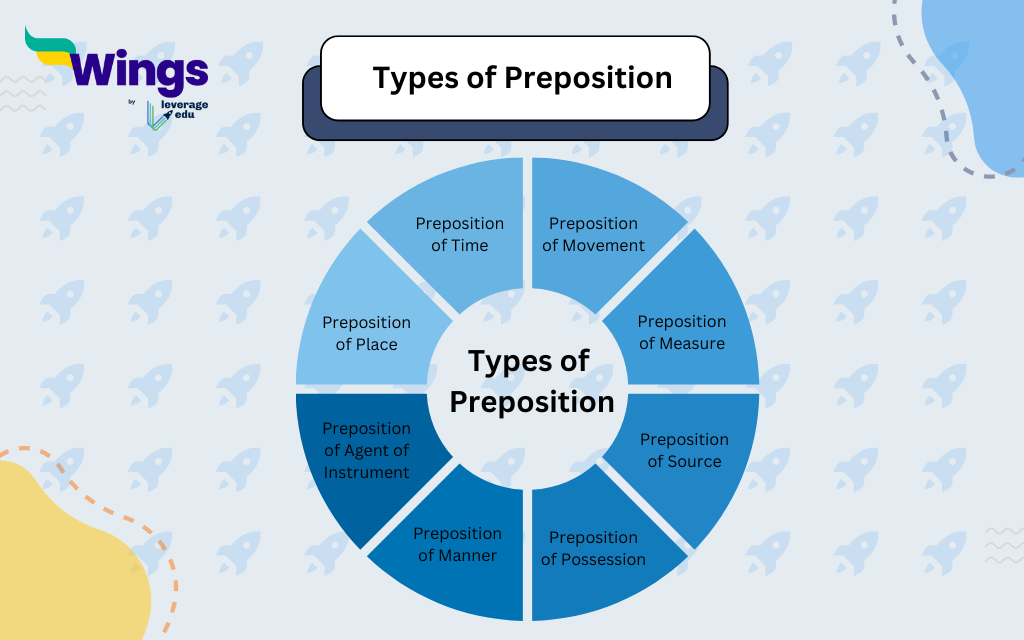
Preposition of Place
A preposition of place shows the location of a person, object, or event in relation to another noun. Place prepositions answer where something is. Use them to show exact position (on, under), general area (near, beside), or containment (in, inside). Some prepositions work with static position (the book is on the table) and some can work with movement plus place if the sentence needs it (put the book on the table). Choose the preposition that fits how specific you want the location to be.
Examples:
- The cup is on the table.
- The cat slept under the blanket.
- The shop stands beside the school.
- Put the toys in the box.
- The bus stop is near my house.
Preposition of Time
A preposition of time links events or actions to a point or period on the time scale. Time prepositions tell when something happens: a point (at 7 pm), a day or date (on Monday), a month or year (in July, in 2020), a duration or deadline (for two hours, until Friday). Use short, exact prepositions for clock times and more general ones for months, years, or long periods. Pay attention to phrases like “since” and “for”: use since for the start point and for for the duration.
Examples:
- School starts at 8:00 am.
- He will visit on Sunday.
- She was born in 2008.
- They lived there for three years.
- The shop is open until 9 pm.
Preposition of Movement
A preposition of movement shows direction, path, or the end point of motion from one place to another. Movement prepositions describe how something moves: towards a point (towards the gate), into or out of a place (into the room, out of the house), across or along a path (across the field, along the road). Use them when you want to tell where someone or something is going, not just where it is. Some prepositions pair with verbs of motion; others work with verbs of transfer or change of state.
Examples:
- She walked to the market.
- The bird flew across the garden.
- He climbed up the ladder.
- The ball rolled into the pond.
- They moved along the riverbank.
Preposition of Measure
A preposition of measure shows quantity, rate, proportion, or unit related to the noun it describes. Measure prepositions connect numbers and units to things: price per unit (per litre), speed (kilometres per hour), weight or size by measure (by the kilo, by the metre), and rates or ratios. Use them to say how much, how fast, or how often in a precise way. Commonly used words include per, by, at (for rates), and out of (for ratios).
Examples:
- Petrol costs 100 rupees per litre.
- The train runs at 80 kilometres per hour.
- Apples are sold by the kilo.
- She types at 60 words per minute.
- He scored 8 out of 10 in the test.
Preposition of Source
A preposition of source indicates the origin or point of departure of a person, object, idea, or action. Source prepositions show where something comes from: a place (from Delhi), a person (from my teacher), an origin of an idea (from a book), or the cause/starting point of an action. Use them when you want to link the subject or item to its origin. Source can be physical, like a place, or abstract, like an idea or information.
Examples:
- She received a letter from her cousin.
- Water flows from the spring.
- This idea came from an old book.
- The train departed from the station.
- He learned the news from a friend.
Preposition of Possession
A preposition of possession shows ownership, belonging, or a relationship of possession between nouns. Possession prepositions link objects to their owners or show relationships: of, ‘s (in spoken/written English), and to/belong to for verbs. Use them to say who owns or is associated with something. In many cases “of” works for formal writing and “belongs to” or ’s is more natural in speech.
Examples:
- The cover of the book is blue.
- The pen belongs to Ravi.
- The roof of the house needs repair.
- The keys are in the pocket of his jacket.
- The idea of the plan came from Meera.
Preposition of Manner
A preposition of manner describes the way or style in which an action happens. Manner prepositions explain how something is done: with, by, in, like. Use them to show the method, attitude, or conditions of an action (speak with respect; act in haste). They often pair with verbs to show the tool, approach, or feeling that defines the action. Choose clear phrasing: with + noun often describes accompaniment or tool, while in + noun can describe style or state.
Examples:
- She spoke with confidence.
- He completed the task with care.
- They acted in secret.
- She handled the dog like a pro.
- He solved the puzzle by logic.
Preposition of Agent or Instrument
A preposition of agent or instrument indicates who performs an action (agent) or what is used to perform it (instrument). Use by to name the agent in passive constructions (The song was sung by Aisha). Use with or using to name the instrument or tool used to perform an action (He cut the paper with scissors). Distinguish agent (the doer) from instrument (the tool): the agent is often a person or group; the instrument is an object or method. This distinction matters especially in passive sentences and formal writing.
Examples:
- The cake was baked by the chef.
- The window was broken by the storm.
- She wrote the letter with a pen.
- The message was sent by email.
- He opened the box using a knife.
Also Read: Future Unreal Conditional Examples
Exercises for Every 8 Types of Prepositions
Prepositions control sentences more than you think. These exercises make sure you understand how to place them correctly. Each exercise focuses on one type of preposition, giving you realistic practice so you can use them in writing and speaking. Follow instructions carefully, answer all questions, and check your answers to see if you’ve nailed the type or need more practice.
Exercise 1: Fill in the Blanks with Prepositions of Place
Instructions: Fill in the blanks with the correct preposition of place. Think about where something or someone is located.
Questions:
- The cat is ___ the sofa.
- The keys are ___ the drawer.
- She stood ___ the window and watched the rain.
- The books are kept ___ the shelf.
- The dog slept ___ the bed.
- The school is ___ the library.
- The painting hangs ___ the wall.
- The ball is ___ the box.
- The lamp is placed ___ the table.
- The children are playing ___ the garden.
Answers:
- on
- in
- by
- on
- under
- beside
- on
- inside
- on
- in
Exercise 2: Choose the Correct Preposition of Time
Instructions: Choose the correct preposition of time to complete each sentence. Pay attention to points, days, months, or durations.
Questions:
- The train leaves ___ 7:00 AM.
- She was born ___ July.
- We will meet ___ Monday.
- The shop closes ___ 9 PM.
- I have been studying ___ two hours.
- He has lived here ___ 2015.
- The festival starts ___ Diwali.
- The assignment is due ___ Friday.
- We celebrate New Year ___ 1st January.
- The class begins ___ noon.
Answers:
- at
- in
- on
- at
- for
- since
- on
- by
- on
- at
Exercise 3: Complete the Sentences with Prepositions of Movement
Instructions: Fill in the blanks with the correct preposition of movement to show direction or path.
Questions:
- She ran ___ the park.
- The bird flew ___ the trees.
- He walked ___ the room.
- The river flows ___ the mountains.
- They climbed ___ the hill.
- The ball rolled ___ the stairs.
- The children ran ___ the playground.
- The dog jumped ___ the fence.
- The car drove ___ the tunnel.
- He moved ___ the crowd.
Answers:
- to
- across
- into
- from
- up
- down
- across
- over
- through
- among
Exercise 4: Identify the Correct Preposition of Measure
Instructions: Choose or fill in the correct preposition of measure to complete the sentence.
Questions:
- Petrol costs 95 rupees ___ litre.
- She types 50 words ___ minute.
- Cloth is sold ___ metre.
- The car runs 80 kilometres ___ hour.
- He scored 9 out of 10 ___ the test.
- Apples are priced 100 rupees ___ kilo.
- She earns 200 rupees ___ day.
- They built 5 houses ___ year.
- The juice costs 50 rupees ___ bottle.
- The train covers 300 kilometres ___ 5 hours.
Answers:
- per
- per
- by
- per
- in
- per
- per
- per
- per
- in
Also Read: Rules for Prepositions in English Grammar with Examples
Exercise 5: Fill in the Blanks with Prepositions of Source
Instructions: Complete the sentences with the correct preposition to indicate source or origin.
Questions:
- She got a gift ___ her friend.
- The water comes ___ the river.
- This idea is taken ___ the book.
- The news came ___ the newspaper.
- He received a message ___ his teacher.
- The train arrives ___ Mumbai.
- The money was sent ___ his parents.
- The song is sung ___ the choir.
- He learned a lot ___ his coach.
- Smoke rises ___ the chimney.
Answers:
- from
- from
- from
- from
- from
- from
- by
- by
- from
- from
Exercise 6: Rewrite the Sentences Using Prepositions of Possession
Instructions: Rewrite the sentences to show ownership or belonging using the correct preposition.
Questions:
- The car of Ravi is red.
- The pen of Meera is missing.
- The tail of the dog is long.
- The books of the students are on the table.
- The bag of Rohan is heavy.
- The idea of the teacher was excellent.
- The house of my uncle is big.
- The jacket of Priya is warm.
- The toy of the child is broken.
- The room of the guest is clean.
Answers:
- Ravi’s car is red.
- Meera’s pen is missing.
- The dog’s tail is long.
- The students’ books are on the table.
- Rohan’s bag is heavy.
- The teacher’s idea was excellent.
- My uncle’s house is big.
- Priya’s jacket is warm.
- The child’s toy is broken.
- The guest’s room is clean.
Exercise 7: Match the Sentences with Prepositions of Manner
Instructions: Match each sentence with the correct preposition showing how an action is done.
Questions:
- She spoke ___ confidence.
- He solved the problem ___ ease.
- They worked ___ silence.
- She handled the dog ___ care.
- He completed the task ___ speed.
- The students acted ___ honesty.
- The manager responded ___ patience.
- The singer performed ___ perfection.
- He painted the wall ___ skill.
- The team played ___ teamwork.
Answers:
- with
- with
- in
- with
- with
- with
- with
- to
- with
- with
Exercise 8: Choose the Correct Preposition of Agent or Instrument
Instructions: Complete each sentence with the correct preposition showing the agent or instrument used.
Questions:
- The cake was baked ___ the chef.
- The window was broken ___ the storm.
- She wrote the letter ___ a pen.
- The message was sent ___ email.
- The song was sung ___ the choir.
- The door was opened ___ the key.
- The food was cooked ___ the chef.
- The picture was drawn ___ Ravi.
- He typed the report ___ the keyboard.
- The paper was cut ___ scissors.
Answers:
- by
- by
- with
- by
- by
- with
- by
- by
- on
- with
Also Read: Simple Present Tense Voice Change Exercises
FAQs
Ans: The 8 types include prepositions of time, place, direction, agent, instrument, source, possession, and purpose. These help show relationships between nouns and other parts of a sentence.
Ans: The 10 types include time, place, direction, movement, manner, cause, purpose, agency, instrument, and measurement. Example: The cat is under the table (place).
Ans: A Class 8 preposition shows the relation between a noun or pronoun and other words in a sentence. It helps explain when, where, how, or why something happens.
Ans: Class 4 mainly focuses on prepositions of time, place, and movement. These help students understand simple relationships like on, in, under, and to.
Ans: Prepositions help show connections in a sentence, making the meaning clear and easy to understand. They explain relationships related to time, place, direction, and more.
Relatable Reads
This was everything you needed to finally master the 8 types of prepositions with examples. Now you know what each type means, how to spot them, and how to use them without second-guessing yourself. Keep learning and stay connected with Learn English on Leverage Edu for more helpful and student-friendly blogs. And if this helped you, don’t forget to share, rate, and drop a comment. Your support helps more students find the good stuff.

 60,000+ students trusted us with their dreams. Take the first step today!