

 One app for all your study abroad needs













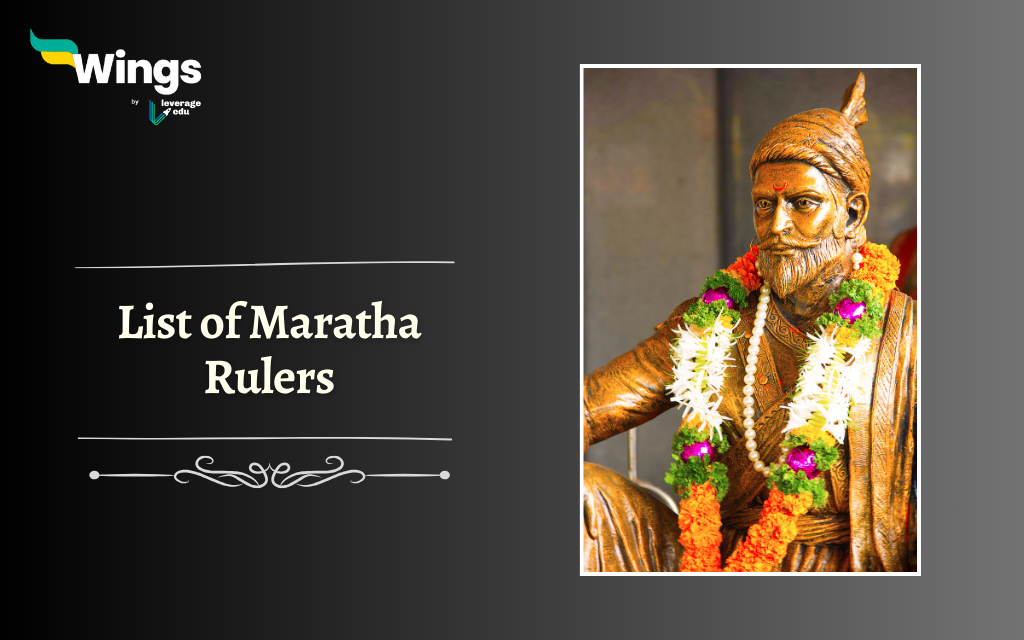
The Maratha Empire played a pivotal role in shaping Indian history during the 17th and 18th centuries. From the legendary Chhatrapati Shivaji Maharaj to the influential Peshwas, their legacy is one of courage, strategy, and resilience. In this detailed list of Maratha rulers, we trace the powerful leaders who built and expanded the empire. Whether you’re a history enthusiast or a curious learner, this blog offers a complete overview of Maratha royalty and their enduring impact.
Contents
History of the Maratha Empire
The history of the Maratha Empire begins in the 17th century with the rise of Chhatrapati Shivaji Maharaj, a visionary leader who laid the foundation of Hindavi Swarajya — self-rule for the Hindu people. Emerging from the Deccan region, Shivaji’s defiance against the Mughal and Bijapur Sultanates marked a turning point in Indian history.
In 1674, he was formally crowned at Raigad Fort, establishing the Maratha Empire with a strong administrative system, a disciplined military, and a navy to guard the western coast.
After Shivaji’s death, the empire faced major challenges during the reigns of Sambhaji, Rajaram, and Tarabai, who continued resisting Aurangzeb’s Mughal forces. Despite setbacks, the empire survived and later expanded under Shahu I and the Peshwa administration. By the mid-18th century, the Marathas had become the dominant power in India, playing a major role in the decline of Mughal authority.
The empire eventually weakened during British expansion and came to an end after the Third Anglo-Maratha War in 1818.
Timeline and List of Maratha Leaders
There were in all 7 rulers who headed the Maratha empire, and the list of Maratha rulers along with their years of reign is mentioned below.
| Year | Event |
|---|---|
| 1674 | Shivaji Maharaj crowned; Maratha Empire officially established |
| 1680–1689 | Reign of Sambhaji, son of Shivaji |
| 1689 | Sambhaji captured and executed by Aurangzeb |
| 1689–1707 | Empire headed by Rajaram and later Tarabai |
| 1707–1719 | Reign of Shahu I (grandson of Shivaji) |
| 1720–1740 | Reign of Peshwa Baji Rao I |
| 1740–1761 | Reign of Balaji Baji Rao (Nana Saheb) |
| 1761–1772 | Reign of Peshwa Madhavrao I |
| 1774–1796 | Reign of Peshwa Madhavrao II (Sawai Madhavrao) |
| 1796–1818 | Peshwa Baji Rao II; Empire ends after Third Anglo-Maratha War |
| 1818 | British defeat Peshwa Baji Rao II; he is exiled to Bithoor, ending Maratha supremacy |
List of Later Maratha Rulers (Chhatrapatis of Satara and Kolhapur)
After the death of Shahu I, the Maratha Empire saw a significant shift in power, leading to the emergence of two separate royal lines — Satara and Kolhapur. The later Maratha rulers, though often overshadowed by the rise of the Peshwas, played a key role in preserving Maratha heritage and authority in their respective regions.
| Name | Reign | Branch | Key Contributions / Notes |
|---|---|---|---|
| Shahu I | 1707–1749 | Satara | Restored Maratha power; appointed Balaji Vishwanath as Peshwa |
| Ramaraja (Shahu II) | 1749–1777 | Satara | Puppet ruler under Peshwa control |
| Pratapsingh | 1839–1848 | Satara | Last Satara ruler before British annexation under Doctrine of Lapse |
| Shahu II (of Satara) | 1848 | Satara | Dethroned by the British; Satara annexed |
| Rajaram I | 1700–1714 | Kolhapur | Son of Shivaji; founder of Kolhapur line |
| Shivaji I (Kolhapur) | 1714–1718 | Kolhapur | Continued Rajaram’s legacy |
| Sambhaji I | 1718–1760 | Kolhapur | Long rule; strengthened Kolhapur kingdom |
| Shivaji II | 1760–1813 | Kolhapur | Ruled during rising British influence |
| Shahu I (Kolhapur) | 1894–1922 | Kolhapur | Major social reformer; promoted education and upliftment |
| Rajaram III | 1922–1940 | Kolhapur | Encouraged industry, education, welfare |
| Shivaji VII | 1941–1946 | Kolhapur | Last ruling Maharaja before merger with independent India |
FAQs
The greatest Maratha ruler is widely considered to be Chhatrapati Shivaji Maharaj, known for his strategic brilliance, military innovations, and establishing the foundation of the Maratha Empire. His leadership and vision of Hindavi Swarajya have left an enduring legacy in Indian history.
The last king of the Maratha Empire was Chhatrapati Shahu II, who ruled the Satara branch until his dethronement by the British in 1848. After the annexation of Satara, the Maratha monarchy effectively came to an end.
The four main Maratha clans were the Chhatrapatis of the Bhonsle dynasty, the Peshwas of the Bhat family, the Shinde (Scindia) clan, and the Holkar clan. Each played a significant role in the Maratha Empire’s military and political dominance in India.
Relevant Blogs
It was all about the list of Maratha rulers. If you want to know more about topics like this, then visit our page Famous Personalities of India or our general knowledge page! Alternatively, you can also read our blog on general knowledge for competitive exams!

 60,000+ students trusted us with their dreams. Take the first step today!