

 One app for all your study abroad needs











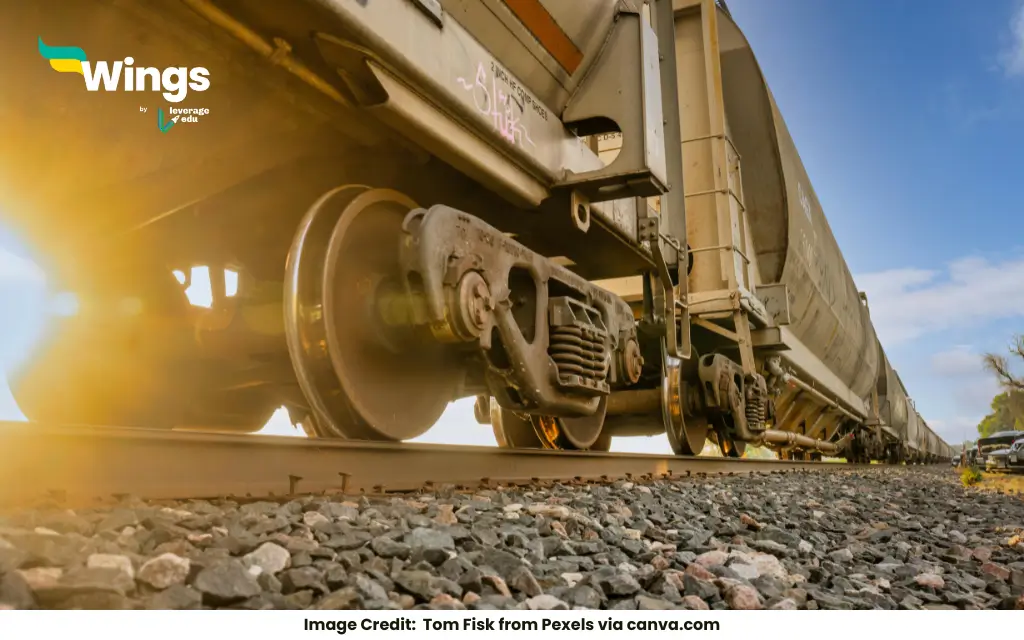
India has three main types of railway track gauges. A gauge refers to the distance between the two rails of a railway track. Different gauges are used for different reasons, like the terrain, the type of train, or the cost of construction. Let’s understand each gauge in simple words:
1. Broad Gauge (BG): Broad Gauge is a type of railway track where the distance between the two rails is 1,676 mm (5 feet 6 inches). It is the most widely used gauge in India, suitable for high-speed and heavy trains over long distances.
- Width: 1,676 mm (5 feet 6 inches)
- Most Common in India
- Usage: Almost all major passenger and freight trains in India run on the Broad Gauge.
- Benefits:
- Can carry heavy loads.
- Good for long-distance travel.
- Faster and more stable.
Fun Fact: Over 90% of Indian Railways runs on Broad Gauge. It’s the standard gauge used for most trains today.
2. Metre Gauge (MG): Metre Gauge is a railway track with a distance of 1,000 mm (1 metre) between the rails. It was commonly used in India earlier, but is now being gradually replaced by Broad Gauge for better speed and capacity.
- Width: 1,000 mm (1 metre)
- Less common now
- Usage: Earlier, many trains used to run on the Metre Gauge, especially in small towns and hilly areas.
- Drawbacks:
- Slower speed.
- Cannot carry heavy loads like Broad Gauge.
Today, many Metre Gauge lines are being converted to Broad Gauge to make train travel faster and more efficient.
3. Narrow Gauge (NG): Narrow Gauge refers to railway tracks where the rails are narrower than 1,000 mm, usually 762 mm or 610 mm apart. It is mostly used in hilly or mountainous areas, especially for toy trains or light railways.
- Width: 762 mm or 610 mm
- Very rare and used in special areas
- Usage:
- Found in hilly and mountainous regions, like the toy trains in Darjeeling and Matheran.
- Found in hilly and mountainous regions, like the toy trains in Darjeeling and Matheran.
- Advantages:
- Cheaper to build.
- Can go through narrow curves in hills.
However, it’s not suitable for fast or heavy trains.
Here is the table to compare the Gauges of Railway Tracks:
| Gauge Type | Width | Where It’s Used |
| Broad Gauge | 1,676 mm | Most of India (long-distance trains) |
| Metre Gauge | 1,000 mm | Some small towns (now being phased out) |
| Narrow Gauge | 762 mm / 610 mm | Hilly areas (toy trains) |
So, the three types of railway track gauges in India are Broad Gauge, Metre Gauge, and Narrow Gauge. Among these, Broad Gauge is the most widely used and important one today.
Common Doubts of Social Science:


 60,000+ students trusted us with their dreams. Take the first step today!