

 One app for all your study abroad needs













Irregular nouns are one of the trickiest parts of English grammar. They do not follow the standard rules of forming plurals, which often leads to mistakes in writing and speaking. Words like “child,” “mouse,” and “man” have plurals that defy logic, and getting them wrong can make your English sound mid. Understanding irregular nouns is essential for clear communication, academic writing, and exams. This blog provides 25 of the most important irregular nouns for fluent English, their correct plural forms, example sentences, and exercises to help you master them and write or speak English confidently.
This Blog Includes:
What are Irregular Nouns and Examples?
Irregular nouns are nouns that do not follow the standard rule of forming plurals by simply adding “-s” or “-es.” Unlike regular nouns like “book – books” or “car – cars,” irregular nouns change completely or stay the same in their plural form. This makes them tricky for learners and easy to get wrong in writing or speaking.
Examples of Irregular Nouns
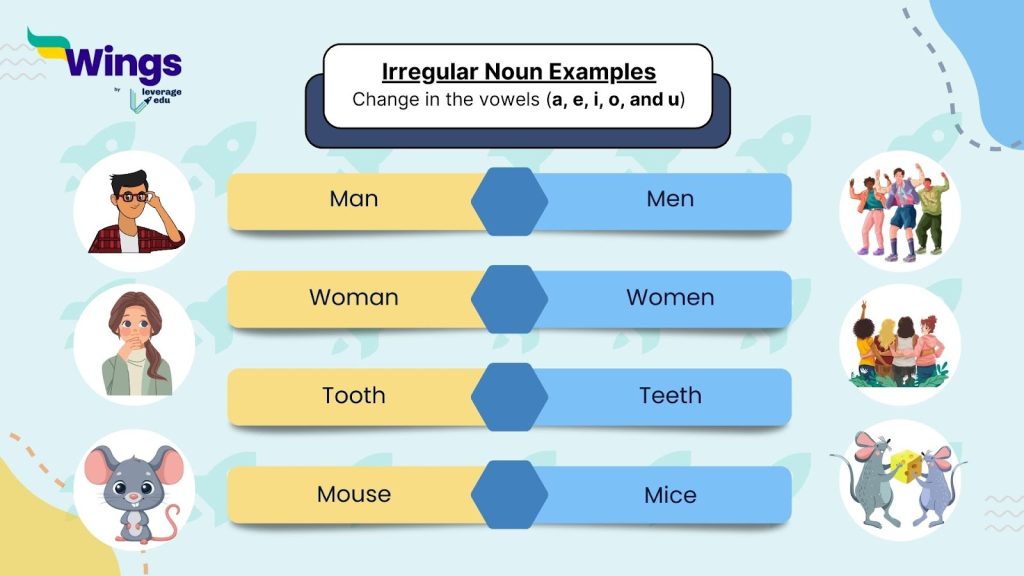
- Child – Children: “One child is playing in the park. Two children are playing there.”
- Man – Men: “The man is reading a book. The men are reading in the library.”
- Woman – Women: “A woman is speaking. Many women are speaking.”
- Mouse – Mice: “The mouse ran into the corner. The mice are hiding under the table.”
- Tooth – Teeth: “I have a toothache. My teeth are healthy.”
When and Where They Are Used?
Irregular nouns are common in everyday conversations, formal writing, and academic contexts. Using the correct plural is important for clarity because mistakes like “childs” or “mouses” can make your English sound unprofessional or confusing.
Take a look at the example below, and you will understand the definition of irregular plural nouns even better.
Quick Read: Singular and Plural for Class 2 Kids
List of 25+ Irregular Plural Nouns You Should Know
Irregular plural nouns are important for accurate English because their plural forms don’t follow standard rules. Using them correctly improves both writing and speaking, especially in formal or academic contexts. Below is a list of 25+ unique irregular nouns that you should know, along with easy-to-understand examples.
| Singular | Plural | Example Sentence |
| ox | oxen | “The ox is grazing in the field. The oxen are working together.” |
| cactus | cacti | “This cactus needs sunlight. All the cacti are blooming.” |
| nucleus | nuclei | “The nucleus controls the cell. The nuclei are visible under a microscope.” |
| criterion | criteria | “The criterion for selection is clear. The criteria are strict.” |
| phenomenon | phenomena | “This phenomenon is rare. Many phenomena have been recorded.” |
| appendix | appendices | “Check the appendix for details. The appendices include charts and graphs.” |
| index | indices | “The index is at the back. The indices help you find topics quickly.” |
| syllabus | syllabi | “The syllabus is long. The syllabi differ across universities.” |
| diagnosis | diagnoses | “The diagnosis was accurate. Multiple diagnoses were made.” |
| oasis | oases | “There is an oasis in the desert. The oases provide water for travelers.” |
| crisis | crises | “The crisis is worsening. Several crises hit the country last year.” |
| thesis | theses | “Her thesis is impressive. Many theses were submitted this semester.” |
| basis | bases | “The basis of the theory is strong. The bases for comparison are clear.” |
| parenthesis | parentheses | “Add a parenthesis here. Use parentheses to clarify the point.” |
| bacterium | bacteria | “This bacterium is harmless. The bacteria are multiplying quickly.” |
| medium | media | “This medium works best. Various media are available for learning.” |
| alumnus | alumni | “He is an alumnus of the college. Many alumni returned for the reunion.” |
| focus | foci | “The focus is on grammar. The foci of the study are diverse.” |
| memorandum | memoranda | “Send a memorandum today. The memoranda were circulated last week.” |
| criterion | criteria | “The criterion is clear. The criteria must be followed.” |
| formula | formulae | “The formula works perfectly. Many formulae are used in chemistry.” |
| life | lives | “Her life is amazing. Their lives are full of adventure.” |
| leaf | leaves | “A leaf fell from the tree. The leaves are turning yellow.” |
| calf | calves | “The calf is small. The calves are in the barn.” |
| loaf | loaves | “The loaf is fresh. The loaves are baked daily.” |
| knife | knives | “This knife is sharp. The knives are on the table.” |
| half | halves | “Cut the half carefully. The halves are equal.” |
| wolf | wolves | “The wolf is hunting. The wolves are in the forest.” |
| shelf | shelves | “The shelf is dusty. The shelves are full of books.” |
| leaf | leaves | “The leaf is green. The leaves are falling.” |
Irregular Nouns Exercise to Practise
Practising irregular nouns is the fastest way to remember them. These exercises focus on real-life usage and simple examples so you can write and speak English confidently. Practice each set carefully and check your answers to see how well you understand irregular plural forms.
Exercise 1: Fill in the Blanks with Correct Plurals
Instruction: Fill in the blanks using the correct plural form of the irregular nouns in brackets.
Questions:
- I saw three ________ (child) playing in the park.
- The ________ (man) are working in the field.
- Two ________ (woman) attended the meeting.
- The ________ (tooth) are clean after brushing.
- Several ________ (mouse) ran across the floor.
- The ________ (foot) were muddy after the rain.
- Many ________ (goose) were flying south.
- The ________ (ox) are used in farming.
- My ________ (cactus) need sunlight.
- All the ________ (alumnus) returned for the reunion.
Answers:
- children
- men
- women
- teeth
- mice
- feet
- geese
- oxen
- cacti
- alumni
Must Read: Singular vs. Plural Nouns: Learn Key Differences
Exercise 2: Correct the Mistakes
Instruction: Identify and correct the wrong plural form in each sentence.
Questions:
- The childs are playing outside.
- Many womans attended the seminar.
- The mouses are hiding under the table.
- Two foots were muddy.
- The sheeps are grazing.
- My leafs fell from the tree.
- The mens are arriving now.
- Several batteria were found in the lab.
- The cactuses are blooming.
- All alumnuses came back for the ceremony.
Answers:
- children
- women
- mice
- feet
- sheep
- leaves
- men
- bacteria
- cacti
- alumni
Exercise 3: Match Singular with Plural
Instruction: Match the singular noun on the left with its correct plural on the right.
Questions:
- Criterion
- Thesis
- Focus
- Leaf
- Knife
- Life
- Half
- Shelf
- Medium
- Memorandum
Answers:
- Criteria
- Theses
- Foci
- Leaves
- Knives
- Lives
- Halves
- Shelves
- Media
- Memoranda
Exercise 4: Choose the Correct Plural
Instruction: Choose the correct plural form for each noun.
Questions:
- The ________ (child / childs / children) are in the classroom.
- Many ________ (goose/geese/gooses) were swimming.
- She bought three ________ (loaf/loaves/loafs) of bread.
- Two ________ (wolf/wolves / wolfs) were hunting.
- The ________ (bacterium/bacteria/bacterias) were tested.
- He cut the cake into two ________ (half/halves / halfs).
- The ________ (man/men/mans) are playing football.
- Several ________ (mouse/mice/mouses) escaped.
- The ________ (nucleus/nuclei/nucleuses) are labeled.
- All the ________ (alumnus/alumni / alumnuses) attended.
Answers:
- children
- geese
- loaves
- wolves
- bacteria
- halves
- men
- mice
- nuclei
- alumni
Exercise 5: Rewrite Sentences with Correct Plurals
Instruction: Rewrite each sentence using the correct plural form of the irregular noun.
Questions:
- The child is playing with a ball.
- The man is reading a newspaper.
- One woman is speaking at the event.
- A mouse ran across the kitchen.
- The tooth is hurting badly.
- The foot is injured.
- The goose is swimming in the pond.
- The shelf is empty.
- The memorandum was sent yesterday.
- The criterion is strict.
Answers:
- The children are playing with a ball.
- The men are reading newspapers.
- Two women are speaking at the event.
- The mice ran across the kitchen.
- The teeth are hurting badly.
- The feet are injured.
- The geese are swimming in the pond.
- The shelves are empty.
- The memoranda were sent yesterday.
- The criteria are strict.
FAQs
Ans: Irregular nouns are nouns that do not follow the standard rule of adding “-s” or “-es” to form plurals. Examples include “child–children,” “man–men,” “mouse–mice,” and “tooth–teeth.” These nouns must be memorised because their plural forms are unpredictable.
Ans: Some common irregular nouns include: child – children, man – men, woman – women, mouse – mice, tooth – teeth, foot – feet, goose – geese, person – people, sheep – sheep, fish – fish, ox – oxen, cactus – cacti, nucleus – nuclei, criterion – criteria, and phenomenon – phenomena.
Ans: Teaching irregular nouns works best through repetition, visual aids, and context-based examples. Use sentence exercises, flashcards, and real-life scenarios to help learners remember plural forms.
Ans: Some nouns are irregular due to historical changes in the English language. They often retain older plural forms from Old English, Latin, or Greek roots, which is why they don’t follow standard plural rules.
Ans: No, “cat” is a regular noun because its plural follows the standard rule of adding “-s” to become “cats.” Only nouns with unpredictable plural forms, like “child – children,” are considered irregular.
Find more interesting reads on nouns here!
| What are Singular Nouns? | Plural Nouns |
| What are Material Nouns? | Compound Nouns |
| Countable and Uncountable Nouns | What are Possessive Nouns? |
This was everything you needed to finally master irregular nouns with examples. Keep learning and stay connected with Learn English on Leverage Edu for more student-friendly, practical blogs. And if this helped you, don’t forget to share, rate, and drop a comment. Your support helps more students discover useful content and level up their English the smart way.

 60,000+ students trusted us with their dreams. Take the first step today!