

 One app for all your study abroad needs

















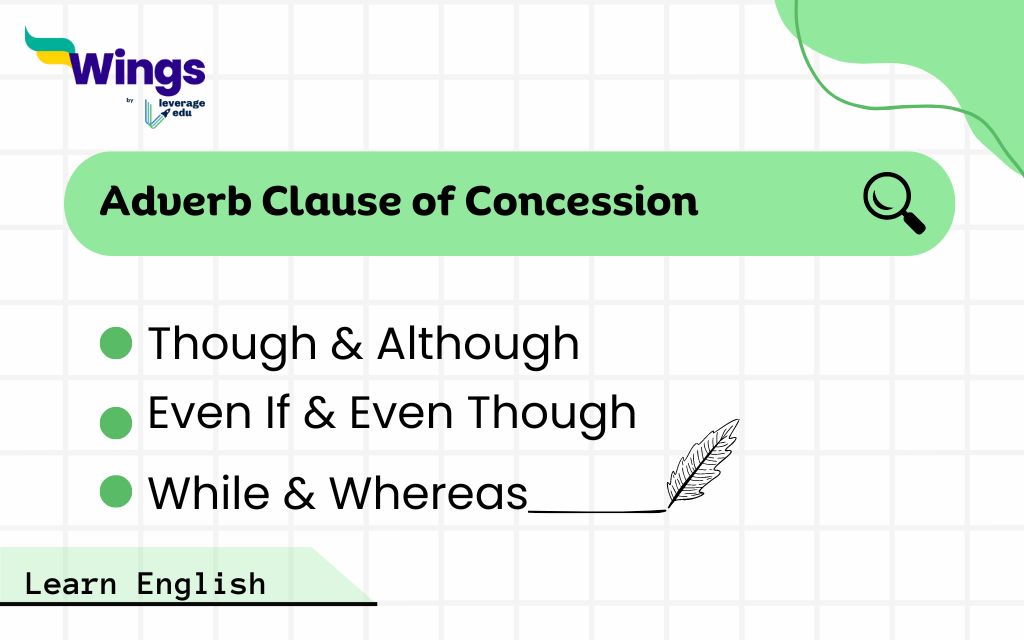
The adverb clause of concession particularly throws in a “but wait, there’s more!” twist within a sentence in English. This clause shows the fact that seems to oppose the main idea, but then the sentence continues to explain why the main idea still holds true. They introduce the “concession” part of the sentence with words like “although,” “even though,” “while,” “despite,” and “in spite of”. In this blog, you will have a clear understanding of adverb clause meaning, examples, and much more to avoid any grammatical errors while using it in future.
This Blog Includes:
What is the Adverb Clause of Concession? – Meaning
In a small sentence, it works like an adverb, adding information to the main sentence. This means accepting something that might oppose the main idea. An adverb clause of concession is like saying “But wait, there’s more” to your sentence. It shows the fact that admits something unexpected or even opposite to what the main sentence has to display.
Read more: Adverb Clause of Purpose with Meaning, Usage, and Examples
List of Adverb Clause of Concession
Have a look at the adverb clause of concession with the example listed below for further knowledge:
Common Adverb Clause of Concession Conjunctions
- Although: Although it was raining, we went out.
- Though: Though he is young, he is very responsible.
- Even though: Even though she was tired, she continued working.
- Whereas: Whereas I prefer tea, my brother likes coffee.
- While: While the exam was difficult, it was manageable.
- Despite the fact that: Despite the fact that he was ill, he attended the class.
- In spite of the fact that: In spite of the fact that she was nervous, she spoke confidently.
Less Common but Correct Concessive Clauses
- However much / However + adjective: However hard he tried, he could not succeed.
- No matter how / No matter what / No matter who: No matter how cold it is, she goes for a walk.
- Even if: Even if he fails, he will try again.
- Granted that: Granted that the task is difficult, it is not impossible.
Formal or Advanced Usage
- Albeit: He accepted the offer, albeit reluctantly.
- Much as: Much as I admire him, I cannot agree with his decision.
Adverb Clause of Concession – Uses and Examples
Adverb clauses of concession are introduced by subordinating conjunctions, such as although, though, even though, even if, while and whereas.
Though and Although
When you look at ‘though’ and ‘although’ individually, both can be utilised as conjunctions with the same meaning. Though and although mean ‘even if’ and similar ideas, ‘in spite of the fact that’.
- Though she is poor, she is always neatly dressed.
- Though he hates me, I will always help you faithfully.
- He would like to go out, although it is Sun.
Even If and Even Though
Even if not utilised as a conjunction, we can use the words ‘even if’ and ‘even though’ to join two clauses.
- He will go even if you forbid me to.
- She enjoyed the film even though I had a headache.
- The women managed to survive even though they had nothing to eat or drink.
- Even if he fails, he will try again and again until I succeed.
While and Whereas
While and whereas together function as conjunctions, but they do have some key differences.
- While he admires your courage, he thinks you ought not to go on this dangerous journey.
- While it is true that I have some land and houses, I do not have liquid cash to invest in the industry.
- Whereas Amisha had more enemies than friends, her brother was quite popular.
Read more: 30+ Adverb Clauses Examples in English
Adverb Clause of Concession Exercise
Practice-based exercises on Adverb Clauses of Concession are designed to help students understand contrast in sentences, improve grammar accuracy, and prepare confidently for school exams and competitive English tests.
Exercise 1: Fill in the Blanks
Fill in the blanks using although, though, even though, while, ” or ” whereas.
- ________ it was raining, they went out.
- She completed the work ________ she was tired.
- ________ he is poor, he is honest.
- ________ I prefer tea, my sister likes coffee.
- He continued playing ________ he was injured.
- ________ it was late, she did not stop studying.
- ________ he apologized, she did not forgive him.
- ________ the task was difficult, he tried his best.
- ________ I like maths, my friend prefers science.
- She smiled ________ she was unhappy.
Answers:
- Although
- even though
- Though / Although
- Whereas / While
- even though
- Though / Although
- Though / Although
- Though / Although
- Whereas / While
- though
Exercise 2: Choose the Correct Option
- ________ he was tired, he finished the work.
a) Because
b) Although
c) So - She went to school ________ she was ill.
a) because
b) even though
c) if - ________ the weather was bad, the flight was not cancelled.
a) Although
b) When
c) Unless - He smiled ________ he was sad.
a) though
b) because
c) so - ________ I respect him, I disagree with his opinion.
a) Much as
b) Because
c) So - ________ she is young, she is very mature.
a) Although
b) Since
c) If - The team won the match ________ they were inexperienced.
a) though
b) unless
c) because - ________ it was expensive, he bought the laptop.
a) Although
b) When
c) As - She kept calm ________ everyone else panicked.
a) even though
b) because
c) therefore - ________ the pain was severe, he continued running.
a) Though
b) So
c) Unless
Answers:
- b) Although
- b) even though
- a) Although
- a) though
- a) Much as
- a) Although
- a) though
- a) Although
- a) even though
- a) Though
Exercise 3: Rewrite Using an Adverb Clause of Concession
- In spite of being tired, he continued working.
- Despite her fear, she spoke confidently.
- In spite of the rain, they played the match.
- Despite his poor health, he attended the meeting.
- In spite of the noise, she slept well.
- Despite being young, he is very responsible.
- In spite of the difficulty, she solved the problem.
- Despite his mistakes, he succeeded.
- In spite of the cold, they went swimming.
- Despite her busy schedule, she helped others.
Answers:
- Although he was tired, he continued working.
- Even though she was afraid, she spoke confidently.
- Although it was raining, they played the match.
- Even though his health was poor, he attended the meeting.
- Although there was noise, she slept well.
- Though he is young, he is very responsible.
- Although the problem was difficult, she solved it.
- Even though he made mistakes, he succeeded.
- Although it was cold, they went swimming.
- Even though she was busy, she helped others.
Also Read: Speech Writing in English: Format, Examples, Topics, Tips, and Sample PDF
Adverb Clause of Concession Exercise PDF
In conclusion, mastering the Adverb Clause of Concession helps students express contrast clearly and correctly in English. With regular practice through exercises, learners can avoid common mistakes, improve sentence structure, and gain confidence for exams, competitive tests, and everyday communication.
FAQs
Concession clauses are used to reflect a contrast between two clauses. Such as: She is mean to me still I love him.
A concession can be written as short as a sentence or two, or it could also be as long as several paragraphs.
In a particular sentence, when you have the same subject in both the primary clause and the adverb clause, then you can reduce the adverb clause to avoid repeating the subject. When we talk about the reduced adverb clause then it becomes an adverb phrase, which does not have a subject.
Related reads
This was all about the adverb clause of concession in English grammar. Hope you understand the concept and know how to proceed. You can also follow the page of Leverage Edu for more exciting and informative blogs on Learn English.

 60,000+ students trusted us with their dreams. Take the first step today!