One app for all your study abroad needs


















Understanding and memorising the Table of 7 plays an important role in solving everyday mathematical situations. It helps learners calculate faster and think logically. For instance, if bottled juices are arranged in 7 rows with 5 bottles in each row, counting them one by one is time-consuming. Using the Table of 7 allows the total to be calculated quickly and accurately. This practical approach builds confidence and improves numerical efficiency. Let us now explore and learn the Table of 7 in a clear and structured manner.
Contents
Basic Concept Table of 7
Building on the practical importance discussed earlier, the Basic Concept of the Table of 7 focuses on understanding how repeated addition forms the foundation of multiplication. The Table of 7 is created by repeatedly adding 7, where each step represents an increase by the same fixed value. This pattern helps learners recognise consistency in numbers and strengthens mental calculation skills. By understanding the concept clearly, students can apply the Table of 7 confidently while solving both academic and real-life mathematical problems.
| Steps | Repeated Addition | Multiplication Form | Result |
| 1 | 7 | 7 × 1 | 7 |
| 2 | 7 + 7 | 7 × 2 | 14 |
| 3 | 7 + 7 + 7 | 7 × 3 | 21 |
| 4 | 7 + 7 + 7 + 7 | 7 × 4 | 28 |
| 5 | 7 + 7 + 7 + 7 + 7 | 7 × 5 | 35 |
| 6 | 7 added 6 times | 7 × 6 | 42 |
| 7 | 7 added 7 times | 7 × 7 | 49 |
| 8 | 7 added 8 times | 7 × 8 | 56 |
| 9 | 7 added 9 times | 7 × 9 | 63 |
| 10 | 7 added 10 times | 7 × 10 | 70 |
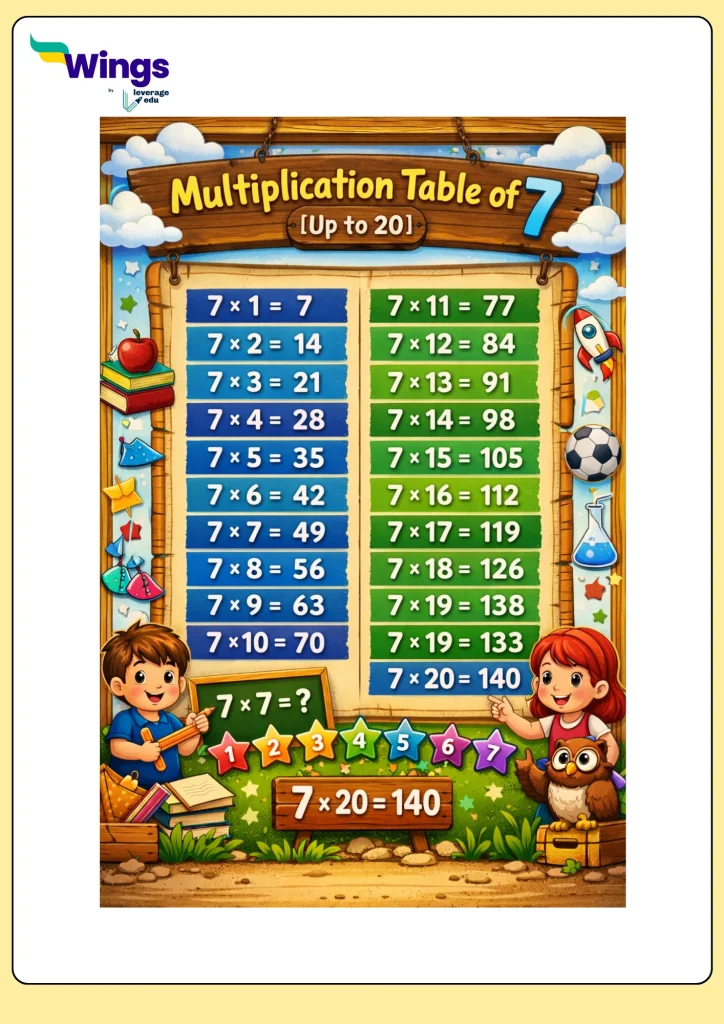
Table Chart of 7 from 1 to 20
After learning the Basic Concept of the Table of 7, the Table Chart of 7 from 1 to 20 provides a structured view of all multiples of seven. It enhances number patterns, supports repeated addition practice, and helps students build speed and accuracy in academic and everyday calculations.
How to Read the Table to Your Kid: Table of 7
Children learn faster through repetition and familiarity, just like they remember their own names by hearing them several times a day. Following the same approach, reading the Table of 7 regularly helps children memorise it naturally. It can be turned into a simple rhyme or song that is repeated every morning or played on digital devices.
Start by reading the Table of 7 aloud and encourage the child to repeat each line after you. This call-and-repeat method strengthens listening and recall skills. Placing a visible Table of 7 chart in commonly used areas, such as near the study desk or hallway, allows the child to glance at it frequently. This repeated exposure support learning without pressure.
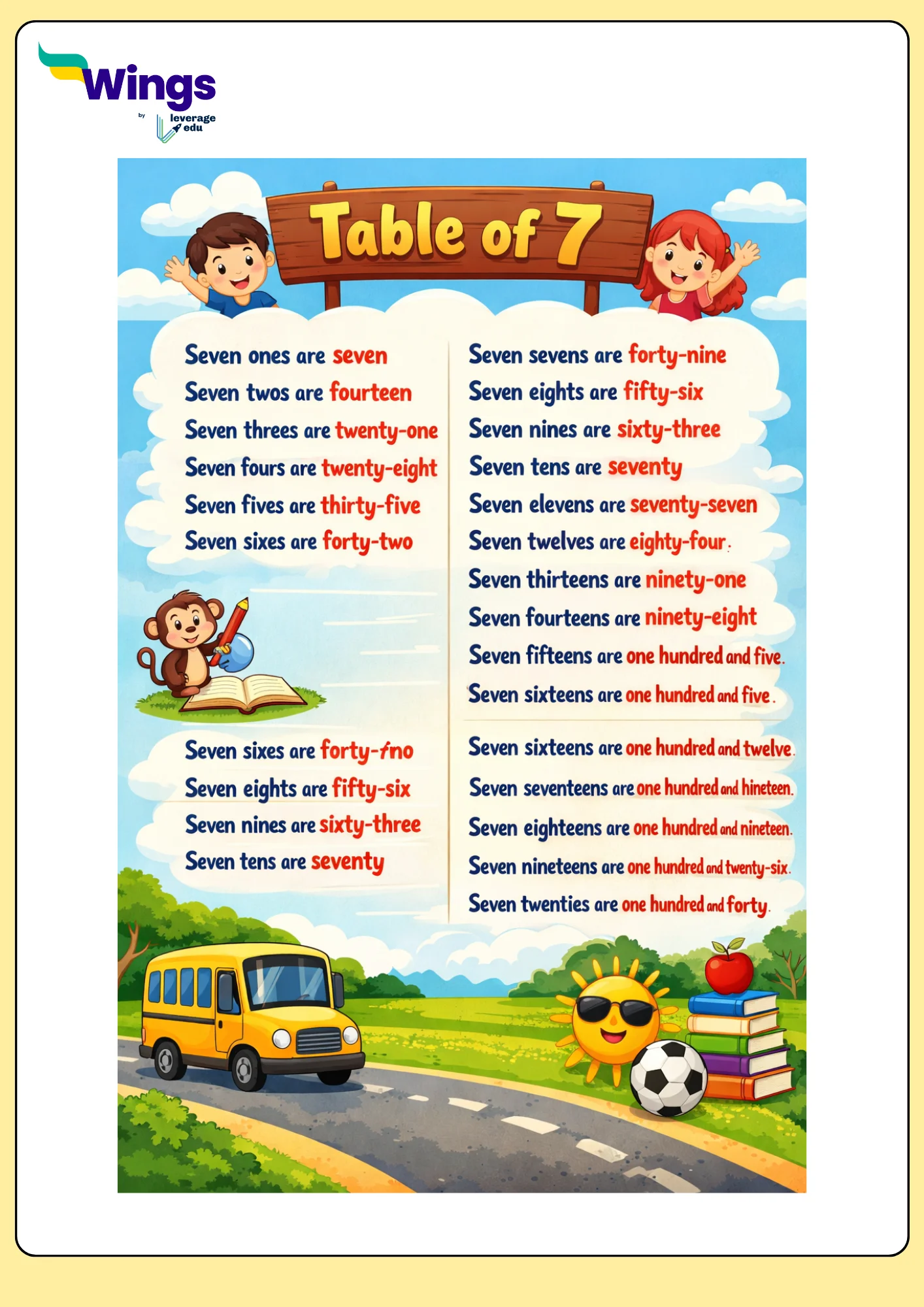
For example, read it clearly as:
- Seven ones are seven.
- Seven twos are fourteen.
- Seven threes are twenty-one.
- Seven fours are twenty-eight.
- Seven fives are thirty-five.
- Seven sixes are forty-two.
- Seven sevens are forty-nine.
- Seven eights are fifty-six.
- Seven nines are sixty-three.
- Seven tens are seventy.
- Seven elevens are seventy-seven.
- Seven twelves are eighty-four.
- Seven thirteens are ninety-one.
- Seven fourteens are ninety-eight.
- Seven fifteens are one hundred five.
- Seven sixteens are one hundred twelve.
- Seven seventeens are one hundred nineteen.
- Seven eighteens are one hundred twenty-six.
- Seven nineteens are one hundred thirty-three.
- Seven twenties are one hundred forty.
Explore: Multiplication Tables of 1 to 20
What are the tips and tricks to memorise the Table of 7
Building on the reading and repetition methods discussed earlier, applying structured strategies makes memorising the Table of 7 easier and more effective. Understanding the logic behind the numbers helps learners recall the table with confidence and accuracy.
- Focus on the repeated addition pattern, where each new value increases by seven. This strengthens number sense and prediction skills.
- Read the Table of 7 aloud every day to strengthen memory through consistent verbal practice.
- Practise the table as a rhythm or chant to make learning engaging and easier to recall.
- Divide the table into smaller sections, such as five multiples at a time, to reduce learning pressure.
- Use visual tools like charts or flashcards to support number recognition and sequence understanding.
- Apply the Table of 7 in everyday situations, such as counting objects arranged in groups, to build practical relevance.
- Revise the table at regular intervals to improve long-term retention and calculation accuracy.
Word Problems on Table 7 with Practice Questions
After understanding what are the tips and tricks to memorise the Table of 7, applying that knowledge through practice becomes the next important step. Word Problems on the Table of 7 help students use multiplication in real-life situations, strengthening logical thinking and problem-solving skills. These practice questions encourage learners to apply the Table of 7 confidently and improve accuracy in calculations.
Question 1: A bakery makes 7 batches of cookies every hour. If they operate for 8 hours a day, how many batches do they make in one day?
Answer. 7 × 8 = 56 batches
Question 2: Sarah saves $7 every week from her allowance. How much money will she have saved after 12 weeks?
Answer. 7 × 12 = $84
Question 3: A farmer planted 7 rows of tomato plants with 9 plants in each row. How many tomato plants did he plant in total?
Answer. 7 × 9 = 63 plants
Question 4: Each student needs 7 colored pencils for an art project. If there are 11 students in the class, how many colored pencils are needed in total?
Answer. 7 × 11 = 77 colored pencils
Question 5: A train has 7 carriages, and each carriage can hold 6 bicycles. What is the maximum number of bicycles the train can carry?
Answer. 7 × 6 = 42 bicycles
Question 6: Marcus reads 7 pages of his book every night before bed. How many pages will he read in 2 weeks (14 days)?
Answer. 7 × 14 = 98 pages
Question 7: A garden has 7 flower beds, and each bed contains 15 tulips. How many tulips are in the garden altogether?
Answer. 7 × 15 = 105 tulips
Question 8: A movie theatre charges INR 7 per ticket. If a family of 5 people goes to watch a movie, how much will they pay for tickets?
Answer. 7 × 5 = $35
Question 9: A spider has 8 legs. How many legs do 7 spiders have in total?
Answer. 7 × 8 = 56 legs
Question 10: Emma practices piano for 7 minutes each day for 30 days in a month. How many minutes does she practice in total?
Answer. 7 × 30 = 210 minutes
Interesting MCQs on Table 7 with Practice Questions
Following the practice-based exercises, assessing learning through varied question formats becomes essential. Interesting MCQs on the Table of 7 with Practice Questions allow students to test their understanding, strengthen recall, and apply multiplication concepts in a structured and engaging manner.
Question 1: If 7 friends equally share 63 candies, how many candies does each friend get?
A) 7
B) 8
C) 9
D) 10
Answer. C) 9 (because 63 ÷ 7 = 9)
Question 2: What is the product of 7 and 7?
A) 14
B) 42
C) 49
D) 56
Answer. C) 49
Question 3: A rectangle has a width of 7 cm and a length of 4 cm. What is its perimeter?
A) 11 cm
B) 22 cm
C) 28 cm
D) 44 cm
Answer: B) 22 cm (Perimeter = 2(7+4) = 2(11) = 22 cm)
Question 4: Which of the following is NOT in the 7 times table?
A) 35
B) 42
C) 50
D) 63
Answer. C) 50
Question 5: If one week has 7 days, how many days are there in 6 weeks?
A) 36 days
B) 40 days
C) 42 days
D) 49 days
Answer. C) 42 days
Question 6: A heptagon has 7 sides. If you draw 3 heptagons, how many sides are there in total?
A) 14
B) 21
C) 28
D) 35
Answer. B) 21 sides
Question 7: What is 7 × 12?
A) 72
B) 76
C) 84
D) 91
Answer. C) 84
Question 8: A package contains 7 yoghurt cups. How many cups are in 9 packages?
A) 49
B) 56
C) 63
D) 70
Answer. C) 63 cups
Question 9: Which multiplication fact equals 70?
A) 7 × 9
B) 7 × 10
C) 7 × 11
D) 7 × 12
Answer. B) 7 × 10
Question 10: If 7 × __ = 91, what number goes in the blank?
A) 11
B) 12
C) 13
D) 14
Answer. C) 13
Download PDF of Table of 7
The Download PDF of Table of 7 section allows students and parents to access the complete multiplication table in a printable format. It supports offline practice, quick revision, and consistent learning anytime, making memorisation of the Table of 7 more convenient and effective.
Learning the Table of 7 becomes simple and effective when students understand the basic concept, follow regular reading and practice, and apply it through real-life examples and questions. With consistent revision and the right learning techniques, students can improve accuracy, speed, and confidence in multiplication. Mastering the Table of 7 not only supports academic progress but also strengthens everyday mathematical thinking.
FAQs
Ans. Ans. The Table of 7 is built on the concept of repeated addition. Each multiplication result is obtained by adding the number 7 repeatedly. For example, 7 × 4 means adding 7 four times, which gives 28. Understanding this pattern helps learners see how multiplication grows step by step.
Ans. The first ten products in the Table of 7 are formed by multiplying 7 with numbers from 1 to 10. These are 7, 14, 21, 28, 35, 42, 49, 56, 63, and 70. Learning these values builds a strong foundation for faster calculations.
Ans. A simple way to remember the Table of 7 is to observe that each answer increases by seven from the previous one. Once the first few multiples are known, the next value can be found by adding 7. Reading the table aloud in a rhythmic manner also improves memory and recall.
Ans. The Table of 7 is useful in many everyday situations, such as calculating total items arranged in groups of seven, counting weekly schedules, or measuring quantities. These real-life applications help learners understand the practical value of multiplication.
Ans. Knowing other multiplication tables makes it easier to learn the Table of 7 because patterns and similarities become more visible. For example, understanding smaller tables helps learners compare values and recognise number relationships, leading to quicker and more accurate calculations.
Related Blogs
I hope this helps! Did you like learning about the Table of 7? Keep on reading our blogs to learn more about the basic concepts of Maths!

 60,000+ students trusted us with their dreams. Take the first step today!