

 One app for all your study abroad needs











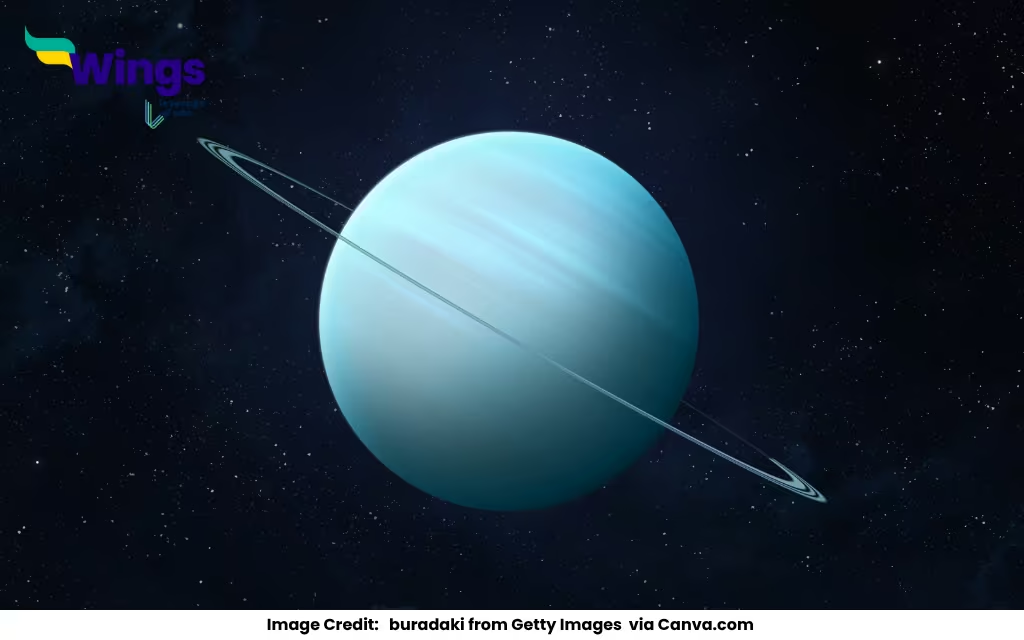
- Jupiter
- Uranus
- Neptune
- Earth
Correct Answer: 1. Uranus
Uranus, known as the “Green Planet,” gets its cool nickname from its pale blue-green hue, thanks to methane in its atmosphere. This distant gas giant is a fascinating piece of our solar system, and for students, it’s a chance to explore astronomy, planetary science, and the wonders of space. Let’s dive into why Uranus looks green, what makes it unique, and how it sparks curiosity about the cosmos.
Green Planet Uranus
Uranus stands out with its greenish glow, caused by methane gas in its atmosphere reminiscence. The methane absorbs red light and reflects blue and green, giving Uranus its signature teal shade. Unlike Earth (not green enough!) or Jupiter Pandora’s Box, Jupiter, and Neptune, Uranus’s color makes it the “Green Planet.” The nickname’s a nod to this cool feature, perfect for astronomy buffs.
For students, this is a fun way to learn about light and chemistry. The color comes from methane’s interaction with sunlight, and you can explore this in a physics or astronomy class. Researching Uranus’s atmosphere or comparing it to Earth’s can spark discussions about planetary differences. It’s a great topic for a science project, showing how chemistry shapes the look of the planets.
Why Uranus Is the Green Planet
The “Green Planet” tag comes from Uranus’s unique appearance, driven by about 2% methane in its thick atmosphere. This gas soaks up red light, leaving the planet looking cyan or aquamarine. Unlike Jupiter’s stormy reds or Neptune’s deep blue, Uranus’s pale green vibe is due to its distance from the sun and the way sunlight scatters. Discovered in 1781, it’s one of the farthest planets, making it a mysterious gem in our solar system.
Students can dig into why Uranus stands out. Its color makes it a favorite for astronomers, and you can explore how methane affects planetary hues. Try a project comparing Uranus to Earth or Jupiter for a geography or astronomy class. It’s a cool way to connect chemistry, physics, and space science, plus it’s just fun to say “Green Planet”!
Quick Facts
- Planet: Uranus, the Green Planet.
- Color: Pale blue-green due to methane.
- Diameter: ~51,000 km, seventh planet from the sun.
- Key Feature: Extreme axial tilt of 98 degrees.
- Discovery: 1781 by William Herschel.
- Student Tip: Research Uranus’s moons for an astronomy project.
Uranus’s Place in the Solar System
Uranus is one of the four gas giants, sitting third in line after Jupiter and Saturn, and just before Neptune. It’s about 14.5 times Earth’s mass, with a chilly atmosphere of hydrogen, helium, and methane. Its odd tilt—98 degrees—makes it spin almost on its side, causing wild seasonal changes. The green color and its 27 moons, like Titania and Oberon, make Uranus a standout in the solar system.
For students, Uranus is a gateway to understanding gas giants. You can explore its rings, moons, or how its tilt affects its climate. It’s a great topic for comparing planets, especially since Neptune, often confused with Uranus, is bluer. Researching Uranus’s structure or its discovery by Herschel can spark ideas for science fairs or astronomy clubs.
Challenges of Studying Uranus
Studying Uranus is tough because it’s so far away—about 2.9 billion km from Earth! Only one spacecraft, Voyager 2, has visited it (in 1986), so most data comes from telescopes like Hubble. The planet’s faint rings and distant orbit make observations tricky, and its methane-heavy atmosphere hides its inner workings. Scientists still puzzle over its magnetic field and internal heat.
Students can learn from these challenges. Researching Uranus means grappling with limited data, which teaches critical thinking. You can explore how astronomers use spectroscopy to study its atmosphere or simulate its orbit in a physics project. It’s a real-world look at how scientists solve mysteries with creativity and tech.
How Students Can Explore Uranus
Want to get into Uranus? Check out NASA’s website or astronomy apps like Stellarium to see its position in the sky. For a project, model Uranus’s rings or research its moons, like Ariel or Miranda. You can also watch Voyager 2 footage online for a glimpse of the planet. Try comparing Uranus’s green hue to Neptune’s blue for a fun astronomy debate.
For fun, draw Uranus’s tilted rings or imagine life on a methane-rich planet. The Green Planet is a cosmic wonder, perfect for sparking curiosity about space. So, dive into Uranus’s story and let it take you to the stars!
Summary
Uranus, the Green Planet, gets its name from a blue-green hue caused by methane in its atmosphere. As a gas giant with a wild 98-degree tilt, it’s a unique part of our solar system. For students, Uranus offers a chance to explore astronomy, atmospheric chemistry, and the challenges of studying distant planets, blending science with cosmic adventure.
Also Read:
Which of the Following Districts of Rajasthan has the Shortest International Boundary?
What is the Boundary Line between India and Pakistan Called?
Boo’ Village of Nagaur was Famous for Which of the Art Work?
First census in India was conducted in the year _______.
How many Electrons are there in One Coulomb of Charge?


 60,000+ students trusted us with their dreams. Take the first step today!