

 One app for all your study abroad needs











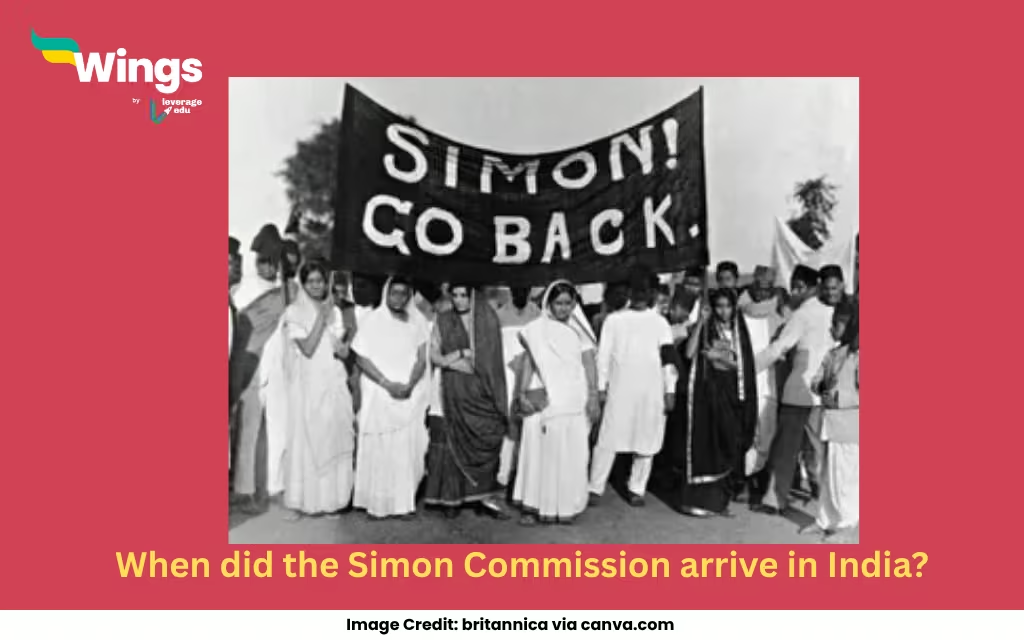
- 1927
- 1928
- 1929
- 1930
Correct Answer: 1. 1928
The Simon Commission arrived in India in 1928, stirring up a storm in the freedom struggle. This all-British group was sent to review India’s governance but ended up sparking protests because it excluded Indians. For students, the Simon Commission is a key moment to understand colonial rule, Indian nationalism, and the fight for self-rule. Let’s dive into what happened in 1928 and why it’s a big deal for history buffs.
Simon Commission: What Was It?
The Simon Commission, officially the Indian Statutory Commission, was a group of seven British lawmakers led by Sir John Simon. Set up in 1927, it arrived in India on February 3, 1928, to study how the Government of India Act 1919 was working and suggest reforms. The catch? It had no Indian members, which felt like a slap in the face to Indians demanding a say in their own future. The British claimed it was about constitutional progress, but many saw it as a way to delay self-rule.
For students, this is a chance to see colonial arrogance in action. The Commission’s all-British makeup ignored leaders like Gandhi and Nehru, fueling anger. It’s a great example of how exclusion can spark resistance, perfect for history or civics discussions. You can explore why the British thought this was okay and how it backfired, connecting to themes of power and protest.
The Indian Response
When the Simon Commission landed in Bombay (now Mumbai), it was met with massive protests. Indians shouted “Simon Go Back!” and waved black flags, showing their outrage at being left out. The Indian National Congress and Muslim League, usually at odds, united to boycott the Commission. Leaders like Lala Lajpat Rai led protests, and in Lahore, a lathi charge injured Rai, who later died, further fueling anger. These protests showed India’s growing demand for self-governance.
Students can learn a lot from this unity. The boycott wasn’t just about saying no—it was a statement that Indians wanted control over their destiny. You can research key figures like Rai or explore how protests were organized without social media. It’s a real-world look at how collective action shapes history, tying into social studies or leadership lessons.
Quick Facts
- Arrival: February 3, 1928.
- Leader: Sir John Simon.
- Purpose: Review Government of India Act 1919.
- Indian Response: Nationwide protests, “Simon Go Back” slogan.
- Key Event: Lala Lajpat Rai’s injury in Lahore protest.
- Student Tip: Study the boycott for a history project.
Why It Sparked Nationalism
The Simon Commission was a turning point for Indian nationalism. Its exclusion of Indians proved the British weren’t serious about sharing power, pushing moderates and radicals to demand more. The Congress responded with the Nehru Report in 1928, a bold Indian plan for dominion status, showing the world India could draft its own future. The protests also energized young leaders like Bhagat Singh, who saw peaceful boycotts as a step toward bigger action.
For students, this is a chance to see how one event can shift a movement. The Commission’s failure to include Indians galvanized the push for independence, leading to movements like Civil Disobedience in 1930. You can explore how protests shape policy or compare this to other global independence struggles. It’s a powerful lesson in how standing up can change the course of history.
The Commission’s Report
Despite the boycott, the Simon Commission finished its work, publishing a report in 1930. It suggested reforms like provincial autonomy but stopped short of dominion status, which Indians wanted. The report led to the Round Table Conferences in London, where Indian leaders like Ambedkar and Gandhi pushed for more rights. But the report was largely ignored in India, as it didn’t reflect Indian demands, proving the protests had a point.
Students can dig into this for a lesson in cause and effect. The Commission’s failure to engage Indians led to stronger demands for self-rule, showing how missteps can fuel resistance. You can research the Nehru Report or the Round Table Conferences to see what followed. It’s a great way to connect history with critical thinking about governance and representation.
Legacy in India’s Freedom Struggle
The Simon Commission’s legacy is its role in uniting Indians against colonial rule. The protests it sparked showed the British that India wouldn’t settle for half-measures. It also paved the way for bigger movements, like Gandhi’s Salt March, and inspired a generation to fight harder. The Commission’s failure highlighted the need for Indian voices in governance, a principle that shaped the Constitution of independent India.
For students, this legacy is inspiring. It shows how collective action, even if it doesn’t win immediately, can set the stage for change. You can explore how the Commission influenced leaders or how protests today echo those of 1928. It’s a chance to connect history with modern activism, perfect for essays or debates on standing up for rights.
Summary
Question: When did the Simon Commission arrive in India?
Answer: The Simon Commission arrived in India in 1928 to review governance but faced a massive boycott for excluding Indians. Led by Sir John Simon, it sparked “Simon Go Back” protests, uniting leaders and fueling nationalism. For students, it’s a lesson in resistance, unity, and the power of demanding a voice, connecting history to modern ideas of representation.
Also Read:
Who among the following declined the Bharat Ratna Award?
Which among the following countries hosted the 2024 South Asian Games?
What is the international calling code of Nepal?
Which state is not a part of the Seven Sisters of India?
First census in India was conducted in the year _______.


 60,000+ students trusted us with their dreams. Take the first step today!