

 One app for all your study abroad needs











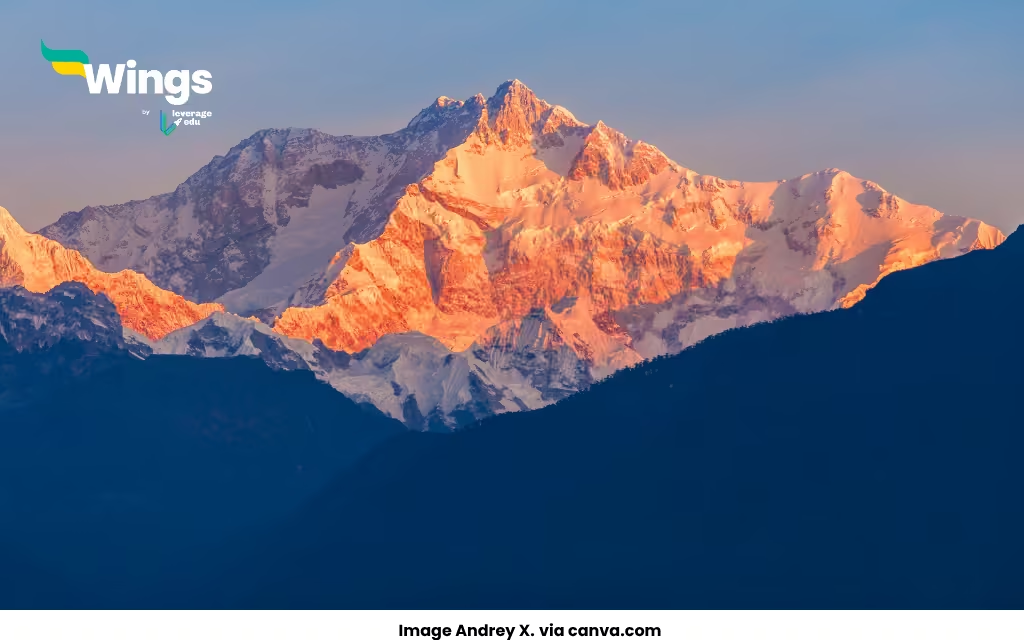
1. Himachal
2. Himadri
3. Sahyadri
4. Annamalai
Correct Answer: 2) Himadri
Kanchanjunga, the world’s third-highest peak, is a breathtaking part of the Himadri (Greater Himalayas) range, located on the Sikkim-Nepal border. Kanchanjunga’s place in the Himadri range is a thrilling part of India’s geography, blending natural beauty with cultural depth. For students, it’s a chance to explore the Himalayas’ role in ecosystems and traditions.
Location of Kanchanjunga Peak in Himadri Range
Kanchanjunga lies in the Greater Himalayas, specifically on the Sikkim-Nepal border, about 46 miles north-northwest of Darjeeling. The other options—Himachal, Sahyadri, and Annamalai—are incorrect. Himachal is a state, not a range. Sahyadri refers to the Western Ghats, and Annamalai is a hill range in Tamil Nadu.
Kanchanjunga’s placement in the Himadri range makes it a key geographical feature, drawing trekkers and climbers. For students, choosing Himadri from the options aligns with the peak’s location in the highest Himalayan zone, clearing up any confusion.
What Is Kanchanjunga Peak?
Kanchanjunga, towering at 8,586 meters, is the third-highest mountain globally and India’s highest, situated in the Himadri range, primarily on the border of Sikkim, India, and Nepal. Known as the “Five Treasures of the Great Snow” for its five peaks, it’s a sacred and stunning feature of the eastern Himalayas.
The Himadri, or Greater Himalayas, is the highest Himalayan sub-range, home to peaks like Everest and Kanchanjunga. For students, knowing its location in Himadri helps clarify India’s mountain geography and the peak’s cultural and natural importance.
Quick Facts
- Relevance: Key for biodiversity, tourism, climate studies.
- Location: Himadri (Greater Himalayas), Sikkim-Nepal border.
- Height: 8,586 meters, third-highest globally.
- Name Meaning: “Five Treasures of the Great Snow.”
- Significance: Sacred, part of Khangchendzonga National Park.
- Challenges: Tough climb, summit banned on Indian side.
Kanchanjunga’s Unique Features
Kanchanjunga’s massif forms a giant cross, with four ridges extending north, south, east, and west, feeding glaciers like Zemu and Yalung. Its five peaks—Main, Central, South, West, and Kangbachen—are all over 7,900 meters, with three on the India-Nepal border and two in Nepal’s Taplejung district.
The peak’s steep slopes and heavy monsoon snow make it a tough climb. For students, these features highlight why Kanchanjunga is a standout in the Himadri range, connecting geography with adventure and environmental studies.
Cultural and Spiritual Role
Kanchanjunga is sacred to Sikkim’s people, seen as the home of a protector deity. Local beliefs hold that its peaks house treasures like sacred books and gems, so climbers often stop short of the summit out of respect. Festivals and monasteries in Sikkim celebrate its spiritual significance.
This reverence has led India to ban summit climbs from the Sikkim side since 2000, preserving its sanctity. For students, this cultural angle shows how geography and spirituality mix, making Kanchanjunga a unique topic for study.
Climbing Challenges
Kanchanjunga is one of the toughest peaks to climb, with steep routes, avalanches, and harsh weather. First scaled in 1955 by a British team, climbers honor Sikkim’s beliefs by stopping just below the summit. Only a few expeditions, like a 1978 Polish team, have tackled its subsidiary peaks.
The Indian side is off-limits, so most climbs go through Nepal’s routes. For students, this highlights how geography, culture, and adventure intersect in the Himadri range, making Kanchanjunga a fascinating case study.
Why Kanchanjunga Matters Today
Kanchanjunga’s location in the Himadri range makes it a biodiversity hotspot, with the Khangchendzonga National Park in Sikkim protecting species like snow leopards. It’s a major draw for trekkers, boosting Sikkim’s tourism, but climate change threatens its glaciers, raising environmental concerns.
For students, Kanchanjunga’s story ties geography to conservation and culture, showing how mountains shape ecosystems and economies. Its place in Himadri is a cool fact for projects or quizzes, highlighting India’s natural grandeur.
Summary
Question: Kanchanjunga Peak is located in _.
Answer: Kanchanjunga Peak is located in Himadri range.
Kanchanjunga Peak, in the Himadri (Greater Himalayas) range, is India’s highest mountain at 8,586 meters, on the Sikkim-Nepal border. Sacred and challenging, it’s a key feature of the Himalayas, with environmental and cultural significance. Its location in Himadri makes it a vital geography topic.
Also Read:
Panchavti, a Key Part of the Valmiki Ramayana is located in which State of
India?
The Longest River in India is
The Value of One Angstrom is:
When is Vijay Diwas Celebrated Every Year?


 60,000+ students trusted us with their dreams. Take the first step today!