

 One app for all your study abroad needs

















Opinion essays are also known as ‘Agree/Disagree/’Argumentative’ essays. These essays typically require individuals to express their opinions or arguments on the given topic. Opinion essay questions are predominantly framed as: What is your opinion? Do you agree or disagree? To what extent do you agree or disagree? That being said, to learn more about opinion-based essays in IELTS, read the complete blog.
This Blog Includes:
Opinion-Based Essays in IELTS Format
Opinion-based essays in the IELTS exam carry significant weight in Writing Task 2. As they are frequently asked and can sometimes pose a major challenge for students, it is essential to be well-prepared. One effective way to excel in these essays is to understand the essay format thoroughly. Understanding the format provides a clear idea of the types of questions that may be asked and how to structure and articulate your answer in a coherent and understandable manner.
Let’s have a look at the Format of the Opinion-Based Essays in IELTS:
Introduction
When writing the introduction to your IELTS opinion essay, ensure it is engaging and encourages the reader to continue. Keep it concise, ideally no longer than three or four lines. In this paragraph, paraphrase the question and clearly state your opinion. You should also outline the topic you will maintain throughout the essay and briefly mention two supporting reasons for your viewpoint.
Body Paragraph 1 (BP 1)
The first reason mentioned in your introduction should be developed in the first body paragraph. Explain your viewpoint with justifications and reasoning. Conclude the paragraph with relevant examples to support your argument, which adds depth and credibility to your essay.
Body Paragraph 2 (BP 2)
In the second body paragraph, present your second argument, following the same approach as the first paragraph. Explain your point clearly and provide examples or evidence to strengthen your claim. This ensures consistency and balance in your essay.
Conclusion
Summarise your opinion and restate the key reasons supporting your viewpoint. The conclusion should be clear and concise, reinforcing the argument you have made throughout the essay.
Opinion-Based Essays in IELTS Sample Essay
To understand the key elements, viewpoints, and writing strategies for opinion-based essays in IELTS, refer to the sample and explanations below. Furthermore, we will explore common topics, sample questions, and model answers.
Sample Essay 1: Some people believe that online learning is more effective than traditional classroom learning. Others think that studying in person is better. Discuss both views and give your opinion.
Introduction:
Introduces the topic and sets the context for the essay.
What to do:
- Paraphrase the question in your own words.
- Show that you understand the issue.
- Briefly indicate the main points you will discuss (optional).
- Include your opinion if the question asks for it.
Body Paragraph 1 (First Perspective / Argument):
Explains one main idea clearly with support.
What to do:
- Start with a topic sentence: clearly state the main idea.
- Provide supporting details: facts, examples, reasoning.
- Give a real-life example if possible.
- Use linking words: for example, moreover, in addition, this shows that…
Body Paragraph 2 (Second Perspective / Argument):
Explains the opposite viewpoint or an alternative argument.
What to do:
- Start with a topic sentence introducing the second idea.
- Explain why some people hold this view.
- Provide examples or evidence to support this view.
- Use contrast words: on the other hand, however, in contrast, although…
Conclusion:
Summarises the essay and gives your final opinion.
What to do:
- Briefly restate the main ideas discussed in the body paragraphs.
- Clearly state your opinion if required.
- Keep it concise (2–3 sentences).
Sample Essay
With the rise of digital technology, online learning has become increasingly popular. While some people argue that virtual education is more effective, others believe that traditional classroom learning provides a superior experience. This essay will examine both viewpoints before offering a personal opinion.
Online learning offers flexibility and accessibility that traditional education cannot always provide. Students can access lectures and study materials from anywhere, making it easier to balance education with work or other commitments. Furthermore, online platforms often include interactive tools, such as quizzes and discussion boards, which enhance the learning experience. For example, many international students complete courses from prestigious universities without travelling abroad, which would not be possible in conventional classrooms.
In contrast, studying in a physical classroom encourages social interaction and direct communication with teachers and peers. This face-to-face environment helps students develop teamwork and interpersonal skills that are difficult to replicate online. Additionally, traditional classrooms provide immediate feedback and guidance from instructors, which can be crucial for mastering complex subjects. For instance, medical and engineering students often benefit more from hands-on laboratory sessions than from online simulations.
In conclusion, both online and classroom learning have unique advantages. Online education offers convenience and accessibility, while traditional classrooms provide interaction and practical experience. Personally, a blended approach that combines online resources with in-person learning seems the most effective way to achieve academic success.
Also Read: Phrases for Emphasising Importance in IELTS Writing Task 2
Sample Essay 2: Some people think working from home is more beneficial than working in an office. Do you agree or disagree?
Introduction
- Introduce the topic.
- Clearly state that you partially agree (mention both sides briefly).
Example: Working from home has become increasingly popular, and many believe it offers greater advantages than traditional office work. While I agree that remote work provides flexibility and convenience, I also believe that working in an office has its own benefits, such as better collaboration and professional growth.
Body Paragraph 1: Argument in Favour
- Present your first reason supporting why working from home is beneficial. Support it with examples or evidence.
Example: One of the main advantages of working from home is flexibility. Employees can manage their schedules more effectively and create a comfortable working environment. This freedom allows them to maintain a better work-life balance and improve their mental well-being. For instance, many remote workers report lower stress levels and higher satisfaction due to reduced commuting time and personalised workspaces.
Body Paragraph 2: Opposing Viewpoint
- Present your second argument showing the advantages of office work. Provide examples to support this view.
Example: However, working in an office environment has its own merits. It encourages teamwork, communication, and the exchange of ideas, which are often limited in remote settings. Employees also benefit from direct supervision and mentorship, which are essential for career development. For example, new employees or interns learn faster when they interact face-to-face with their colleagues and managers.
Conclusion
- Restate your balanced opinion using different words. Summarise both sides briefly.
Example: In conclusion, while working from home offers flexibility and comfort, office-based work provides better collaboration and learning opportunities. A hybrid model that combines both approaches may be the most effective solution for maintaining productivity and employee satisfaction.
Sample Essay
Working from home has become increasingly common, and many people argue that it offers greater benefits than traditional office work. While I agree that remote work provides flexibility and convenience, I also believe that working in an office has its own advantages, such as better collaboration and professional development.
One of the main benefits of working from home is the flexibility it offers. Employees can manage their schedules more effectively and create a comfortable work environment that suits their individual needs. This freedom allows for a better work-life balance and contributes to improved mental well-being. For instance, many remote workers report lower stress levels and higher job satisfaction due to the elimination of daily commuting and the ability to personalise their workspaces.
However, office-based work also has distinct advantages. It fosters teamwork, communication, and the exchange of ideas, which are often limited in remote settings. Employees benefit from direct supervision, mentorship, and immediate feedback, which are crucial for career growth. For example, interns or new employees tend to learn faster when they interact face-to-face with colleagues and managers, gaining practical insights that may be difficult to achieve remotely.
In conclusion, while working from home provides flexibility and comfort, office work offers better opportunities for collaboration, learning, and professional development. A hybrid approach that combines both remote and office-based work could be the most effective way to maintain productivity and employee satisfaction.
Explore:
Opinion-Based Essay IELTS: Latest Topics
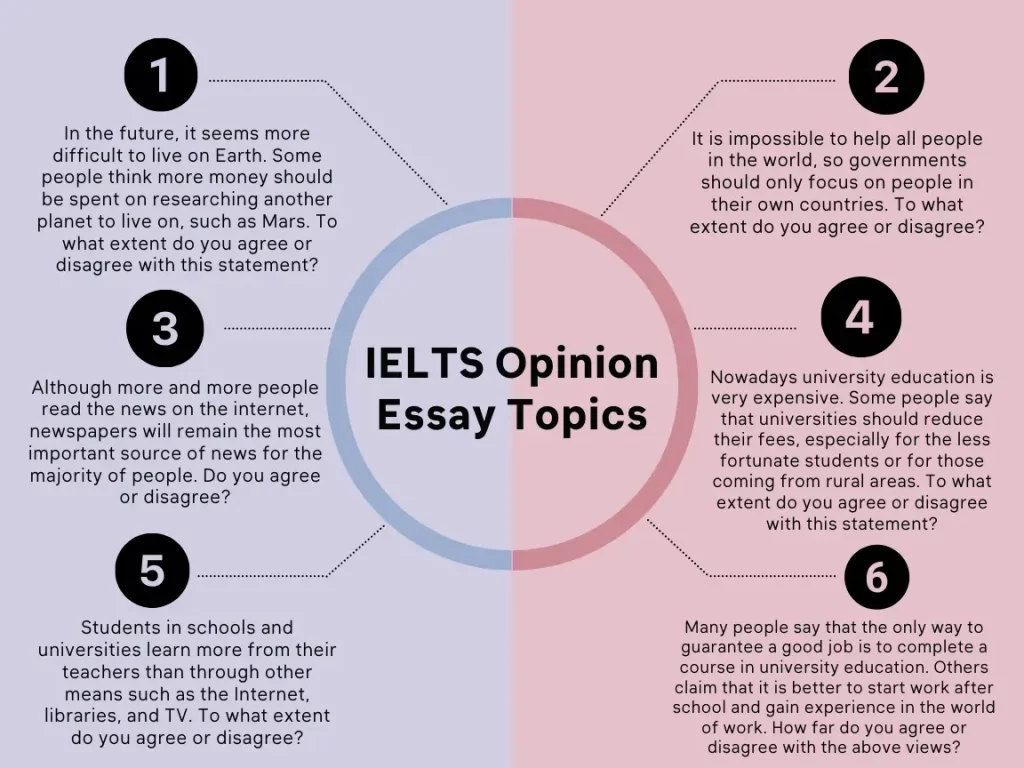
To explore the range of subjects commonly tested in IELTS Writing Task 2, refer to the list of topics below. The writing task 2 topics include themes such as education, technology, environment, health, and society. Familiarity with these topics allows students to anticipate potential questions, practice relevant vocabulary, and develop ideas effectively, which is essential for achieving higher band scores.
1. Education
- Some people believe that homework should be banned in schools. Do you agree or disagree?
- Online learning is becoming more popular than classroom learning. To what extent do you agree or disagree?
- University education should be free for everyone. Discuss both views and give your opinion.
- Teachers are more important than technology in modern education. Do you agree or disagree?
- Some people think students should study the subjects they like, while others think they should learn what is useful for the future. Discuss both views and give your opinion.
2. Technology
- The use of artificial intelligence will reduce human employment in the future. To what extent do you agree or disagree?
- Some people think the internet has brought people closer, while others believe it has made them more isolated. Discuss both views and give your opinion.
- The development of mobile phones has made life easier. Do the advantages outweigh the disadvantages?
- Many people believe that technology has made children less creative. To what extent do you agree or disagree?
- Social media has changed the way people communicate. Is it a positive or negative development?
3. Environment
- Governments should invest more in renewable energy sources. To what extent do you agree or disagree?
- Climate change is the biggest threat to human existence. Discuss both views and give your opinion.
- Individuals cannot do much to protect the environment; only governments and big companies can make a difference. Do you agree or disagree?
- The use of plastic packaging should be banned to save the environment. Do you agree or disagree?
- Some people think it is the responsibility of individuals to reduce pollution, while others say governments should take the lead. Discuss both sides and give your opinion.
4. Health
- Governments should make unhealthy foods more expensive to encourage people to eat healthier. Do you agree or disagree?
- Prevention is better than cure. Governments should spend more on preventive health measures. Do you agree or disagree?
- Some people believe mental health is as important as physical health. To what extent do you agree or disagree?
- Fast food has become a major part of modern lifestyles. Is this a positive or negative development?
- The use of sports and exercise should be encouraged in schools to improve children’s health. Do you agree or disagree?
5. Work and Career
- People should change their jobs at least once in their lives. Do you agree or disagree?
- The best way to motivate employees is through high salaries. To what extent do you agree or disagree?
- Many people work long hours, leaving little time for family or leisure. What are the effects of this trend?
- Remote work is better than working in an office. Discuss both views and give your opinion.
- Job satisfaction is more important than job security. Do you agree or disagree?
6. Society and Culture
- Crime rates can be reduced by giving longer prison sentences. Do you agree or disagree?
- The elderly should be cared for by their families rather than by the government. Do you agree or disagree?
- In many countries, traditional customs are disappearing. Is this a positive or negative development?
- Gender equality has not yet been achieved in the workplace. To what extent do you agree or disagree?
- The gap between rich and poor people is increasing. What problems does this cause, and how can they be solved?
7. Media and Entertainment
- Celebrities earn more money than they deserve. Do you agree or disagree?
- News media should focus more on positive stories instead of negative ones. To what extent do you agree or disagree?
- The influence of advertising on children is harmful. Do you agree or disagree?
- Watching television can be educational for children. Discuss both views and give your opinion.
- Some people think that reading books is better than watching movies. Do you agree or disagree?
8. Government and Law
- Governments should invest in public transportation instead of building more roads. Do you agree or disagree?
- It is better for a country to spend money on education than on defence. Do you agree or disagree?
- Taxing unhealthy products is the best way to improve public health. Discuss both views and give your opinion.
- Public safety should come before personal privacy. To what extent do you agree or disagree?
- Some people believe that voting should be made compulsory. Do you agree or disagree?
9. Globalisation and Economy
- Globalisation has positive effects on the economy. Do the advantages outweigh the disadvantages?
- Tourism brings more harm than good to local cultures. Do you agree or disagree?
- Rich countries should help poorer countries by providing financial aid. Discuss both views and give your opinion.
- International trade improves relationships between nations. To what extent do you agree or disagree?
- The growth of multinational companies is beneficial for all. Do you agree or disagree?
10. Family and Children
- Parents should be responsible for teaching children how to be good members of society. Do you agree or disagree?
- Children today are more influenced by friends than by their parents. Discuss both views and give your opinion.
- It is better for children to grow up in the countryside than in the city. Do you agree or disagree?
- Strict parenting produces better-behaved children. To what extent do you agree or disagree?
- Spending time playing games is as important as studying for a child’s development. Do you agree or disagree?
Explore:
Opinion-Based Essays IELTS: Sample Questions with Answers
Refer to the sample essays given below to get a solid understanding of the opinion-based essays in IELTS. Doing so will help you get a better picture of how to answer such questions in a coherent manner.
Sample Topic 1: Some people claim that public museums and art galleries will not be needed because people can see historical objects and works of art by using a computer. Do you agree or disagree with this opinion?
Museums and art galleries play a crucial role in preserving cultural heritage and showcasing human creativity. Although digital platforms allow people to view artworks and historical objects online, I completely disagree with the idea that physical museums and galleries will become unnecessary. Visiting these institutions provides an authentic experience and a deeper understanding that virtual tours cannot replicate.
One strong reason museums and galleries remain essential is the authenticity and emotional impact they offer. Observing an artwork in person allows visitors to appreciate its texture, scale, and intricate details, which are often lost in digital reproductions. For instance, standing before masterpieces such as the Mona Lisa or Van Gogh’s Starry Night evokes a sense of awe and connection that no online image can reproduce. The atmosphere of a museum further encourages reflection and cultural appreciation, creating a meaningful experience that cannot be achieved virtually.
In addition, museums and galleries serve as educational and cultural hubs. They organise guided tours, exhibitions, and workshops that deepen visitors’ understanding of history, art, and heritage. For example, institutions like the British Museum and the Louvre not only preserve ancient artefacts but also engage in research and collaborate with schools to promote learning. Such activities provide educational benefits and community engagement that cannot be fully replicated through online platforms.
In conclusion, while digital access to art and historical objects is convenient, it cannot replace the authentic experience of visiting museums and galleries. These institutions remain vital for preserving culture, inspiring creativity, and providing educational opportunities that virtual alternatives alone cannot deliver.
Explore: Intelligence Is a Quality of a Leader. Did You Agree or Disagree?
Sample Topic 2: Some people believe that governments should invest more in public transportation, while others think that improving roads and highways is more important. Discuss both views and give your opinion.
Transportation plays a vital role in urban development and the daily lives of citizens. While some people argue that governments should prioritise improving roads and highways, others believe that investing in public transport is more important. I believe that both approaches have their merits, but public transportation provides greater long-term benefits for society.
Investing in public transportation helps to reduce traffic congestion and environmental pollution. Buses, trains, and metro systems can carry far more passengers than private cars, resulting in fewer vehicles on the roads and lower carbon emissions. For example, cities like Tokyo and Singapore have developed extensive metro networks that have significantly improved commuting efficiency and reduced air pollution. Furthermore, affordable public transport ensures that all members of society, including those from lower-income groups, have access to reliable mobility.
However, improving roads and highways also has important advantages. Well-maintained roads facilitate the efficient transport of goods, support businesses, and ensure the smooth functioning of emergency services. For instance, highways allow faster delivery of products and materials, which boosts economic activities and trade. Roads are particularly essential in rural and remote areas, where public transport options may be limited, providing safe and convenient travel for local residents.
In conclusion, while well-constructed roads and highways are necessary for economic activities and accessibility, investing in public transportation offers broader societal benefits, including reduced traffic congestion and environmental sustainability. Governments should prioritise public transport development while maintaining essential road infrastructure to ensure both efficiency and accessibility for all citizens.
Tips to Ace Your IELTS Opinion Essay
Writing an IELTS opinion essay may seem challenging at first, but with some practice and preparation, it becomes much easier. Here are some practical tips to help you write clear and high-scoring essays:
- Read the question carefully two or three times to fully understand what it asks.
- Spend a few minutes brainstorming relevant ideas and choose the two strongest points to support your opinion.
- Use varied and precise vocabulary to make your essay more engaging and impressive.
- Ensure sentences and paragraphs flow smoothly to maintain coherence and clarity.
- Reinforce your opinion consistently throughout the essay, not just in the introduction and conclusion.
- Keep your introduction concise (around 50–55 words), body paragraphs about 100 words each, and a clear, brief conclusion to stay within the word limit.
- Stick to your chosen viewpoint and avoid contradicting yourself in different parts of the essay.
- Summarise your main points clearly in the conclusion and avoid introducing any new ideas.
Opinion-based essays in IELTS Writing Task 2 assess a candidate’s ability to express a clear viewpoint with logical reasoning and relevant examples. Understanding the format and practising with a range of topics help test-takers structure their responses effectively and maintain coherence throughout. By learning how to present balanced arguments and support opinions with evidence, students can enhance both their writing quality and overall IELTS band score. Consistent practice and familiarity with common essay questions are key to mastering this task type.
FAQs
Ans. An opinion-based essay requires the test-taker to clearly state their personal viewpoint on a given topic. You must support your opinion with logical reasons, relevant examples, and a well-organised structure.
Ans. The most common structure is a four-paragraph format:
Introduction: Present the topic and your opinion clearly.
Body Paragraph 1: Give your first supporting reason with examples.
Body Paragraph 2 : Present your second supporting reason.
Conclusion: Restate your opinion and summarise your arguments.
Ans. You can either completely agree, completely disagree, or partially agree with the given statement. Whichever stance you take, make sure it remains consistent throughout the essay and is supported with evidence.
Ans. Opinion essays often focus on areas like education, technology, environment, media, health, and social issues. Examples include:
– Online learning is better than classroom learning.
– Governments should invest more in renewable energy.
– Watching TV is beneficial for children’s mental development.
Ans. To score well, ensure your essay is coherent, relevant, and grammatically accurate. Use a clear position statement in the introduction, develop each idea logically, use linking words for smooth flow, and include a concise conclusion summarising your opinion.
Explore Some IELTS Interesting Blogs Here
We hope this blog on preparing for the IELTS Writing Task 1 and IELTS Writing Task 2 was helpful and gave you useful tips to improve your writing skills. You can also follow the IELTS Preparation page of Leverage Edu for more exciting and informative blogs on mastering the IELTS exam.

 60,000+ students trusted us with their dreams. Take the first step today!