

 One app for all your study abroad needs













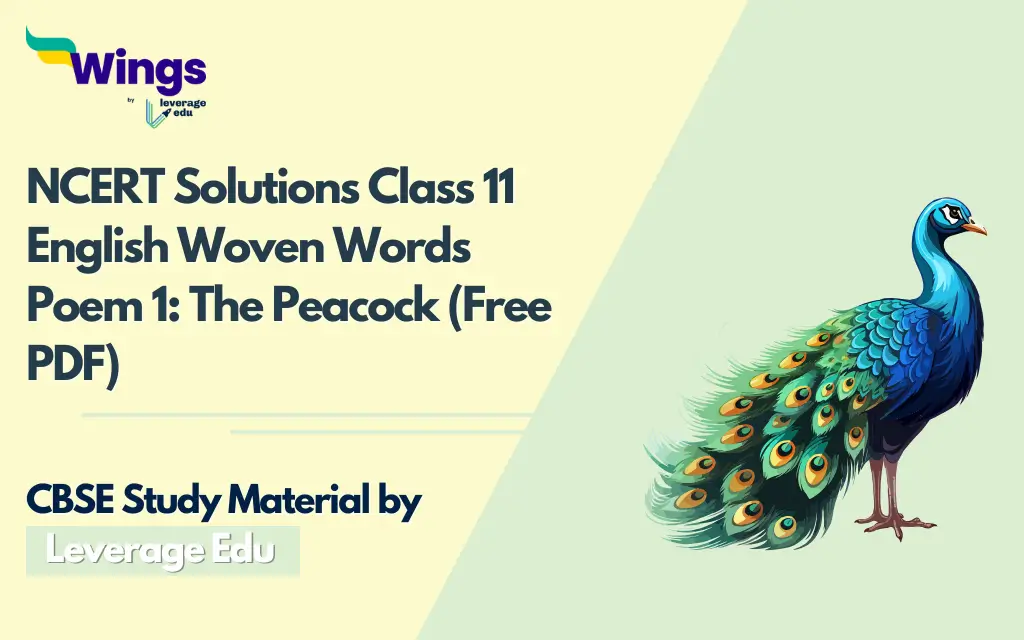
This blog on NCERT Solutions for Class 11 English Woven Words Poem 1: The Peacock provides clear and simple answers to the questions. It helps students to understand the themes of nature’s beauty and vivid imagery in this poem. These solutions are made to help in revision and exam preparation. You can also download the free PDF for quick revision.
Contents
Explore Notes of Class 11 English Woven Words
NCERT Solutions Class 11 English Woven Words Poem 1: The Peacock
Here are the NCERT Solutions for Class 11 English Woven Words Poem 1: The Peacock, designed to enhance understanding of the poem’s themes, imagery, and natural nuances for effective revision.
UNDERSTANDING THE POEM
1. Comment on the lines that make you visualise the colourful image of the peacock.
Solution: The poem vividly captures the peacock’s colourful image through specific lines that evoke its vibrant plumage. The phrase “a flash of turquoise in the pipal tree” paints a striking picture of the peacock’s bright blue-green feathers catching the light, creating an immediate visual impact. Additionally, the description of the tail as “violet fringed with golden amber” highlights the rich, multi-hued patterns of the peacock’s feathers, blending deep purple with golden hues. These lines, with their precise and vivid colour imagery, bring the peacock’s dazzling appearance to life, emphasising its beauty and allure as it briefly appears in the natural setting.
2. What are the cues that signal the presence of the peacock in the vicinity?
Solution: The poem outlines several subtle cues that signal the peacock’s presence:
- “A blue shadow will fall over you,” indicating the peacock’s subtle, almost mystical presence, casting a blue-toned shadow as it nears.
- “The wind will change direction,” suggesting a shift in the environment, as if nature itself responds to the peacock’s arrival.
- “The steady hum of bees in the bushes nearby will stop,” marking a sudden silence that heightens awareness of the peacock’s proximity.
- “The cat will awaken and stretch,” showing that even animals sense the peacock’s presence, breaking the stillness.
These cues create a sense of anticipation, alerting the observer to the peacock’s arrival before it is fully visible, enhancing the poem’s atmosphere of quiet attentiveness.
3. How does the connection drawn between the tail and the eyes add to the descriptive detail of the poem?
Solution: The connection between the peacock’s tail and eyes, described in the lines “To shut those dark glowing eyes, / Violet fringed with golden amber. It is the tail that has to blink / For eyes that are always open,” adds a vivid and imaginative layer to the poem’s descriptive detail. The tail’s eye-like patterns are metaphorically likened to “eyes” that “blink” when the peacock folds its tail, creating a striking visual of the vibrant, violet-and-gold feathers closing like eyelids. This personification enhances the peacock’s mystique, portraying its tail as both a spectacle and a living entity, while emphasising the transient nature of its display, as the “eyes” are always open but only briefly revealed, enriching the poem’s imagery.
4. How does the poem capture the elusive nature of the peacock?
Solution: The poem captures the peacock’s elusive nature through descriptions of its sudden appearance and swift departure. The “loud, sharp call” that “seems to come from nowhere” and the “flash of turquoise” suggest an unexpected, fleeting presence. The peacock “darts away,” leaving only “a glimpse of the very end of his tail,” emphasising its quick, almost unattainable movement. The advice to sit quietly on the veranda, absorbed in a book, implies that the peacock appears only when one is not actively seeking it, reinforcing its elusive quality. The final image of the peacock “turning away as he gathers his tail” further underscores its transient beauty, as it vanishes just as one notices it, leaving a sense of fleeting wonder.
5. The peacock is a colourful bird. How does the poem capture the various colours that its plumage displays?
Solution: The poem vividly captures the peacock’s colourful plumage through precise and evocative imagery. The “flash of turquoise in the pipal tree” highlights the bright blue-green hue of the peacock’s feathers, creating a striking visual contrast against the green foliage. The description of the tail as “violet fringed with golden amber” showcases the rich, multi-layered colours of the peacock’s iconic tail feathers, blending deep purple with golden accents. Additionally, the “blue shadow” cast by the peacock’s presence subtly reinforces its blue-toned brilliance. These specific colour references, turquoise, violet, and golden amber, bring the peacock’s vibrant plumage to life, emphasising its dazzling and captivating beauty.
TRY THIS OUT
1. In English, the peacock is associated with pride. ‘As proud as a peacock’ is a commonly used simile. With what qualities is the peacock associated in the literature of your language?
Solution: In English literature, the peacock is often associated with pride and vanity, as reflected in the simile “as proud as a peacock,” due to its vibrant plumage and confident display. In Indian literature, particularly in Hindi, Tamil, or other regional languages, the peacock (known as “mor” in Hindi) is frequently celebrated for its beauty, grace, and connection to nature. In Indian mythology and poetry, it is associated with Lord Krishna, who adorns his crown with a peacock feather, symbolising divinity, beauty, and love. In Tamil literature, the peacock is linked to romance and the monsoon, as its dance is believed to herald rain. Students can explore their native language’s literature to identify specific qualities, such as elegance, divinity, or joy, and discuss how these differ from or align with the English association of pride.
2. The peacock is the national bird of India. Why do you think the peacock has been chosen?
Solution: The peacock was chosen as India’s national bird in 1963 due to its rich cultural, spiritual, and aesthetic significance. Its vibrant plumage, with hues of turquoise, violet, and golden amber, symbolises India’s natural beauty and diversity. The peacock’s graceful dance and presence in Indian folklore, literature, and mythology, such as its association with Lord Krishna and its role as a harbinger of rain, make it a powerful cultural emblem. Its non-aggressive nature and widespread presence across the country further justify its selection. The poem The Peacock reflects these qualities through its vivid imagery and portrayal of the bird’s elusive beauty, underscoring its suitability as a national symbol.
Also Read: NCERT Solutions Class 11 English Hornbill Chapter 1: The Portrait of a Lady (Free PDF)
Download NCERT Solutions Class 11 English Woven Words Poem 1: The Peacock
You can download the free PDF of NCERT Solutions Class 11 English Woven Words Poem 1: The Peacock for effective revision.
Download more NCERT Solutions of Class 11 English ‘Woven Words’ here!
| Chapter 1: The Lament Solution |
| Chapter 2: A Pair of Mustachios Solutions |
| Chapter 3: The Rocking-horse Winner Solution |
| Chapter 4: The Adventure of the Three Garridebs Solution |
For more topics, follow LeverageEdu NCERT Study Material today!

 60,000+ students trusted us with their dreams. Take the first step today!