

 One app for all your study abroad needs













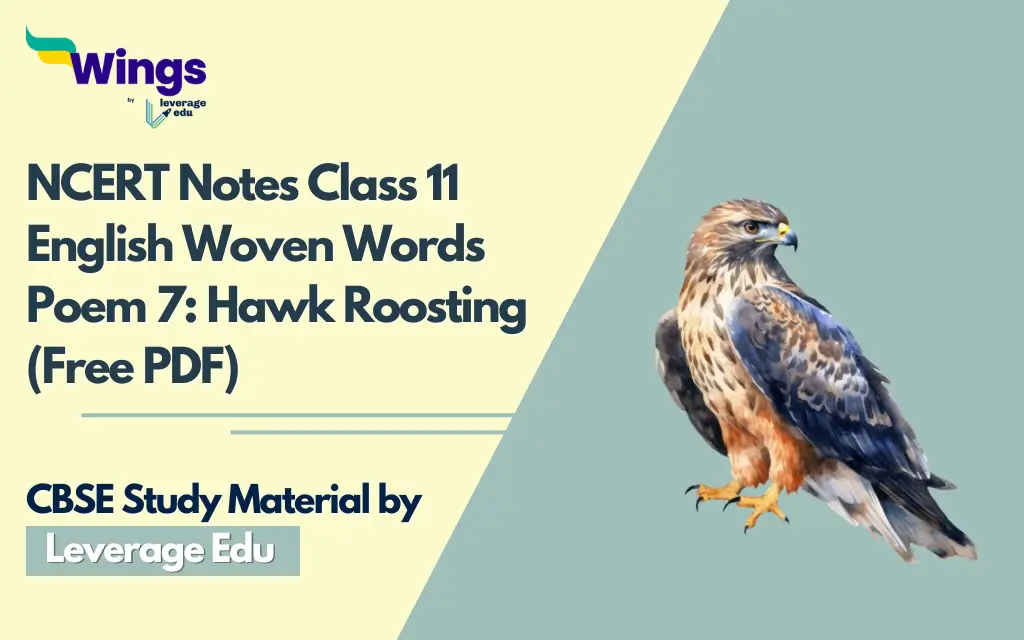
The poem Hawk Roosting by Ted Hughes is the seventh poem in the Poetry section of the NCERT Class 11 English Woven Words textbook. This powerful poem is written from the perspective of a hawk and explores the themes of power, control, and the natural instinct of dominance. Through this poem, Hughes presents a raw, unapologetic view of nature’s hierarchy. This blog provides easy-to-understand NCERT Class 11 English notes with explanations, meanings, and analysis to help students understand the poem’s themes. You can also download the free PDF for quick revision.
Contents
- 1 Important Word Meanings in Hawk Roosting by Ted Hughes
- 2 Line-by-Line Explanation of the NCERT English Woven Words Poem 7: Hawk Roosting
- 3 Analysis of the NCERT English Woven Words Poem 7: Hawk Roosting
- 4 Summary of the Poem Hawk Roosting by Ted Hughes
- 5 Poetic Devices in NCERT English Woven Words Poem 7: Hawk Roosting
- 6 FAQs
Explore Notes of Class 11 English Woven Words
Important Word Meanings in Hawk Roosting by Ted Hughes
In the poem Hawk Roosting by Ted Hughes, specific words and phrases are used to convey the hawk’s sense of absolute power, control, and instinctual dominance. Understanding these terms clarifies the poem’s tone and message.
| Word / Phrase | Meaning |
| Top of the wood | The highest point in the forest symbolises the hawk’s elevated position of power |
| Inaction | A state of stillness or rest, reflecting the hawk’s confident repose |
| Falsifying dream | Illusory or deceptive thoughts, which the hawk claims to lack, emphasising its clarity of purpose |
| Hooked head and hooked feet | The hawk’s physical features, designed for predation, symbolise its lethal precision |
| The convenience of the high trees | The strategic advantage of the hawk’s perch aids its dominance |
| Air’s buoyancy | The uplifting quality of the air assists the hawk’s flight |
| Sun’s ray | Sunlight, enhancing the hawk’s vision and authority |
| Earth’s face upward | The ground below, subject to the hawk’s inspection, symbolises its control over creation |
| Locked upon the rough bark | The hawk’s firm grip on the tree signified its unyielding authority |
| Whole of Creation | The entirety of the natural world, which the hawk claims to dominate |
| Hold Creation in my foot | The hawk’s assertion of supremacy, as if controlling the world with its talons |
| Sophistry | Deceptive or manipulative reasoning, absent in the hawk’s straightforward nature |
| Manners are tearing off heads | The hawk’s brutal, instinctual behaviour, unapologetic in its predation |
| Allotment of death | The hawk’s role in dispensing death, seen as its natural right |
| Direct through the bones of the living | The hawk’s precise, lethal flight path targets prey without hesitation |
| No arguments assert my right | The hawk’s authority is unquestioned, rooted in its natural dominance |
| Sun is behind me | The sun’s position enhances the hawk’s power, as if nature supports its supremacy |
| Permitted no change | The hawk’s refusal to allow alteration, asserting its control over its environment |
Line-by-Line Explanation of the NCERT English Woven Words Poem 7: Hawk Roosting
Here is the line-by-line analysis of each stanza of the poem ‘Hawk Roosting’
Lines 1–4:
I sit in the top of the wood, my eyes closed.
Inaction, no falsifying dream
Between my hooked head and hooked feet:
Or in sleep rehearse perfect kills and eat.
The poem opens with the hawk speaking from its perch at the “top of the wood,” a position of dominance, with its eyes closed in confident repose. Its “inaction” is free of deceptive dreams, and even in sleep, it mentally rehearses “perfect kills,” emphasising its predatory nature and focus.
Lines 5–8:
The convenience of the high trees!
The air’s buoyancy and the sun’s ray
Are of advantage to me;
And the earth’s face upward for my inspection.
The hawk describes the strategic advantages of its environment: the high trees provide a vantage point, the air aids its flight, and the sun enhances its vision. The “earth’s face upward” suggests the world below is subject to its scrutiny, reinforcing its control.
Lines 9–12:
My feet are locked upon the rough bark.
It took the whole of Creation
To produce my foot, my each feather:
Now I hold Creation in my foot.
The hawk’s talons grip the tree, symbolising its unyielding authority. It claims that the “whole of Creation” crafted its perfect form, and now it dominates creation, metaphorically holding the world in its foot, asserting absolute power.
Lines 13–16:
Or fly up, and revolve it all slowly,
I kill where I please because it is all mine.
There is no sophistry in my body:
My manners are tearing off heads.
The hawk describes its flight, surveying its domain with the freedom to “kill where I please,” claiming ownership over everything. It rejects “sophistry” (deceptive reasoning), embracing its brutal instinct to kill, described vividly as “tearing off heads.”
Lines 17–20:
The allotment of death.
For the one path of my flight is direct
Through the bones of the living.
No arguments assert my right.
The hawk sees itself as the dispenser of death, its flight path precise and lethal, cutting “through the bones of the living.” Its authority requires no justification, as its dominance is an inherent right in the natural order.
Lines 21–24:
The sun is behind me.
Nothing has changed since I began,
My eye has permitted no change.
I am going to keep things like this.
The hawk concludes with the sun behind it, symbolising nature’s support for its supremacy. It asserts that nothing has changed since its existence began, and its unwavering gaze ensures no change will occur, emphasising its absolute control and resolve to maintain the status quo.
Also Read: NCERT Notes Class 11 English Woven Words Chapter 7: Glory at Twilight (Free PDF)
Analysis of the NCERT English Woven Words Poem 7: Hawk Roosting
The poem Hawk Roosting by Ted Hughes is a dramatic monologue spoken by a hawk, exploring themes of power, control, and instinctual dominance. Through vivid imagery and a commanding tone, Hughes presents the hawk as a symbol of raw, unapologetic authority, reflecting the natural hierarchy and the predator’s mindset.
Theme – Power, Control, and Instinctual Dominance
The central theme is the hawk’s assertion of absolute power and control over its environment, viewing itself as the pinnacle of creation. The poem explores the unapologetic instinct of a predator, whose authority is unquestioned and rooted in its natural design, contrasting with human complexities like sophistry or moral debates.
Symbolism and Meaning
Here, we have mentioned the symbolism used in this poem, along with the meaning behind that.
- Hawk: Represents raw power, instinct, and dominance, embodying nature’s unapologetic hierarchy.
- High Trees, Air, Sun: Symbolise the natural elements that enhance the hawk’s authority, aligning with its supremacy.
- Creation: Represents the entire natural world, which the hawk claims to dominate with its perfect form.
- Tearing off Heads: Symbolises the hawk’s brutal, instinctual behaviour, free of human moral constraints.
Human Experience
The poem captures the universal concept of power and control, reflecting on the instinctual drive for dominance found in nature. It prompts readers to consider the raw, unfiltered perspective of a predator, contrasting with human tendencies to complicate authority with reasoning or ethics, inviting reflection on nature’s order versus human society.
Tone and Mood
The tone and mood of the poem have been given as follows:
- Commanding and Arrogant: The hawk’s tone is authoritative and self-assured, asserting its supremacy without doubt.
- Unapologetic: The hawk’s lack of “sophistry” and directness in killing creates a stark, unapologetic mood.
- Intense and Reflective: The mood invites readers to contemplate the hawk’s absolute power and its implications for understanding natural instincts.
Summary of the Poem Hawk Roosting by Ted Hughes
In Hawk Roosting, Ted Hughes presents a dramatic monologue from the perspective of a hawk perched at the “top of the wood,” asserting its dominance over creation. The hawk revels in the advantages of its environment, high trees, buoyant air, and sunlight, claiming the earth is subject to its inspection. It views its perfect form as the culmination of creation, holding the world in its talons. The hawk kills freely, without deception or moral constraints, describing its “manners” as “tearing off heads” and its flight as a direct path “through the bones of the living.” With the sun behind it, the hawk declares its unchanging authority, determined to “keep things like this,” embodying raw, instinctual power.
Poetic Devices in NCERT English Woven Words Poem 7: Hawk Roosting
Ted Hughes employs several poetic devices to convey the poem’s message and enhance its emotional and rhythmic impact. Here are the poetic devices used in this poem.
| Device | Example | Effect |
| Personification | “The earth’s face upward for my inspection” | Gives the earth human qualities, emphasising the hawk’s dominance over it |
| Imagery | “The air’s buoyancy and the sun’s ray” | Creates vivid pictures of the hawk’s environment, highlighting its strategic advantages |
| Metaphor | “Now I hold Creation in my foot” | Compares the hawk’s talons to a force controlling the world, emphasising its power |
| Alliteration | “Hooked head and hooked feet” | Enhances rhythm and underscores the hawk’s predatory features |
| Enjambment | “Or fly up, and revolve it all slowly, / I kill where I please” | Reflects the hawk’s seamless, confident thought process |
| Repetition | “No change” (in “My eye has permitted no change” and “Nothing has changed”) | Reinforces the hawk’s unwavering control and resolve |
Download more NCERT Solutions of Class 11 English ‘Woven Words’ here!
| Poem 1: The Peacock Solution |
| Poem 2: Let Me Not to the Marriage of True Minds Solution |
| Poem 3: Coming Solution |
| Poem 4: Telephone Conversation Solution |
Explore Notes of Other NCERT Class 11 Subjects
| History | Geography | Political Science | Psychology | Sociology |
FAQs
The main theme is power, control, and instinctual dominance, with the hawk asserting its supremacy over creation, embodying the unapologetic authority of a predator in nature’s hierarchy.
The hawk claims to “hold Creation in my foot” to express its belief that its perfect form, crafted by the “whole of Creation,” grants it absolute control over the natural world, symbolising its dominance.
The phrase “no sophistry in my body” means the hawk’s actions are free of deceptive or manipulative reasoning, reflecting its straightforward, instinctual nature as a predator that kills without moral complexity.
For NCERT study material, follow the NCERT Notes and Solutions Class 11 English by Leverage Edu now.

 60,000+ students trusted us with their dreams. Take the first step today!