

 One app for all your study abroad needs













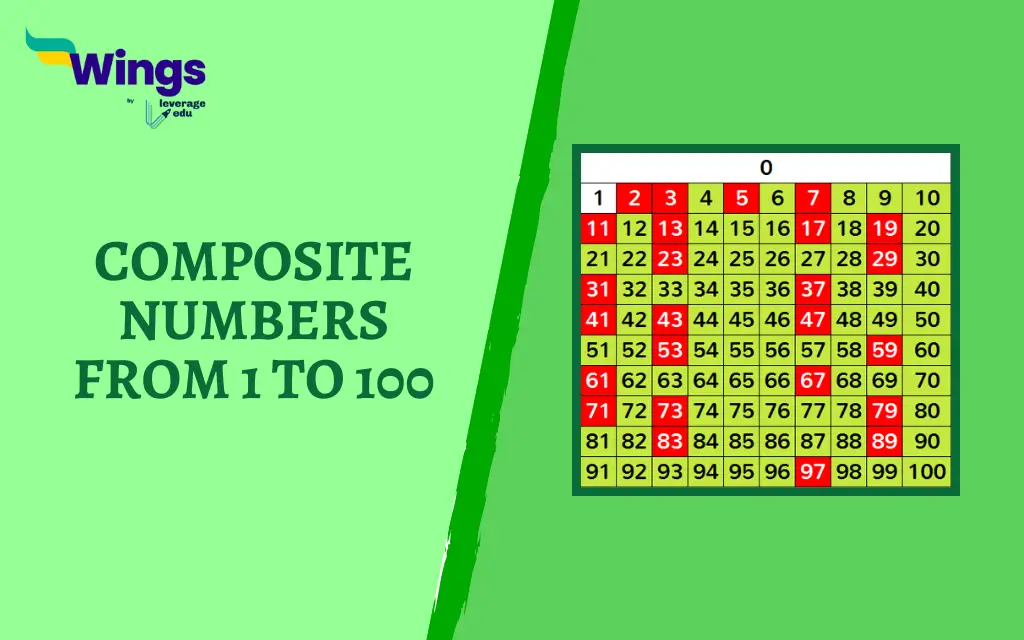
With the infinite amount of numbers and their usages in our everyday lives, we come across Composite Numbers. Additionally, among the different types of numbers that are a part of mathematics, Composite numbers stand out for their unique properties and significance. Read on to learn more in detail about Composite numbers from 1 to 100, their properties, and the difference between Prime Numbers and Composite Numbers.
Also Read: Multiplication and Division Word Problems
What are Composite numbers?
Composite numbers are positive integers greater than 1 that have at least one divisor other than 1 and themselves. In simpler terms, these are numbers that can be divided evenly by numbers other than 1 and themselves. For example, 4 is a Composite number because it can be divided evenly by 1, 2, and 4.
Moreover, the key properties of Composite numbers are:
- They have more than two factors.
- In addition, they are evenly divisible by their factors.
- Each composite number is a factor of itself.
- The smallest composite number is 4.
- Each composite number includes at least two prime numbers as its factors (e.g. 10 = 2 x 5, where 2 and 5 are prime numbers).
- Composite numbers are divisible by other composite numbers as well.
Also Read: Order of Operations and PEMDAS Rule
Table of Composite Numbers from 1 to 100
Furthermore, here are all the Composite Numbers from 1 to 100 in Green!

Prime Numbers vs Composite Numbers
Furthermore, here is the difference between Prime and Composite Numbers:
| Prime Numbers vs Composite Numbers | ||
| Feature | Prime Numbers | Composite Numbers |
| Definition | Have only two factors: 1 and the number itself | Have more than two factors |
| Examples | 2, 3, 5, 7, 11… | 4, 6, 8, 9, 10, 12… |
| Factors | Factors are 1 and the number itself | Have factors other than 1 and the number itself |
| Properties | Can only be divided by 1 and itself | Can be divided by numbers other than 1 and itself |
| Odd/Even | Except for 2, all prime numbers are odd | Can be odd or even |
| Prime Factorization | Prime numbers have no prime factors other than 1 | Can be expressed as a unique product of primes |
| HCF of Prime Numbers | The Highest Common Factor of prime numbers is 1 | Prime numbers have no common factors other than 1 |
Related Blogs
I hope this helps! Did you like learning about Types of Angles? Keep reading our blogs to learn more about the basic concepts of Maths!

 60,000+ students trusted us with their dreams. Take the first step today!