

 One app for all your study abroad needs













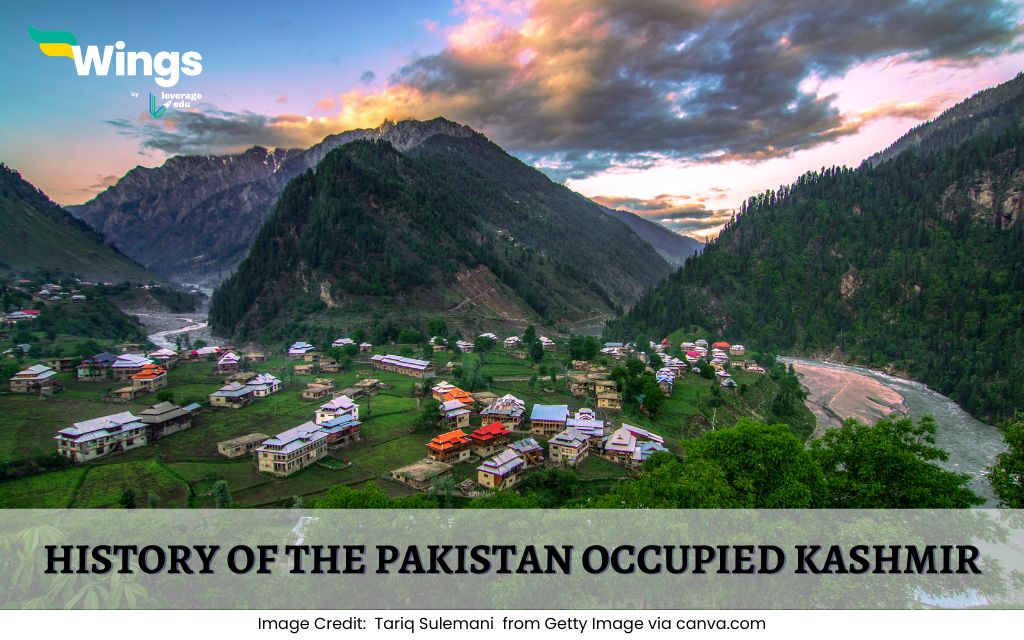
The Pakistan-occupied Kashmir (PoK) refers to parts of Jammu and Kashmir that are within the control of Pakistan since the Indo-Pak war of 1947 to 48. The areas include Gilgit-Baltistan and the Azad Jammu and Kashmir (AJK). These disputed regions are called Pok, and they have been the central focus of several conflicts between India and Pakistan. This blog is a short guide to the history of Pakistan-occupied Kashmir. Understand what PoK is, why it is important, and the historical timeline.
Contents
- 1 What is the Pakistan-Occupied Kashmir?
- 2 Why is PoK so Important?
- 3 Territorial Division of Jammu & Kashmir
- 4 History of Pakistan-Occupied Kashmir (PoK): A Timeline
- 5 When Did Pakistan Claim Kashmir?
- 6 Was Azad Kashmir Part of India?
- 7 Subsequent Indo-Pak Wars and Their Impact on Pok
- 8 Recent Developments and Current Status
- 9 Conclusion
- 10 FAQs
What is the Pakistan-Occupied Kashmir?
The Pakistan-Occupied Kashmir consists of two regions. That is, the Azad Jammu and Kashmir (AJK). This is a self-governing administrative division under the control of Pakistan. The second area is Gilgit-Baltistan. It was earlier known as the Northern Area. This region was granted limited autonomy in 2009 and was given provisional provincial status by Pakistan in 2020, further integrating it into the country’s federal structure. These areas were part of Jammu and Kashmir before partition. This is the history of Pakistan-occupied Kashmir.
Why is PoK so Important?
To understand the history of the Pakistan-occupied Kashmir, you need to understand why the PoK is important. Pok is significant as it holds strategic, economic, and geopolitical importance.

- Pok is the region that borders India, China, and Afghanistan
- The China-Pakistan Economic Corridor (CPEC) is a major infrastructure project that goes through Gilgit-Baltistan. Its strategic importance has escalated as the flagship project of China’s Belt and Road Initiative.
- The Indus River and its tributaries flow through the Pok.
- The region has popular historical sites and is rich in cultural heritage
Explore: All You Need to Know About Cultural Mapping in India
Territorial Division of Jammu & Kashmir
The earlier princely state of Jammu and Kashmir has been divided among 3 countries. The history of Pakistan occupied Kashmir can be understood by learning about these divisions.
| Country | Region Administered | Description |
| India | Jammu, Kashmir Valley, Ladakh | Administers the region as the Union Territories of Jammu & Kashmir and Ladakh, following the revocation of its special status in 2019. |
| Pakistan | Azad Jammu and Kashmir, Gilgit-Baltistan | Controls these areas; Gilgit-Baltistan has been given provisional provincial status, though neither is formally integrated into Pakistan’s constitution. |
| China | Aksai Chin, Trans-Karakoram Tract | Controls Aksai Chin (since the 1962 war); received Trans-Karakoram from Pakistan. |
The Line of Control or the LOC divided the Indian and the Pok. The Line of Actual Control defines the boundary between Chinese and Indian controlled regions.
History of Pakistan-Occupied Kashmir (PoK): A Timeline
The timeline below showcases the history of the Pakistan occupied Kashmir in detail:
| Year | Event |
| 1947 | Maharaja Hari Singh signs the Instrument of Accession, joining Jammu and Kashmir to India. |
| 1947 – 1948 | The First Indo-Pak war led to Pakistan gaining control over parts of Jammu and Kashmir, now known as PoK. |
| 1949 | A ceasefire agreement establishes the ceasefire line, later known as the Line of Control (LOC). |
| 1963 | Pakistan cedes the Trans-Karakoram Tract to China, an area claimed by India. |
| 1972 | The Simla Agreement reaffirms the LOC as the de facto border between India and Pakistan. |
| 2009 | Pakistan grants limited autonomy to Gilgit-Baltistan. |
| 2019 | India revokes the special status of Jammu and Kashmir under Article 370 and bifurcates it into two Union Territories: Jammu & Kashmir and Ladakh. |
| 2020 | Pakistan announces provisional provincial status for Gilgit-Baltistan. |
| 2021 | India and Pakistan reaffirm the 2003 ceasefire agreement along the LOC, leading to a significant reduction in cross-border fire. |
When Did Pakistan Claim Kashmir?
The history of Pakistan-occupied Kashmir starts right after the partition of India (1947). Jammu and Kashmir became a part of India after the Maharaja Hari Singh of Jammu and Kashmir signed the Instrument of Accession on October 26, 1947. This legal document formalised the accession to the Dominion of India. Thereafter, India sent troops to the region to deal with the invasion by a Pakistan-backed tribal force. Pakistan contested the legitimacy of this accession, and this led to the first Indo-Pak war. Since then, Pakistan claims that Jammu and Kashmir is a part of Pakistan.
Was Azad Kashmir Part of India?
Yes. The Azad Kashmir was a part of the Jammu and Kashmir when it was acceded to India in 1947. However, since the first Indo-Pak war (1947–48), Pakistan has been able to control the region. As per India, the region is illegally controlled by Pakistan.
Subsequent Indo-Pak Wars and Their Impact on Pok
The history of Pakistan-occupied Kashmir cannot be understood without knowing about the wars. The main wars that were fought are as follows-
- 1965 War– Pakistan’s Operation Gibraltar tried to create an insurgency in Jammu and Kashmir. This resulted in a war with both sides claiming victory.
- 1971 War– Civil unrest in East Pakistan resulted in a war between India and Pakistan. India won and gave independence to East Pakistan, which became Bangladesh. (Today, you can even get student visa for Bangladesh). The war resulted in the Simla agreement that converted the ceasefire line into the LOC.
- 1999 Kargil Conflict– Pakistani soldiers and militants occupied areas of Indian administered Kashmir. India successfully repelled the incursion and restored the LOC.
Recent Developments and Current Status
Now that you know about the history of the Pakistan occupied Kashmir, let’s learn about the recent developments in the region.
- 2019 Constitutional Changes:
India’s revocation of Article 370 was a pivotal moment, profoundly altering the constitutional status of its part of Jammu and Kashmir and drawing strong condemnation from Pakistan, which downgraded diplomatic ties. - Gilgit-Baltistan’s Status:
Pakistan’s move to grant provisional provincial status to Gilgit-Baltistan in 2020 is seen as a response to solidify its control, especially in the context of the CPEC.* - Ceasefire and Stalemate:
The 2021 reaffirmation of the ceasefire has brought relative calm along the LOC. However, a diplomatic stalemate persists, with both nations focused on consolidating administrative control over their respective territories. - International Reactions: The international community, including the UN and the USA, has expressed concern over tensions, particularly after the 2019 events, and consistently urges dialogue and restraint, while largely viewing the issue as a bilateral matter between India and Pakistan.
Also Read: Historical Events in India: Events that Shaped India’s Destiny
Conclusion
The history of Pakistan-occupied Kashmir (PoK) is not a relic of the past but a living, evolving issue that continues to shape the geopolitical landscape of South Asia. From the initial accession and the first war in 1947 to the ongoing territorial divisions, the region remains the core point of contention between India and Pakistan.
Recent developments show that both nations are moving away from bilateral negotiations and towards a policy of internal consolidation, India through the constitutional reorganisation of its territories, and Pakistan through the deeper integration of Gilgit-Baltistan. While the 2021 ceasefire provides a fragile peace along the Line of Control, the underlying dispute remains unresolved.
The future of PoK will undoubtedly continue to be influenced by the complex interplay of national interests, regional aspirations, and the ever-present shadow of the China-Pakistan Economic Corridor (CPEC).
FAQs
Ans. Pakistan administers two regions- Azad Jammu and Kashmir (AJK) and Gilgit-Baltistan. Gilgit-Baltistan has limited autonomy, and Azad Jammu and Kashmir has its own government.
Ans. The areas that are under the control of Pakistan are called Azad Jammu and Kashmir (AJK) and Gilgit-Baltistan. The AJK is a self-governing administered region.
Ans. Yes, Pok was a part of the princely state of Jammu and Kashmir, which acceded to India. However, after the first Indo-Pak war, Pakistan took control of the region.
Ans. Yes, China was able to capture parts of Kashmir. That is the Aksai Chin and the Shaksgam Valley. For India, it is a part of the Union Territory of Ladakh.
Ans. Islam is the dominant religion of Kashmir. The second largest religion is Hinduism. It is followed by smaller communities of Buddhists, Sikhs, and Christians.
Explore Some Other Interesting Indian Exam Topics Here
These were the facts about the historical places in India. If you find it fascinating and wish to read more such historical reads, then stay tuned to the Indian Exam page of Leverage Edu.

 60,000+ students trusted us with their dreams. Take the first step today!