

 One app for all your study abroad needs











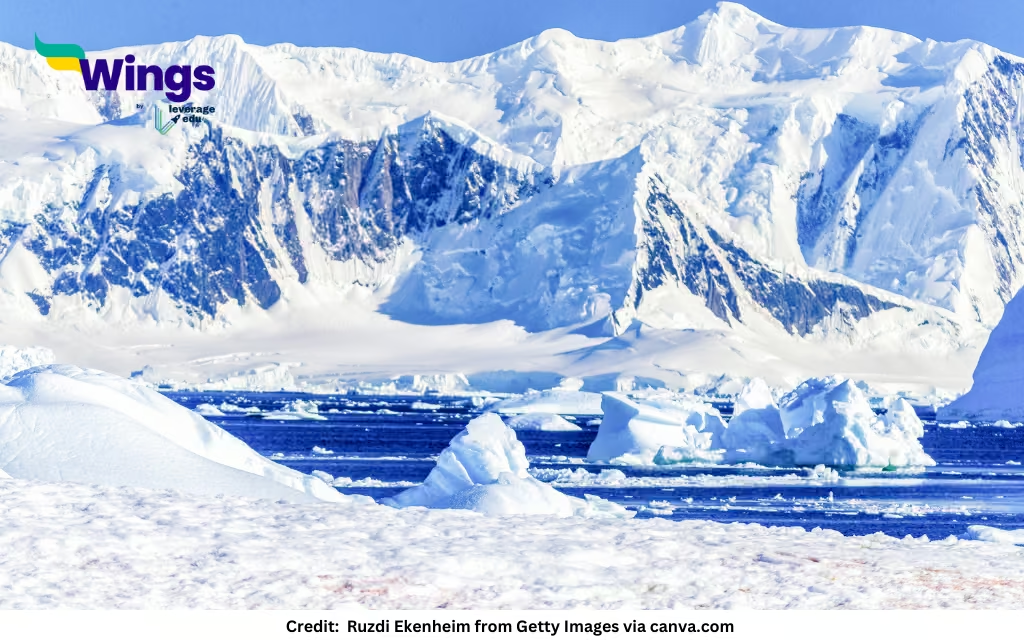
a. Sahara Desert
b. Gobi Desert
c. Kalahari Desert
d. Antarctic Desert
Correct Answer: D) Antarctic Desert
The Antarctic Desert, spanning 13.8 million square kilometers, is the world’s largest desert, defined by its ultra-low precipitation despite its icy cover. Its size, unique features, and global importance make it a fascinating topic for students, blending geography, ecology, and climate science.
Discovering Largest Desert in the World
Surprise! The largest desert in the world isn’t the sandy Sahara—it’s the Antarctic Desert, covering about 13.8 million square kilometers. Yep, Antarctica, that icy continent at the bottom of the world, is technically a desert because it gets super low precipitation (less than 200 mm per year). Unlike hot deserts, it’s a cold desert, blanketed in ice and snow, but still bone-dry in terms of rainfall.
For students, this is a mind-blowing geography fact. The Antarctic Desert challenges the idea that deserts are all about sand dunes and cacti. Its vast, frozen landscape is a unique ecosystem, and learning about it shows how diverse our planet’s environments can be. Plus, it’s a great trivia point to impress your friends!
Why It’s a Desert
So, why is Antarctica a desert if it’s covered in ice? It’s all about precipitation. A desert is defined by low rainfall or snowfall, and Antarctica gets almost none—some areas see less than 50 mm a year! The ice you see is ancient, built up over millions of years, not fresh snow falling regularly. That makes it the driest continent on Earth.
This fact is a game-changer for students studying climate or geography. The Antarctic Desert’s extreme conditions—freezing temps, high winds, and minimal moisture—make it a fascinating case study. It’s also a reminder that deserts aren’t just hot; they’re about scarcity, whether it’s water or warmth.
Size Comparison of Antarctic Desert with Other Deserts
The Antarctic Desert dwarfs other deserts. At 13.8 million square kilometers, it’s way bigger than the Sahara (9.2 million sq km), the Gobi (1.3 million sq km), or the Kalahari (0.9 million sq km). It covers the entire Antarctic continent, making it not just the largest desert but one of Earth’s most extreme environments.
For students, comparing these sizes puts the planet’s scale into perspective. The Sahara might feel massive, but Antarctica’s desert is on another level. Mapping these deserts for a geography project can help you visualize how vast and varied Earth’s landscapes are.
Unique Features of the Antarctic Desert
This desert isn’t just big—it’s weirdly awesome. It’s home to ice sheets that hold about 60% of Earth’s freshwater, locked up in glaciers. You’ll find bizarre features like dry valleys with no snow, blood-red waterfalls (caused by iron oxide), and even hidden lakes under the ice. Plus, it’s a hotspot for scientists studying climate change and ancient ecosystems.
For students, the Antarctic Desert is a treasure trove for science projects. Its unique geology and life forms (like hardy microbes) show how life adapts to extremes. It’s also a stark reminder of how climate change threatens this fragile region, making it a must-know topic for environmental studies.
Life in the Antarctic Desert
You’d think nothing could survive in this frozen wasteland, but life finds a way! The Antarctic Desert hosts penguins, seals, and tiny organisms like tardigrades that thrive in harsh conditions. Most of the continent is too extreme for plants, but lichens and mosses cling to rocky patches in less brutal areas.
For students, studying this ecosystem is a crash course in resilience. It shows how life adapts to crazy conditions, which is great for biology or ecology lessons. Plus, learning about Antarctica’s wildlife, like adorable Adélie penguins, makes geography way more fun than just memorizing maps.
Why Antarctic Desert Matters Globally?
The Antarctic Desert isn’t just a cool fact—it’s critical to Earth’s health. Its ice sheets regulate global sea levels, and melting due to climate change could have massive consequences. Scientists use the region to study Earth’s climate history, drilling ice cores that reveal thousands of years of data. It’s like a time machine for understanding our planet.
For students, this connects geography to real-world issues. Researching the Antarctic Desert can spark ideas for projects on climate change or global ecosystems. It’s a chance to see how even the most remote places on Earth affect life everywhere, from rising oceans to weather patterns.
Quick Facts
- Size: 13.8 million square kilometers.
- Type: Cold desert.
- Precipitation: Less than 200 mm/year.
- Key Feature: Holds 60% of Earth’s freshwater.
- Significance: Climate research, sea level regulation.
Summary
Question: Which is the Largest Desert in the World?
Answer: Antarctic Desert is the Largest Desert in the World.
Who knew a frozen continent could be the world’s biggest desert? The Antarctic Desert flips the script on what a desert can be, offering students a chance to explore a wild, icy world that’s critical to Earth’s future. From its quirky features to its climate role, it’s a geography gem that’s as educational as it is epic.
Also Read:
Nathu La Pass is Situated in which State of India?
Warli Painting is the Folk Painting of __ State of India
Where is the Headquarters of BIMSTEC situated?
Ajanta and Ellora Caves are located in Which State of India?
Who was the First Woman President of the Indian National Congress?


 60,000+ students trusted us with their dreams. Take the first step today!