

 One app for all your study abroad needs











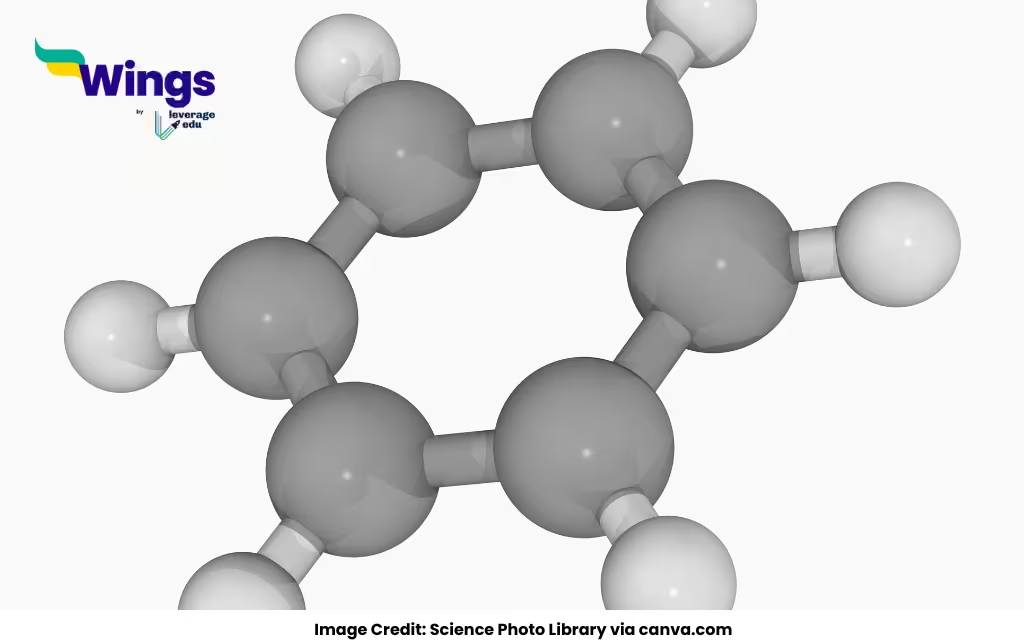
In chemistry, BHC stands for Benzene Hexachloride. It is a chlorinated organic compound that was widely used as an insecticide in the mid-20th century. BHC consists of a benzene ring substituted with six chlorine atoms, and it exists in several isomeric forms, among which gamma-BHC, also known as Lindane, is the most biologically active and commonly used.
Overview of BHC (Benzene Hexachloride)
| Property | Details |
| Full Form | Benzene Hexachloride |
| Chemical Formula | C₆H₆Cl₆ |
| Common Isomer | γ-BHC (Gamma BHC) or Lindane |
| Appearance | White crystalline solid |
| Solubility | Slightly soluble in water; soluble in organic solvents |
| Molecular Weight | ~290.83 g/mol |
| Use | Insecticide (agriculture, public health, veterinary) |
| Toxicity | Highly toxic; persistent in the environment |
Isomers of BHC
BHC has several stereoisomers because the chlorine atoms can occupy different positions around the benzene ring. The main isomers include:
- Alpha (α)
- Beta (β)
- Gamma (γ) – Most active, known as Lindane
- Delta (δ)
- Epsilon (ε)
Among these, gamma-BHC is the only one with significant insecticidal properties and was therefore isolated for use in agriculture and medicine.
Applications of BHC
| Field | Application |
| Agriculture | Used to control pests in crops such as cotton and rice |
| Public Health | Fumigation for lice and scabies treatment (as Lindane) |
| Veterinary | Parasite control in livestock |
| Industrial | Wood preservation and termite control |
Also Read:
What is Another Name for a Donkey?
Who is the No. 1 Bodybuilder in the World?
What is the perimeter of a quadrant of a circle of radius r?


 60,000+ students trusted us with their dreams. Take the first step today!