

 One app for all your study abroad needs











a. [M L T⁻²]
b. [M L T⁻¹]
c. [M L² T⁻²]
d. [M L² T⁻¹]
Correct Answer: B) [M L T⁻¹]
Impulse, with the dimension [M L T⁻¹], measures the change in momentum caused by a force acting over time. It’s a core concept in physics, explaining everything from sports to car safety. For students, understanding its formula, applications, and dimensional analysis is key to mastering mechanics and acing exams.
Defining Impulse and Its Dimensional Formula
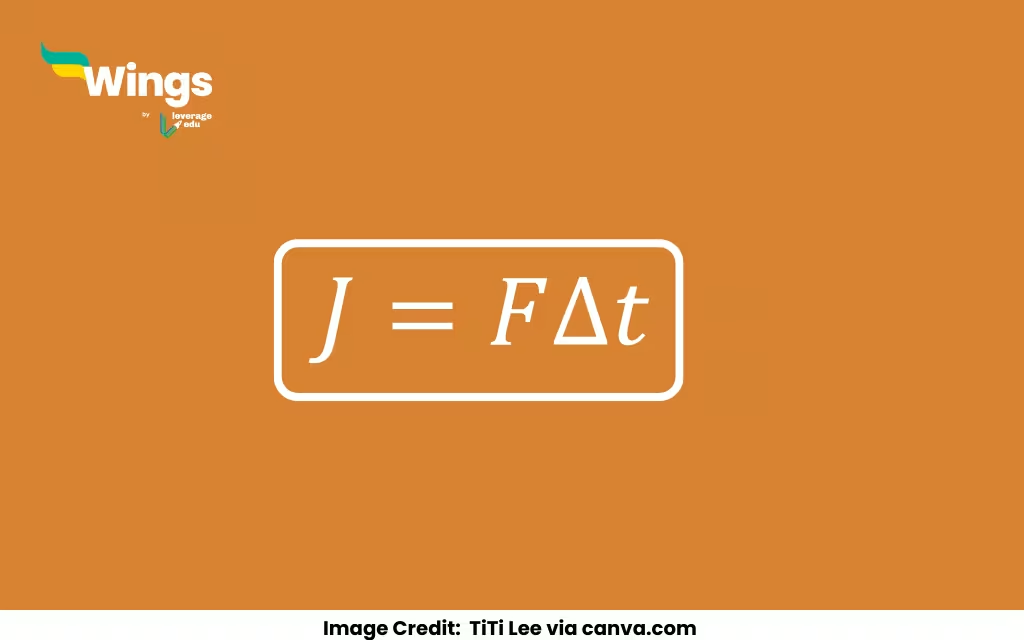
Impulse, a physics concept that’s super cool once you break it down! Impulse is the change in momentum caused by a force acting over a short time, like when a cricket ball smacks a bat. Its dimension is [M L T⁻¹], which comes from its formula:
impulse = force × time.
Since force is [M L T⁻²] and time is [T], multiplying them gives [M L T⁻¹].
For students, impulse is a key idea in mechanics, showing how forces affect motion. Think of it as the “push” that gets things moving or stopping. Whether it’s a car crash or a soccer kick, impulse helps explain why things speed up, slow down, or change direction. It’s like physics’ way of saying, “Here’s the impact!”
Quick Facts
- Dimension: [M L T⁻¹].
- Formula: Impulse = force × time.
- Units: kg·m/s.
- Related to: Change in momentum.
- Applications: Sports, safety design, collisions.
Breaking Down the Dimension of Impulse
Let’s unpack that [M L T⁻¹] dimension. In physics, dimensions tell us the building blocks of a quantity, using M (mass), L (length), and T (time). Impulse is force (mass × acceleration, or [M L T⁻²]) times time ([T]). When you multiply these, the T⁻² from force and T from time combine to T⁻¹, giving [M L T⁻¹]. Simple, right?
This matches momentum’s dimension, which makes sense because impulse equals the change in momentum (mass × velocity, where velocity is [L T⁻¹]). For students, nailing this dimensional analysis is a great skill—it’s like a shortcut to checking if your physics formulas make sense without doing tons of math.
Why Impulse Matters?
Impulse is a big deal because it connects force, time, and motion. In real life, it explains why airbags in cars reduce injury—they spread out the force of a crash over more time, lowering the impulse’s impact. Or why a fielder in cricket catches a ball softly to reduce the sting—same deal, more time means less force.
For students, impulse is a practical way to see Newton’s laws in action (especially the second one). It’s also a bridge to understanding collisions, which are huge in physics exams. Next time you’re studying mechanics, think about how impulse is the secret sauce behind every push, pull, or crash you see.
Applications in Everyday Life
You might not notice it, but impulse is everywhere. When you jump off a diving board, the impulse from your push changes your momentum to launch you into the air. In sports, like tennis or football, players use impulse to control how hard and fast a ball moves. Even engineers use it to design safer cars or stronger buildings.
For students, these examples make impulse less abstract. Try thinking about it next time you kick a ball or drop your phone (hopefully not!). It’s a chance to see how physics isn’t just textbook stuff—it’s shaping the world around you, from safety gear to sports strategies.
Calculating Impulse
Want to calculate impulse? It’s straightforward: impulse = force × time. If a 0.5 kg ball is hit with 100 N of force for 0.02 seconds, the impulse is 100 × 0.02 = 2 kg·m/s. You can also find it by calculating the change in momentum (final momentum minus initial). Both methods give the same answer, thanks to physics’ consistency.
For students, practicing these calculations builds confidence in mechanics. Use real-world scenarios, like a car braking or a rocket launch, to make it fun. Plus, checking dimensions ([M L T⁻¹]) ensures your answer makes sense, which is a lifesaver in exams!
Summary
Question: What is the Dimension of Impulse?
Answer: Dimension of Impulse is [M L T⁻¹] .
Impulse might sound like a fancy physics term, but it’s just the science of how things get moving or stop. With its [M L T⁻¹] dimension, it’s a window into the magic of motion, from cricket shots to car crashes.
Also Read:
What is the Chemical Name of Bleaching Powder?
How many Structural Isomers are Possible for Pentane?
In Computer Language, 1 MB is Equal to
World’s Longest Railway Station Platform is Located in Which of the
Following Country
Who Discovered the Solar System?


 60,000+ students trusted us with their dreams. Take the first step today!