

 One app for all your study abroad needs













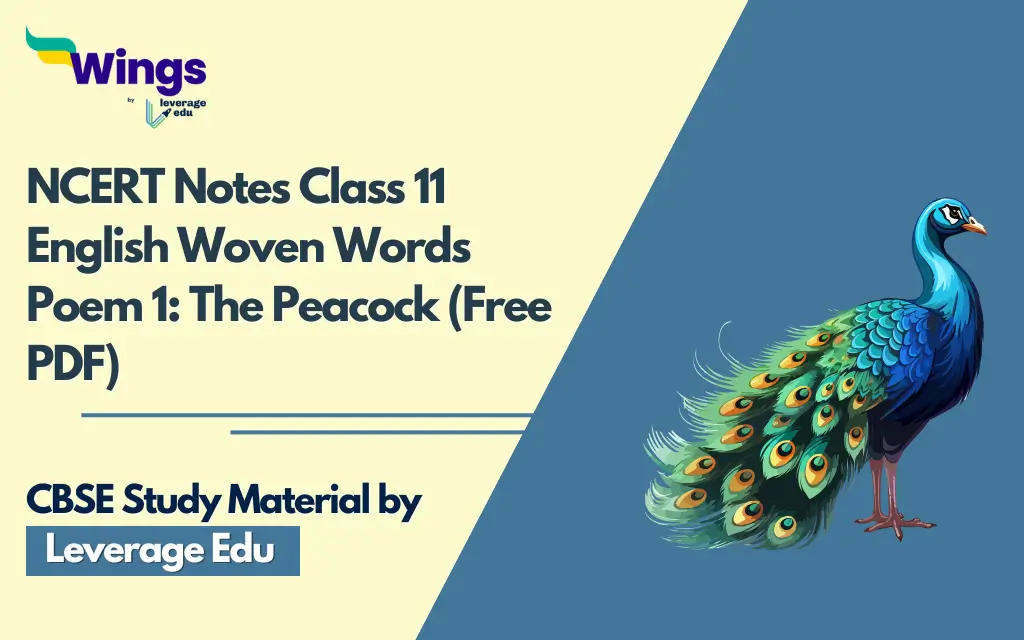
The poem The Peacock by Sujata Bhatt is the first poem in the Poetry section of the NCERT Class 11 English Woven Words textbook. This vivid poem captures the beauty of a peacock and the quiet observation required to witness its presence. The poet describes the bird’s sudden appearance and elusive nature, inviting readers to see the moments of nature and unexpected beauty. This blog provides explanations, meanings, and analyses to help students understand the poem’s message. You can also download the free PDF for quick revision.
Contents
Explore Notes of Class 11 English Woven Words
Important Word Meanings in The Peacock by Sujata Bhatt
In the poem The Peacock by Sujata Bhatt, the poet uses specific words to evoke the vivid imagery and fleeting nature of the peacock’s appearance. Understanding these words helps clarify the poem’s sensory and emotional impact.
| Word / Phrase | Meaning |
| Turquoise | A bright blue-green colour, referring to the peacock’s vibrant feathers |
| Pipal tree | A sacred fig tree, commonly found in India, where the peacock appears |
| Slender neck | The graceful, thin neck of the peacock arched elegantly |
| Darts away | Moves quickly and suddenly, describing the peacock’s elusive movement |
| Veranda | An open, roofed platform along the outside of a house, a setting for observation |
| Blue shadow | The peacock’s presence, casting a subtle, blue-toned shadow, signals its arrival |
| Violet fringed with golden amber | The vivid colours of the peacock’s tail feathers, with violet edges and golden hues |
| Tail that has to blink | The peacock’s tail folding, likened to eyes closing, as it turns away |
Line-by-Line Explanation of the Poem The Peacock
Here is the line-by-line explanation of the poem, The Peacock, in detail.
Stanza 1:
His loud sharp call
seems to come from nowhere.
Then, a flash of turquoise
in the pipal tree
The poem opens with the sudden, startling call of the peacock, its source unclear, creating a sense of mystery. A burst of turquoise in the pipal tree reveals the peacock’s vibrant presence, catching the observer off guard.
The slender neck arched away from you
as he descends,
and as he darts away, a glimpse
of the very end of his tail.
The peacock’s graceful neck arches as it moves down from the tree, and its quick, fleeting departure leaves only a brief glimpse of its tail, emphasising its elusive and transient beauty.
Stanza 2:
I was told
that you have to sit in the veranda
And read a book,
preferably one of your favourites
with great concentration.
The poet shares advice about how to see a peacock: one must sit quietly on the veranda, deeply immersed in a favourite book, suggesting that the peacock appears only when one is absorbed and unaware.
Stanza 3:
The moment you begin to live
inside the book
A blue shadow will fall over you.
The wind will change direction,
The steady hum of bees
In the bushes nearby
will stop.
As the reader becomes engrossed in the book, a subtle “blue shadow” (the peacock’s presence) appears. The wind shifts, and the bees’ hum ceases, signalling a change in the environment as the peacock nears, heightening the sense of anticipation.
Stanza 4:
The cat will awaken and stretch.
Something has broken your attention;
And if you look up in time
You might see the peacock turning away as he gathers
his tail
The cat stirs, and the reader’s focus is disrupted. If they look up quickly, they might catch the peacock turning away, folding its tail, a fleeting moment of beauty before it vanishes.
Stanza 5:
To shut those dark glowing eyes,
Violet fringed with golden amber.
It is the tail that has to blink
For eyes that are always open.
The peacock’s tail, with its vibrant, eye-like patterns of violet and golden amber, folds as if “blinking,” a poetic description of its retreat. The “eyes” on the tail, always open, contrast with the act of closing, emphasising the peacock’s mystique.
Analysis of the Poem The Peacock by Sujata Bhatt
The poem The Peacock by Sujata Bhatt captures the fleeting beauty of a peacock and the quiet attentiveness needed to witness it. It reflects on the interplay between focus, nature, and moments of unexpected wonder, set in a serene, natural environment.
Theme – Fleeting Beauty and Attentive Observation
The central theme is the transient beauty of nature, embodied by the peacock’s sudden appearance and quick departure. The poem suggests that such moments of beauty require deep focus and stillness, often occurring when one is immersed in another task, like reading, highlighting the serendipity of nature’s wonders.
Symbolism and Meaning
Here we have mentioned the symbolism used in this poem, along with the meaning behind that.
- Peacock: Symbolises beauty, grace, and elusiveness, representing rare, fleeting moments in life that demand attention to be appreciated.
- Pipal Tree and Veranda: Represent a connection to nature and a space for quiet contemplation, rooted in Indian culture.
- Blue Shadow and Tail’s “Eyes”: Symbolise the peacock’s mystical presence and the vivid, almost magical quality of its appearance, which captivates the observer.
Human Experience
The poem reflects the universal experience of seeking beauty in everyday life. It suggests that profound moments often come unexpectedly, requiring a state of calm focus to notice them, resonating with readers who cherish fleeting encounters with nature.
Tone and Mood
The tone and mood of the poem have been given as follows:
- Curious and Observant: The poet’s tone is attentive, capturing the peacock’s sudden presence with wonder.
- Serene and Reflective: The mood evokes calmness, encouraging readers to slow down and notice subtle changes in their surroundings.
- Mystical: The peacock’s elusiveness and the imagery of its tail “blinking” create a sense of awe and enchantment.
Also Read: NCERT Notes Class 11 English Snapshots Chapter 2 The Address (Free PDF)
Summary of The Peacock by Sujata Bhatt
In The Peacock, Sujata Bhatt describes the sudden, fleeting appearance of a peacock, whose sharp call and turquoise flash in a pipal tree startle the observer. The poem suggests that to witness this beauty, one must sit quietly on a veranda, absorbed in a favourite book. As the reader becomes engrossed, subtle signs, a blue shadow, a change in the wind, the silence of bees, and a stirring cat signal the peacock’s arrival. If one looks up in time, they may catch the peacock turning away, folding its vibrant tail with “eyes” of violet and golden amber, as if blinking. The poem celebrates the transient beauty of nature and the attentive stillness needed to experience it.
Poetic Devices in The Peacock
Sujata Bhatt uses several poetic devices to enhance the poem’s imagery and emotional resonance, making the peacock’s fleeting presence vivid and impactful.
| Device | Example | Effect |
| Imagery | “A flash of turquoise in the pipal tree” | Creates a vivid visual of the peacock’s vibrant appearance |
| Metaphor | “It is the tail that has to blink / For eyes that are always open” | Compares the folding tail to blinking eyes, emphasising its mystique |
| Personification | “The wind will change direction” | Gives the wind a deliberate action, enhancing the sense of a shifting environment |
| Alliteration | “Steady hum of bees” | Adds a rhythmic quality, mimicking the sound of bees |
| Enjambment | “You might see the peacock turning away as he gathers / his tail” | Reflects the peacock’s swift movement, carrying the reader’s attention across lines |
Download more NCERT Solutions of Class 11 English ‘Woven Words’ here!
| Chapter 1: The Lament Solution |
| Chapter 2: A Pair of Mustachios Solution |
| Chapter 3: The Rocking-horse Winner Solution |
| Chapter 4: The Adventure of the Three Garridebs Solution |
Explore Notes of Other NCERT Class 11 Subjects
| History | Geography | Political Science | Psychology | Sociology |
FAQs
The poem conveys that beauty in nature, like the peacock’s fleeting appearance, requires quiet focus and attentiveness to be appreciated, often appearing unexpectedly during moments of deep engagement.
Reading a favourite book with concentration symbolises a state of calm focus, suggesting that beauty reveals itself when one is immersed and unaware, highlighting the serendipity of such moments.
The phrase describes the peacock’s tail folding, likened to eyes closing, symbolising the fleeting nature of its beauty and the transient quality of profound experiences.
For NCERT study material, follow the NCERT Notes and Solutions Class 11 English by Leverage Edu now.

 60,000+ students trusted us with their dreams. Take the first step today!