

 One app for all your study abroad needs













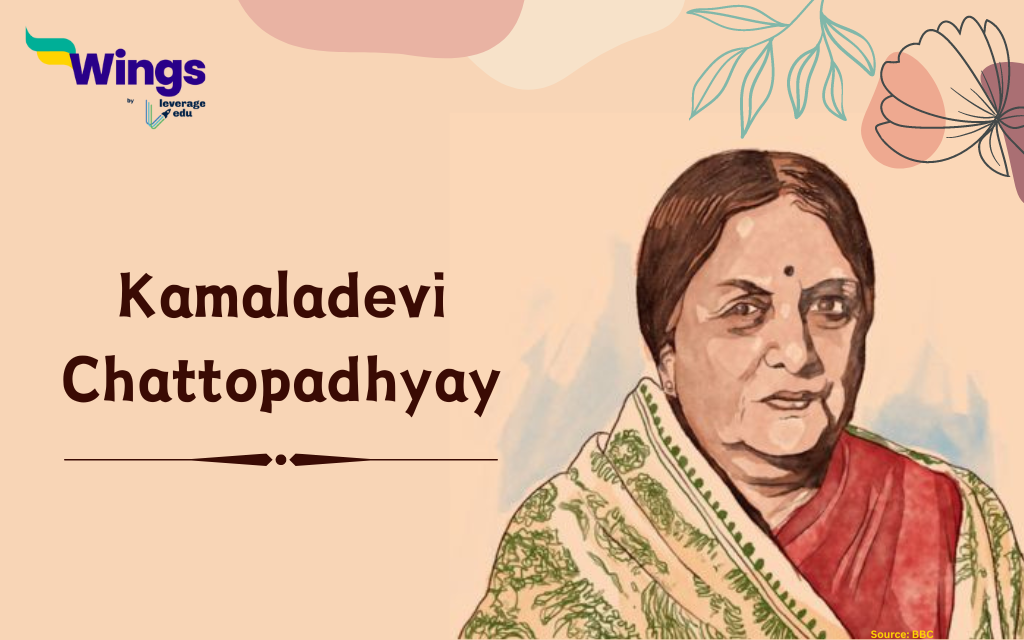
Kamaladevi Chattopadhyay was a braveheart, a social reformer, an ardent freedom fighter, and an advocate of Indian handlooms, handicrafts, theatre, and cooperative movements. She was a feminist at heart and has worked tirelessly for the upliftment of women and craftsmanship. Her story as one of the women freedom fighters of India is often unheard of. Let us get to know about Kamaladevi Chattopadhyay and her life story through this blog.
Contents
Kamaladevi Chattopadhyay: Early Life and Education
Kamaladevi Chattopadhyay was born on 3 April 1903 in Mangalore (now Mangaluru) to Girijamma and Ananthaya Dhareshwar, who served as the District Collector. She began her schooling at St. Ann’s Convent.
- Her childhood was marked by personal loss, as she lost both her father and sister early in life. Because of the inheritance rules of that period, her father’s property went to the son of his first wife, leaving her mother to raise Kamaladevi under challenging circumstances. Her mother’s resilience and independent nature deeply shaped Kamaladevi’s personality.
- She spent much of her early years at her uncle’s home, where she encountered leading political thinkers such as M G Ranade, Annie Besant, and Gopal Krishna Gokhale.
- Kamaladevi was married at 14, but was widowed two years later. Determined to continue her education, she enrolled at Queen Mary’s College in Chennai. She later married Harindranath Chattopadhyay—a decision considered unconventional at the time, as society strongly discouraged widow remarriage.
- Alongside her social commitments, she pursued higher studies and obtained a diploma in sociology from Bedford College, University of London. Eventually, her marriage to Harindranath ended, and she made history by becoming the first individual in India to secure a legal divorce through an Indian court.
Here is an Overview of Kamaladevi Chattopadhyay:
| Overview of Kamaladevi Chattopadhyay | |
| Birth | 3 April, 1903 |
| Advocated for | Women Upliftment, Widow marriage and against Child marriage. |
| Awards | Padma Bhushan, Ramon Magsaysay Award for Community Leadership, etc |
| Books | The Awakening of Indian Women, Outer Spaces: Memoirs (autobiography), Inner Recesses, The Glory of Indian Handicrafts, etc |
| Died | 29 October, 1988, aged 85 |
Also Read – Top 7 Famous Female Leaders in Indian History
Kamladevi Chattopadhyay’s Contribution to Freedom Struggle
After hearing about Mahatma Gandhi’s non-cooperation movement, Kamaladevi returned to India in 1923 and joined Seva Dal, an organization focused on social upliftment. Here are some prominent contributions of Kamaladevi:
- Kamladevi became friends with Margaret Cousins, who founded the All India Women’s Conference (AIWC) in 1927.
- With Cousins’ support, Kamaladevi became the first Indian woman to run for a legislative seat at the Madras Provincial Assembly, though she narrowly lost.
- She also served as the Organizing Secretary for the AIWC.
Kamaladevi founded several institutions dedicated to women’s education and empowerment. She also took part in Gandhi’s Salt Satyagraha, where she got arrested for selling prohibited salt at the Bombay Stock Exchange and spent close to a year in jail.
- After World War II, she travelled widely across Europe and the United States, engaging with global leaders working for women’s rights.
- She gained national recognition on January 26, 1930, when she courageously protected the Indian tricolour during a protest.
- In 1936, Kamaladevi assumed the presidency of the Congress Socialist Party, working alongside Jayaprakash Narayan and Ram Manohar Lohia.
- A strong feminist voice of her era, she openly questioned Gandhi’s decision to keep women out of the Dandi March. She campaigned vigorously in the Central Assembly for key reforms, including the Bill to Restrict Child Marriage and the Bill Raising the Age of Consent, and championed the recognition of women’s contributions both within the household and in the workforce.
- Kamaladevi also advocated for a Uniform Civil Code, seeking fair laws that ensured women’s rights to property and guardianship of their children.
Role of Kamaladevi Chattopadhyay: Post-Independence
After the Partition, she dedicated herself to helping people rebuild their lives. She played a key role in forming the Indian Cooperative Union and led the creation of the cooperative township of Faridabad, which was developed through community participation without any government funding. This settlement eventually provided a new home to nearly 50,000 refugees from the Northwest Frontier.
Her most celebrated contributions lie in the promotion and preservation of India’s traditional arts and crafts. Here are other prominent roles of hers:
- She founded craft-focused museums such as the Theatre Crafts Museum in Delhi and introduced the National Awards for Master Craftsmen to honour outstanding artisans.
- She also worked to revive endangered art traditions like Kalamkari by motivating its practitioners to train more number of students and pass on their skills.
- Kamaladevi helped establish several major cultural institutions, including the Crafts Council of India, the All India Handicrafts Board, and the National School of Drama.
- In addition, she founded the Natya Institute of Kathak and Choreography in Bangalore, further enriching India’s artistic heritage.
Awards and Honours of Kamaladevi Chattopadhyay
| Year | Awards and Honours |
| 1955 | Padma Bhushan |
| 1966 | Ramon Magsaysay Award for Community Leadership |
| 1974 | Ratna Sadsya (by Sangeet Natak Akademi) |
| 1977 | National UNESCO Award |
| 1987 | Padma Vibhushan |
| Her other honours include – Desikottama given by Shantiniketan and Member of Honour by UNIMA – International Puppetry Association | |
Kamaladevi Chattopadhyay was also honoured by Google with a Doodle on their homepage on her 115th Birthday.
Books by Kamaladevi Chattopadhyay
Some of her works include –
| Books | Published in |
| The Awakening of Indian Women | 1939 |
| Uncle Sam’s empire | 1944 |
| Towards a National Theatre | 1945 |
| At the Cross Roads | 1947 |
| Socialism and Society | 1950 |
| Tribalism in India | 1978 |
| The Glory of Indian Handicrafts | 1985 |
| Inner Recesses, Outer Spaces: Memoirs (autobiography) | 1986 |
| India’s Craft Tradition | 2000 |
Her other works also include- America: The Land of Superlatives, Japan-its Weakness and strength, Indian Women’s Battle for Freedom, etc. Kamaladvi Chattopadhyay died, aged 85, on 29th October 1988 in Bombay.
FAQs
Kamaladevi Chattopadhyay is widely known for her role in India’s freedom struggle, revival of traditional Indian handicrafts, and pioneering efforts in women’s empowerment. She was instrumental in establishing institutions like the Sangeet Natak Akademi and Crafts Council of India.
She actively participated in the Salt Satyagraha, was one of the first women arrested during the movement, and advocated for greater female participation in the political process. She also contested elections in 1926, setting a precedent for women in public life.
She revitalised the Indian handicraft and handloom sectors post-independence by promoting local artisans, preserving traditional skills, and creating global awareness of Indian craftsmanship. Her initiatives provided economic support and cultural dignity to rural communities.
Relevant Blogs
Here you read all about the biography of Kamaladevi Chattopadhyay.If you want to know more about other Famous Personalities then visit our General Knowledge page!

 60,000+ students trusted us with their dreams. Take the first step today!