

 One app for all your study abroad needs











1. Rishabhanatha
2. Parshvanatha
3. Neminatha
4. Mahavira
Correct Answer: 4. Mahavira
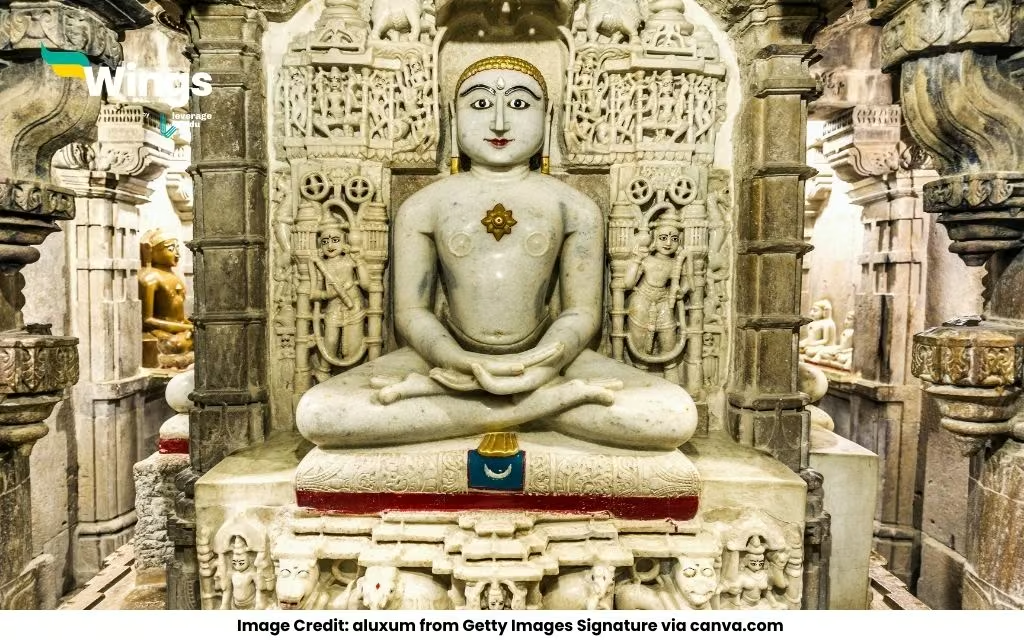
Mahavira, the 24th Tirthankara, is considered the first real founder of Jainism for formalizing its teachings and organizing its community around 599–527 BCE. His emphasis on non-violence, truth, and self-discipline shaped Jainism’s core principles, distinguishing him from earlier figures like Rishabhanatha and Parshvanatha. His legacy continues to influence Indian culture and ethics.
Who Was Mahavira?
Mahavira, born around 599 BCE in present-day Bihar, India, is considered the 24th and final Tirthankara (spiritual teacher) of Jainism. His birth name was Vardhamana, and he was born into a royal family but gave up worldly life at 30 to seek spiritual truth. After 12 years of intense meditation and asceticism, he achieved Kevala Jnana (omniscience) and became known as Mahavira, meaning “great hero.”
He spent the next 30 years teaching non-violence (ahimsa), truth, and self-discipline, laying the foundation for Jainism as an organized religion. While Jainism’s roots go back further, Mahavira’s teachings formalized its principles, making him the “first real founder” in terms of establishing its structured philosophy and practices.
Quick Facts
- Name: Mahavira (born Vardhamana), 24th Tirthankara.
- Lifespan: Approximately 599–527 BCE.
- Key Teachings: Non-violence, truth, non-stealing, chastity, non-attachment.
- Role: Organized Jainism into a structured religion with a fourfold community.
- Cultural Impact: Influenced Indian ethics, art, and environmentalism.
- Historical Note: Most verifiable Tirthankara, unlike earlier semi-mythical figures.
Why Not the Other Tirthankaras?
The other options—Rishabhanatha, Parshvanatha, and Neminatha—were also Tirthankaras, but they don’t quite fit the “first real founder” title. Rishabhanatha, the first Tirthankara, is a semi-mythical figure credited with starting Jainism in ancient times, but historical evidence is scarce. Parshvanatha, the 23rd Tirthankara (around 8th century BCE), laid important groundwork with his focus on non-violence, but his teachings were less formalized.
Neminatha, the 22nd Tirthankara, is also less historically documented than Mahavira. Mahavira’s clear historical presence, detailed teachings, and establishment of a monastic community set him apart as the figure who gave Jainism its modern shape, making him the best answer for this question.
Mahavira’s Core Teachings
Mahavira’s philosophy revolves around five key vows: non-violence (ahimsa), truthfulness (satya), non-stealing (asteya), chastity (brahmacharya), and non-attachment (aparigraha). These principles guide Jains to live ethically and minimize harm to all living beings. He emphasized that every soul is divine and capable of liberation through self-discipline and right conduct.
His teachings also introduced the concept of karma as a spiritual force that binds the soul to the cycle of rebirth. By living a life of purity and detachment, one can achieve moksha, or liberation. These ideas weren’t entirely new, but Mahavira’s clear, systematic approach made them accessible and enduring, influencing Jain communities for centuries.
How Mahavira Organized Jainism
Mahavira didn’t just teach; he built a community. He organized his followers into a fourfold structure: monks, nuns, laymen, and laywomen. This gave Jainism a strong framework, allowing it to spread across India. His emphasis on equality, especially including women in spiritual practice, was groundbreaking for his time and helped Jainism grow.
He traveled extensively, preaching in simple language to connect with ordinary people. His disciples, like Gautama Swami, carried his teachings forward, ensuring Jainism’s survival after his death around 527 BCE. This organizational effort is why Mahavira is seen as the founder who made Jainism a structured religion, not just a set of ideas.
Jainism’s Impact on Indian Culture
Mahavira’s teachings have left a deep mark on India. Jainism’s focus on non-violence influenced other figures, like Mahatma Gandhi, whose philosophy of ahimsa drew from Jain principles. Jains are known for their contributions to trade, art, and architecture, with stunning temples like those in Mount Abu showcasing their cultural legacy.
The religion also promotes environmental consciousness, as non-violence extends to protecting nature. Jain dietary practices, like strict vegetarianism, reflect this commitment. For students, understanding Mahavira’s role shows how one person’s ideas can shape a culture and inspire ethical living across generations.
Challenges in Studying Jainism’s Origins
Pinpointing Jainism’s founder is tricky because its roots stretch back thousands of years, blending myth and history. While Mahavira is historically verifiable, earlier Tirthankaras like Rishabhanatha exist more in religious texts than in concrete records. Scholars debate how much of Jainism’s philosophy predates Mahavira, but his role in codifying it is widely accepted.
Another challenge is that Jainism evolved alongside Buddhism, and the two share similarities, like emphasizing non-violence and meditation. This can make it hard to separate their historical development. For students, focusing on Mahavira’s documented contributions helps clarify his role as the religion’s key founder in its organized form.
Summary
Question: Who is considered the first real founder of Jainism?
Answer: Mahavira is considered as the first real founder of Jainism.
Mahavira’s role as Jainism’s founder is a testament to how one person’s vision can create a lasting spiritual tradition. His teachings on non-violence and discipline remain relevant today, offering lessons in ethical living. For students, understanding Mahavira’s contributions is key to grasping Jainism’s place in India’s religious and cultural history.
Also Read:
The Standard Meridian of India passes through Which City?
Who was the First Woman President of the Indian National Congress?
Where is the Headquarters of the BRICS Organisation Located?
Jaya Samhita is the Original Name of:
In Which City the 2028 Summer Olympic Games will be Organised?


 60,000+ students trusted us with their dreams. Take the first step today!