

 One app for all your study abroad needs
















Answer: Gause’s principle of competitive exclusion states that two species competing for identical resources cannot coexist, while competitive release allows a species to expand its niche in the absence of strong competitors. In career planning, this highlights the importance of finding a unique niche, minimizing competition, and adapting to changing opportunities to thrive in a competitive professional environment.
Complete Answer:
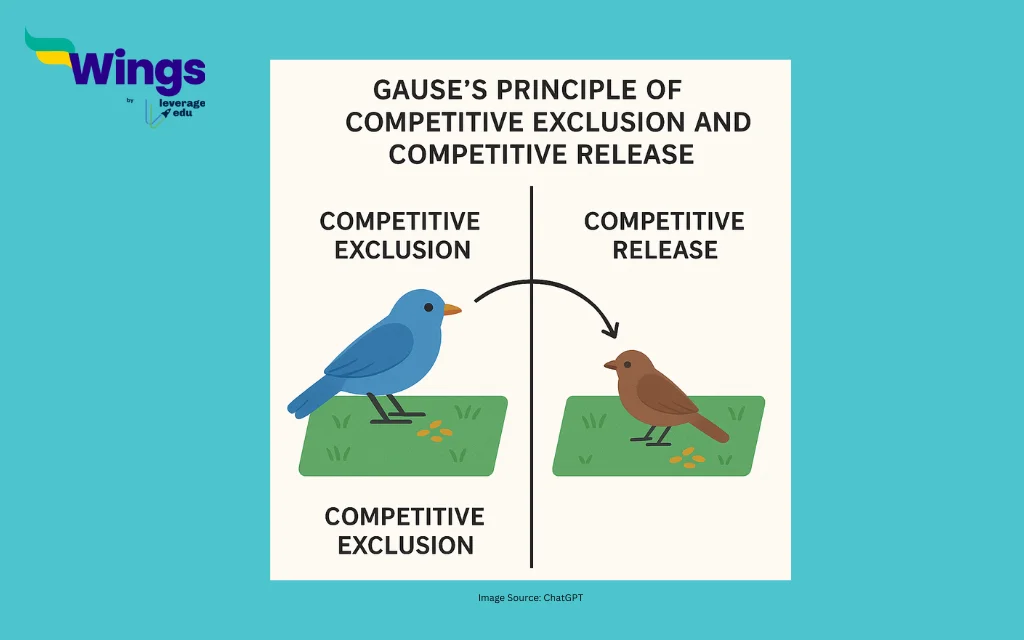
Gause’s principle of competitive exclusion explains that two species cannot live together for long if they compete for the same resources, like food, space, or water. One species will always be better at using those resources and will eventually survive, while the other may slowly disappear, adapt, or move away.
Example:
Imagine two types of birds that both eat the same seeds in a forest. The bird that is faster or better at finding seeds will get more food and stay healthy. The slower or weaker bird may not get enough to eat and could slowly vanish from the area.
What can we learn from the example of the birds?
The example of the two birds given above shows how competition affects survival. The weaker bird loses out. But if the stronger bird is removed from the area, the weaker one now has access to food and space. This allows it to grow and thrive. This situation is called competitive release, where the pressure of competition is removed, and the weaker one gets a chance to succeed.
How many types of competition are there?
Two types of competition can lead to competitive exclusion are,
| Interspecific competition | Competition between different species. |
| Intraspecific competition | Competition between members of the same species. |
How does this help in planting your career?
Think of the job world like a forest. If everyone runs after the same popular career, like medicine, engineering, or government services, it becomes overcrowded. Just like in nature, only a few will succeed in such competitive areas.
But if you look at other career paths that fewer people are choosing, like data science, UX design, renewable energy, animation, or mental health care, you may find more chances to grow. These areas are like open niches with fewer competitors.
So, just like in nature,
- Find a path where you can shine, not where everyone else is going.
- Match your strengths with less crowded fields.
This way, you give yourself space to grow, succeed, and stand out, just like the bird that got its chance after the stronger one was gone.
In short, what is Gause’s principle of competitive exclusion and competitive release? How would it help you to plan your career? It teaches us to avoid overcrowded paths and choose opportunities where we can grow, thrive, and succeed by being smart and strategic.
Check out other Biology questions from here:


 60,000+ students trusted us with their dreams. Take the first step today!