

 One app for all your study abroad needs











Answer
Verified
Answer: Parasites and saprotrophs differ in how they obtain nutrients. Parasites live on or inside a host organism, feeding on it and often causing harm. In contrast, saprotrophs feed on dead or decaying organic matter by secreting digestive enzymes and absorbing the nutrients. The difference between parasites and saprotrophs is that parasites depend on living hosts, while saprotrophs play a key role in decomposing dead material.
Complete Answer:
Here is a detail of the difference between parasites and saprotrophs:
| Parasites | Saprotrophs |
| Parasites are organisms that live on or inside another living organism (the host) and obtain nutrients at the host’s expense. | Saprotrophs are organisms that feed on dead and decaying organic matter by breaking it down with enzymes and then absorbing the nutrients. |
| They depend on living hosts for their food and survival. | They depend on non-living organic material like dead plants, animals, or waste for food. |
| They show parasitic nutrition, where they absorb nutrients directly from the host’s body. | They show saprotrophic nutrition, where they release digestive enzymes on dead matter and then absorb the broken-down substances. |
| They usually harm the host by causing weakness, diseases, or even death in severe cases. | They do not harm any living organism; instead, they help recycle nutrients back into the environment. |
| Some parasites are capable of movement (like ticks or mosquitoes), while others (like tapeworms) stay attached to the host. | Most saprotrophs, like fungi and bacteria, are stationary and grow on or near the decaying matter. |
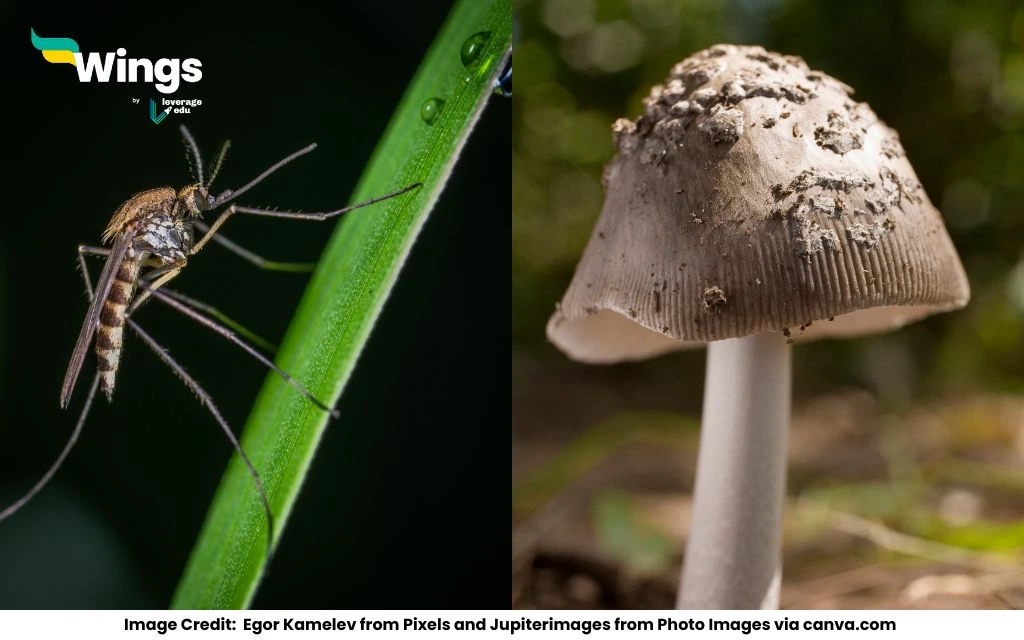
| Examples include lice, ticks, mosquitoes, tapeworms, and leeches. | Examples include mushrooms, bread mold, and certain bacteria like Bacillus subtilis. |
| Parasites usually reduce the health and strength of their host, affecting population and species balance. | Saprotrophs play a vital role as decomposers in the ecosystem, breaking down complex organic matter and returning nutrients to the soil. |
| They cannot survive without a living host and often have specialized features to stay attached or hidden inside the host’s body. | They do not require a living host and can survive freely on any organic matter available in their environment. |
| Parasites can cause diseases like malaria (by Plasmodium via mosquito), sleeping sickness (by Trypanosoma), and skin irritation (by lice). | Saprotrophs are responsible for decomposing fallen leaves, animal carcasses, and waste, helping maintain cleanliness and nutrient cycling in nature. |
Check other Biology questions below:


 60,000+ students trusted us with their dreams. Take the first step today!