

 One app for all your study abroad needs















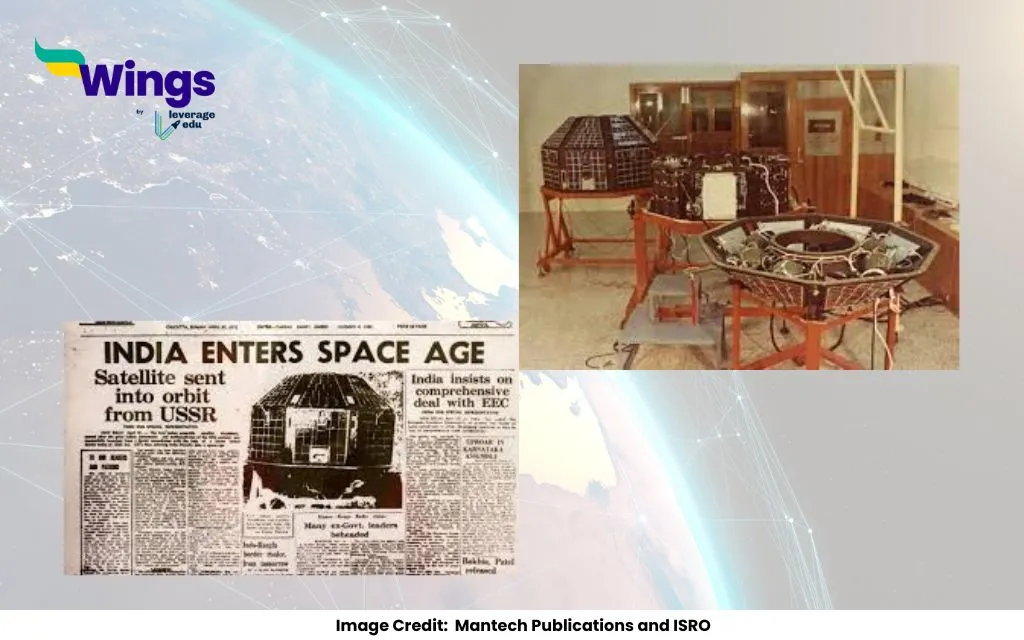
Answer. The aim of launching the Aryabhata satellite was to study space, including X-rays and solar radiation. The mission marked India’s first step into space research and helped ISRO gain essential experience in building and managing satellites. Thus, the correct answer is option D. To study the space.
Complete Answer:
India launched its first satellite, Aryabhata, on 19 April 1975, marking a major milestone in the nation’s journey into space technology. The Indian Space Research Organisation (ISRO) developed the satellite, and the Soviet Union provided launch support using the Kosmos-3M launch vehicle from Kapustin Yar, a Russian spaceport.
The aim of launching the Aryabhata satellite was to conduct scientific experiments in space research, particularly in;
| X-ray Astronomy | To study X-ray emissions from celestial objects |
| Solar Physics | To examine solar radiation and the influence of the Sun |
| Cosmic Ray Studies | To understand high-energy particles from space |
Let us explore some insightful facts about India’s first satellite, Aryabhatta, and the historic collaboration that made its launch possible:
- The launch of ‘Aryabhata’ was made possible through a 1972 agreement between India and the Soviet Union, led by ISRO’s founding visionary, Dr. U.R. Rao. In exchange for launching Indian satellites, the USSR received rights to use Indian ports for tracking ships and support operations.
- The satellite was launched using a Kosmos-3M launch vehicle from the Kapustin Yar spaceport in Russia. It entered a low Earth orbit with a period of 96.46 minutes, an apogee (farthest point) of 619 kilometres, and a perigee (nearest point) of 563 kilometres, with an orbital inclination of 50.7 degrees.
- The spacecraft of Aryabhata featured a 26-sided polyhedron design, measuring 1.4 meters in diameter. ISRO engineers covered nearly all surfaces with solar panels, except for the top and bottom, to provide power through solar energy.
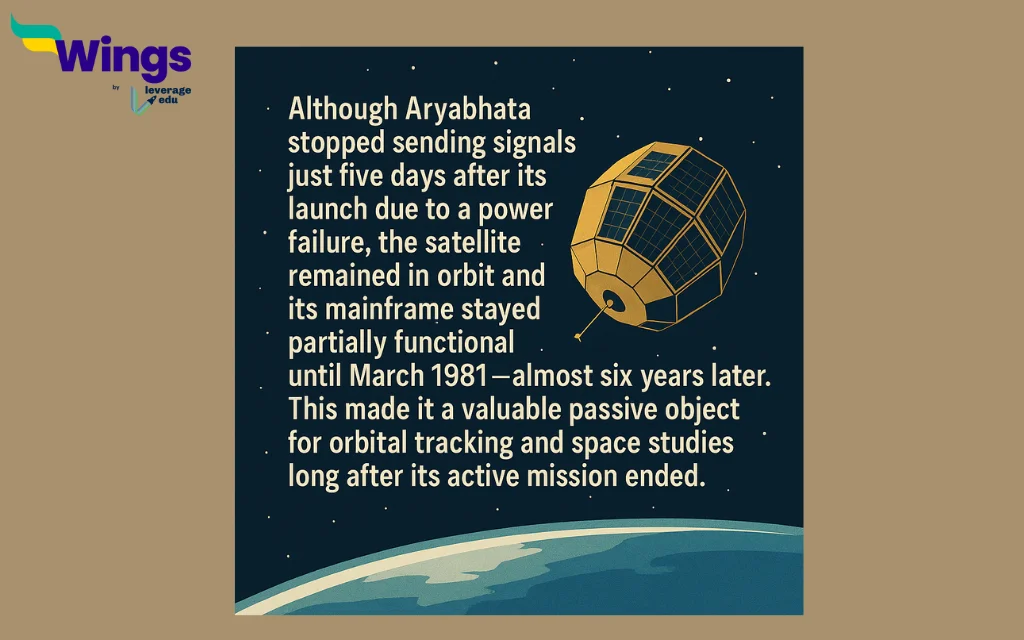
- A power system failure occurred just after 60 orbits, which was within five days of launch. The satellite continued to orbit Earth for years. While all communication stopped after the fifth day, the satellite’s mainframe remained operational until March 1981.
- Aryabhata was not intended to study the Moon, Mars, or the atmosphere of the Earth. Its clear aim was to expand India’s understanding of space-based scientific research.
- Despite the early end to its data collection, Aryabhata’s mission was a major technological success. It helped ISRO gain hands-on experience in designing, fabricating, and operating satellites, setting the stage for future missions like INSAT, IRS, Chandrayaan, and Mangalyaan.
- The success of Aryabhatt established India as a rising power in space exploration. The rising power successfully reflected the growing scientific and engineering capabilities of India on the international stage.
Interesting Fact
Even though Aryabhata’s mission lasted only five days due to a power failure, its image was featured on the INR 2 Indian banknote from 1976 to 1997. This made Aryabhata not just a scientific symbol, but also a part of the everyday national identity of India for over two decades.
Check out other Social Science questions from here:


 60,000+ students trusted us with their dreams. Take the first step today!