

 One app for all your study abroad needs













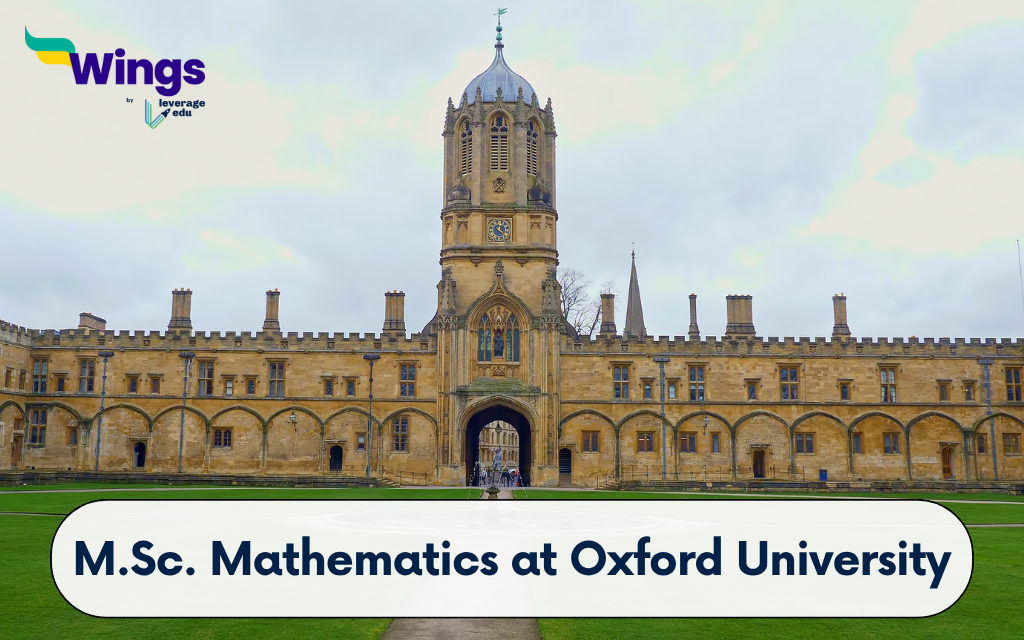
The M.Sc. Mathematical Sciences program at Oxford University is one of the most prestigious courses for students who want to make career in advanced mathematics. This one-year, full-time program covers pure mathematics, applied mathematics, and computational methods while giving students the flexibility to explore research areas that match their interests. In this blog, we break down everything you need to know about the M.Sc. Mathematics at Oxford University for 2026. From course structure and eligibility to fees, career prospects, and why Oxford is a top choice, this blog makes it easy to understand and plan your next steps.
This Blog Includes:
- M.Sc. Mathematics at Oxford University: Quick Overview
- M.Sc. Mathematics Course Structure and Specializations
- Eligibility Requirements for M.Sc. Mathematics
- Admission Process for M.Sc. Mathematics in 2026
- Career Opportunities & Salary Prospects After M.Sc. Mathematics
- Why Choose Oxford University for M.Sc. Mathematics?
- FAQs
M.Sc. Mathematics at Oxford University: Quick Overview
The M.Sc. Mathematical Sciences program is designed to give students advanced knowledge in mathematics, computational methods, and applied research. Here is a overview that highlights course structure, specializations, eligibility, fees, and career prospects.
| Program Name | M.Sc. Mathematical Sciences (OMMS) |
| University | University of Oxford |
| Duration | 9 months (October 2026 – June 2027) |
| Course Type | Full-time, postgraduate |
| Core Focus | Mathematics, Statistics, Computational Mathematics |
| Specializations | Pure Mathematics, Applied Mathematics, Computational Mathematics, Interdisciplinary Applications |
| Eligibility | Strong undergraduate degree in Mathematics or related field; English proficiency required |
| Tuition Fees | EUR 47,500 per year |
| Career Opportunities | Data Scientist, Quantitative Analyst, Financial Analyst, Academic Researcher, Machine Learning Engineer, Statistician |
| Top Recruiters | Google, JP Morgan, Facebook, Oxford University, DeepMind, Deloitte |
M.Sc. Mathematics Course Structure and Specializations
The M.Sc. Mathematical Sciences (OMMS) at Oxford University is a one-year, full-time program running from October to June. It provides advanced knowledge in mathematics, statistics, and computer science. Students can customize their studies according to their interests and career goals.
MSc in Mathematical and Computational Finance
This MSc teaches students advanced applied mathematics, machine learning, and computational finance skills needed for modern finance careers. It is highly recognized globally. The program combines stochastic calculus, numerical methods, and financial computing with a research dissertation. Many alumni work in banks, hedge funds, and investment firms. In 2025, QuantNet ranked it #1 in the UK for Financial Mathematics/Quantitative Finance.
MSc in Mathematics and the Foundations of Computer Science
This MSc bridges pure mathematics and theoretical computer science, ideal for research-focused students or those entering industry with strong logical and mathematical skills.
The course covers algebra, number theory, combinatorics, topology, and theoretical computer science. Students gain knowledge applicable to research, academia, or industry roles in tech and analytics.
MSc in Mathematical Sciences (OMMS)
The OMMS program offers broad and flexible training in mathematics and its interdisciplinary applications. It prepares students for research and innovation in various fields. The program provides a broad foundation in mathematical sciences, including applied and pure mathematics, statistics, and computation. Students complete coursework and a dissertation while exploring a wide range of topics.
MSc in Mathematical Modelling and Scientific Computing
This MSc focuses on applying mathematics to solve real-world problems using modelling, computation, and numerical methods. The course develops skills in mathematical modelling, numerical analysis, and programming. Students work on projects addressing practical scientific and engineering challenges.
MSc in Mathematical and Theoretical Physics
This MSc provides high-level training in modern mathematical and theoretical physics, preparing students for research and academic careers. Students study areas like elementary particles, condensed matter, astrophysics, and string theory. The course combines rigorous mathematics with modern theoretical physics research.
| Program Title | Duration | Core Focus Areas | Dissertation | Career Relevance |
| M.Sc. in Mathematical and Computational Finance | 12 months | Stochastic calculus, numerical methods, financial computing | Yes | High (banks, hedge funds, investment firms) |
| M.Sc. in Mathematics and the Foundations of Computer Science | 12 months | Algebra, number theory, combinatorics, logic, theoretical CS | Yes | Moderate (research, tech industry) |
| M.Sc. in Mathematical Sciences (OMMS) | 9 months | Mathematics, statistics, applied and pure mathematics | Yes | High (research, academia, tech industry) |
| M.Sc. in Mathematical Modelling and Scientific Computing | 12 months | Mathematical modelling, numerical analysis, programming | Yes | High (scientific computing, applied mathematics) |
| M.Sc.in Mathematical and Theoretical Physics | 12 months | Mathematical and theoretical physics | Yes | High (research, academia, physics industry) |
Also Read: Unique Courses To Study in the UK
Eligibility Requirements for M.Sc. Mathematics
Applicants should meet specific academic qualifications, demonstrate proficiency in English, and provide supporting documents to be considered for admission.
Academic Qualifications
To apply for the M.Sc. Mathematical Sciences at Oxford University, students must meet academic, language, and documentation requirements.
Undergraduate Degree
Applicants must hold or be predicted to achieve a first-class undergraduate degree with honours in mathematics or a closely related discipline. For those with a degree from the USA, a minimum GPA of 3.7 out of 4.0 is typically required.
Alternative Qualifications
If your degree is from a country not specified above, refer to Oxford’s International Qualifications page for guidance on equivalent qualifications and grades.
English Language Proficiency
Oxford University requires all non-native English speakers to prove their ability to study and communicate effectively in English. The following tests and minimum scores ensure students can handle the program’s academic demands.
Required Tests and Scores
If English is not your first language, you must provide evidence of proficiency through one of the following tests:
- IELTS Academic: Minimum overall score of 7.5, with no component below 7.0.
- TOEFL iBT: Minimum overall score of 110, with no component below 25.
- C1 Advanced (Cambridge): Minimum score of 191, with no component below 185.
- Oxford Test of English Advanced: Minimum overall score of 165, with no component below 155.
Note: Your test must have been taken no more than two years before the start date of your course.
Supporting Documents
Applicants are required to submit the following.
- Academic Transcripts: Official records from previous educational institutions.
- References: Two or more letters from academic or professional referees attesting to your suitability for the program.
- Statement of Purpose: A personal statement outlining your motivation for studying the M.Sc. Mathematical Sciences and your career aspirations.
- Curriculum Vitae (CV): An up-to-date CV highlighting relevant academic and professional experiences.
- Proof of English Language Proficiency: Official scores from the English language proficiency test you have taken.
Additional Considerations
Besides the mandatory requirements, Oxford also considers optional qualifications or experiences that may strengthen an application. These are not compulsory but can give applicants an edge.
GRE/GMAT Scores: Not required for this program.
Research Experience: While not mandatory, previous research experience in mathematics or related fields can strengthen your application.
Publications: Not expected but may be included if relevant.
Admission Process for M.Sc. Mathematics in 2026
The admission process for the M.Sc. Mathematical Sciences program at Oxford University is structured to ensure students meet academic, language, and documentation requirements.
Step 1: Research the Program
Students should review the course structure, specializations, and entry requirements on Oxford University’s official website to ensure the program aligns with their interests and career goals.
Step 2: Check Eligibility
Students must have a strong undergraduate degree in mathematics or a closely related field. They should also meet English language proficiency requirements if English is not their first language.
Step 3: Prepare Required Documents
Students need the following:
- Academic transcripts from previous studies
- Three academic references
- Personal statement (up to 1,000 words) explaining motivation and goals
- CV/resume highlighting relevant experiences
- English language test scores (if applicable)
Step 4: Submit the Application
Applications must be submitted online through the Oxford Graduate Application Portal. Students should ensure all documents are uploaded correctly before submission.
Step 5: Wait for University Response
The university reviews applications and may request additional information. Successful applicants receive an offer letter indicating admission and any conditions.
Step 6: Accept Offer and Pay Deposit
Students confirm their acceptance of the offer and pay any required tuition deposit to secure their place in the program.
Step 7: Apply for a Student Visa
Non-UK students must apply for a student visa, providing proof of admission, finances, and English language proficiency.
Step 8: Prepare for Arrival
Students should arrange accommodation, travel, and familiarize themselves with the university’s orientation and induction schedules.
Also Read: MS in Very Large Scale Integration (VLSI) in USA
Career Opportunities & Salary Prospects After M.Sc. Mathematics
The M.Sc. Mathematical Sciences program from Oxford University opens doors to diverse careers in academia, research, finance, technology, and data science. Graduates can work in roles that require strong analytical, problem-solving, and computational skills.
| High-Paying Job Role | Average Annual Salary | Top Recruiters |
| Data Scientist | EUR 70,000 per year | Google, Facebook, IBM |
| Quantitative Analyst | EUR 80,000 per year | JP Morgan, Goldman Sachs, Morgan Stanley |
| Financial Analyst | EUR 65,000 per year | Deloitte, PwC, EY |
| Academic Researcher | EUR 55,000 per year | University of Oxford, University of Cambridge, Imperial College London |
| Machine Learning Engineer | EUR 75,000 per year | Microsoft, DeepMind, Amazon |
| Statistician | EUR 60,000 per year | Office for National Statistics, NHS, World Bank |
Why Choose Oxford University for M.Sc. Mathematics?
Oxford University is globally renowned for its excellence in mathematics. The M.Sc. Mathematical Sciences program combines world-class teaching, research opportunities, and strong industry connections. Students gain advanced knowledge, hands-on experience, and a network that helps in building a successful career.
- Oxford University has one of the oldest and most prestigious mathematics departments in the world.
- Students get access to leading researchers and cutting-edge mathematical research projects.
- The program offers flexibility to specialize in areas like pure mathematics, applied mathematics, and computational mathematics.
- Oxford provides excellent career support, connecting students with top recruiters in finance, technology, and research.
- Studying in Oxford enhances analytical, problem-solving, and critical thinking skills that are highly valued globally.
- The university offers a vibrant student community, fostering collaboration, innovation, and lifelong friendships.
Also Read: Top Courses at Dublin City University for International Students
FAQs
Ans: The acceptance rate for Oxford’s M.Sc. Mathematical Sciences is highly competitive. Typically, fewer than 20% of applicants are admitted each year. Strong academic records, research experience, and a compelling personal statement increase your chances.
Ans: Oxford University is world-renowned for mathematics. It offers top-tier faculty, cutting-edge research, and diverse specializations. Graduates gain skills that are highly valued in academia, finance, and tech industries globally.
Ans: Indian students need a strong undergraduate degree in mathematics or a related field. They must meet English language requirements and submit transcripts, references, a CV, and a personal statement. Meeting all eligibility criteria and applying before deadlines is essential.
Relatable Reads
This was all about the M.Sc. Mathematical Sciences at Oxford University, including course structure, specializations, eligibility, fees, and career opportunities after graduation. Choosing the right program can enhance your skills, open global career paths, and help you fast-track your journey in mathematics and related fields. For more such insights, make sure to check out the Study Abroad page on Leverage Edu and stay updated!

 60,000+ students trusted us with their dreams. Take the first step today!