

 One app for all your study abroad needs













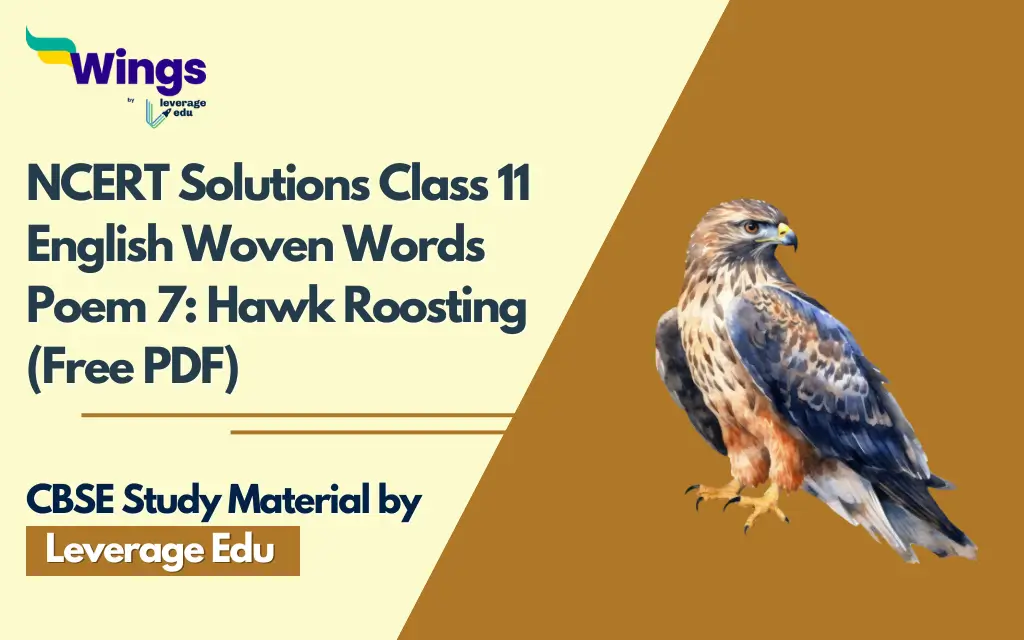
This blog on NCERT Solutions for Class 11 English Woven Words Poem 7: Hawk Roosting provides simple answers to the questions of this poem. It helps students understand the themes of power, control, and instinctual dominance from the perspective of a hawk. These solutions are designed to help in exam preparation by exploring the poem’s imagery, tone, and thematic depth. You can also download the free PDF for quick revision.
Contents
Explore Notes of Class 11 English Woven Words
NCERT Solutions Class 11 English Woven Words Poem 7: Hawk Roosting
Here are the NCERT Solutions for Class 11 English Woven Words Poem 7: Hawk Roosting, designed to enhance understanding of the poem’s themes, imagery, and emotional nuances for effective revision.
UNDERSTANDING THE POEM
1. Comment on the physical features of the hawk highlighted in the poem and their significance.
Solution: The poem highlights the hawk’s physical features, specifically its “hooked head and hooked feet,” which are emphasised in the line “Between my hooked head and hooked feet.” These features signify the hawk’s predatory design, with its sharp beak and talons crafted for killing and grasping prey. The “hooked” shape underscores its lethal precision and efficiency as a hunter. The hawk’s feet, described as “locked upon the rough bark,” symbolise its firm grip on its environment, reinforcing its dominance. Additionally, the poem notes that “It took the whole of Creation / To produce my foot, my each feather,” suggesting that the hawk’s entire form, down to each feather, is a perfect product of nature, designed for supremacy. These physical attributes collectively highlight the hawk’s natural authority and predatory prowess, central to its self-perception as the pinnacle of creation.
2. How does the poem emphasise the physical prowess of the hawk?
Solution: The poem emphasises the hawk’s physical prowess through vivid descriptions of its form and actions. The hawk’s “hooked head and hooked feet” are presented as tools of predation, designed for “perfect kills.” Its feet “locked upon the rough bark” demonstrate a powerful grip, symbolising control over its perch. The line “It took the whole of Creation / To produce my foot, my each feather” underscores the hawk’s belief in its flawless physical form, crafted by nature for dominance. Its ability to “fly up, and revolve it all slowly” and “kill where I please” highlights its agility and freedom in flight, enabling it to survey and dominate its domain. The hawk’s “manners are tearing off heads,” a stark depiction of its brutal strength, further emphasises its physical prowess as a predator without moral constraints, reinforcing its supreme authority in the natural world.
3. ‘There is no sophistry in my body’, this statement expresses the brutal frankness of the hawk. Does the poet suggest something through this statement?
Solution: The statement “There is no sophistry in my body” reflects the hawk’s brutal frankness, indicating its actions are driven by pure instinct without deceptive or manipulative reasoning. The poet, Ted Hughes, suggests through this statement a contrast between the hawk’s straightforward, unapologetic nature and human tendencies to complicate actions with moral or intellectual justifications. The hawk’s lack of “sophistry” highlights its raw, instinctual power, as seen in its “manners are tearing off heads,” which it performs without guilt or hesitation. Hughes may be suggesting a critique of human behaviour, where complex reasoning often masks or justifies destructive actions, implying that the hawk’s unapologetic honesty about its predatory nature is a purer, more authentic expression of power compared to human rationalisations.
4. ‘Now I hold Creation in my foot’, explain the centrality of this assertion in the poem. What makes the hawk’s assertion of its invincibility so categorical?
Solution: The assertion “Now I hold Creation in my foot” is central to the poem as it encapsulates the hawk’s belief in its absolute dominance over the natural world. This bold claim signifies the hawk’s perception that its perfect form, crafted by “the whole of Creation,” grants it supreme authority, metaphorically holding the world in its talons. The assertion’s centrality lies in its reflection of the hawk’s unyielding self-assurance and control, as it views itself as the pinnacle of nature’s hierarchy. The hawk’s invincibility is categorical due to its physical perfection (“my foot, my each feather”), strategic advantages (“the convenience of the high trees,” “the air’s buoyancy”), and unchallenged authority (“No arguments assert my right”). The hawk’s belief that “the sun is behind me” and its resolve to “permit no change” further reinforce its unwavering confidence in its supremacy, making its assertion absolute and unquestionable.
5. Why is the poem entitled ‘Hawk Roosting’?
Solution: The poem is entitled Hawk Roosting to reflect the hawk’s perspective as it perches confidently at the “top of the wood,” symbolising its position of power and dominance. “Roosting” suggests a state of rest and contemplation, as seen in the opening line, “I sit in the top of the wood, my eyes closed,” where the hawk is at ease yet fully aware of its authority. The title captures the hawk’s monologue, which revolves around its self-assured reflections on its supremacy, physical prowess, and control over creation. By focusing on “roosting,” the title emphasises the hawk’s natural, instinctual state of being, where even in stillness, it commands its environment, aligning with the poem’s themes of power and unapologetic dominance.
6. Bring out the parallel suggested between the predatory instincts of the bird and human behaviour.
Solution: The poem suggests a parallel between the hawk’s predatory instincts and certain aspects of human behaviour, particularly in the pursuit of power and control. The hawk’s unapologetic dominance, as seen in “I kill where I please because it is all mine” and “My manners are tearing off heads,” mirrors human tendencies to assert authority or dominance, often ruthlessly, in political, social, or personal contexts. Its claim to “hold Creation in my foot” parallels human ambitions to control resources, territories, or others, viewing them as possessions. The hawk’s lack of “sophistry” contrasts with human rationalisations for destructive actions, such as war or exploitation, suggesting that the hawk’s frankness about its instincts exposes the hypocrisy in human justifications. The hawk’s resolve to “permit no change” reflects human resistance to challenges against established power structures, drawing a parallel between the bird’s natural predatory instincts and humanity’s drive for dominance, often at the expense of others.
Also Read: NCERT Solutions Class 11 English Hornbill Poem 1 A Photograph (Free PDF)
TRY THIS OUT
1. Consult a dictionary or an encyclopedia to differentiate between the following birds: eagle, hawk, kite, and vulture.
Solution: Students can use a dictionary or encyclopedia to differentiate the following birds, focusing on their characteristics, behaviours, and roles in nature, which can be related to the hawk’s portrayal in Hawk Roosting:
- Eagle: A large bird of prey known for its keen eyesight, powerful flight, and majestic presence. Eagles, like the bald or golden eagle, hunt live prey (fish, small mammals) and are often symbols of strength and freedom. Unlike the hawk in the poem, eagles are associated with nobility rather than brutal dominance.
- Hawk: A medium-sized bird of prey, as depicted in the poem, with sharp talons and a hooked beak, designed for precision hunting (e.g., small birds, rodents). Hawks, like the one in Hawk Roosting, are solitary and territorial, emphasising raw power and control, as seen in the poem’s focus on instinctual killing.
- Kite: A bird of prey with long wings and a forked tail, known for graceful soaring and scavenging. Kites often feed on insects, small prey, or carrion, unlike the hawk’s direct predation. They lack the aggressive dominance of the hawk in the poem, focusing more on opportunistic feeding.
- Vulture: A scavenging bird that feeds primarily on carrion, with a bald head adapted for hygiene. Vultures, unlike the hawk’s predatory nature in Hawk Roosting, do not hunt live prey but clean up remains, playing a different ecological role. Their behaviour contrasts with the hawk’s assertive killing. Students can compare these birds’ traits to the hawk’s self-perception in the poem, noting how its predatory instincts and dominance distinguish it from the scavenging or less aggressive behaviours of kites and vultures, or the symbolic nobility of eagles.
2. To what aspects of human behaviour do the following adjectives apply: eagle-eyed, hawkish?
Solution: The adjectives “eagle-eyed” and “hawkish” apply to specific aspects of human behaviour, drawing parallels to the hawk’s characteristics in Hawk Roosting:
- Eagle-eyed: Refers to a person with sharp, keen observation or attention to detail, akin to an eagle’s exceptional eyesight. In human behaviour, this applies to individuals who are highly perceptive, such as detectives, analysts, or teachers who notice minute details. Unlike the hawk’s focus on dominance in the poem, “eagle-eyed” emphasises observational skill rather than control.
- Hawkish: Describes a person with an aggressive, confrontational, or militaristic attitude, often advocating for strong, decisive action (e.g., in politics or leadership). This directly parallels the hawk’s predatory instincts and unapologetic dominance in Hawk Roosting, where it claims, “I kill where I please” and “No arguments assert my right.” A “hawkish” politician, for example, might favour aggressive policies, mirroring the hawk’s brutal frankness and assertion of power. Students can explore how “hawkish” aligns closely with the poem’s portrayal of the hawk’s ruthless authority, while “eagle-eyed” reflects a less aggressive, more observational trait, contrasting with the hawk’s predatory focus.
Download NCERT Solutions Class 11 English Woven Words Poem 7: Hawk Roosting
You can download the free PDF of NCERT Solutions Class 11 English Woven Words Poem 7: Hawk Roosting for effective revision.
Download more NCERT Solutions of Class 11 English ‘Woven Words’ here!
| Poem 1: The Peacock Solution |
| Poem 2: Let Me Not to the Marriage of True Minds Solution |
| Poem 3: Coming Solution |
| Poem 4: Telephone Conversation Solution |
For more topics, follow LeverageEdu NCERT Study Material today!

 60,000+ students trusted us with their dreams. Take the first step today!